
There is no universal percentage for engagement uplift from gamification that you should use as a campaign forecast in 2026. A realistic estimate comes from comparing your gamified experience with a control, using the same audience and a clearly defined action. More plays or longer sessions do not establish that you generated more qualified leads, purchases, or useful customer data.
- Measure engagement uplift from gamification against a control, not an unrelated campaign benchmark.
- Separate quiz starts, completions, qualified leads, and purchases; they answer different questions.
- Brainylab builds gamified brand experiences for engagement and first-party data collection.
- Scale only when the chosen engagement metric improves without weakening downstream results.
What engagement uplift can gamification realistically deliver?
The defensible uplift is the improvement your campaign demonstrates against a comparable control. A published result from another campaign is not your expected result: the audience, experience, incentive, and definition of engagement can all differ.
For a 2026 campaign, define the outcome before selecting the mechanic. If you need help shaping that experience, Brainylab develops quizzes, branded games, and interactive experiences for brands.
Use the following measurement hierarchy to distinguish interaction from business value:
| Measurement | What it tells you | What it does not establish |
|---|---|---|
| Participation rate | Whether eligible visitors start the experience | Whether they finish or become useful leads |
| Completion rate | Whether participants reach the defined endpoint | Whether the experience attracts more people overall |
| Qualified lead rate | Whether eligible visitors become leads meeting your criteria | Whether those leads purchase |
| Purchase conversion rate | Whether eligible visitors complete a purchase | Whether customers return later |
| Return participation rate | Whether previous participants engage again | Whether repeat activity creates commercial value |
Choose a primary metric that matches the campaign brief. Keep the others as supporting measures or guardrails rather than combining them into an undefined engagement score.
Why this matters
A game creates interactions that a static page does not have. Counting every tap, answer, or replay as engagement makes the comparison favor the game by definition, rather than showing whether it helped your audience do something valuable.
For example, compare completed registrations across both experiences, not game interactions against page views. The control and the gamified experience need a shared success definition. Otherwise, the reported uplift describes different behaviors rather than better performance.
How to measure engagement uplift without inflating it
A useful measurement plan separates eligibility, participation, completion, and the business outcome. Write these definitions into the campaign brief so creative, analytics, and sales teams assess the same result.
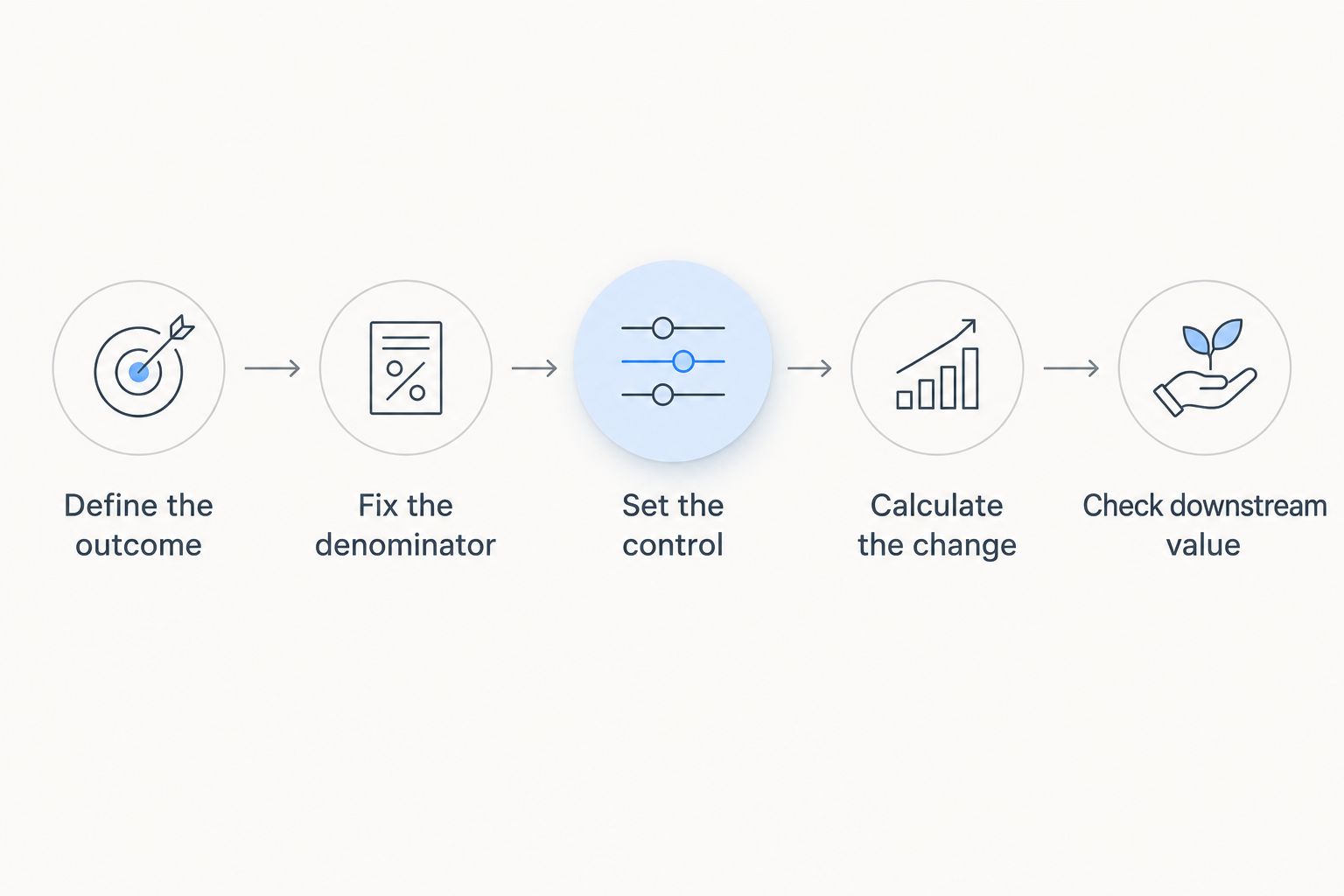
Define the outcome
Choose the action that answers the business question. For lead generation, that might be a submitted contact record meeting agreed qualification criteria; for product discovery, it might be a purchase following the experience.
Do not make completion the primary outcome simply because the quiz produces a convenient completion event. Completion is appropriate when finishing the experience is itself the objective, such as completing an educational interaction.
Fix the denominator
Calculate each rate using an explicitly defined population. Participation rate uses eligible visitors as its denominator; completion rate uses participants who started. Those rates are not interchangeable.
Report the qualified lead rate against eligible visitors when evaluating the full campaign. Also inspect qualification among submitted leads, but label that separately. This distinguishes campaign effectiveness from the quality of the records collected.
Set the control
Compare the gamified experience with a credible alternative serving the same objective. A conventional lead form is a relevant control for a lead-generation quiz; an unrelated awareness campaign is not.
Keep audience eligibility, acquisition sources, campaign timing, and the intended next action comparable. Where practical, randomly assign eligible visitors and keep each visitor in the assigned experience.
Calculate the change
Relative uplift equals the treatment rate divided by the control rate, minus one. Express that result as a percentage. Percentage-point change is the treatment percentage minus the control percentage.
Report both, alongside the underlying rates and eligible visitor counts. A relative improvement without its baseline does not tell your stakeholders how much additional activity the campaign produced.
Check downstream value
Inspect what happens after the engagement event. For a lead-generation campaign, check qualification, duplicate records, contactability, and the next agreed sales outcome.
For your 2026 reporting, preserve that distinction from the first dashboard onward. The guide to measuring gamification campaign ROI addresses the separate question of whether campaign outcomes justify the investment.
Match the experience to the engagement you need
Quizzes, branded games, and conventional forms offer different ways to complete a campaign objective. Choose by the task you want visitors to perform, not by the number of interactions the format can generate.
| Experience | Best for | Useful strength | Limitation to account for |
|---|---|---|---|
| Marketing quiz | Collecting answers linked to a result | Connects questions with an outcome the participant receives | Adds steps before the final action |
| Branded game | Campaigns where playing is part of the intended experience | Makes participation central to the creative concept | Game activity alone does not establish buying intent |
| Conventional form | Visitors ready to submit their details | Provides a direct submission path | Does not provide a game or quiz experience |
These are design distinctions, not performance rankings. A quiz does not win because it produces more events, and a form does not win because its path is shorter. Compare the same final action across the experiences.
For a 2026 acquisition campaign, start with the customer task: discover a suitable product, demonstrate knowledge, enter a campaign, or request follow-up. Then decide whether answering questions or playing helps complete that task. Remove mechanics that do not serve it.
Why engagement uplift varies
The campaign brief needs to account for the elements that define the comparison. Treat the following as test variables, not as evidence that a particular mechanic will deliver a particular percentage:
- Audience and intent. Separate visitors seeking information from visitors ready to act. Record acquisition source so an audience change does not become a creative success claim.
- Baseline experience. Describe the control clearly. Improving on a confusing page and improving on a direct, usable form are different tests.
- Participation task. State what visitors must do before reaching the outcome. A quiz, a branded game, and an interactive experience require different actions.
- Requested data. Document which questions and contact fields are required. Distinguish information needed for the participant’s result from information requested for marketing follow-up.
- Completion destination. Define what happens after play: a result, a registration, a product page, or a sales handoff. Measure that next step separately.
- Measurement window. Set the observation period and repeat-visit rules before launch. Apply the same rules to the treatment and control.
Change these elements deliberately. If the audience, offer, and experience all change together, you can evaluate the combined campaign, but you cannot attribute the difference specifically to gamification.
How do you set a realistic target before launch?
Use your current baseline and business requirements to set the target, then test whether the campaign reaches it. A desired improvement is a decision threshold, not a predicted result.
Start by documenting the baseline rate using the same eligibility and outcome definitions planned for the experiment. If the existing measurement counts sessions while the new measurement counts people, reconcile that difference before setting the target.
Next, define the smallest improvement that would justify continuing the campaign. Include the work needed to design, maintain, measure, and act on the experience. A campaign that collects additional records also needs a clear use for those records.
Finally, plan the experiment around that decision. Use the baseline, the minimum meaningful improvement, and your chosen statistical criteria to determine the traffic requirement. There is no campaign-independent visitor count that establishes a trustworthy result.
Write down the stopping rule before launch. Do not stop simply because an early result looks favorable, and do not keep extending a weak test until a favorable reading appears. If the result remains uncertain, report it as uncertain rather than converting it into an uplift claim.
Does more time spent mean gamification worked?
More time spent does not, by itself, establish successful engagement. Time can represent intended play, difficult questions, unclear instructions, or difficulty reaching the next step; the metric does not identify the cause.
Assess time alongside completion and the campaign’s intended outcome. If an experience takes longer but produces fewer qualified submissions per eligible visitor, longer sessions are not evidence of lead-generation success.
For a 2026 brand-engagement brief, time spent can still be a useful supporting measure. Define the intended behavior first, then check whether participants complete it rather than merely remaining on the page.
How should you interpret the result before scaling?
Use an explicit decision rule rather than choosing whichever metric improved. Review the primary outcome first, check the agreed guardrails, and then inspect supporting metrics to understand the result.
- Continue: The primary outcome meets the decision threshold and downstream quality remains acceptable.
- Revise: Participation improves, but completion or the business outcome does not. Inspect the transition between those stages before adding more traffic.
- Stop: The experience fails the agreed business criteria or creates an unacceptable downstream problem.
- Keep testing: The evidence does not yet support a decision under the original test plan.
Segment analysis helps explain results, but keep it separate from the original verdict. A favorable audience segment discovered after the test is a reason to design a focused follow-up, not a reason to rewrite the original success criteria.
More interaction is useful only when it serves the campaign objective. Preserve that rule when presenting results to stakeholders who will otherwise see the largest percentage first.
When does a custom studio fit this brief?
Brainylab is best for brands seeking custom gamified experiences and first-party data collection. Its stated work includes quizzes, games, and interactive experiences; that makes the studio relevant when your brief calls for development rather than a performance benchmark alone.
Brainylab’s gamification work is not a substitute for defining success. Bring a clear audience, intended participant outcome, data requirements, and measurement plan to the brief. Custom development also requires decisions about scope and acceptance criteria that a direct form does not.
FAQ
What is a realistic engagement uplift from gamification?
A realistic engagement uplift is the improvement demonstrated against a comparable control using your chosen success metric. Do not use another campaign’s percentage as your forecast without establishing that the audience, experience, and outcome are comparable.
Can gamification guarantee higher engagement?
Gamification does not guarantee higher engagement. Test the experience against a control and judge it using the outcome defined before launch, not whichever interaction count looks strongest.
What should I measure in a gamified lead-generation campaign?
Measure qualified leads per eligible visitor as the primary outcome when qualified lead generation is the objective. Track starts, completions, submissions, and downstream qualification separately to identify where the experience succeeds or loses participants.
Is quiz completion rate the same as engagement uplift?
Quiz completion rate is not engagement uplift. Completion rate describes how many starters finish, while uplift describes a change against a baseline or control.
How much traffic do I need to test gamification?
The traffic requirement depends on your baseline rate, minimum meaningful improvement, and statistical criteria. Plan the sample before launch rather than selecting a visitor count that has no connection to the decision.
Should I count repeat plays as new leads?
Repeat plays are not new leads. Track repeat participation separately and deduplicate lead records using an appropriate identifier so repeated activity does not inflate acquisition results.
Does engagement uplift prove that gamification increased sales?
Engagement uplift does not prove sales uplift. Measure purchases against a suitable control and preserve the distinction between participation, lead generation, and revenue outcomes.
One last thing
Before approving your 2026 campaign, finish this sentence: We will continue only if the experience improves our chosen outcome without weakening our agreed guardrails. Name the outcome and guardrails explicitly.
If the brief cannot complete that sentence, adding a game will not resolve the measurement problem. Define the decision first; build the experience around it.