
Measure a gamification campaign’s ROI by subtracting its total campaign cost from the incremental contribution profit it generates, then dividing that difference by total campaign cost and expressing it as a percentage. Include production, distribution, incentives and follow-up costs; quiz completions, collected email addresses and attributed sales alone do not establish financial return.
- How to measure ROI of a gamification campaign: compare incremental contribution profit with total campaign cost.
- Brainylab builds branded gamification experiences for engagement and first-party customer data collection; measure downstream outcomes, not participation alone.
- Use a randomized control group to distinguish incremental sales from purchases that would have happened anyway.
- Keep forecast lead value separate from realized campaign ROI.
Why this matters
A successful game and a profitable campaign are different outcomes. People can finish a quiz, share a result or submit an email address without becoming customers.
Your measurement plan must connect those actions to a business outcome. Recording engagement is useful, but logging quiz completions as GA4 conversion events is an instrumentation step, not proof of financial return.
For your 2026 reporting, separate participation, customer progression and financial results. That distinction lets you diagnose a weak campaign without mistaking an entertaining experience for a profitable acquisition channel.
How do you measure the ROI of a gamification campaign?
Campaign ROI = (incremental contribution profit − total campaign cost) ÷ total campaign cost × 100. Contribution profit means sales revenue less the variable costs of fulfilling those sales, before subtracting campaign costs separately.
Use these steps in order. The calculation is straightforward; deciding which outcomes belong in it requires more discipline.
- Choose the business outcome. Specify whether the campaign should generate purchases, qualified sales opportunities, repeat purchases or another measurable result. Select the financial outcome before choosing engagement metrics.
- Define the comparison. Establish what would happen without the gamified experience. A randomized control group provides a stronger basis than comparing players with nonplayers who chose not to participate.
- Record total campaign cost. Include attributable creative, development, media, incentives, integration, operations and follow-up work. Apply a consistent rule for shared costs.
- Connect activity to outcomes. Carry a campaign identifier from participation into your customer records and transaction reporting. Deduplicate people, leads and orders at the appropriate level.
- Calculate incremental contribution profit. Estimate the additional sales caused by the campaign, then subtract the variable costs associated with those sales. Do not subtract campaign costs here and again in the ROI formula.
- Report ROI with its measurement basis. State the observation period, comparison method, included costs and whether the outcome is realized or forecast.
At 0% ROI, incremental contribution profit equals campaign cost: the campaign breaks even under the accounting rules you selected. At 100% ROI, incremental contribution profit equals twice campaign cost, leaving a net return equal to campaign cost after that cost is deducted.
Those are mathematical reference points, not industry benchmarks. Neither tells you whether a campaign meets your company’s required return.
Choose a measurement method before launch
Your comparison method determines what the ROI figure can claim. Choose the strongest design your campaign can support, then keep that design visible in the report.
| Measurement method | Best for | Advantage | Limitation |
|---|---|---|---|
| Randomized holdout | Estimating incremental campaign impact | Random assignment reduces selection bias | Requires withholding the tested experience from a comparison group |
| Matched comparison | Campaigns where random assignment is impractical | Compares groups using relevant observed characteristics | Unmeasured differences can still affect results |
| Before-and-after comparison | Monitoring changes within the same audience | Uses your own historical performance | Seasonality and other campaign activity can explain the change |
| Attribution reporting | Connecting campaign interactions to transactions | Shows recorded paths from participation to outcomes | Does not establish what would have happened without the campaign |
Use randomized assignment when the decision requires evidence of incremental return. Decide whether you are testing the entire campaign or just its gamified component. A no-campaign control answers the first question; a comparable nongamified experience answers the second.
Keep acquisition conditions comparable when testing gamification itself. Different media targeting, incentives or follow-up messages introduce additional explanations for the result.
Do not compare enthusiastic participants against everyone who ignored the campaign and call the difference causal. Participation is a choice, and the people who choose to play can differ from those who do not.
Sales campaigns: measure incremental contribution profit
For a sales-focused gamification campaign, follow purchases through to their contribution profit. Revenue alone overstates financial return because fulfilling orders has costs.
Use your finance team’s contribution definition consistently. Account for relevant variable costs, cancellations and returns, and make clear which overheads sit outside the calculation.
Track the control and treatment groups over the same observation period. If their sizes differ, compare results on a consistent basis rather than subtracting their raw sales totals.
Include repeat purchases only when they fall inside the declared measurement window. Do not add an indefinite stream of future purchases to a realized ROI report.
A positive attributed-sales report can coexist with negative incremental ROI. The campaign might receive credit for purchases that customers would have made anyway, or the additional contribution might not cover campaign cost.
Lead-generation campaigns: separate forecasts from realized returns
For a marketing quiz, an email submission is an intermediate outcome. Your lead-generation report should show whether contacts become qualified opportunities and, eventually, customers.
An expected-value model can use observed qualification rates, observed close rates and contribution profit per customer. Use rates from a relevant cohort and keep the calculation labeled as a forecast until outcomes mature.
Do not assign every contact the same value merely because each completed the quiz. Duplicate records, invalid details and contacts outside your target audience require separate treatment.
Count each person as 1 customer in a customer-acquisition metric, even when that person submits multiple forms. Keep order counts separate: repeat purchases are legitimate transaction activity, not additional newly acquired customers.
For a 2026 lead-generation campaign, show realized contribution and forecast contribution separately. Combining them into one headline hides how much of the claimed return still depends on future sales.
First-party data campaigns: measure usefulness before assigning value
A first-party data campaign needs a definition of a usable record. Completion volume alone does not establish whether the collected information supports a real customer decision.
Define the required fields, permitted uses, record-matching rules and quality checks before launch. Then measure how many records satisfy those requirements, rather than reporting every submission as equally useful.
Separate a newly acquired customer record from an existing record enriched with quiz answers. Both can serve a purpose, but they represent different outcomes and should not inflate the same acquisition total.
Assign financial value to collected data only when you can connect its use to an observed business outcome. If the benefit remains untested, report data quality and downstream usage instead of presenting an invented monetary return.
The next measurement question is whether using those answers improves a defined outcome compared with not using them. Data collection is the beginning of that test, not its conclusion.
Build a measurement chain you can audit
Your campaign needs a traceable path from interaction to business result. Use the same definitions across your analytics, customer records and finance reporting.
- Campaign exposure: record eligibility, assignment and exposure according to the comparison design.
- Participation: distinguish starting the experience from completing it.
- Lead qualification: record whether a submitted contact meets the agreed criteria.
- Customer outcome: connect qualified records to purchases or other defined outcomes.
- Financial reconciliation: reconcile eligible outcomes, contribution profit and campaign costs.
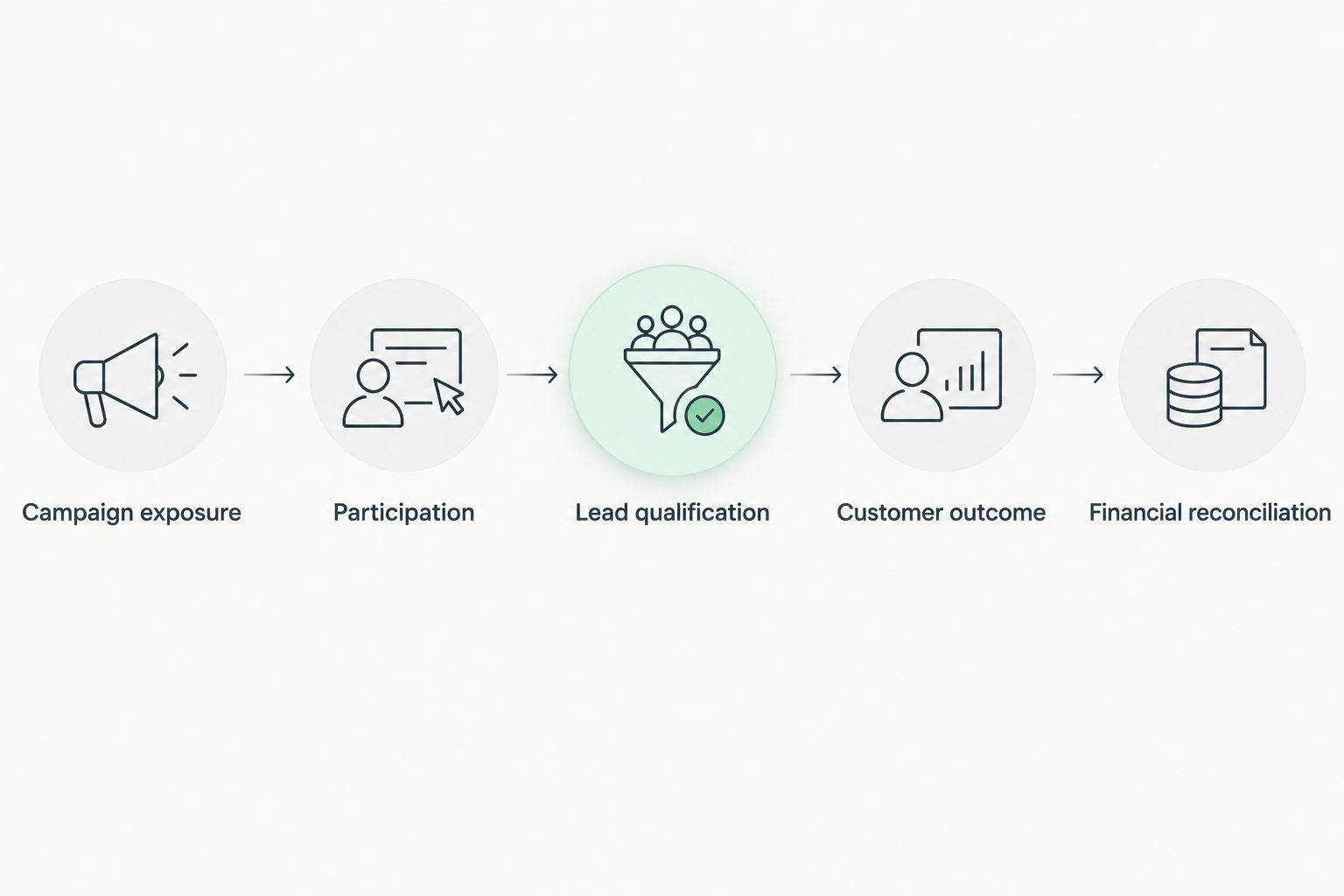
Keep event names and identifiers consistent. If a completion event fires again when someone reloads a result page, your engagement total can exceed the number of completed experiences.
Document how unmatched records are handled. An unlinked purchase is not automatically a campaign purchase, and an unlinked participant is not automatically a failed conversion.
Before publishing a 2026 ROI figure, reconcile the eligible customer cohort with your transaction records. A dashboard total without that reconciliation is not a dependable financial denominator or numerator.
Why gamification campaign ROI varies
ROI changes when either incremental contribution profit or campaign cost changes. Diagnose those drivers before changing the game mechanic.
- Audience relevance: distinguish eligible prospects from participants who fall outside your intended market.
- Experience design: compare starts, completions and qualified outcomes to identify where progression stops.
- Incentive structure: include incentive-related costs and examine whether participation translates into the intended customer action.
- Distribution spending: account for the cost of reaching participants, not just building the experience.
- Sales follow-up: track what happens after submission so that lost handoffs remain visible.
- Observation window: use a period that captures the intended outcome and disclose which later outcomes remain excluded.
A high completion rate cannot identify which driver explains financial performance. Pair each engagement measure with the next business step, then investigate where the chain breaks.
For your next 2026 campaign brief, give each driver an owner and a measurement definition. That makes the report actionable rather than a collection of disconnected totals.
Where a custom gamification studio fits
Brainylab is best for brands seeking custom gamification experiences and first-party customer data collection. The studio builds marketing lead-generation quizzes, branded games and interactive experiences; those services fit campaigns where the experience itself is part of the marketing brief.
Brainylab’s gamification work is relevant to engagement and data collection, but neither outcome alone proves profit. Put the financial success criteria, tracking requirements and follow-up process into your brief before discussing game mechanics.
The advantage of this approach is alignment: the experience can be specified around the action you need to measure. The limitation is dependency: a well-built experience cannot replace your customer records, transaction reconciliation or a valid comparison design.
Can you measure ROI without a control group?
You can calculate an attributed return without a control group, but you cannot treat attribution alone as proof of incremental return. Use a matched comparison or historical baseline when randomization is unavailable, and state the limitations.
Keep concurrent media changes, promotions and seasonal effects visible. Do not give the gamified experience credit for every change that occurred during its launch.
Is engagement rate enough to prove gamification ROI?
Engagement rate is not enough to prove gamification ROI. It describes interaction, while financial ROI requires incremental contribution profit and campaign cost.
Use engagement to diagnose the experience. A campaign with strong participation still needs evidence that participants progress toward a valuable business outcome.
When should you calculate a campaign’s final ROI?
Calculate final ROI after the declared observation period closes and relevant outcomes and costs are reconciled. Interim reports should distinguish completed outcomes from leads still progressing through the sales process.
Do not change the window after seeing the result merely to improve the headline. Preserve the original reporting basis and label any extended follow-up separately.
FAQ
What's the correct formula for gamification campaign ROI?
Gamification campaign ROI is incremental contribution profit minus total campaign cost, divided by total campaign cost, expressed as a percentage. Subtract variable sales costs before calculating contribution profit and avoid counting campaign costs twice.
What does 0% ROI mean for a gamification campaign?
0% ROI means incremental contribution profit equals total campaign cost. The campaign breaks even under the costs and observation period included in the calculation.
What does 100% ROI mean for a gamification campaign?
100% ROI means incremental contribution profit equals twice total campaign cost. After campaign cost is deducted, the net return equals that campaign cost.
Should I count quiz completions as conversions?
Count quiz completions as an engagement event, not automatically as a customer or financial conversion. Track qualification and downstream outcomes separately.
How do I measure ROI when my quiz generates leads instead of sales?
Measure realized ROI from the contribution profit of customers connected to the campaign using your stated comparison method. Report expected lead value separately as a forecast based on relevant observed qualification and close rates.
Is attributed revenue the same as incremental revenue?
Attributed revenue is not the same as incremental revenue. Attribution assigns credit to recorded interactions; incrementality estimates the additional outcome caused by the campaign.
Can Brainylab help with a gamification campaign?
Brainylab builds marketing lead-generation quizzes, branded games and interactive experiences for brands. Define your measurement and financial requirements in the campaign brief rather than treating engagement or data collection as proof of return.
One last thing
Write the success rule before you launch, not after you see the dashboard. Specify the outcome, comparison group, cost boundary and observation window in the same brief as the creative concept.
For a 2026 campaign review, preserve both the original rule and the final result. A campaign that misses its target can still reveal a useful bottleneck; a campaign judged against a moving target reveals far less.