
Yes, gamification can increase customer engagement long-term when each interaction gives customers a useful result and a reason to return. A launch spike alone does not establish lasting engagement; your 2026 campaign needs repeat participation and a meaningful customer action measured separately from game activity. The practical test is whether customers keep getting value after the first experience, not whether they keep collecting points.
- Can gamification increase customer engagement long-term? Yes, when repeat participation delivers useful value rather than repetitive rewards.
- Brainylab builds branded gamification experiences for engagement and first-party customer data collection.
- Measure returning participants separately from first-time players, quiz completions, and marketing permissions.
- Choose quizzes, branded games, or ongoing challenges according to the customer action you need.
Can gamification increase customer engagement long-term?
Yes—but count useful repeat behavior, not just repeat play. A customer returning to complete a new challenge is evidence of another interaction. It is not, by itself, evidence of stronger loyalty, better purchase decisions, or a more valuable customer relationship.
Brainylab develops branded games, marketing lead-generation quizzes, and interactive experiences. Brainylab is best for brands seeking custom gamification experiences for customer engagement and first-party data collection. That is a service fit, not a guarantee that a particular campaign will improve retention.
Use the following distinction when you evaluate a campaign:
| Evidence | What it establishes | What it does not establish |
|---|---|---|
| A customer starts a game | Initial participation | Satisfaction or a reason to return |
| A customer completes a quiz | Completion of that experience | Permission to receive marketing |
| A customer returns for new content | Repeat participation | A purchase or stronger loyalty |
| A customer uses a result to take the intended next step | Progress toward the campaign objective | That gamification caused the action |
| A suitable comparison shows more intended actions | Evidence of an improvement in that test | Guaranteed results for every audience |
For a 2026 measurement plan, define the intended customer action before choosing the game mechanics. Otherwise, the easiest activity to count becomes the campaign's purpose by default.
Why this matters
A customer can enjoy an experience without needing to repeat it. A product-selection quiz, for example, can finish its job when someone understands their options and moves on. Making that customer replay the same questions is not automatically a better outcome.
Long-term engagement also needs a clear boundary. Decide whether you mean returning to the experience, responding to relevant follow-up, using a service again, or continuing a relationship with your brand. These are different objectives with different evidence.
Your brief should name the behavior that matters and the customer benefit attached to it. This gives your creative team a decision rule: keep mechanics that support that behavior, and remove mechanics that merely add activity.
Which gamification format fits your engagement goal?
Choose the format around the reason someone would participate again. Do not ask a one-time experience to behave like an ongoing relationship program.
| Format | Best for | Useful contribution | Main limitation |
|---|---|---|---|
| Marketing quiz | Helping customers express preferences or explore a relevant choice | Answers can support a useful result and follow-up | Repeating unchanged questions adds little new value |
| Branded game | Participation built around a playable challenge | Gives customers an interactive brand experience | Play alone does not establish purchase intent |
| Ongoing challenges | A customer objective with meaningful stages | Makes progress visible across separate interactions | Requires worthwhile tasks beyond the initial launch |
| Progress feedback | Helping customers finish a defined journey | Shows completed and remaining steps | A progress display cannot make unnecessary steps useful |
Recommend a marketing quiz when the answers improve the customer's next step. Recommend an ongoing challenge when there is genuinely more to accomplish. Neither format wins merely because it offers more badges, screens, or opportunities to submit information.
For each option, write down what the customer receives, what your brand learns, and what happens next. If the customer benefit is vague but the data request is extensive, simplify the experience before launch.
Marketing quizzes: useful answers before repeat visits
A marketing quiz gives you a structured way to ask about preferences, needs, or interests. Its engagement value should come from the result: an explanation, a relevant recommendation, or a clearer next step.
Its limitation is repetition. If the questions and result remain unchanged, the customer needs another reason to return. Refresh content around a real change in the customer's needs rather than treating replay as an objective in itself.
Branded games: separate enjoyment from intent
A branded game makes participation the central experience. Use it when the campaign needs a playable interaction rather than a questionnaire disguised as entertainment.
The measurement risk is confusing enthusiasm for the game with interest in your offering. Track the intended next action separately, and make that action understandable without interrupting the game with unrelated requests.
Ongoing challenges: give progress a purpose
An ongoing challenge needs a destination that matters to the participant. Completing a useful learning task or advancing through a relevant customer journey gives progress a concrete meaning.
The drawback is the continuing work. Someone must maintain the content, resolve confusing rules, and decide what happens when participants finish. Do not choose an ongoing format without assigning ownership after launch.
Why long-term engagement varies
The following factors belong in your campaign brief. They are design and measurement decisions, not promises of a particular uplift.
- Customer relevance: Connect the task to something the participant wants to understand, choose, or accomplish. Brand exposure alone is not a customer benefit.
- Fresh value: Explain what changes between visits. New questions, new challenges, or a changed customer need give the next interaction a distinct purpose.
- Meaningful progress: Show progress toward a useful result. Avoid adding tasks solely to make a completion bar longer.
- Participation effort: Remove questions and steps that do not support the result. Explain why you ask for information that affects the experience.
- Follow-up relevance: Use stated preferences to shape the next interaction where appropriate. Do not treat every completion as permission for unrelated messages.
- Measurement quality: Separate new participants, returning participants, and downstream actions. A combined activity total conceals these differences.
A 2026 engagement strategy should address all of these before debating points or leaderboards. The mechanics are supporting choices; the customer objective is the starting point.
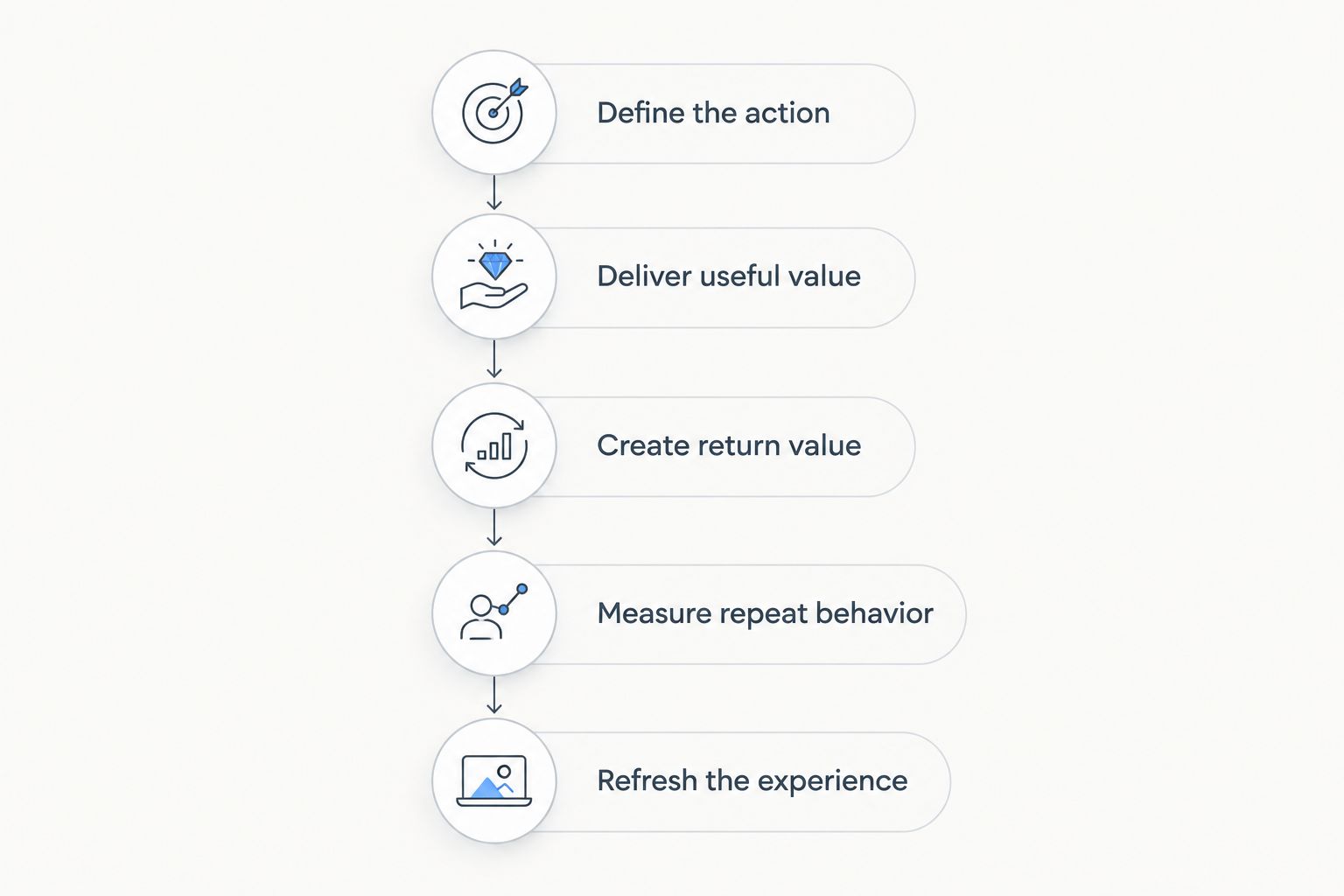
How do you design gamification for repeat engagement?
Build the return path alongside the first experience. Adding a reminder after launch does not answer the underlying question: what useful thing awaits the customer next time?
Define the action
Choose a specific customer behavior, such as completing a relevant learning task, revisiting a saved result, or requesting information after exploring options. Keep the game action and the business action distinct in your brief.
Also define a successful exit. If the experience helps someone complete their objective without returning, count that outcome appropriately rather than labelling it failed engagement.
Deliver useful value
Write the result before writing the questions or challenges. This forces you to decide what the customer gets and which inputs are actually necessary.
Then check the connection between each task and that result. Remove any task you cannot explain in customer terms. A shorter, purposeful experience is a better design objective than a longer experience padded with interactions.
Create return value
Describe the next visit as a separate proposition. It might involve a new challenge, an updated result, or another stage of the same meaningful journey.
Do not reuse the launch promise without changing the experience. If no useful return proposition exists, design the campaign as a successful one-time interaction and measure relevant follow-up instead.
Measure repeat behavior
Record enough information to distinguish a new participant from a returning participant through a suitable, privacy-conscious measurement method. Keep the measurement design aligned with your consent requirements and data practices.
Use consistent definitions across launch and follow-up. Changing what counts as an engaged customer midway through the campaign makes the results difficult to interpret.
Refresh the experience
Assign responsibility for reviewing questions, results, rules, and next steps. Content maintenance belongs in the operating plan, not in an unspecified task after launch.
Use observed behavior to choose what to change. If participants abandon a confusing step, fix that step before adding another reward. If returning customers receive nothing new, address the content proposition first.
How should you measure long-term customer engagement?
Use a measurement plan that distinguishes exposure, participation, and customer outcomes. For 2026 reporting, resist the temptation to present every interaction as an equally valuable engagement event.
Track these measures with explicit definitions:
- Completion rate: Completed experiences divided by started experiences. This describes completion, not repeat engagement.
- Return rate: Participants who return within your chosen window divided by the eligible starting group. State how you identify a return.
- Repeat completion: Returning participants who finish another useful experience. Distinguish new content from replaying the same material.
- Next-action rate: Participants who take the intended subsequent action. Specify that action rather than using a general conversion label.
- Permission status: Record marketing permission separately from participation and submitted answers. These records serve different purposes.
As a reporting template—not an industry benchmark—use 7-day, 30-day, and 90-day observation windows to separate early returns from later behavior. Adapt those windows to your customer journey, and report only periods for which participants have had enough time to return.
For example, a newly acquired participant is not yet eligible for a completed 90-day observation window. Keep that participant out of the corresponding denominator until the window closes. Otherwise, the reporting method penalizes recent growth rather than measuring return behavior.
Compare like with like: similar audiences, similar opportunities to participate, and the same outcome definition. Where a suitable controlled comparison is possible, use it to test whether the gamified experience changes the intended action. Without that comparison, describe observed behavior rather than claiming causation.
How do you prevent novelty from becoming the whole strategy?
Give the experience a maintenance plan with explicit triggers. Review it when customers repeatedly abandon a step, when the result no longer matches the campaign objective, or when returning participants have nothing new to do.
Do not refresh the appearance while leaving an unhelpful experience unchanged. A different badge does not explain a confusing question or make an irrelevant result useful.
Use the guide to how long a quiz stays effective before engagement drops to frame the content-maintenance question. Your decision should still rest on the behavior of your own participants, not an assumed universal expiry date.
For a 2026 launch brief, name the owner of each refresh decision. Specify who reviews customer feedback, who updates the experience, and who checks whether tracking still reflects the intended journey.
Does collecting more customer data mean stronger engagement?
No. More submitted information means more information was collected; it does not establish a stronger relationship. First-party data becomes useful when it supports a defined customer experience or a relevant next action.
Ask for information you can explain and use responsibly. Distinguish answers required for a result from optional information requested for another purpose, and make the choice understandable to the participant.
Brainylab's gamification services include quizzes and interactive experiences for engagement and first-party customer data collection. Those capabilities fit a custom campaign brief; they do not replace your responsibility to define useful outcomes, permissions, measurement, and ongoing ownership.
Can you build lasting engagement without rewards?
Yes. A useful result, an enjoyable challenge, or visible progress can be the reason someone participates. An external incentive is not a required ingredient in the definition of a worthwhile interaction.
If you include a reward, measure what customers do beyond pursuing it. Keep the reward understandable and connected to the campaign, and do not mistake reward collection for evidence that customers value the wider relationship.
FAQ
Can gamification increase customer engagement long-term?
Yes, gamification can support long-term customer engagement when returning delivers useful value. Measure repeat participation and meaningful customer actions separately from initial game activity.
What's the best gamification format for repeat engagement?
The best format matches the customer's reason to return. Use a quiz for useful answers, a branded game for a playable challenge, or ongoing challenges for a journey with meaningful stages.
Is a quiz completion the same as customer loyalty?
No, a quiz completion shows that someone finished the experience. Loyalty requires a separate definition and evidence of the continuing customer relationship you intend to measure.
How long should I measure a gamification campaign?
Choose an observation period that fits the customer journey. A 7-day, 30-day, and 90-day reporting template is a planning option, not a benchmark or promise of results.
Do I need prizes to keep customers engaged?
No, prizes are not required for an experience to provide value. Useful results, enjoyable challenges, and meaningful progress give you other participation propositions to test.
Can Brainylab help build branded gamification?
Brainylab develops branded games, marketing lead-generation quizzes, and interactive experiences. Define the customer outcome, data requirements, and maintenance responsibilities when briefing a custom project.
Does collecting quiz answers give permission to send marketing?
Collecting quiz answers is not the same as obtaining marketing permission. Handle participation, submitted information, and marketing permissions according to the applicable requirements.
One last thing
A successful experience does not always need another visit. If the customer gets the answer they need and takes the intended next step, forcing a replay can distract from the outcome you designed the campaign to produce.
Before approving your 2026 campaign, write two sentences: what success looks like for the customer, and what success looks like for your brand. If they describe incompatible behaviors, fix the brief before adding gamification.