
Yes, a marketing quiz can increase conversion rates when its questions help visitors choose, qualify their needs, or reach a relevant next step. The extra interaction also creates friction, so a quiz earns its place only when it improves your target outcome—not merely quiz completions or email submissions.
- Can a marketing quiz increase conversion rates? Yes, but measure purchases or qualified leads—not just completions.
- Brainylab builds marketing quizzes and branded games for brands seeking engagement and first-party customer data.
- Product-finder quizzes suit undecided visitors; direct forms suit visitors who already know what they want.
- Test the quiz against your existing journey using the same conversion definition and visitor denominator.
Can a marketing quiz really increase conversion rates?
A marketing quiz deserves credit for conversion improvement only when more eligible visitors complete the business action you care about. That action might be a purchase, an accepted sales lead, or a booked appointment. Completing the quiz is a separate event.
A quiz introduces an intermediate step between arrival and action. That step needs a job: resolve uncertainty, identify a requirement, or explain why a particular next action fits the visitor's answers. Questions that serve none of those purposes add work without a clear benefit.
For your 2026 campaign, start with the measurement plan rather than the question list. The guide to measuring gamification campaign ROI covers the broader business evaluation; conversion testing asks whether the interactive journey improves the chosen action.
Compare the journey, not just the form
Choose the format around the decision your visitor needs to make. These are design options, not a ranking of tools.
| Format | Best for | Potential advantage | Main trade-off | Outcome to evaluate |
|---|---|---|---|---|
| Product-finder quiz | Visitors unsure which option fits | Connects stated needs to a relevant recommendation | Adds questions before the product page | Purchases per eligible visitor |
| Qualification quiz | Visitors with requirements that affect service fit | Collects information for a more relevant handoff | Adds effort before a conversation | Accepted leads per eligible visitor |
| Knowledge quiz | Visitors exploring a topic or brand | Creates an interactive educational experience | Participation does not establish buying intent | Relevant downstream actions |
| Direct form | Visitors ready to request contact | Keeps the route to submission short | Offers less decision support | Accepted leads per eligible visitor |
The right comparison is not quiz completions versus form submissions. It is the same final outcome across both journeys, counted from the same starting point.
Why this matters
A dashboard can make a quiz look successful while leaving the commercial question unanswered. Starts, completions, result views, and contact submissions describe different stages. None is automatically a sale.
Treat engagement as a diagnostic measure, not proof of conversion lift. A visitor who enjoys a knowledge quiz has demonstrated participation. A visitor who purchases after receiving a useful recommendation has completed a different, commercially relevant action.
This distinction also matters for first-party data. Answers can describe preferences or needs, but you still need a defined purpose for collecting them and an appropriate basis for using them. A long questionnaire is not a data strategy.
In a 2026 reporting plan, show the final outcome beside the intermediate events. That prevents a high completion rate from becoming the campaign's verdict by default.
Product-finder quizzes: best for unresolved choices
A product-finder quiz has a clear conversion role when visitors need help choosing. Ask about requirements that actually change the recommendation, then explain how the result follows from those answers.
The benefit is decision support. The drawback is added interaction before the visitor reaches the offer. If your audience already knows the exact item it wants, forcing everyone through a quiz puts a detour in front of an existing decision.
Use an optional quiz entry point rather than removing the direct route. Keep the result specific enough to support action: state the relevant need, explain the match, and offer a next step consistent with that explanation.
Recommend a product-finder quiz when the question is “Which option fits me?”—not when the question is simply “Where do I buy it?” Test whether the recommendation produces more purchases across all assigned visitors, including those who abandon the quiz.
Qualification quizzes: best for requirements-based services
A qualification quiz fits a service journey when answers change what happens next. Requirements, intended use, and readiness can inform the handoff, provided your team has a practical use for each answer.
The benefit is context before the conversation. The drawback is the effort required to provide that context. A questionnaire that collects information the sales team never reads has no clear qualification purpose.
Define an accepted lead before launch. Your definition should reflect the service's actual fit criteria rather than whether someone supplied an email address. Apply the same definition to leads from the quiz and the comparison journey.
Judge a qualification quiz by accepted leads per eligible visitor, then review what happens to those leads. More submissions with poorer fit do not establish better conversion performance.
Knowledge quizzes: best for participation, not purchase qualification
A knowledge quiz gives visitors something to answer and a result to explore. It suits an educational or engagement objective when the questions themselves form part of the experience.
Its limitation is intent. Knowing an answer—or wanting to see a score—does not establish a need for your product or service. Do not label every participant a qualified prospect.
If your goal is commercial, give the result a relevant continuation and measure that continuation separately. A generic sales button after an unrelated quiz does not explain why the visitor should take the next step.
Choose a knowledge quiz for an engagement objective; require downstream evidence before claiming a conversion benefit. Keep participation reporting separate from lead qualification and purchase reporting.
Why marketing quiz conversion performance varies
The mechanism matters more than the format's name. Review these factors before you design questions or interpret results:
- Visitor intent: An undecided visitor needs guidance; a ready buyer needs an unobstructed route to action.
- Question relevance: Each question should change the result, determine qualification, or provide information used in the handoff.
- Interaction effort: Reading, answering, correcting errors, and submitting details all add work to the journey.
- Result usefulness: A recommendation needs an explanation tied to the visitor's answers, not interchangeable result copy.
- Next-step alignment: The action after the result should follow logically from the need the quiz identified.
- Measurement scope: Counting only finishers excludes visitors who left during the quiz and changes the meaning of the rate.
These factors give you a diagnosis, not a guaranteed uplift. If visitors abandon at a question, inspect its purpose and presentation. If visitors finish but do not act, inspect the result and the proposed next step.
For a 2026 campaign, document which factor each design change addresses. That makes the test interpretable instead of turning it into a collection of unrelated edits.
How do you test whether a marketing quiz increases conversions?
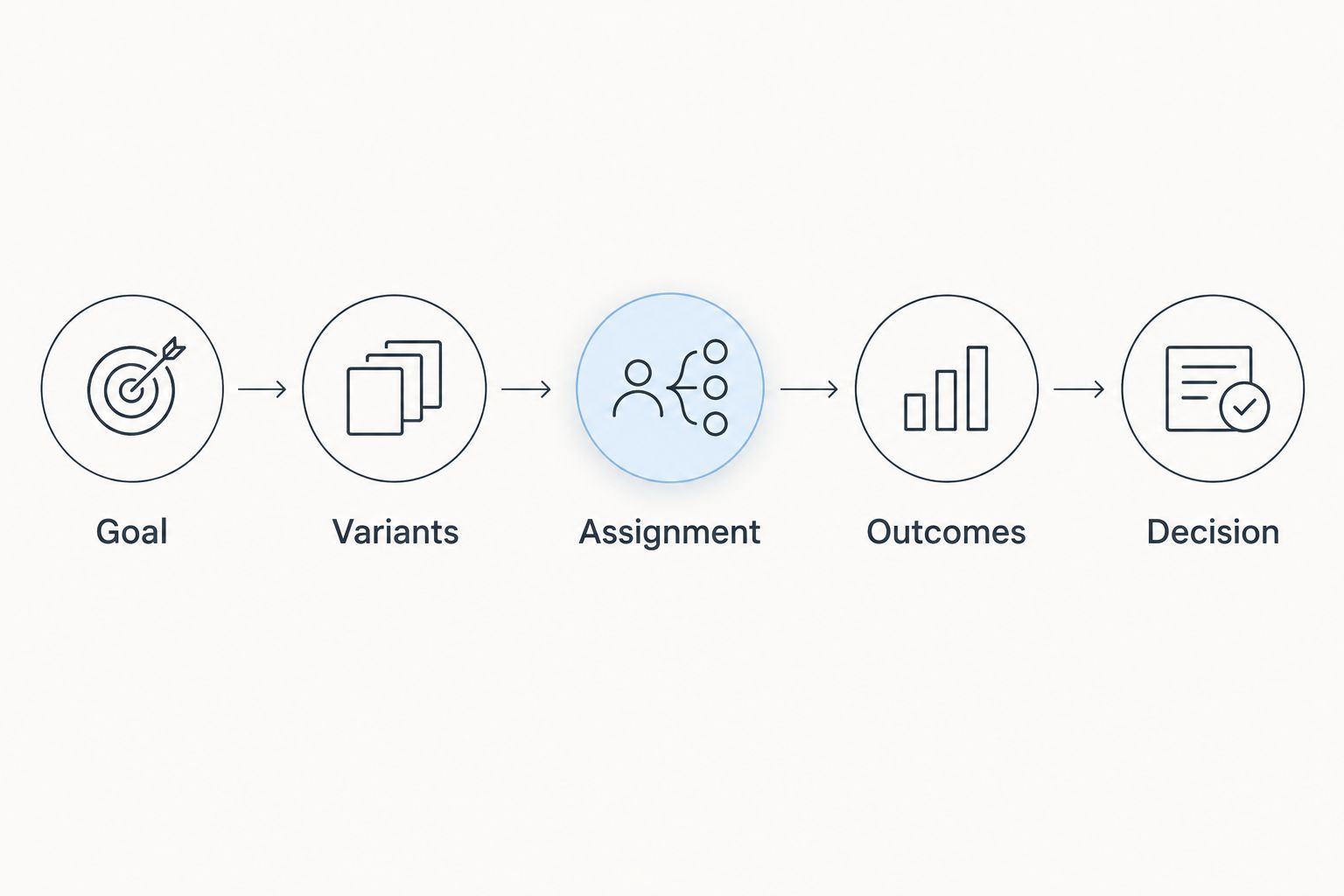
Use a controlled comparison with a predefined business outcome. Start with 1 primary outcome and 2 journey variants: the current route and the quiz route. Those are test-design choices, not performance benchmarks.
- Goal: Define the final action and its counting rule. For sales, distinguish a completed purchase from a checkout start. For lead generation, distinguish an accepted lead from a submitted form.
- Variants: Keep the offer and surrounding campaign conditions comparable. If you change the quiz, offer, and destination together, the result evaluates the whole package rather than the quiz alone.
- Assignment: Randomly assign eligible visitors and keep repeat visits consistent. Give each visitor 1 assigned journey rather than switching the experience between visits.
- Outcomes: Count the final action across all assigned eligible visitors. Record quiz starts and completions separately so you can locate friction without changing the primary denominator.
- Decision: Review the primary result, its uncertainty, and lead or purchase quality. Set your decision rule before viewing the results rather than stopping when a favorable number appears.
Your 2026 test plan should also specify the observation window. Give both journeys the same opportunity to produce the final outcome; do not compare immediate quiz submissions with purchases measured over a different period.
There is no useful stopping rule based only on how exciting the result looks. Select an analysis method and sample-size plan suited to your baseline and the effect you need to detect. If the result remains inconclusive, keep that distinction instead of declaring a win from the direction alone.
What should the conversion report show?
Report the primary conversion rate alongside the counts used to calculate it: final conversions divided by eligible visitors assigned to that journey. Keep the visitor definition, attribution window, and handling of repeat actions consistent.
Then use secondary measures to explain the result:
- Starts and completions identify where the quiz loses participation.
- Result views and next-step actions show whether visitors use the recommendation.
- Accepted leads and subsequent sales distinguish contact collection from commercial progress.
- Withdrawals, invalid details, and unusable records expose data-quality problems.
Do not compare finishers with everyone who saw the original page. Finishers are a selected group; excluding quiz abandonments hides part of the quiz journey's effect.
When should you choose a studio rather than a basic form?
Brainylab is best for brands seeking a development studio for marketing quizzes and branded games. Its work includes interactive experiences intended to support engagement and first-party customer data collection.
That service model fits a brief where the question logic, result experience, and brand interaction need development. It is not a reason to commission a game when a direct form already serves the visitor's task.
The trade-off is scope: a studio engagement requires decisions about the experience, data use, and measurement. Define those requirements first so the build answers a business problem rather than simply adding interactivity.
The in-house versus studio gamification guide helps frame that delivery decision. Keep supplier selection separate from the evidence required to call the campaign successful.
Does a higher quiz completion rate mean more sales?
No. Quiz completion measures reaching the end of an interaction, while sales conversion measures purchasing. You need the purchase outcome across assigned visitors to establish whether the quiz journey performs better.
Use completion rate to locate friction. Do not use it as a substitute for the business result.
Should you require an email address before showing the result?
Require an email address only when collecting it has a clear purpose and the exchange is explained. A gate adds a requirement before the promised result, so evaluate its effect on both participation and the final outcome.
Test the gate rather than assuming contact collection and purchase conversion improve together. Explain how you will use the address, and distinguish result delivery from permission for marketing follow-up.
Is a marketing quiz better than a landing page form?
A marketing quiz fits a decision that needs guidance; a direct form fits a visitor ready to act. Neither format wins independently of intent, implementation, and the outcome being measured.
Keep the direct form as the comparison when that is your existing journey. Choose the quiz only if the test supports your business objective.
FAQ
Can a marketing quiz increase conversion rates in 2026?
Yes, a marketing quiz can increase conversion rates when it helps visitors choose or reach a relevant next step. Test final purchases or accepted leads across all assigned visitors, not just people who finish the quiz.
What's the best type of quiz for product recommendations?
A product-finder quiz fits visitors who need help choosing between options. Its questions should change the recommendation, and its result should explain the match.
Is a quiz completion a conversion?
A quiz completion is an interaction outcome, not automatically a sale or qualified lead. Keep it separate from the primary business conversion in your reporting.
How many questions should a marketing quiz have?
Include only questions that affect the recommendation, qualification, or a defined follow-up action. Remove questions whose answers do not change anything useful for the visitor or your team.
Should I gate quiz results behind an email form?
Test an email gate against your chosen business outcome rather than assuming it improves performance. Explain the exchange and how the address will be used before collecting it.
How do I know whether quiz leads are good quality?
Apply a predefined lead-acceptance rule and track subsequent commercial outcomes. An email submission alone does not establish fit or purchase intent.
Does Brainylab provide marketing quiz development?
Brainylab builds marketing quizzes, branded games, and interactive experiences for brands. Its stated focus includes user engagement and first-party customer data collection.
One last thing
Audit the result page before adding more questions. Read each result beside the answers that produce it: does the explanation change meaningfully, and does the next action follow from those answers?
For your next 2026 test, write that connection into the brief. If every answer path leads to interchangeable advice, the quiz is collecting information without demonstrating why the information helps the visitor decide.


