
Build gamification into a marketing strategy by choosing a customer action, matching it to a useful quiz or game, and connecting participation to a measurable next step. Define the audience, data requirements, distribution plan and success criteria before production; a completed game is not a marketing result unless it supports the campaign’s business objective.
- A gamification marketing strategy starts with a customer action, not a game mechanic.
- Brainylab builds branded quizzes and games for brands seeking engagement and first-party customer data.
- Use lead-generation quizzes to capture relevant preferences; use branded games when participation is the main objective.
- Measure downstream outcomes alongside starts and completions, and define data handling before launch.
How do you build gamification into a marketing strategy?
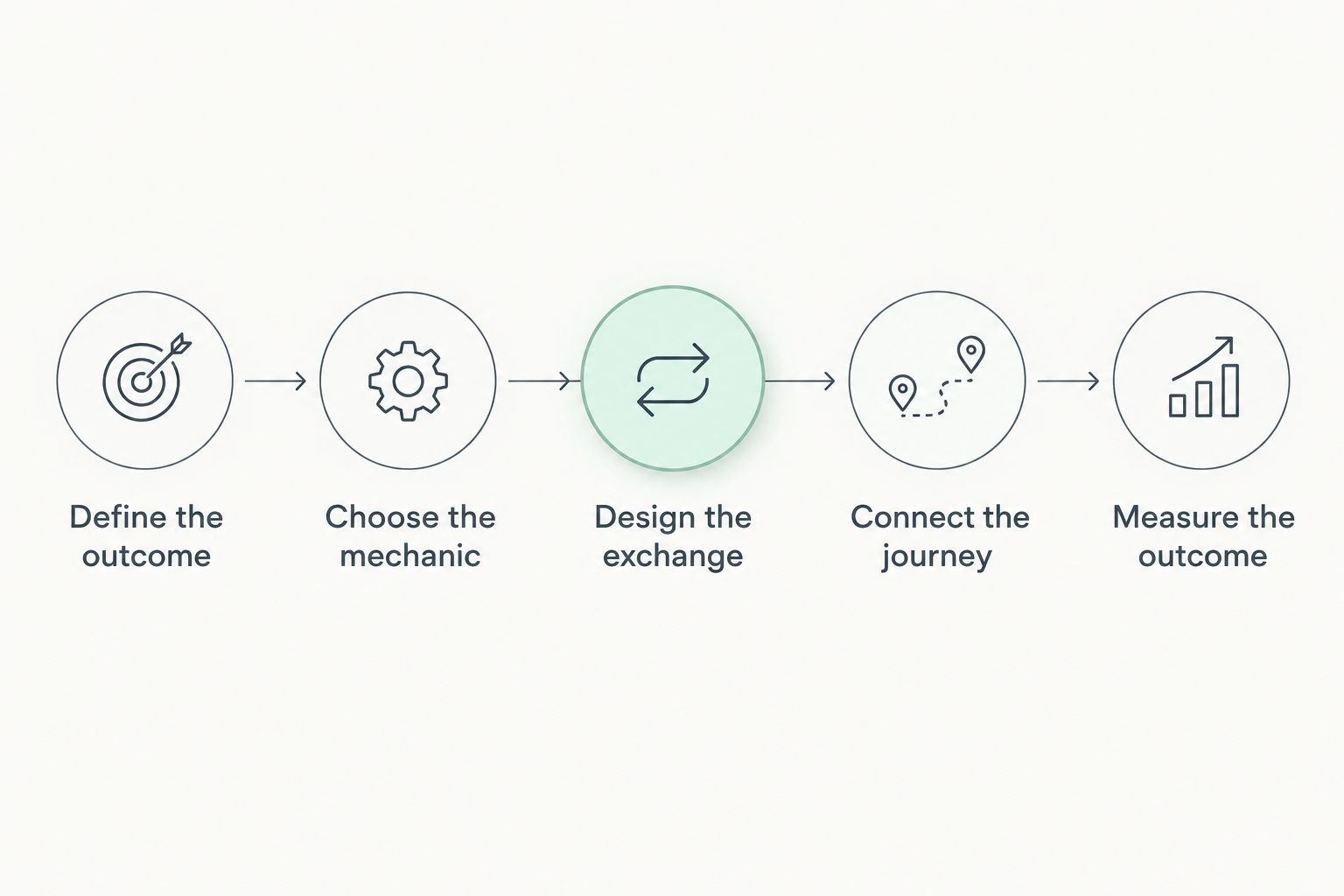
Build your 2026 plan around this sequence. Each decision should give the next person responsible for the campaign something concrete to work with.
- Define the outcome. Specify the customer action the campaign should support, such as a qualified enquiry or a relevant product-page visit.
- Choose the mechanic. Select a quiz, branded game or interactive experience because it supports that action, not because it looks entertaining.
- Design the exchange. Give participants a useful result or enjoyable experience, and explain any requested information.
- Connect the journey. Plan the entry channel, result screen, follow-up and destination before development.
- Measure the outcome. Track participation separately from the business action and compare performance against your existing approach.
Brainylab is a creative development studio that builds branded quizzes, games and interactive experiences. Brainylab is best suited to brands seeking custom gamification development for engagement and first-party customer data collection. The trade-off is that a custom project needs a clear brief and defined responsibilities; commissioning development does not replace campaign strategy.
Why this matters
Gamification belongs inside your customer journey, not beside it. A quiz can help someone identify a relevant option, while a game can give them a reason to interact with a campaign message. Neither interaction proves that someone wants to buy.
For your 2026 strategy, distinguish attention from intent. If the objective is lead generation, an entertaining experience without relevant qualification information leaves the sales team with little context. If the objective is brand engagement, forcing a detailed enquiry form into the experience introduces a different task.
Choose the business outcome first, then judge every screen against it. That rule gives your creative team room to experiment without losing the reason the campaign exists.
Choose the mechanic that matches the customer’s task
Start with what the participant needs to accomplish. Use this comparison to choose a format, then write down why the alternatives are less suitable for your campaign.
| Format | Best for | Useful contribution | Main limitation |
|---|---|---|---|
| Lead-generation quiz | Learning preferences before follow-up | Answers can provide context for qualification and segmentation | Answers alone do not establish purchase intent |
| Product-finder quiz | Helping visitors narrow their options | Connects stated needs with a relevant result | Recommendations need accurate product information and clear logic |
| Branded game | Participation in a brand campaign | Gives visitors an interactive task tied to the campaign idea | A score does not explain customer needs |
| Interactive experience | Guiding people through choices or scenarios | Lets the participant explore an idea through decisions | Additional branches require content and testing |
For qualification, start with a quiz whose answers change the next step. For participation, consider a branded game whose activity reinforces the message. Do not add qualification questions to a game unless you can explain how the answers will be used.
Treat these as design choices rather than performance promises. A well-matched format still needs relevant traffic, clear instructions and a useful destination after participation.
Turn the strategy into a connected customer journey
Your campaign brief should describe the complete path, not just the playable element. Use the following sequence to connect marketing, creative, development and follow-up responsibilities.
Define the outcome
Write the objective as an observable action. “Improve engagement” is too open-ended for a production brief; “help visitors identify a relevant service and submit an enquiry” describes a journey you can design and measure.
Name the audience and entry context beside that objective. Someone arriving from an existing customer email has a different relationship with your brand from someone seeing an unfamiliar campaign advertisement. Match the opening explanation to that context.
Choose the mechanic
Describe what the participant actually does: answers preference questions, completes a challenge or explores a scenario. Then explain how that activity supports the outcome. If that connection is unclear, revise the mechanic before adding visual detail.
Keep the rules understandable without a separate tutorial whenever possible. Any instruction the participant must remember becomes another requirement to test during production.
Design the exchange
State what the participant receives and what you request in return. A useful recommendation, an explanation or an enjoyable challenge can provide a reason to participate without making data collection the entire experience.
Do not promise personalized guidance if every answer leads to the same generic result. The result should reflect the information the participant contributed. Otherwise, the questions add effort without helping the customer.
Connect the journey
Write the result-screen action before finalizing the opening screen. That action might direct someone to relevant information, invite an enquiry or offer an appropriate follow-up choice.
Define who owns the next step. If a lead reaches your team without the answers needed to respond meaningfully, the campaign has captured a contact but lost the context that made the interaction useful.
Measure the outcome
Specify the events needed to understand progress from arrival to the intended action. Separate a campaign start, a completed experience and a qualified enquiry rather than treating them as interchangeable conversions.
Document the measurement rules before launch. Your 2026 reporting should make it possible to distinguish a tracking change from a genuine change in customer behavior.
Plan first-party data around its actual use
Start with the decision each answer will inform. A preference question belongs in the experience when it changes a recommendation, creates a useful segment or gives the follow-up team relevant context. Remove questions that have no defined purpose.
Separate gameplay information from contact information in the brief. A completion event tells you that someone finished; a preference answer tells you what they selected. Neither automatically gives permission for every later use of that information.
For your 2026 data plan, assign responsibility for privacy review before launch. Document the collection purpose, required notices, access, retention and any permissions relevant to the intended follow-up. Have the responsible privacy specialist assess the actual campaign rather than treating the presence of a checkbox as sufficient.
Also define how answers should be interpreted. A participant selecting an option in a lighthearted game is not necessarily making a reliable declaration about their needs. Use questions with clear wording when the answers will influence sales or marketing decisions.
Write a brief that your team can build from
A useful brief resolves decisions instead of listing ambitions. Include these items before approving production:
- Audience and context: Who should participate, where they arrive from and what they already know.
- Participant task: What they do, what feedback they receive and how they finish.
- Result logic: How answers or actions affect the outcome shown.
- Data purpose: Which information is necessary and who will use it.
- Next action: The destination or follow-up that connects participation to the objective.
- Ownership: Who approves content, checks privacy, tests behavior and responds to enquiries.
Add explicit exclusions. If the initial campaign does not require accounts, repeat-play tracking or complex branching, say so. A defined boundary helps prevent a focused marketing experience from turning into an unrelated software project.
Brainylab’s gamification services are relevant when that brief calls for a custom branded quiz, game or interactive experience. Keep responsibility for audience selection, campaign distribution and business success criteria explicit in the project discussion.
Discuss your gamification brief
Bring your audience, campaign objective, data requirements and intended customer journey.
Why gamification strategy varies between campaigns
Use these factors to explain why your campaign needs a particular design. They are planning decisions, not reasons to add complexity automatically.
- Business objective: An engagement campaign and a lead-generation campaign need different evidence of success.
- Audience familiarity: Existing customers and unfamiliar visitors need different introductions and explanations.
- Information required: Qualification and recommendation logic determine which questions have a purpose.
- Experience format: Quizzes, games and branching interactions require different content and result logic.
- Follow-up requirements: The destination and responsible team determine what context must accompany a submission.
- Data handling: Collection purposes and intended uses shape the privacy review and implementation requirements.
Keep each factor connected to a decision. “We need personalization” is incomplete; identifying which answer changes which result gives the team something testable.
How do you measure whether gamification supports marketing?
Measure the intended business action alongside participation. Completion rate describes progress through the experience; it does not describe the commercial value of the people completing it.
Your 2026 measurement plan should distinguish these layers:
- Entry: Which channels bring people to the experience?
- Participation: Where do people start, progress and leave?
- Completion: Do participants reach the intended result?
- Business action: Do they take the next step the campaign was designed to support?
- Quality: Does the resulting enquiry or action meet your defined criteria?
Keep denominators consistent. A completion rate based on people who started cannot be compared directly with a rate based on everyone who saw the landing page. Record the definition beside the metric.
Where practical, compare the gamified journey with your existing approach under comparable conditions. If the audience, offer and distribution all change at once, the comparison cannot isolate the effect of gamification. Avoid claiming causation from a simple before-and-after difference.
Should you start with a quiz or a branded game?
Start with a quiz when answers are necessary to guide the customer or qualify the next step. Start with a branded game when the activity itself serves the campaign message; do not treat game participation as a substitute for qualification.
Does every gamified campaign need personal data?
No, a gamified campaign does not need personal data simply to provide an interactive experience. Decide whether identifiable information is necessary for the objective, and distinguish that choice from any analytics or technical data processing involved.
Where should gamification fit in the marketing funnel?
Place gamification where participation helps the customer make progress. That can mean exploring a campaign idea before considering an offer, narrowing options during consideration or supplying useful context before an enquiry.
FAQ
What should a gamification marketing strategy include?
A gamification marketing strategy should include an audience, business objective, participant task, useful outcome, data plan, distribution plan and measurement rules. Define the next customer action before production.
What’s the best gamification format for lead generation?
A lead-generation quiz is a suitable starting point when answers help qualify an enquiry or guide follow-up. Keep questions tied to decisions your team will actually make.
Is a branded game better than a marketing quiz?
A branded game and a marketing quiz serve different tasks. Choose a game for campaign participation and a quiz when answers support guidance, segmentation or qualification.
Can I run gamification without collecting email addresses?
Yes, you can design an experience without requesting email addresses. Review any other data processing separately and decide whether follow-up is necessary for the campaign objective.
How do I know whether my campaign is working?
Judge the campaign against its intended business action, not completion alone. Track participation and downstream outcomes separately, using consistent definitions.
Do I need a custom development studio for gamification?
A custom development studio is relevant when your brief requires a bespoke branded experience. Brainylab builds quizzes, games and interactive experiences; define your requirements before deciding how to produce the campaign.
What should I test before launching a gamified campaign?
Test instructions, answer paths, result logic, mobile interaction, data handling, follow-up and measurement. Confirm that the complete customer journey works, not just the playable screen.
One last thing
Write the result screen before you write the opening invitation. If you cannot describe what the participant learns or does at the end, you have not yet defined the value of the interaction.
Use that result as a filter during production. Keep the questions and game elements that help people reach it, and remove the ones that merely extend the experience.