
Yes—quiz marketing is still effective in 2026 when it helps people make a decision and gives your team useful, actionable customer information. A completed quiz is not proof of business impact: judge the campaign by qualified leads, relevant follow-up, and downstream actions rather than participation alone.
- Is quiz marketing still effective in 2026? Yes—when useful results connect participation to a measurable business outcome.
- Brainylab builds custom quiz marketing experiences for brands seeking engagement and first-party customer data.
- Choose a quiz for guided discovery; keep a direct form for visitors already ready to enquire.
- Measure qualified leads and downstream actions, not quiz completions alone.
Why this matters
A quiz asks for attention before it asks for action. You need to justify that attention with a result people can use, not simply a score followed by an email gate. Otherwise, you have added work to the conversion path without giving the visitor a clear benefit.
Brainylab is a creative development studio in Slovenia that builds quizzes, branded games, and interactive experiences for brand engagement and first-party customer data collection. That service fits a custom campaign brief; it does not remove the need to define what the campaign must achieve.
Treat the quiz as a decision tool, not an engagement decoration. Before approving creative, name the action that should happen after the result and the information your team needs to support it.
Is quiz marketing still effective in 2026?
Yes, when the interaction serves a purpose beyond collecting an email address. A useful quiz connects a visitor's answers to a relevant result, then offers an appropriate next step. Its effectiveness is something you establish against your own alternative, not something the format guarantees.
Use this sequence to decide whether a campaign deserves a test:
- Define the decision. Specify what the visitor needs help choosing, understanding, or assessing. If you cannot describe that need, the quiz lacks a reason to exist.
- Define the result. Write the useful outcome before writing questions. Each answer should contribute to that outcome or serve a clearly explained research purpose.
- Define the handoff. Decide what happens after completion: a relevant enquiry, a product exploration, or permission-based follow-up.
- Define the comparison. Identify the current form, landing page, or content journey the quiz will compete against.
- Define success. Select the downstream outcome that justifies the campaign and track participation separately.
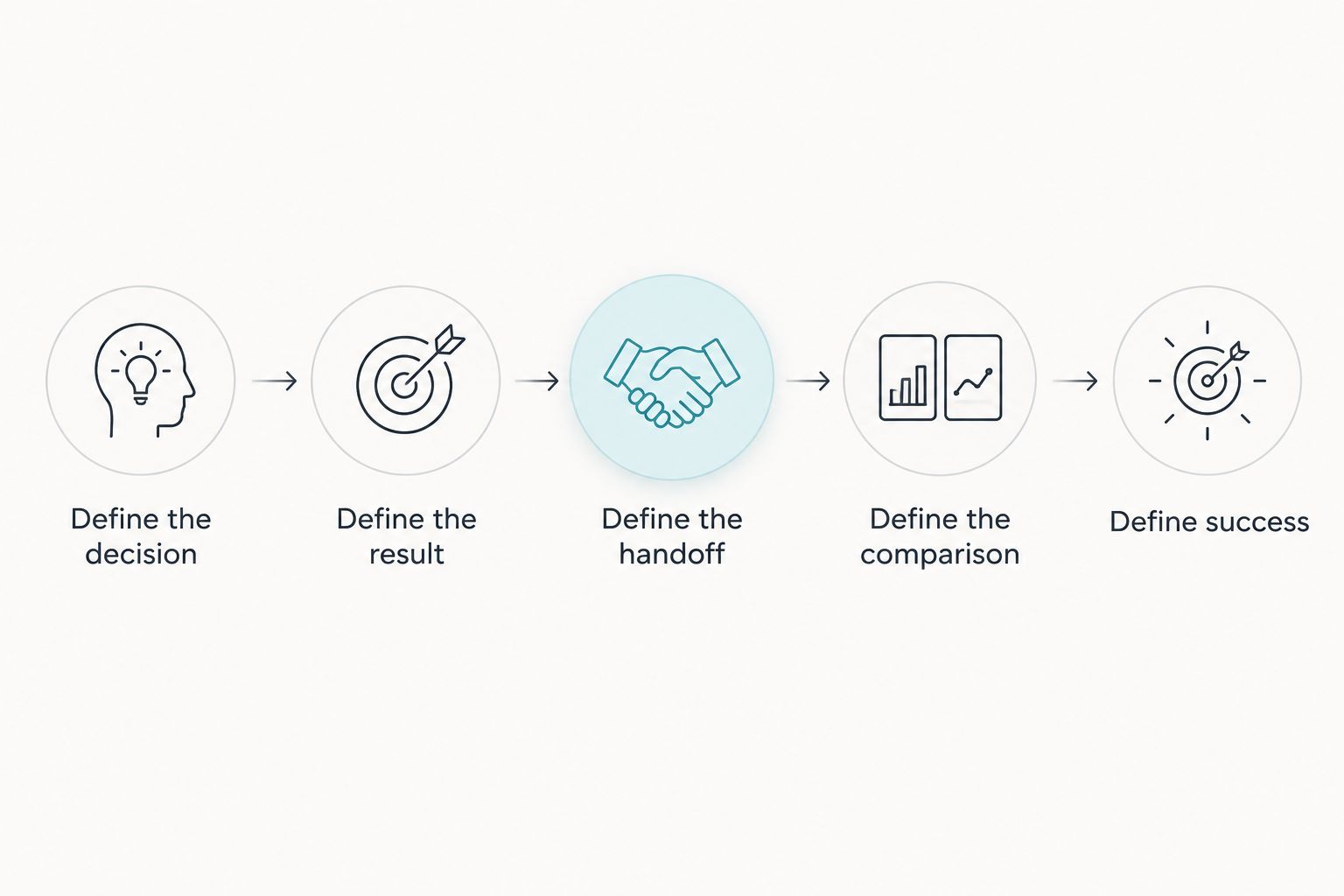
The practical answer for 2026 is therefore conditional but clear: test quiz marketing where guided discovery has a job to do. Do not replace a working conversion path merely because an interactive format looks more interesting.
Which format fits the job best?
A quiz, a direct form, and a survey ask users to do different work. Choose according to the visitor's task, not your preference for a particular interface.
| Format | Best for | Main advantage | Main limitation |
|---|---|---|---|
| Marketing quiz | Visitors who need guided discovery or a tailored result | Connects stated preferences to an outcome | Requires meaningful questions and credible result logic |
| Direct lead form | Visitors already ready to request contact | Provides a direct route to an enquiry | Offers little help with an unresolved decision |
| Survey | Visitors providing feedback or research responses | Collects answers around a defined research objective | Does not inherently deliver a personalised recommendation |
Keep a direct route for high-intent visitors. Someone who already knows what they want should not have to complete a quiz to reach your team.
A quiz also needs to earn its place beside existing content. If a short comparison explains the choice clearly, publish the comparison. Add interaction when the answer genuinely depends on what the visitor tells you.
Lead-generation quizzes: qualify before the handoff
A lead-generation quiz fits a campaign that needs context before a sales conversation. Questions can ask about the visitor's goal, current challenge, or intended use, provided those answers influence the result or follow-up.
The advantage is relevance. Your team receives more than a contact detail when the submitted answers explain why someone is interested. The limitation is added effort: every question needs a reason to be there, and collecting information does not ensure anyone will use it.
Before launch, assign an owner to the next step. Specify which answers should change the message, routing, or conversation, and remove fields that nobody needs. A detailed lead profile has no operational value if it lands in an unattended inbox.
Recommendation quizzes: make the explanation useful
A recommendation quiz fits a visitor who faces a choice and needs help narrowing it down. The result should explain why an option matches the stated needs, rather than present a recommendation with no visible reasoning.
Its strength is guided discovery. Its weakness is dependence on the quality of the matching logic: a polished interface cannot fix an irrelevant result. Review answer combinations for contradictions and avoid implying that every visitor has an ideal match.
Provide a sensible next step when the answers do not support a confident recommendation. That might mean explaining the trade-off or inviting a discussion, rather than forcing a result the answers do not justify.
Knowledge quizzes: connect the score to the campaign
A knowledge quiz fits an educational or awareness objective. It can show participants what they understand and explain an answer immediately after they respond.
The benefit is active participation in the subject. The limitation is interpretation: knowing an answer does not establish purchase intent, and getting an answer wrong does not establish a sales opportunity. Keep educational engagement separate from commercial qualification.
For a 2026 campaign, decide whether learning is the intended outcome or a route to another action. Either can be a valid brief, but the reporting should reflect the distinction.
Why quiz marketing results vary
Quiz marketing depends on the relationship between the audience, the experience, and the next step. Review these factors before changing visual design or adding features:
- Audience fit. Give visitors a quiz that addresses the reason they arrived. A mismatch between the campaign promise and the questions undermines the experience.
- Result usefulness. Make the outcome specific enough to help someone act. A generic result gives the visitor little reason to value the interaction.
- Question relevance. Ask for information that changes the outcome or supports a stated purpose. Avoid turning the quiz into an unrelated intake form.
- Data collection clarity. Explain what information you request and how you intend to use it. Do not treat participation as automatic permission for every follow-up activity.
- Follow-up relevance. Use the answers to inform the next message or conversation. Otherwise, the additional information has no defined role.
- Measurement discipline. Separate starts, completions, submitted contacts, qualified leads, and downstream outcomes. These describe different stages, not interchangeable wins.
Change the part that failed, not the whole campaign at once. If participants finish but do not take the next step, inspect the result and the offer before rewriting every question.
How should you measure whether the quiz works?
Start with a business outcome and work backwards through the journey. A dashboard full of interaction events cannot answer whether the campaign generated useful demand unless those events connect to a relevant next action.
Use clear definitions across the campaign:
- Starts: people who begin answering, rather than merely view the page.
- Completions: people who reach the result under your chosen event definition.
- Submitted contacts: people who provide the requested contact information.
- Qualified leads: contacts that meet your documented qualification criteria.
- Downstream outcomes: the enquiries, opportunities, purchases, or other actions your campaign exists to support.
Record how each metric is counted. For example, a completion rate based on quiz starts answers a different question from a completion rate based on page visits. Keep the denominator consistent when comparing versions.
For a commercial assessment, use a gamification campaign ROI measurement plan that connects results to the resources required to produce them. Include creative, development, distribution, and follow-up effort in the decision, rather than assessing the interface in isolation.
In 2026, the useful comparison remains your own alternative under comparable conditions. Document changes in audience, traffic source, campaign message, and follow-up so you do not attribute every difference to the quiz itself.
Does collecting quiz answers make the data useful?
No. Quiz answers become useful when they are accurate enough for the intended purpose and connected to an action your team can take. An unused preference field is still an unused field, however engaging the collection experience looks.
Build a simple answer-to-action map before development. For each proposed question, write down what changes when a person selects a different answer. If nothing changes, reconsider whether the question belongs in the campaign.
Keep purpose and permission distinct. A visitor supplying an answer for a result is not the same as agreeing to unrelated marketing. Where GDPR applies, determine the appropriate lawful basis, provide the required information, and assess any consent requirements for the proposed processing.
Does a marketing quiz need AI to work?
No. A fixed question path with clear matching rules can provide a useful result. The decision to add AI should follow a specific requirement, not precede the campaign brief.
AI-powered interactions introduce additional review questions: are outputs accurate, are recommendations consistent with the permitted options, and what happens when an answer falls outside the intended scope? Define those boundaries before exposing the experience to visitors.
Brainylab's quiz marketing service is best suited to brands seeking a custom interactive campaign. The benefit is a studio-led build around the brief; the trade-off is that a custom project requires decisions about scope, content, result logic, and ongoing ownership.
Can a quiz replace your existing lead form?
A quiz can provide a guided route to an enquiry, but it should not automatically replace a direct form. The right choice depends on whether visitors need help deciding or already know what they want.
Keep both routes when they serve distinct needs. Evaluate the quiz on the quality of the journey it creates, not on how effectively it forces every visitor through additional questions.
FAQ
Is quiz marketing still effective in 2026?
Yes—quiz marketing remains useful in 2026 when it delivers a relevant result and supports a measurable next action. Establish its business impact through qualified leads and downstream outcomes, not completions alone.
What's the best type of marketing quiz for lead generation?
A qualification-focused quiz fits lead generation when its answers help determine relevant follow-up. Ask only for information that supports the result, qualification, or a clearly stated purpose.
Is a marketing quiz better than a landing-page form?
A marketing quiz fits guided discovery; a direct form fits visitors already ready to enquire. Compare the resulting lead quality and downstream actions rather than assuming interaction is better.
Do I need AI to create an effective marketing quiz?
No, an effective marketing quiz does not require AI. Clear questions, useful results, and reliable matching rules can support the experience without generated content.
Can I use quiz answers for email marketing?
Quiz participation alone does not establish permission for email marketing. Determine the applicable legal requirements, explain the intended use, and collect any required consent.
How do I know whether quiz leads are good quality?
Quiz lead quality depends on whether contacts meet your documented qualification criteria and progress to relevant next actions. Track those outcomes separately from contact submissions.
Who is Brainylab's quiz marketing service for?
Brainylab's quiz marketing service fits brands seeking a custom interactive campaign for engagement and first-party customer data collection. Define the required result and follow-up process before commissioning the build.
One last thing
Write the result page before the opening question. If the result cannot explain something useful, the quiz has not yet earned the visitor's effort.
For your 2026 campaign brief, write the visitor benefit, the business action, and the answer-to-action logic before choosing a theme. That order keeps the experience accountable to its purpose.


