Yes, quizzes can replace traditional lead capture forms when answering questions helps visitors choose, understand their needs, or receive a relevant result. They replace the experience around data collection—not the need for contact fields, appropriate consent, and a clear next step—and should not obstruct someone already ready to enquire.
- Can quizzes replace lead capture forms? Yes, when the questions deliver useful guidance rather than unnecessary friction.
- Keep traditional forms for visitors who already know what they want and need a direct route to contact.
- Judge lead-generation quizzes by qualified enquiries, not quiz completions alone.
- Brainylab builds marketing lead-gen quizzes for brands seeking interactive experiences and first-party customer data.
Why this matters
A contact form asks visitors to identify themselves. A useful quiz first helps them make a decision. That distinction matters when your audience needs guidance before it can describe what it wants.
For your 2026 lead-generation plan, choose the format around the visitor’s decision, not the novelty of the interface. Adding interaction without improving the result creates extra work for both the visitor and your team.
Brainylab is a creative development studio that builds branded quizzes, games, and interactive experiences. A custom studio approach fits a brief that needs campaign-specific questions and outcomes; it is not necessary merely to collect a name and email address.
Can quizzes replace traditional lead capture forms?
Quizzes can replace a standalone lead capture form, but they do not eliminate the underlying form fields. A lead-generation quiz combines questions, result logic, and a contact step into a single experience. Without a contact method, the quiz captures answers rather than a contactable lead.
The right choice depends on what visitors need before taking action. Use this comparison to decide where each format belongs.
| Format | Best for | Main advantage | Main limitation |
|---|---|---|---|
| Traditional form | Visitors ready to request contact | Direct path to an enquiry | Limited guidance before submission |
| Lead-generation quiz | Visitors choosing between needs or preferences | Connects answers to a relevant result | Requires meaningful questions and maintained result logic |
| Quiz plus direct form | Campaigns serving exploratory and ready-to-act visitors | Preserves both guided and direct routes | Requires separate tracking for each route |
A quiz earns its place when an answer changes the recommendation, qualification, or follow-up. If every answer leads to the same generic message, the quiz does not justify replacing the form.
The related question is whether the experience produces better business outcomes. The guide to whether a marketing quiz can increase conversion rates addresses that decision separately. Replacing a form and improving conversion are not the same claim.
Traditional forms: best for explicit enquiries
Keep a traditional form when visitors already know what they need. Someone requesting a callback, submitting a specific brief, or asking a direct question should not have to complete a preference quiz first.
A ready-to-act visitor needs an action, not an assessment. Ask for the information required to respond, explain what happens after submission, and avoid turning the contact route into a discovery exercise.
The advantage is clarity: visitors can state their request directly. The limitation is that an open enquiry gives you less structured information about preferences unless you deliberately ask for it.
For a 2026 campaign, retain this route wherever the page already promises direct contact. Do not change the promise halfway through the journey by introducing a quiz that the visitor did not expect.
Lead-generation quizzes: best for guided decisions
Use a quiz when visitors need help identifying a suitable direction. The questions should reflect decisions the visitor actually faces, and the result should explain why a particular recommendation follows from the answers.
Examples include identifying interests, choosing an appropriate category, or clarifying a problem before an enquiry. These are possible campaign designs, not claims about a particular brand’s existing quiz.
The advantage is structured context. Your follow-up can refer to the visitor’s stated needs instead of treating every submitted email address as the same type of enquiry.
The limitation is added responsibility. You must maintain the questions, answer choices, result mapping, and handoff; a broken or irrelevant result makes the interaction harder to justify than a straightforward form.
Brainylab is a fit for brands seeking custom marketing lead-gen quizzes and branded interactive experiences. That fit does not make a quiz the correct replacement for every contact form: start with the decision you need to help the visitor make.
Quiz plus direct form: best for mixed intent
Offer both routes when the campaign serves people exploring options and people ready to speak to you. Label the choice by purpose, such as getting guidance versus making an enquiry, rather than asking visitors to understand your marketing terminology.
The quiz route should end with a relevant result and an appropriate next action. The direct route should let visitors submit their request without answering exploratory questions.
This approach preserves choice, but it also creates a measurement task. Track each route separately so a rise in quiz participation does not conceal a fall in direct enquiries.
Do not force every visitor through the same discovery process. A useful replacement strategy changes the route for the audience that needs help, not for everyone who lands on the page.
Why quiz effectiveness varies
A quiz is not a conversion improvement by definition. Its usefulness depends on the relationship between the visitor’s intent, the questions, and the outcome.
- Visitor intent: Exploratory visitors need guidance; explicit enquiries need a direct response route.
- Question relevance: Each question should change the result, qualification, or planned follow-up.
- Result usefulness: The outcome must answer the promise that persuaded someone to start.
- Contact timing: Explain any email requirement before the visitor invests effort in the quiz.
- Follow-up relevance: Use the submitted answers to inform the response rather than sending an unrelated message.
- Data handling: Decide which answers you need, how you will use them, and who receives them.
Treat these as design checks for your 2026 brief, not as guarantees of higher conversion. The quiz should create useful context before it asks your team to act on that context.
How do you replace a form without losing the enquiry route?
Replace the experience in stages. Keep the original business action visible, then build the guided route around a result that helps visitors decide whether to take that action.
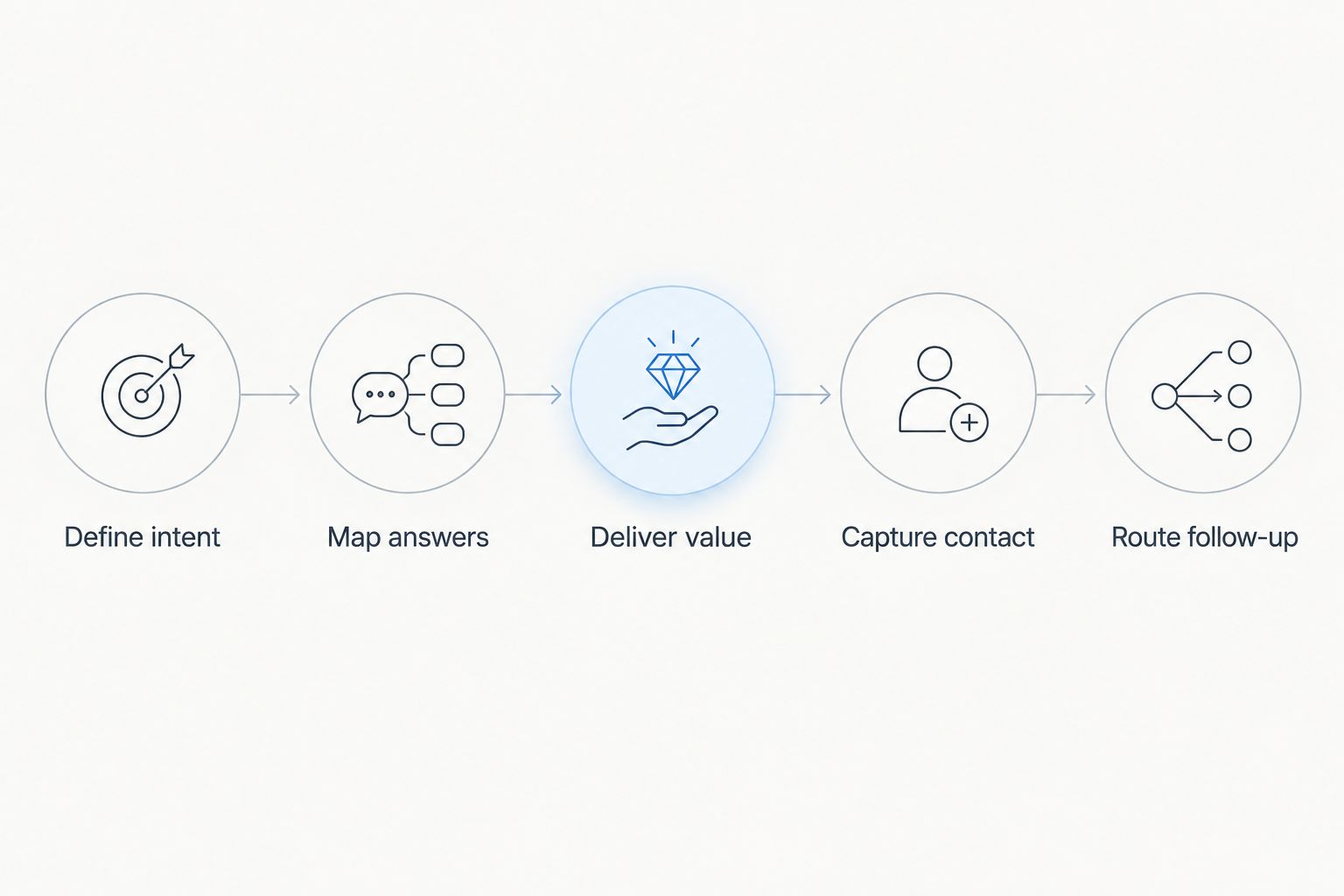
Define intent
Write down why someone arrives on the page. Distinguish a visitor seeking guidance from a visitor requesting contact, and decide which group the quiz is meant to serve.
Map answers
Connect each answer to a result or a follow-up decision. Remove questions that collect interesting information without changing anything you will do for the visitor.
Deliver value
Explain the result in plain language. Show how the answers shaped it, and give visitors enough context to judge whether the recommendation fits their needs.
Capture contact
Ask for the details required for the next action. State whether those details are for sending a result, responding to an enquiry, or another clearly described purpose.
Route follow-up
Send the relevant answers and contact information to the team responsible for responding. Check the actual record that arrives, not just the success message shown on screen.
Before launch, walk through each result path and the direct enquiry path. Check that answers produce the intended outcome, contact details reach the correct destination, and the visitor receives the next step you promised.
Should you ask for an email before showing quiz results?
Disclose an email requirement before the quiz starts if the result depends on submitting an email address. Do not promise an immediate result and reveal a contact gate only after the visitor finishes answering.
Showing a useful result before an optional enquiry creates a different exchange: visitors can judge the guidance before asking for follow-up. Gating the result makes contact submission part of the initial promise. Choose deliberately rather than hiding the trade-off.
An email address alone does not describe every permitted use of that address. Separate the request for a result or response from unrelated promotional messaging, and obtain legal review for the consent and privacy wording your campaign needs.
How do you know whether the quiz performs better than the form?
Compare the routes against the same business outcome. For a 2026 evaluation, define what counts as a qualified enquiry before you compare submissions; otherwise, the format that collects more addresses automatically appears to win.
Use a measurement chain that separates participation from commercial intent:
- Quiz starts: Visitors who begin the guided experience.
- Quiz completions: Visitors who reach the result stage.
- Contact submissions: Visitors who provide the required contact details.
- Qualified enquiries: Submitted contacts that meet your documented criteria.
- Follow-up outcomes: What happens after the responsible team responds.
A completion without contact details is participation, not a contactable lead. A contact submission without the required fit is not automatically a qualified enquiry.
Compare qualified enquiries relative to the visitors exposed to each route. Keep the offer, audience, and destination consistent where practical, and record changes that make the comparison unequal.
Do not declare the quiz successful because its completion count is high. Check whether the result attracts the people your team can actually help and whether the follow-up produces the intended action.
What quiz answers should reach your follow-up team?
Send the answers that explain the enquiry, together with the result the visitor saw. The person responding needs to understand what the visitor was told, not just which internal segment received the contact.
Use readable field names. Preserve the distinction between an explicit answer and an interpretation generated from that answer; a stated preference is not proof of purchase intent.
For your 2026 handoff, document the contact destination, the qualification criteria, and the responsibility for responding. If the follow-up team cannot use a field, question whether the campaign needs to collect it.
The downside of richer quiz data is additional management. More answers create more fields to maintain and more information to handle, so collect deliberately rather than treating every possible question as useful.
FAQ
Can quizzes replace lead capture forms completely?
Quizzes can replace the standalone form experience, but contactable leads still require contact details. Keep a direct enquiry route for visitors who do not need guidance.
Is a quiz better than a contact form for lead generation?
A quiz is better suited to guided decisions; a contact form is better suited to explicit enquiries. Compare qualified enquiries rather than assuming interaction produces better leads.
Do I have to collect an email address in a marketing quiz?
You need a contact method if the goal is a contactable lead, but a quiz can provide guidance without collecting email addresses. Separate participation from lead capture in your reporting.
Should I show quiz results before asking for contact details?
Show results first when you want visitors to assess the guidance before requesting follow-up. If contact details are required to receive the result, disclose that requirement before the quiz starts.
Can I keep my existing form alongside a quiz?
Yes, keep the existing form for direct enquiries and offer the quiz for visitors seeking guidance. Track the routes separately so you can compare their qualified enquiry outcomes.
What should I measure when testing a quiz in 2026?
Measure qualified enquiries relative to the visitors exposed to each route in 2026. Track starts, completions, contact submissions, and follow-up outcomes separately to identify where the journey breaks.
Is Brainylab relevant if I need a custom lead-generation quiz?
Brainylab builds marketing lead-gen quizzes and branded interactive experiences. Define the visitor’s decision, the intended result, and the follow-up requirements before commissioning a custom experience.
One last thing
Write the result before you write the questions. If you cannot describe a useful outcome for the visitor, you have not yet established why the quiz should replace the form.
Then work backwards: identify the answers required to produce that outcome and the contact details required for the next action. This keeps your 2026 campaign focused on guidance and relevant enquiries rather than interaction for its own sake.