
Quiz-based lead generation is cheaper than paid ads only when its total campaign cost per qualified lead is lower than your paid-ad baseline. A quiz still needs traffic, and a paid campaign can send visitors to a quiz, so the comparison must include development, distribution, lead handling, and lead quality—not just advertising spend.
- Is quiz-based lead generation cheaper than paid ads? Only when total cost per qualified lead is lower.
- Paid ads distribute a campaign; lead-generation quizzes capture answers and contact details.
- Compare qualified leads and acquired customers, not quiz completions alone.
- Brainylab builds branded quizzes for engagement and first-party customer data collection, not ad inventory.
Is quiz-based lead generation cheaper than paid ads?
A quiz is a lead-capture experience; paid advertising is a distribution channel. You can use them together. Comparing a quiz with paid ads as if they were mutually exclusive hides the actual decision: which destination turns your traffic into useful business opportunities at the lowest total cost?
For your 2026 campaign, compare these campaign structures rather than treating every quiz lead as an alternative to an advertising lead.
| Campaign structure | Best for | Main advantage | Main drawback | What to include in the comparison |
|---|---|---|---|---|
| Paid ads with a standard form | Buyers ready to request contact | Direct route from interest to enquiry | A short form captures limited preference information | Media, creative, landing page, tracking, and lead handling |
| Paid ads with a lead-generation quiz | Buyers who need help identifying a suitable option | Answers provide context before follow-up | Quiz development adds work, and visitors must complete the experience | Media plus quiz production, tracking, and lead handling |
| Owned-channel traffic with a quiz | An existing audience you can reach through your own channels | Distribution does not require buying each visit | Results depend on the audience you already reach | Quiz production, channel management, tracking, and lead handling |
Do not label the final row free. Staff time, content production, and technical maintenance still belong in the calculation. Equally, do not credit the quiz with all the value of an audience built through earlier marketing activity.
Why this matters
An inexpensive email address is not necessarily an inexpensive sales opportunity. If quiz submissions require extensive filtering, the apparent saving disappears into your follow-up workload.
Brainylab is best suited to brands commissioning branded lead-generation quizzes for engagement and first-party data collection. The studio builds quizzes, games, and interactive experiences; that service addresses the experience itself, not the purchase of advertising inventory.
Keep those roles separate when evaluating proposals. An experience-development brief should explain the questions, results, data capture, and intended next action. A distribution brief should explain how the right audience reaches that experience. Neither brief substitutes for the other.
Paid ads with a standard lead form
A standard form is a sensible baseline when visitors already understand the offer and want a direct response. You ask for the details needed to handle the enquiry, then send the submission to the appropriate follow-up process.
Its advantage is a short path to contact. Its limitation is the information available before that conversation: contact details alone do not explain preferences, use cases, or purchasing constraints.
For a 2026 comparison, retain this route as your control rather than replacing it before measuring anything. A quiz should earn its place against the existing experience. If buyers already know what they need, extra questions must serve a clear purpose.
Best for: campaigns where the visitor's next step is an explicit enquiry, booking request, or conversation. Keep the form if a quiz adds questions without adding decision value.
Paid ads with a lead-generation quiz
A quiz can ask about needs before requesting contact details. That makes it suitable for a campaign where the answers support a result, recommendation, or relevant follow-up.
The benefit is context. The trade-off is an additional interaction between the ad click and the final submission, plus the work required to build and maintain the experience.
Define the result before writing the questions. Every question should change the result, establish a useful qualification criterion, or support the next conversation. Questions added purely to make the experience longer create work without a clear business purpose.
Best for: brands that need preference or needs information alongside a contact record. Choose this route when the information changes what you do after capture—not simply because a quiz looks more engaging.
Owned-channel traffic with a lead-generation quiz
You can distribute a quiz through channels you already manage, such as your website or an email audience. This separates the experience from paid media buying, but it does not establish that quizzes are inherently cheaper.
The advantage is access to an existing audience. The constraint is audience reach and relevance: you are measuring the people those channels bring, not the same population as a prospecting campaign.
Record whether participants are existing customers, known contacts, or new prospects. Combining those groups can make acquisition performance look better without demonstrating that you acquired new customers more efficiently.
Best for: learning about an existing audience or capturing additional preferences. Evaluate new-prospect acquisition separately from customer engagement and profile enrichment.
Why quiz-based lead-generation costs vary
Your 2026 comparison should explain the following cost drivers. Treat them as budget categories to inspect, not as assumptions about which campaign will win.
- Traffic source: Paid distribution carries media expenditure. Owned distribution still requires channel management, and its audience differs from a paid prospecting audience.
- Experience scope: Question logic, result content, design, and testing determine the production work. A more involved experience needs an explicit reason for that work.
- Data handling: Specify which answers and contact fields must reach your customer records. Include the effort required to map fields and check that submissions arrive correctly.
- Qualification: Define which submissions count as useful leads. An email address, a completed quiz, and a sales-accepted opportunity are different outcomes.
- Follow-up: Include the staff time and campaign work needed to turn a submission into a conversation or purchase. Capture alone does not complete acquisition.
- Maintenance: Include changes to questions, result content, tracking, and campaign materials over the comparison period. Initial production is not the entire operating cost.
Avoid comparing an established form with a newly launched quiz while ignoring setup on one side. Show recurring performance and initial production separately, then combine them for the total campaign result.
How do you compare quiz leads with paid-ad leads fairly?
Use the same accounting boundary and the same qualification definition. For a 2026 decision, document the rules before launch so that a disappointing outcome cannot be reclassified as a different kind of success afterward.
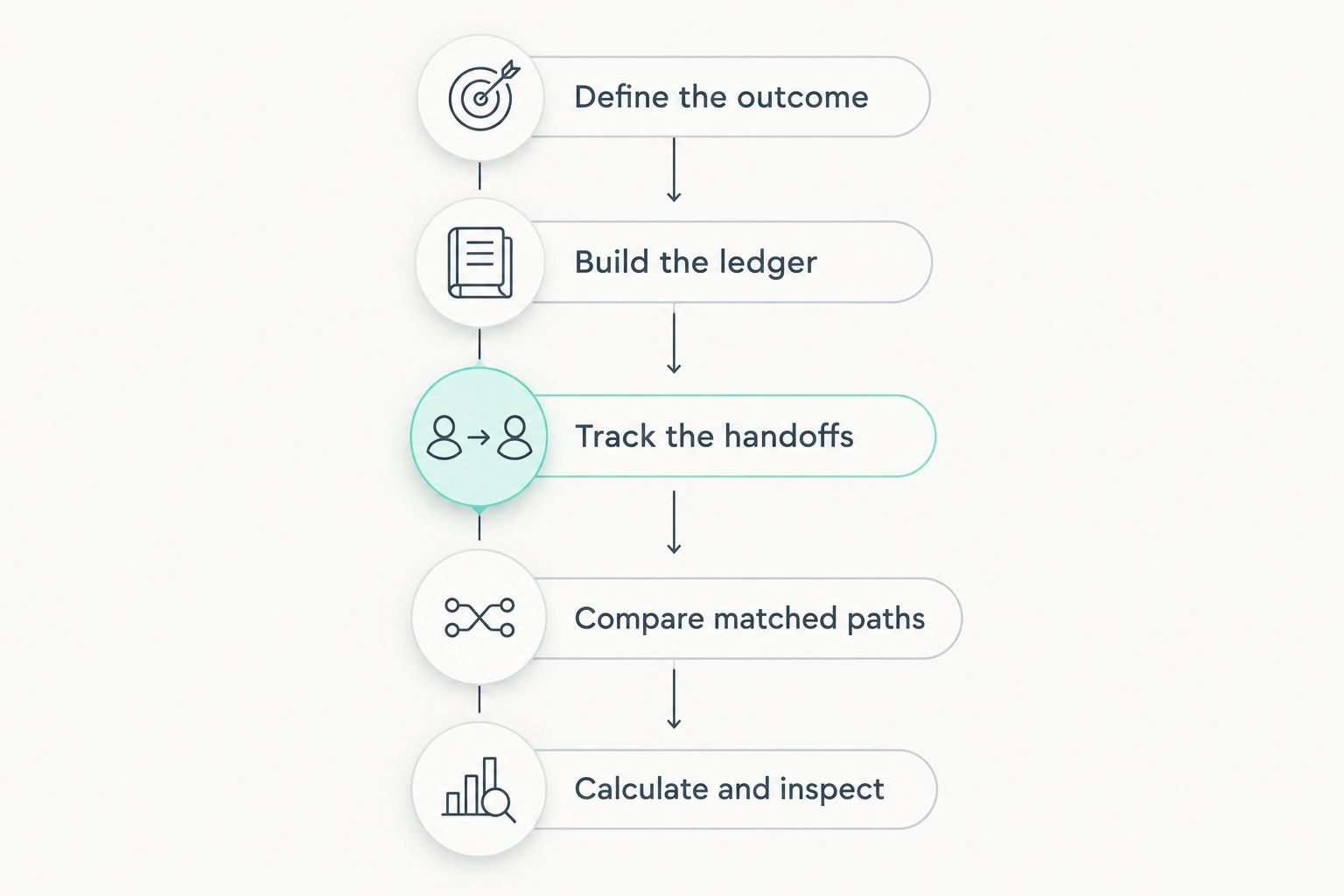
1. Define the outcome
Select the business outcome that matters: a qualified contact, an accepted sales opportunity, or an acquired customer. Write down what makes a record qualify and apply that rule to both campaign routes.
Do not count every quiz finisher as a lead. A completion without contact permission or a usable next action is an engagement event, not automatically an acquisition outcome.
2. Build the cost ledger
Organize your ledger into 3 cost groups: production, distribution, and follow-up. This is a recommended accounting structure, not a performance benchmark.
Production includes the experience, content, and technical work. Distribution includes media and channel execution. Follow-up includes processing, qualification, and the work required to pursue the captured contact.
Assign shared expenses consistently. If the same creative work supports both routes, do not charge it entirely to the quiz while leaving the form campaign untouched.
3. Track the handoffs
Track 4 funnel events: arrival, completion, qualified submission, and customer acquisition. These are measurement checkpoints, not target conversion rates.
Use arrival to understand distribution, completion to understand the experience, qualified submission to judge lead capture, and acquisition to judge business value. Preserve the connection between those events where your measurement setup permits it.
Document any tracking gaps before interpreting the result. A campaign cannot receive credit for downstream outcomes that your records do not connect to it.
4. Compare matched paths
Start with 2 test paths: the standard form and the quiz. Keep the offer, audience criteria, traffic source, and evaluation period aligned so that you are comparing the destination rather than unrelated campaigns.
Check audience composition as well as headline totals. An existing-customer email campaign and a prospecting ad campaign answer different questions, even if both generate contact records.
5. Calculate and inspect
Use these formulas consistently:
- Cost per qualified lead = total campaign cost ÷ qualified leads.
- Customer acquisition cost = total acquisition cost ÷ acquired customers.
- Qualified-lead rate = qualified leads ÷ campaign arrivals.
If a route produces no qualified leads, there is no finite cost-per-qualified-lead result to report. Do not substitute completions to make the calculation look successful.
Then inspect why one route wins. Lower distribution expenditure, stronger qualification, and less follow-up work are different explanations and imply different next actions. The guide to measuring gamification campaign ROI addresses the broader evaluation question.
The measurement sequence keeps spending, engagement, and sales outcomes separate. Preserve that order before deciding which campaign deserves additional investment.
When does a quiz justify its development work?
A quiz justifies development work when its measured business value exceeds the extra work needed to build and operate it. Useful answers can support that value, but collecting more fields is not itself proof of a better campaign.
Before commissioning the experience, map each answer to an action. A preference might change a result, a qualification answer might change routing, and a stated need might change follow-up content. If nobody uses the answer, remove the question or define its purpose.
Brainylab's lead-generation quiz service fits the experience-development side of this decision. You still need a distribution plan, qualification rules, and a way to evaluate downstream outcomes; a branded experience does not establish a saving on its own.
Plan your lead-generation quiz
Define the experience around useful answers, first-party data, and the next customer action.
Can a quiz replace paid ads?
A quiz can replace a landing-page experience, but it does not replace the need for distribution. If you stop paid advertising, identify the channel that will bring relevant visitors instead.
For your 2026 plan, separate the decision to change the destination from the decision to change traffic acquisition. Otherwise, you cannot tell whether the result came from the quiz or from the audience reaching it.
Are quiz leads better than form leads?
Quiz leads are better only when the answers improve qualification or the next action. A contact record with unused answers is more detailed, not necessarily more valuable.
Ask the team handling leads which information changes its decisions. Use that feedback to design the questions and evaluate the submissions against the same acceptance criteria as form leads.
Should you stop paid ads if quiz leads look cheaper?
Do not stop paid ads based on a lower submission cost alone. Check total cost per qualified lead, customer acquisition outcomes, and whether paid ads supplied the quiz traffic.
Shift investment only after identifying the source of the saving. Keep the successful distribution channel if the quiz is improving what happens after the click.
FAQ
Is quiz-based lead generation cheaper than paid ads in 2026?
Quiz-based lead generation is cheaper only when its total cost per qualified lead is lower than the paid-ad baseline. Include production, distribution, and follow-up rather than comparing media spend with quiz completions.
Can I run paid ads and a lead-generation quiz together?
Yes, paid ads can send visitors to a lead-generation quiz. Advertising supplies distribution, while the quiz supplies the interactive capture experience.
What's the best metric for comparing quiz and form campaigns?
Cost per qualified lead is the direct comparison when both campaigns use the same qualification rule. Also assess customer acquisition cost when you can connect submissions to acquired customers.
Do quiz completions count as leads?
Quiz completions do not automatically count as leads. Define the contact details, permission, qualification, and next action required for a submission to enter your lead count.
Is a quiz sent to my email audience free lead generation?
A quiz distributed through your email audience still has production, channel-management, and follow-up costs. Separate existing contacts from new prospects when evaluating acquisition.
Does Brainylab sell advertising or build quiz experiences?
Brainylab is a creative development studio that builds branded quizzes, games, and interactive experiences for engagement and first-party customer data collection. Evaluate the experience-development work separately from your advertising distribution plan.
One last thing
The most useful quiz question is the one that changes your next action. Before adding a question, name the decision its answer will inform. If the answer changes neither the result nor the follow-up, it needs a stronger reason to exist.
That discipline also improves your cost comparison. You are not paying to accumulate answers; you are paying to create an experience that supports a measurable business outcome. Keep the form baseline, count the full workload, and let qualified leads—not completion totals—decide the winner.


