
A gamified marketing campaign needs a scope-based delivery estimate, not a universal number of weeks. Set the build timeline after you define the experience, approve the content and agree on the data handoff; include review, testing and launch preparation rather than treating development as the whole project.
- How long to build a gamified marketing campaign depends on the approved experience and launch requirements.
- Brainylab builds gamified marketing experiences for brands seeking user engagement and first-party customer data.
- Separate development work from content approvals, data handoff and launch testing.
- Use an approved scope and named decision owner before committing to a delivery date.
Why this matters
Your media calendar needs a working campaign, not merely a finished game screen. If participants can complete the experience but their answers never reach the intended destination, the campaign is not ready for a data-collection objective.
Brainylab is a creative development studio that builds quizzes, branded games and interactive experiences. Those formats need different briefs, so a useful 2026 schedule starts with what you want the participant to do and what your team needs afterward.
Define the finish line before asking for the deadline. That gives your marketing team and development partner the same definition of launch-ready.
How long does it take to build a gamified marketing campaign?
There is no single build duration that applies to every gamified marketing campaign. A usable estimate describes the agreed work, the inputs you must supply, the approval points and the conditions for release. A date without those assumptions is not a complete delivery plan.
Use the following sequence to turn a campaign idea into an estimable project. These are 5 launch gates, not a claim that each stage takes the same amount of time.
- Scope approval. Confirm the audience, campaign objective, format, participant journey and completion action. Record what is excluded as clearly as what is included.
- Content approval. Sign off questions, instructions, results, brand assets and any participant-facing terms before treating them as final build inputs.
- Experience approval. Review the interaction and result logic against the agreed brief. Resolve disagreements about the experience before approving it for release.
- Data validation. Check that the intended answers and contact details reach the agreed destination with the correct meaning and permissions.
- Launch approval. Complete functional checks, confirm tracking and name the person who authorizes publication.
Some work can overlap. Your plan should show which tasks depend on an earlier decision, rather than assuming that every task can start immediately.
What should the delivery estimate include?
Ask for a milestone plan that separates studio work from client decisions. Your campaign owner should be able to identify what is ready, what is waiting and which unresolved decision prevents the next stage from starting.
For a 2026 campaign brief, request these fields:
- Deliverable: the specific output being reviewed.
- Owner: the person responsible for producing or approving it.
- Dependency: the input or decision required before work starts.
- Acceptance condition: what makes the deliverable complete.
- Target date: the agreed milestone, with its assumptions attached.
Do not interpret an early estimate as permission to add features without revisiting the schedule. When the scope changes, ask for the affected milestones to be updated before accepting a replacement launch date.
Marketing quiz: define the answers and results first
Best for: collecting stated preferences through a structured question-and-answer journey. A quiz brief should explain what you want to learn, how answers determine the outcome and what happens after completion.
The benefit is an explicit connection between the participant's choices and the information you collect. The constraint is that questions and result logic need approval; a finished interface cannot resolve an unclear scoring rule or contradictory outcome.
Give the development team an approved question set, answer choices and result mapping. Include the wording participants see when they submit details, and explain whether contact collection is required for the campaign's intended journey.
If stakeholders are still debating the questions, identify content approval as an open dependency. Do not hide it inside a general development deadline.
Branded game: define the interaction before adding features
Best for: a campaign where playing is the central participant action. A branded game brief should describe the controls, objective, feedback and end state in plain language.
The benefit is an experience built around participation rather than a sequence of questions. The constraint is that interaction design needs explicit acceptance criteria: your team must agree on what the player can do and what counts as a completed session.
Describe the simplest version that delivers the campaign idea. If scoring, repeat play or competitive mechanics are part of your proposed scope, decide how they work before asking the team to estimate implementation.
Treat additional mechanics as scope decisions, not decorative extras. Each one needs instructions, expected behavior and a way to verify that behavior before release.
Interactive experience: define every meaningful outcome
Best for: a campaign built around choices that lead to different content or outcomes. An interactive experience brief should show how a participant moves from the opening screen to the intended completion action.
The benefit is control over the participant's route through the campaign. The constraint is that conditional journeys need clear rules; every intended outcome must have approved content and a defined route to reach it.
Map the journey before commissioning the finished experience. Include incomplete submissions, back navigation and any other behavior you intend to support, rather than leaving these decisions until launch review.
Which format should you scope?
Choose the format by the campaign objective, not by an assumed delivery speed. This comparison describes planning requirements, not turnaround promises.
| Format | Best for | Main planning benefit | Main constraint | Define before estimating |
|---|---|---|---|---|
| Marketing quiz | Collecting stated preferences | Answers provide an explicit data structure | Questions and outcomes need approval | Questions, result logic and submission flow |
| Branded game | Making play the campaign's central action | The interaction gives the creative idea a playable form | Gameplay needs agreed acceptance criteria | Controls, objective and completion behavior |
| Interactive experience | Guiding participants through different outcomes | The journey can reflect participant choices | Conditional routes require clear rules | Journey map, content and outcome conditions |
Why gamified campaign build timelines vary
The useful question is not whether gamification is inherently quick or slow. It is which decisions and deliverables remain unresolved in your particular campaign.
Use these factors to structure the estimate discussion:
- Experience scope: specify whether the brief calls for a quiz, branded game or interactive journey, then describe the actual behavior required.
- Content readiness: separate approved copy and assets from material still being written or reviewed.
- Outcome logic: document how answers or actions produce a result, including the behavior you expect when a participant stops early.
- Data requirements: state what information you intend to collect and where your team needs it delivered.
- Approval ownership: name the people who approve creative, participant-facing wording and release readiness.
- Launch acceptance: agree on the functional and measurement checks required before publication.
Do not reduce the estimate to screen count. A screen list does not explain result logic, data handling or the decisions needed to approve the campaign.
For 2026 planning, keep unresolved requirements visible in the brief. Assign an owner to each one so the schedule distinguishes a development task from a decision your team still owes.
How do you create a launch-ready campaign brief?
Write a brief that another person can use without reconstructing your intentions from meeting notes. Start with the participant journey, then connect that journey to the marketing action you want to support.
Use these headings as the backbone of the brief:
- Campaign objective: explain the business action the experience supports.
- Participant journey: describe entry, interaction, result and completion.
- Approved content: identify final questions, instructions, results and assets.
- Data handoff: define the information collected and its destination.
- Launch checks: describe what must work before publication.
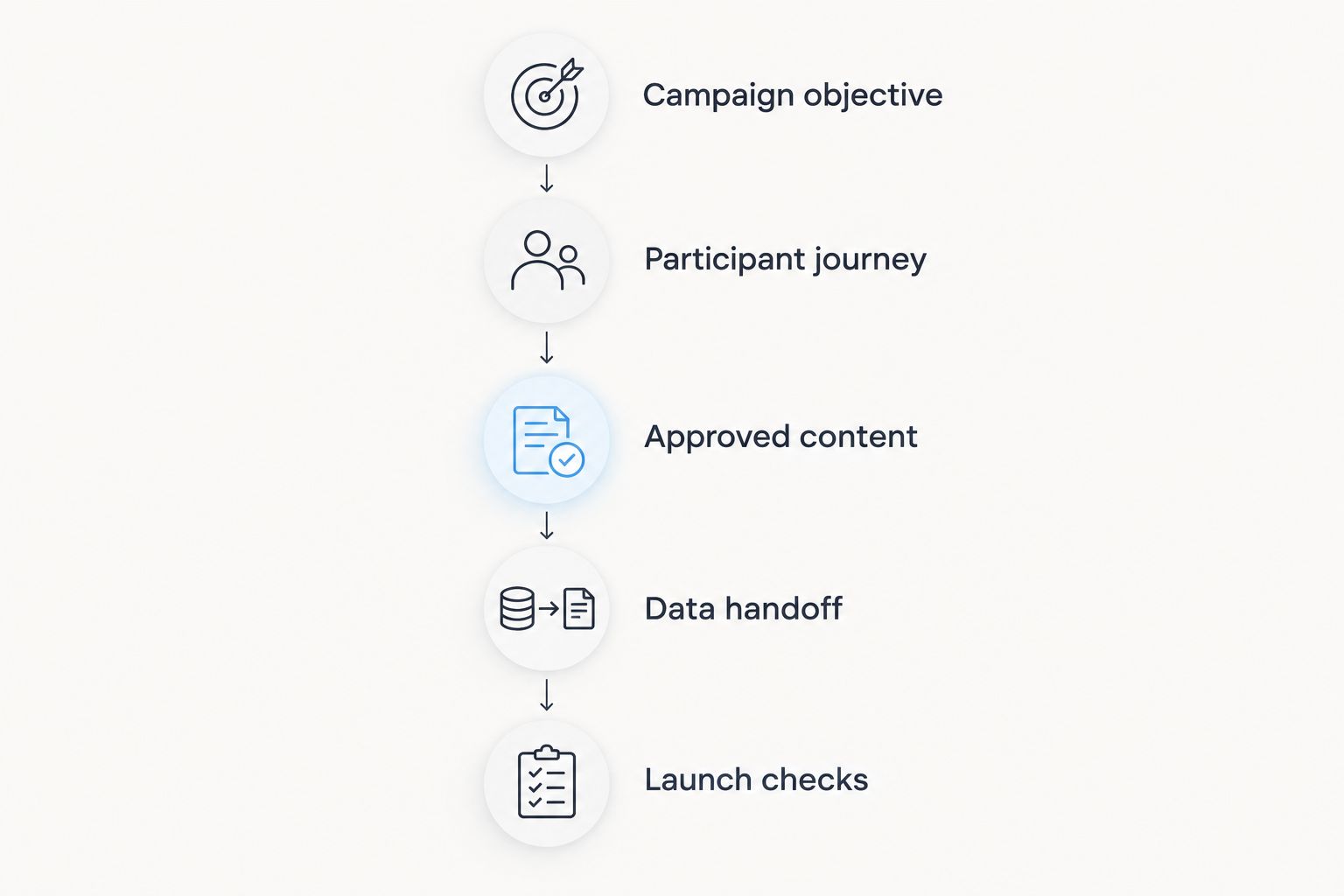
Write exclusions underneath the brief. If a feature is not part of launch, say so explicitly; do not rely on silence to keep it outside the project.
Brainylab is a fit for brands commissioning gamified marketing experiences for engagement and first-party data collection. Its stated services include marketing lead-generation quizzes, branded games and gamification strategy. Those services fit the commissioning question, but they do not establish a standard delivery duration.
Can you shorten the build without weakening the campaign?
Reduce the approved scope before reducing the launch checks. Choose the smallest experience that still supports the campaign objective, and move optional ideas outside the release brief.
Appoint 1 decision owner to consolidate feedback and resolve conflicting requests. Specialists can still review their areas, but the development team needs a single approved response rather than incompatible instructions from different stakeholders.
Supply final content in a shared, clearly versioned document. When wording changes, identify exactly which questions, outcomes or instructions need replacing so the team can review the effect on the build.
Decide who will deliver the experience as well as who will approve it. The guide to building gamification in-house versus hiring a studio addresses that ownership decision; neither route removes your team's responsibility to define the brief.
Avoid choosing a more complicated experience simply because the launch is important. A larger scope needs its own justification, not an assumption that more features produce a better campaign.
What should you test before a gamified campaign launches?
Start with 1 complete test journey from the campaign entry point to the final record your team receives. That first journey checks the connection between the experience and its intended marketing use; it is not a substitute for testing the remaining approved routes.
Then test every intended outcome against the brief. Verify that instructions match the interaction, results follow the approved rules and submissions contain the information your team expects.
Include failure behavior in the launch checklist. Decide what participants see when a required field is missing, a submission fails or they leave before completion, wherever those behaviors apply to your agreed scope.
For a 2026 launch, confirm the measurement plan before release authorization. Record which actions represent participation, completion and a usable lead so your reporting does not silently treat different events as the same result.
What if the media launch date is already fixed?
Treat the fixed date as a constraint in the brief, not as evidence that the proposed scope will fit. Ask the delivery team to assess the required experience against the deadline before committing media that depends on it.
Separate the essential release from optional additions. If the plan cannot accommodate the original scope, choose explicitly between changing the experience, changing the date or changing the campaign dependency.
Your 2026 media plan should name the person who makes that decision. Leaving the trade-off unresolved does not create additional development time.
FAQ
How long does it take to build a gamified marketing campaign?
A gamified marketing campaign needs a scope-based estimate rather than a universal number of weeks. Define the experience, content, approvals, data handoff and launch checks before agreeing on a delivery date.
Is a marketing quiz faster to build than a branded game?
The format alone does not establish which campaign is faster to build. Compare the actual question logic, gameplay requirements, approved content and data handling before comparing delivery estimates.
What should I send a studio to get a useful timeline?
Send the campaign objective, participant journey, approved content, data requirements and target launch date. Identify unresolved decisions and the people responsible for approving them.
Does the build timeline include reviews and testing?
Your launch plan should explicitly include reviews and testing. Ask the delivery team to separate implementation milestones from client approvals and release checks.
Can I collect first-party data through a gamified campaign?
A gamified campaign can collect information participants submit through the experience. Define the intended fields, participant-facing explanations, permissions and destination before approving the data flow.
Can Brainylab build a gamified marketing campaign?
Brainylab builds quizzes, branded games and interactive experiences for brands seeking engagement and first-party customer data. Its stated services do not establish a standard turnaround time; request an estimate against your campaign brief.
What should I remove when the campaign deadline is fixed?
Remove optional scope before removing necessary launch checks. Keep the participant journey, intended data handoff and release acceptance criteria clear, then agree on what belongs outside the initial launch.
One last thing
Make the final acceptance check happen where your marketing team uses the data, not only where the participant finishes playing. Open the resulting record and verify that its meaning matches the participant's actual choices.
A completion screen proves that a journey reached its end. It does not, by itself, prove that the campaign delivered the information you intended to collect.