
Yes—gamification can reduce customer acquisition cost when it increases the number of new paying customers enough to cover the full cost of the campaign. For a 2026 acquisition plan, count development, promotion, incentives and follow-up: cheaper quiz entries or more game completions do not, by themselves, prove lower customer acquisition cost.
- Can gamification reduce customer acquisition cost? Yes, when additional new customers justify the campaign’s total acquisition spend.
- Brainylab builds branded quizzes and games; judge acquisition performance by paying customers, not participation.
- Lead generation and first-party data collection support acquisition only when answers inform a relevant next action.
- Compare a gamified experience against your existing journey, including development, promotion and sales follow-up costs.
Can gamification reduce customer acquisition cost?
Gamification reduces customer acquisition cost only when total acquisition spend divided by new customers falls. It can achieve that through a better conversion journey, useful qualification or more relevant follow-up. It can also add expense without producing additional buyers.
Brainylab develops branded quizzes, games and interactive experiences for engagement and first-party customer data collection. Those activities belong at the beginning of an acquisition evaluation, not at the end: your commercial result is still the customer acquired.
Use this calculation consistently:
Customer acquisition cost = total acquisition spend ÷ new customers acquired.
For a campaign comparison, apply the same spending boundaries, customer definition and attribution window to both journeys. Do not compare a fully costed interactive campaign with a baseline that includes advertising spend alone.
| Acquisition approach | Best for | Potential acquisition benefit | Main limitation |
|---|---|---|---|
| Standard landing page and form | Visitors already ready to enquire or buy | A direct route to the next commercial action | Collects little qualification context unless you request it |
| Lead-generation quiz | Buyers who need help identifying a relevant option | Connects stated needs with a suitable result and follow-up | Extra questions introduce friction; completion is not a sale |
| Branded game | Campaigns where participation is a deliberate engagement objective | Gives visitors a reason to interact with the brand | Gameplay can attract people without purchase intent |
These are different acquisition mechanisms, not interchangeable campaign decorations. Pick the format that addresses a specific obstacle in your current journey.
A direct form remains the better starting point when your audience already knows what it wants. A quiz earns its place when the answers help the buyer or your sales team make a decision.
Why this matters
A lower cost per lead can coexist with a higher customer acquisition cost. That happens when inexpensive entries require more follow-up or convert into fewer paying customers.
Your 2026 acquisition reporting should separate participation, qualification and purchase. Each answers a different question: did someone engage, did they fit your buyer criteria, and did they become a customer?
Treat engagement as diagnostic evidence. It helps locate friction, but it does not replace a commercial outcome.
For an agency-built experience, include the creative and development work in your evaluation. Comparing advertising results while excluding the experience itself hides part of the acquisition expense.
How a lead-generation quiz can affect acquisition cost
A lead-generation quiz is best for buyers who benefit from guided selection or qualification. Its strongest acquisition role is connecting an answer to an action: a relevant recommendation, an appropriate enquiry or a useful sales conversation.
Ask questions that change what happens next. A question about the visitor’s intended use can inform the result; a question collected without any follow-up purpose just lengthens the journey.
The advantage is context. Instead of receiving only contact details, your team can receive stated needs that help determine which message or conversation is relevant.
The limitation is friction. Every required response asks the visitor to do more before reaching the commercial action, so the quiz must provide value in return.
Choose a lead-generation quiz when its answers improve the buying journey, not merely because the format is interactive. Keep the result connected to the reason the visitor arrived, and make the next action clear.
How a branded game can affect acquisition cost
A branded game is best for campaigns where interaction with the brand is part of the objective. It gives the visitor something to do, but the acquisition case depends on what follows that interaction.
Define the commercial bridge before designing the game. Identify why a player would want to enquire, explore a relevant offer or become a customer after participating.
The advantage is an experience beyond a conventional form. The limitation is that enjoyment and purchase intent are separate signals.
A reward-driven entry also needs careful interpretation. Someone who participates for an incentive has not necessarily demonstrated interest in your product or service.
Choose a branded game for an acquisition campaign only when the post-game journey has a clear buying purpose. If the objective is engagement alone, evaluate it as engagement rather than presenting it as evidence of lower acquisition cost.
Why gamification’s effect on acquisition cost varies
The same interactive format can serve different commercial purposes. Evaluate the fit between the campaign and the buyer’s decision rather than assuming the format delivers a fixed result.
- Audience intent: A visitor seeking help choosing has a different need from someone seeking entertainment. Match the experience to that need.
- Question relevance: Useful answers support recommendations or qualification. Unused answers add work without improving the next step.
- Participation friction: Instructions, required fields and unclear results can obstruct the path to purchase. Inspect each requirement against its purpose.
- Incentive design: Participation motivated by a reward must be distinguished from interest in buying. Include incentive expense in the acquisition calculation.
- Follow-up relevance: Collected answers create value only when the next message or sales action uses them appropriately.
- Full campaign expense: Development, distribution, operation and sales effort all affect whether the campaign improves acquisition economics.
No universal reduction follows from these factors. The decision comes from your campaign’s customer outcomes and complete cost record.
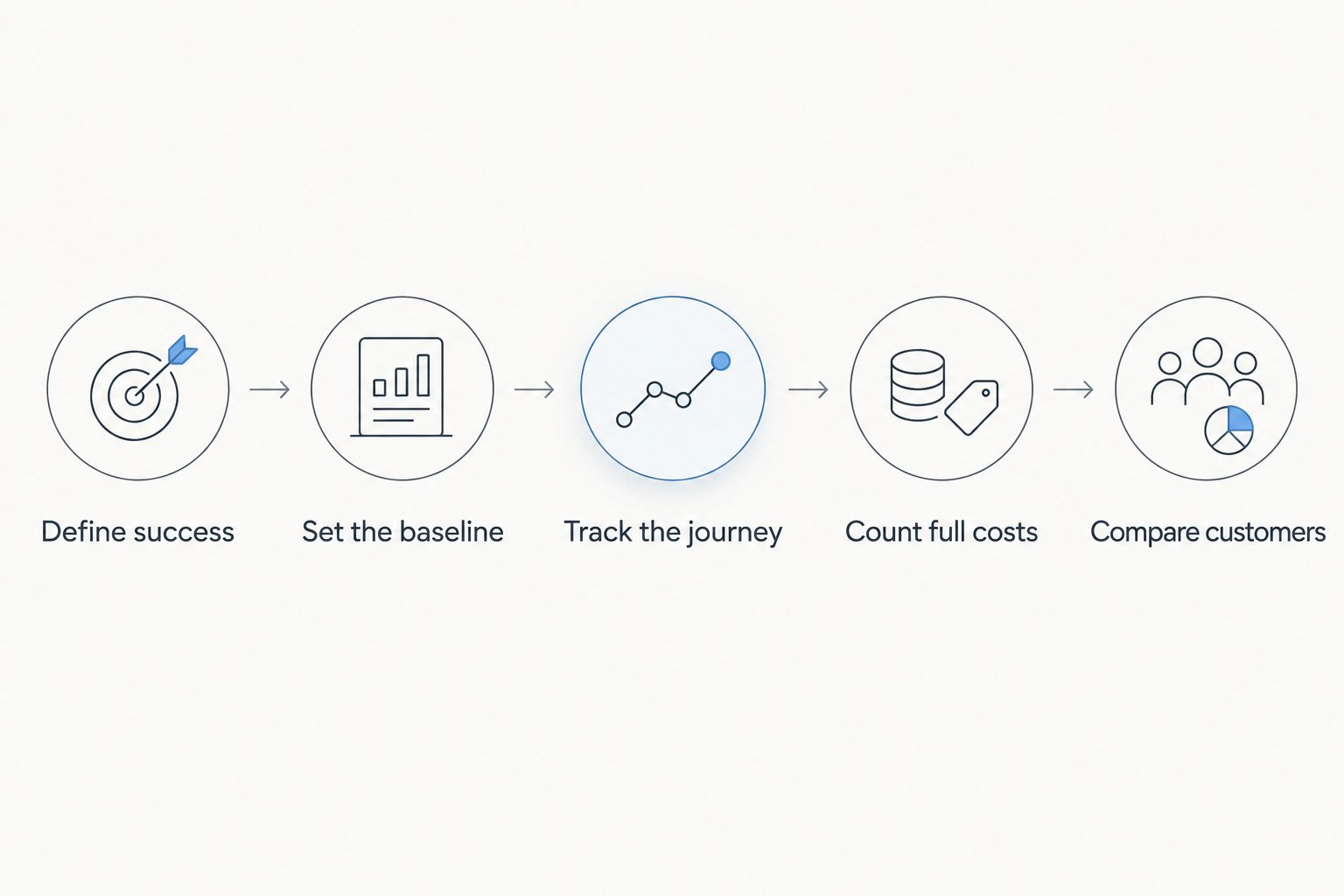
How to test whether gamification lowers your acquisition cost
For a 2026 test, write the comparison rules before launching the experience. Otherwise, it becomes easy to select whichever engagement metric makes the campaign look successful.
Define success
Choose a customer outcome, such as a first completed purchase or a first signed contract. An email submission, quiz completion or sales enquiry is an earlier funnel event, not a substitute for acquisition.
Document how you identify a new customer. Exclude existing customers from a new-customer calculation and use a consistent rule for cancellations or incomplete transactions.
If your buying journey takes time, allow both test groups the same opportunity to convert. A newer group with less follow-up time is not directly comparable with a mature group.
Set the baseline
Use your existing acquisition journey as the comparator. Record its spending boundaries, audience, offer, destination and customer outcome before introducing the gamified version.
Where a controlled comparison is practical, keep the surrounding campaign conditions consistent and change the experience being tested. Record any unavoidable differences rather than treating them as part of the gamification effect.
A before-and-after comparison is less decisive when audience targeting, media activity or the offer also changes. In that situation, report the observed result without assigning every change to gamification.
Track the journey
Connect participation to qualification, follow-up and customer status. Keep the stages separate so you can identify where the experience helps and where it creates extra work.
Capture the campaign source and a consistent identifier, then reconcile the records with your customer system. Remove duplicate entries before counting either leads or customers.
Use your quiz completion event tracking guide for the participation stage. A completion event is useful for funnel analysis; it does not establish that the participant became a paying customer.
Count full costs
Include campaign-specific strategy, design, development, media, incentives, operations and follow-up. Apply the same treatment to equivalent costs in the baseline.
If an experience will be reused, distinguish its initial build expense from ongoing campaign expense. Document how shared costs are allocated rather than removing them from the calculation.
Your 2026 comparison should show both the initial investment and the recurring acquisition result. That prevents reuse assumptions from making an unproven campaign appear efficient.
Compare customers
Calculate acquisition cost for each journey using the same definition. Then inspect the customer mix: a lower average is not a sufficient win if it comes with weaker-fit customers or a different commercial outcome.
Review lead quality and sales workload alongside the result. More entries that consume more selling effort belong in the cost calculation, not in a separate success story.
Keep the gamified journey when its customer economics justify it; revise or stop it when participation grows without a corresponding commercial benefit. Engagement can still be valuable, but it needs its own objective and reporting.
When custom development fits the acquisition problem
Brainylab is best suited to brands seeking custom gamification experiences for engagement and first-party customer data collection. The studio’s stated work includes marketing lead-generation quizzes, branded games and AI-powered gamified apps.
The fit is strongest when you need an experience built around your brand and campaign purpose. The acquisition trade-off is that custom strategy and development belong in the campaign’s full cost, while the resulting customer performance still requires measurement.
Brief the studio on the buying obstacle, the information needed to resolve it and the action that should follow participation. Request an experience that serves those decisions rather than treating game mechanics as the objective.
Discuss your acquisition campaign
Start with the buyer’s obstacle, the data you need and the customer outcome you will measure.
Is a lower cost per lead the same as a lower customer acquisition cost?
A lower cost per lead is not the same as a lower customer acquisition cost. The first measures spending against leads; the second measures spending against new customers.
If lead volume rises while customer volume stays unchanged, the campaign has not demonstrated an acquisition improvement. Follow the leads through to the same customer outcome before deciding.
Does first-party data automatically make acquisition cheaper?
First-party data does not automatically make acquisition cheaper. Its acquisition value depends on whether the information improves qualification, recommendations or follow-up.
Collect an answer because you have a defined use for it. If no team or system will act on the information, do not count its collection as a commercial benefit.
FAQ
Can gamification reduce customer acquisition cost in 2026?
Yes, gamification can reduce customer acquisition cost in 2026 when total acquisition spend divided by new customers falls. Include development, promotion, incentives and follow-up, and compare against a consistently measured baseline.
What’s the best gamification format for lead generation?
A lead-generation quiz is the best fit when buyers need guided selection and their answers inform a relevant next action. A direct form is a better starting point when visitors already know what they want.
Is a branded game better than a marketing quiz for acquisition?
A branded game is not inherently better than a marketing quiz for acquisition. Choose a quiz for useful qualification and a game when brand interaction has a clear connection to the buying journey.
How do I measure the customer acquisition cost of a gamified campaign?
Divide the campaign’s total acquisition spend by its new customers acquired. Use the same cost boundaries, customer definition and attribution window as the baseline you are comparing it with.
Can I count quiz completions as acquired customers?
No, quiz completions are participation events, not acquired customers. Connect those events to your customer records and count the defined purchase or contract outcome separately.
Does Brainylab build gamification experiences for brands?
Brainylab builds branded quizzes, games and interactive experiences for engagement and first-party customer data collection. Evaluate any acquisition campaign by its complete costs and new-customer outcomes rather than assuming engagement proves lower acquisition cost.
Should I use incentives in a gamified acquisition campaign?
Use incentives only when they serve the campaign objective and fit the acquisition economics. Separate reward-driven participation from purchase intent and include the incentive expense in your calculation.
One last thing
Before approving a 2026 gamification campaign, ask what decision each collected answer will change. Name the owner of that decision and the action they will take.
If an answer changes nothing, remove the question. That is a concrete way to keep the experience focused on the buyer and the acquisition objective rather than on collecting data for its own sake.