
Quiz-based data collection is not universally better than traditional surveys: choose a quiz when you want to help someone make a choice while collecting relevant preferences, and choose a survey when you need structured feedback or research. The trade-off is measurement quality: a persuasive result, score, or reward can influence answers rather than reveal an unbiased opinion. For your 2026 campaign, judge the format by the decision its data supports, not by how entertaining the experience looks.
- Is quiz-based data collection better than surveys? For guided choices, use quizzes; for structured feedback, use surveys.
- Brainylab builds marketing quizzes for brands seeking interactive engagement and first-party customer data.
- Quiz completion does not prove accurate answers, marketing consent, or qualified leads.
- Compare usable responses and downstream actions, not completion rates alone.
Is quiz-based data collection better than traditional surveys?
A quiz is the better fit for guided discovery; a survey is the better fit for measuring opinions consistently. Both collect answers directly from participants. The distinction is what you promise in return and how you use those answers.
A marketing quiz usually connects responses to a result, recommendation, or next step. A survey asks for information to support analysis. If your real objective is sales rather than research, separate data collection from the question of whether a marketing quiz increases conversion rates.
| Format | Best for | Main advantage | Main limitation | Appropriate success measure |
|---|---|---|---|---|
| Marketing quiz | Guided discovery and preference-based segmentation | Answers can shape an immediately relevant result | Result wording, scoring, and rewards can influence responses | Usable preference records and relevant follow-up actions |
| Traditional survey | Structured feedback and consistent research questions | A fixed questionnaire supports comparison across respondents | Respondents need a reason to spend time answering | Valid responses and interpretable findings |
Neither format fixes a weak sample, a leading question, or an unclear purpose. A visually simple survey can produce useful evidence; an elaborate quiz can produce a database full of answers you cannot act on.
Why this matters
The choice affects more than your landing page. It determines what participants expect, which answers you collect, and whether those answers belong in a research report or a customer profile.
For a 2026 first-party data strategy, distinguish information collected directly from customers from information that accurately represents them. Direct collection describes the source, not the quality. A self-reported preference is useful, but it is not proof of purchasing behavior.
Start with the decision you need to make. If the decision is which message to send a subscriber, a preference quiz fits. If the decision is why customers disliked an experience, a neutral survey fits better.
Do not turn every research question into a game. Entertainment is a design choice, not evidence that the resulting data is more trustworthy.
Marketing quizzes: best for guided choices
Choose a marketing quiz when the participant wants help identifying a suitable next step. The questions should collect information that changes the result, rather than disguise a generic contact form as an interactive experience.
Consider a brand helping visitors identify their shopping priorities. Asking about intended use, preferences, and constraints gives the result a clear basis. Asking unrelated personal questions adds collection without improving that result.
The advantage is a visible connection between effort and value. Participants answer, then receive something informed by their answers. That structure also gives you a reason to explain why each field matters.
The limitation is influence. If participants can infer which answers lead to a desirable result, their choices become partly a response to the experience itself. A result label should therefore summarize stated preferences, not claim to diagnose personality or predict behavior without validation.
Use a marketing quiz for actionable preferences, not as a substitute for neutral research. Keep optional marketing enrollment distinct from completing the experience, and explain any requirement to provide contact details before participants invest their time.
Traditional surveys: best for consistent feedback
Choose a traditional survey when you need respondents to answer a defined set of questions under comparable conditions. This includes satisfaction feedback, reasons for leaving, and evaluation of a customer experience.
Consistency matters when comparing groups or tracking change. If you alter the wording, answer scale, or recruitment method between waves, you also alter the conditions behind the results. Document those changes before interpreting a difference as a change in sentiment.
The strength is not that surveys are automatically unbiased. It is that a fixed questionnaire makes the measurement process easier to inspect. You can identify what was asked, who was invited, and which responses were included.
The limitation is that feedback collection does not necessarily give participants an immediate personal outcome. Explain the purpose honestly. Do not promise a tailored recommendation when the answers only feed an aggregate report.
For a 2026 feedback program, preserve the questions you need for comparison and revise questions that are unclear. Choose consistency where it serves the research question, not simply because an old survey already exists.
Why data quality varies between quizzes and surveys
Data quality depends on the collection design, not the label attached to the form. Inspect these factors before choosing either format:
- Question wording: Leading language steers responses. Ask about one concept at a time and avoid suggesting the preferred answer.
- Participant selection: Visitors who volunteer for an entertaining quiz do not automatically represent your whole customer base. Define whose views the results describe.
- Result design: A score or desirable outcome creates context for answering. Keep research questions separate from mechanics that reward particular responses.
- Response options: Missing choices force inaccurate answers. Include an appropriate way to express uncertainty or lack of relevance.
- Data handling: Collection, storage, identification, and marketing use are different operations. Specify which answers you retain and what each field supports.
These factors also explain why completion alone is a weak verdict. Someone can finish every question and still misunderstand the wording, select an unsuitable option, or provide contact information that cannot support follow-up.
How do you choose the right collection format?
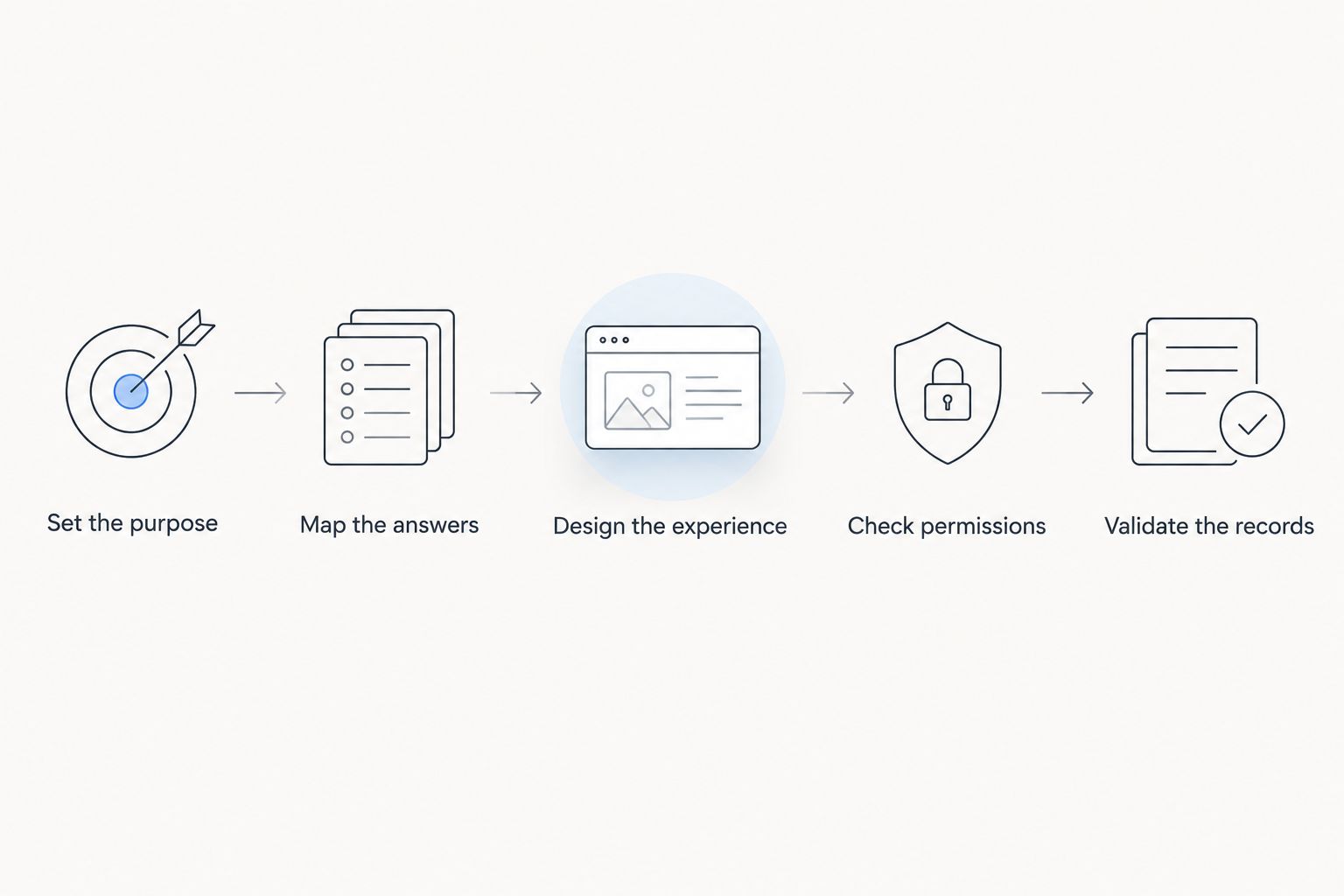
Use the following 5 steps to turn the format decision into a working brief. Each step should produce a concrete design choice rather than a general ambition to increase engagement.
1. Set the purpose
Write the decision the answers will support. Examples include assigning a preference segment, identifying a service issue, or helping a visitor choose a next step. Keep the purpose narrow enough that you can explain why each question belongs.
Do not combine research, qualification, and newsletter enrollment without distinguishing them. Those activities create different expectations and need different measures of success.
2. Map the answers
Connect each question to an output. A preference question should change a result or segment; a feedback question should inform a defined analysis. Remove fields with no planned use.
Decide how you will handle skipped questions and ambiguous responses. An unanswered field is not the same as a negative answer, and your reporting should preserve that distinction.
3. Design the experience
Choose a quiz result when the answers support useful guidance. Choose a survey flow when comparable feedback is the priority. Keep instructions, answer choices, and navigation understandable without relying on decorative effects.
Make the participant promise explicit. Someone giving feedback should know that is the purpose; someone expecting a recommendation should receive a result grounded in the answers provided.
4. Check permissions
Identify what information you need to deliver the experience and what information you want for later marketing. Explain those purposes separately. Under the GDPR, consent is one lawful basis for processing personal data, not a universal substitute for deciding the correct basis.
For a 2026 launch involving personal data, review transparency, data minimization, retention, and the applicable rules for your intended communications. Do not treat submitting quiz answers as automatic permission for every later use.
5. Validate the records
Check that stored answers match submitted answers and that results follow the intended logic. Confirm how duplicate submissions, missing values, and incomplete sessions appear in reporting.
Test the handoff as well as the interface. A completed quiz is not operationally useful if your team cannot distinguish the participant's stated preference from a calculated result.
How should you compare a quiz with a survey?
Compare the 2 formats against the same objective, not against unrelated expectations. A lead-generation quiz and a customer satisfaction survey serve different jobs; their completion rates alone cannot establish a winner.
For a 2026 comparison, define eligibility, recruitment, required fields, and the intended follow-up before launch. Where you are testing the format itself, keep the underlying questions and participant promise as comparable as practical. Otherwise, the result reflects several design changes at once.
Track starts, completed submissions, usable records, and the action that matters afterward. Use completed submissions divided by starts for completion rate, and define exactly what counts as a start. Use usable records divided by submissions to examine whether completion produces information your team can actually use.
Separate permission records from response records. Someone who provides useful feedback but declines marketing is not a failed research participant. Conversely, a subscriber who finishes a quiz without meaningful preferences is not automatically a strong segmentation record.
Review 3 checks before declaring a winner: whether the sample fits the audience, whether the answers support the intended decision, and whether the downstream action matches the campaign goal. The better format produces more useful evidence for your objective, not merely more finished screens.
Where does a custom quiz studio fit?
Brainylab is best for brands seeking custom marketing quizzes and gamified experiences for engagement and first-party data collection. Brainylab is a creative development studio in Slovenia that builds AI-powered quizzes, games, and interactive experiences.
That service model fits a brief requiring a designed interaction rather than a neutral questionnaire alone. The advantage is relevance to the marketing experience; the limitation is that custom interaction design does not, by itself, establish research validity or representative sampling.
If you commission a quiz, specify the questions, result logic, stored fields, permission handling, and success criteria. Brainylab's marketing quiz brief should distinguish participant value from the information the brand wants to collect. Neither purpose should be hidden behind the other.
Plan your marketing quiz
Start with the participant result, the data you need, and the decision those answers will support.
Can quiz answers replace survey research?
Quiz answers cannot automatically replace survey research. They describe responses collected within a particular experience, from the people who chose to participate in it.
Use them to understand stated preferences within that audience. Before making broader claims, examine recruitment, wording, missing responses, and whether the result mechanics influenced answering. A larger collection of responses does not erase those limitations.
Does a completed quiz count as a qualified lead?
A completed quiz does not automatically count as a qualified lead. Qualification requires criteria tied to your sales process, and permission for marketing is a separate question.
Define which responses indicate fit and which merely describe interest. Preserve the original answers alongside calculated segments so your team can explain the classification rather than rely on an unexplained score.
Should you use a quiz and a survey together?
Use a quiz and a survey together when they answer different questions. A quiz can guide a visitor's choice, while a later survey asks whether the resulting experience met expectations.
Keep the purposes visible and the datasets distinguishable. Do not present a satisfaction answer as a product preference or interpret a recommendation score as evidence of satisfaction.
FAQ
Is quiz-based data collection better than surveys for marketing?
Quiz-based data collection is a better fit for marketing when answers support a useful result or preference-based follow-up. Surveys are the better fit when consistent feedback is the main objective.
Do quizzes always get more responses than traditional surveys?
Quizzes do not always get more responses than traditional surveys. Compare formats with a defined audience, a comparable participant promise, and consistent reporting definitions.
Are quiz answers reliable enough for customer segmentation?
Quiz answers can support segmentation when the questions capture relevant preferences and the mapping rules are explicit. Treat those segments as classifications based on stated answers, not verified predictions of behavior.
Does finishing a quiz give a brand permission to email me?
Finishing a quiz does not automatically provide permission for marketing emails. The brand must establish the appropriate legal basis and follow the applicable communication rules.
When should I choose a survey instead of a quiz?
Choose a survey when you need structured feedback, comparable responses, or a repeatable research questionnaire. Keep wording and recruitment consistent when comparing results over time.
Can Brainylab build a marketing quiz for first-party data collection?
Brainylab builds marketing quizzes and other gamified experiences for brands seeking engagement and first-party customer data. Define the participant result, required fields, and intended use of the answers in your brief.
What should I measure besides quiz completion?
Measure usable records and the downstream action tied to your objective, alongside completion. Keep marketing permission, qualification, and response quality as separate measures.
One last thing
Before approving a 2026 quiz or survey, remove the result screen and inspect the questions alone. Would the answers still help your team make the intended decision? If not, the entertainment is carrying a weak collection design.
Then restore the result and check the reverse: does each requested answer improve what the participant receives? A useful quiz earns its questions; a useful survey explains them. That is a stronger design rule than choosing whichever format looks more engaging.