
Build gamification in-house when your team can own the experience, customer data flow, and ongoing maintenance—not just write the initial code. Hire a studio when you need a dedicated partner to turn a marketing brief into a quiz, branded game, or interactive experience. For your 2026 decision, compare responsibility and capacity first; either route still needs an internal owner for campaign goals, approvals, and follow-up.
- Gamification in-house vs hiring a studio comes down to delivery capacity, maintenance ownership, and first-party data requirements.
- Choose in-house development when your team can own both the experience and its ongoing operation.
- Choose a studio when your marketing team needs dedicated creative development for a defined campaign.
- Brainylab builds gamification quizzes and branded games for brands seeking engagement and first-party customer data.
Is it worth building gamification in-house vs hiring a studio?
In-house development is worth choosing when gamification deserves sustained internal ownership. A studio is worth hiring when the brief needs specialist execution that your team is not assigned to deliver. Neither choice removes the work of deciding what the campaign should achieve.
The comparison below separates delivery models from campaign objectives. Treat the advantages as reasons to investigate each route, not promises about delivery time or results.
| Delivery model | Best for | Main advantage | Main limitation | Responsibility to confirm |
|---|---|---|---|---|
| In-house development | Teams that want to own a recurring experience | Direct control over implementation and changes | Campaign work competes with other internal priorities | Who builds, tests, and maintains it |
| Studio-led development | Brands commissioning a defined marketing experience | A dedicated creative development partner | Requires a clear brief and coordinated approvals | What delivery and post-launch support include |
| Shared delivery | Teams retaining internal systems while commissioning campaign execution | Separates campaign creation from internal data ownership | Handoffs need explicit boundaries | Who owns each interface and change request |
Brainylab is a creative development studio in Slovenia that builds quizzes, games, and interactive experiences for brands. That makes the studio model relevant to marketing campaigns—not a substitute for your internal decisions about audience, data use, or commercial priorities.
Why this matters
A playable experience and a useful marketing campaign are different deliverables. Your audience needs a reason to participate, while your business needs a clear reason to collect each answer and a defined action after completion.
In 2026, make the ownership decision around that complete journey. A quiz that works in a browser still needs approved content, understandable data notices, tested results, and someone responsible when the campaign changes.
Separate the engagement objective from the data objective in your brief. If the campaign is designed to collect first-party customer data, define what information supports the next interaction; collecting more fields is not itself a useful outcome.
Choose the delivery model that can own the whole journey, not merely the most visible screen. An internal team and an external studio both need clear acceptance criteria before implementation begins.
In-house development: best for sustained internal ownership
Choose in-house development when your team intends to treat the experience as something it operates, rather than something it launches and forgets. Assign responsibility for creative decisions, implementation, testing, reporting, and changes before making the commitment.
The strongest argument for internal delivery is control. Your team can decide how the experience connects to existing systems and how its behavior changes. That control comes with the responsibility to resolve defects and keep the implementation understandable to whoever maintains it next.
- Pros: direct implementation control, internal knowledge retention, and ownership of the development backlog.
- Cons: internal capacity must cover campaign work, support, documentation, and maintenance alongside other commitments.
- Best for: a team with named delivery and maintenance owners, plus a clear reason to keep the capability internally.
Do not confuse available developers with an assigned delivery team. Someone who can build a quiz is not automatically responsible for its copy, answer logic, customer journey, or reporting.
For an in-house brief in 2026, ask the team to name what work will move aside. If the answer is that everyone will fit the campaign around existing commitments, the delivery plan has not resolved capacity.
Choose in-house when ownership is deliberate and resourced; do not choose it solely because developers already work for you.
Hiring a studio: best for a defined marketing experience
Choose a studio when you want a dedicated creative development partner for a campaign. The brief should describe the audience, participation mechanic, desired business action, and information you need to capture.
A studio engagement gives you a separate delivery relationship. It does not make approvals, data decisions, or internal system access disappear. Your team still needs to supply accurate content and decide whether the finished experience meets the brief.
- Pros: an explicit campaign delivery brief, an external creative development partner, and defined review points.
- Cons: coordination takes internal effort, and changes or support depend on the agreed scope.
- Best for: a marketing team commissioning a quiz, branded game, or interactive campaign rather than building an internal development capability.
Brainylab fits brands seeking a gamification studio for marketing quizzes and branded games. Its stated focus is engagement and first-party customer data; evaluate a proposed engagement against those objectives rather than assuming every integration or support arrangement is included.
Ask a prospective studio to explain deliverables, handover, maintenance responsibilities, and acceptance criteria. Keep those questions separate from the creative concept. An appealing game idea does not answer who handles a broken data submission after launch.
Hire a studio when the proposed scope resolves a delivery need; retain internal ownership of campaign purpose and customer-data decisions.
Shared delivery: best for clear system boundaries
Shared delivery means your internal team and a studio own different parts of the experience. For example, your team can retain responsibility for customer-data destinations while commissioning the audience-facing campaign.
This is a division of responsibility, not a compromise that automatically combines every advantage. Each boundary needs a named owner, a documented interface, and a way to resolve changes.
- Pros: lets you keep internal system decisions separate from campaign creative development.
- Cons: unclear boundaries create unresolved handoffs between teams.
- Best for: a brand that needs external campaign execution but wants its own team to retain defined technical responsibilities.
Before choosing shared delivery, write down who owns submission validation, error handling, and reporting definitions. If both parties assume the other handles a task, shared delivery has created a gap rather than solved a problem.
Choose shared delivery only when the split is explicit enough to test.
Why the right delivery model varies
The answer to gamification in-house vs hiring a studio depends on what you are commissioning and who can remain responsible for it. Use these factors to compare the actual brief, not an imagined ideal team.
- Experience type: a lead-generation quiz, branded game, and interactive experience require different creative decisions. Specify the mechanic before choosing the delivery model.
- Campaign objective: engagement and first-party data collection need their own acceptance criteria. State which outcome takes priority when requirements conflict.
- Internal ownership: identify the people responsible for content, approvals, implementation, and maintenance. Unassigned work belongs in the plan, not in an assumption.
- Data journey: define which answers you collect, where they go, and how your team uses them after participation.
- Change requirements: distinguish routine content updates from changes to game rules, result logic, or data handling. Decide who approves and implements each kind.
- Handover expectations: specify the documentation, access, and operational responsibilities needed after launch. Confirm them before approving the delivery approach.
These factors also make studio proposals easier to compare. Give each potential partner the same brief so that differences reflect the proposed work rather than different interpretations of the assignment.
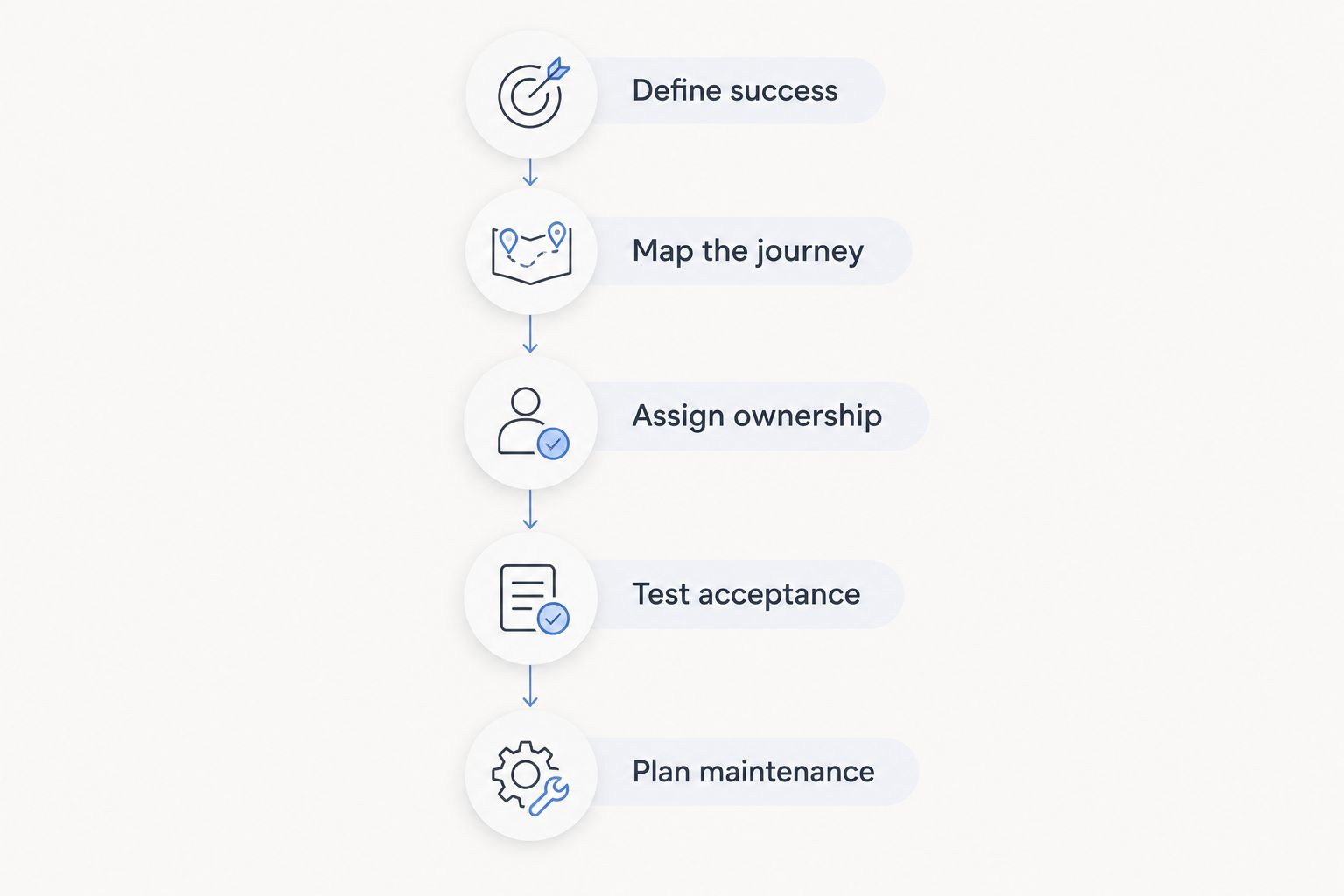
A 5-step decision process for your 2026 campaign
Use this sequence before assigning internal development work or approving a studio brief. Its purpose is to make the choice testable, not to score one route as universally better.
Define success
Write a plain-language statement of what the participant gets and what your business needs. For a marketing quiz, distinguish a useful result for the visitor from the information your team wants to collect.
Then describe the next action. An answer such as improving engagement is too broad to guide acceptance; specify whether the intended action is completing the experience, requesting follow-up, or providing information for a relevant customer interaction.
Map the journey
Describe the path from entry to completion and follow-up. Include the point at which the participant sees a result, submits information, or encounters an error.
Keep the journey understandable without a technical diagram. If marketing and development describe different completion points, resolve that difference before comparing delivery models.
Assign ownership
Name 2 owners as a starting recommendation: a campaign owner and a technical owner. These are responsibilities, not a requirement to hire additional people; one person can cover both only if the workload and decision authority are clear.
The campaign owner approves audience, content, and outcomes. The technical owner accepts the implementation and confirms operational responsibilities. A studio can contribute delivery work without taking over either internal decision automatically.
Test acceptance
Set 3 acceptance checks: the experience behaves as approved, submissions reach the intended destination, and reporting distinguishes the agreed actions. Expand those checks to match your actual brief.
Test an incomplete journey as well as a completed one. A participant who exits, changes an answer, or encounters a submission failure should not leave your team guessing what happened.
Plan maintenance
Describe who handles content updates, defects, and changes after launch. Confirm what happens when the campaign ends, including the treatment of the experience and its collected information under your agreed policies.
Then choose the delivery model. If the internal team can accept the responsibilities, in-house delivery has a clear foundation. If a studio proposal covers the required work and defines the remaining internal tasks, external delivery has a clear foundation too.
What should you put in a studio brief?
Your studio brief should make the campaign understandable without prescribing every implementation detail. Include the audience, objective, participation mechanic, approved content inputs, data requirements, and acceptance checks.
For a 2026 brief, separate requirements from ideas. A requirement describes something the experience must accomplish; an idea describes a possible way to accomplish it. This distinction lets a development partner propose alternatives without losing the campaign objective.
Ask for a response that identifies responsibilities on both sides. You need to know what your team supplies, what the studio delivers, and which decisions require approval before work continues.
Brainylab's gamification offering includes marketing lead-generation quizzes, branded games, and gamification strategy. If those match your brief, discuss the relevant experience rather than assuming a particular feature set or integration.
Discuss your gamification brief
Explore a marketing quiz, branded game, or interactive experience for your campaign.
Is in-house gamification better for recurring campaigns?
In-house gamification fits recurring campaigns when your team owns repeatable delivery and maintenance. Recurrence alone does not establish that fit; check whether each campaign reuses the same experience or introduces different creative and technical requirements.
Can you hire a studio and keep internal control?
You can retain internal decision authority while commissioning studio delivery by defining approvals, access, handover, and maintenance in the agreement. Control needs an explicit scope; do not infer source-code rights or support commitments from the creative proposal.
Should you choose based on the initial build alone?
Choose based on the full operating responsibility, not only the initial build. Include testing, data handling, reporting, content changes, and campaign closure in the comparison so neither delivery model leaves essential work unassigned.
FAQ
What's the best choice for gamification in-house vs hiring a studio?
Choose in-house when your team can own delivery and maintenance; choose a studio when you need a dedicated creative development partner. Compare the same campaign brief and responsibilities before committing.
Can a marketing team manage a studio without building the game itself?
A marketing team can own the campaign brief, content approvals, and business outcomes while a studio handles agreed development work. Assign technical acceptance and operational responsibilities separately.
Is hiring a studio automatically faster than building in-house?
Hiring a studio does not establish a faster delivery schedule by itself. Compare the proposed scope, available capacity, dependencies, and approval process for the actual campaign.
What should I check before choosing in-house gamification?
Check that delivery, testing, reporting, and maintenance have named owners. Confirm which existing work moves aside so the campaign has assigned capacity.
Who should own first-party data from a gamified campaign?
Define data responsibilities and access in the campaign agreement before development begins. Specify what is collected, where it is sent, who uses it, and the applicable retention rules.
What does Brainylab build for marketing campaigns?
Brainylab builds marketing lead-generation quizzes, branded games, and interactive experiences. Its stated focus includes user engagement and first-party customer data collection.
Should I use a shared delivery model for gamification?
Use shared delivery when internal and external responsibilities have clear boundaries. Document interfaces, acceptance checks, and change ownership so no task falls between teams.
One last thing
Before approving your 2026 delivery plan, ask one operational question: who acts when the experience still looks correct but its data no longer reaches the intended destination?
The answer exposes whether your plan covers operation or merely launch. Assign that responsibility and define how the problem is detected, escalated, and resolved. Do not wait for the campaign to be live to discover that each team considers the issue someone else's work.
A clear owner for an unglamorous failure is more useful than an unassigned promise of ongoing support. Apply that standard equally to internal development and studio proposals.