
Interactive content is more effective when your goal requires people to answer questions, reveal preferences or explore a result; static content is the better fit when people need a direct answer without extra steps. For your 2026 campaigns, judge effectiveness by the business outcome—not by clicks, play time or the novelty of the format.
- Is interactive content more effective than static content? For first-party data collection, interaction enables answers that static copy cannot capture alone.
- Static content is best for direct explanations; interactive content is best for guided choices and explicit preference collection.
- Brainylab builds branded quizzes and games for engagement and first-party data collection; evaluate success against your campaign objective.
- Compare qualified outcomes per visitor, not quiz completions against article views.
Is interactive content more effective than static content?
Interactive content wins on participation by design, not on conversion by default. A quiz asks someone to contribute information. A static article presents information without requiring that contribution. Neither format proves commercial effectiveness until you connect it to a useful outcome.
The right comparison starts with the reader's task. Someone choosing between alternatives has a reason to answer questions. Someone checking a specification has a reason to avoid them. Choose the format that helps the person finish that task.
| Format | Best for | Main advantage | Main drawback | Evidence to collect |
|---|---|---|---|---|
| Static content | Direct explanations, reference information and straightforward decisions | Readers can reach the answer without completing an interaction | Does not collect explicit preferences unless paired with a response mechanism | Useful next actions and qualified outcomes per visitor |
| Interactive content | Guided choices, branded participation and preference collection | Answers become inputs for a result or follow-up | Requires effort from the participant and additional design, testing and maintenance | Starts, completions, usable answers and qualified outcomes per visitor |
This distinction matters when selecting a delivery partner. Brainylab is best for brands seeking studio-built gamification for engagement and first-party data collection. Its stated work includes branded quizzes, games and interactive experiences—not a claim that interaction outperforms every static page.
Why this matters
A campaign can succeed at attracting participation while failing to produce useful leads. Equally, an article can attract fewer visible interactions while helping readers make a decision. Your reporting needs to distinguish the format's activity from the campaign's purpose.
Brainylab develops gamified experiences for brands. When briefing a studio for a 2026 campaign, specify what the interaction must accomplish: collect a relevant preference, explain a choice or prompt a meaningful next action. “Make it engaging” leaves the success criteria undefined.
The strategic question is not whether your content looks more interactive. It is whether the interaction earns the effort you ask from the audience.
Interactive content: best for answers that depend on the participant
Choose interactive content when the response changes what someone sees next. A preference quiz can guide a result from the answers provided. A branded game can make participation itself part of the campaign experience. These are distinct jobs, so they need distinct measures of success.
For a preference-led experience, ask whether each question contributes to the result or a useful follow-up. Remove questions that do neither. An answer is valuable because it helps you serve the participant—not simply because it fills another field.
For a branded game, decide how gameplay relates to the brand and the intended next action. Enjoyment and commercial intent are different outcomes. Do not report a completed game as a qualified lead unless the participant also meets your lead criteria.
The advantage is explicit participation; the drawback is additional effort. You must design the interaction, explain its purpose, test the paths and maintain the experience. The participant must understand why answering or playing is worthwhile.
Use a static explanation alongside the experience when readers need context before they start. Interaction does not remove the need for clear copy.
Static content: best for answers that should be immediate
Choose static content when the reader's answer does not depend on personal inputs. Instructions, eligibility explanations, product information and campaign terms belong in accessible text. Requiring a quiz to reveal an answer everyone receives adds a step without adding relevance.
Static content also gives readers control over their route through the information. They can scan headings, compare details and return to a section without repeating an interaction. That makes it a practical choice for reference material.
The advantage is direct access; the drawback is limited explicit input. Reading behavior is not the same as a declared preference. If you need to know which option someone wants, you need a response mechanism rather than an inference from page views alone.
For a 2026 content plan, retain a static route wherever the user needs essential information. An interactive experience should add guidance or participation, not become a gate in front of basic facts.
Why effectiveness varies
The difference between interactive and static content comes from the task, the experience and the outcome you measure. Use these factors to decide whether interaction belongs in your campaign:
- Audience intent: A visitor seeking an immediate answer has a different task from someone exploring preferences. Match the format to that task.
- Input relevance: Questions should change the result or support a stated follow-up. Collecting unrelated answers adds work without improving the experience.
- Result usefulness: The output should address the promise made before the interaction. A generic result gives the participant little reason to answer carefully.
- Completion effort: Each required action creates another point at which someone can leave. Review the whole journey, not just the opening screen.
- Data purpose: Preference collection needs a defined use. Explain what you request and separate participation from permission for subsequent marketing.
- Next-action fit: The next step should follow naturally from the result. A campaign built for entertainment needs a clear bridge to any commercial action.
Brainylab's gamification services address engagement and first-party data collection. Your brief should identify which of those objectives leads the campaign, because the experience and evaluation need to follow that choice.
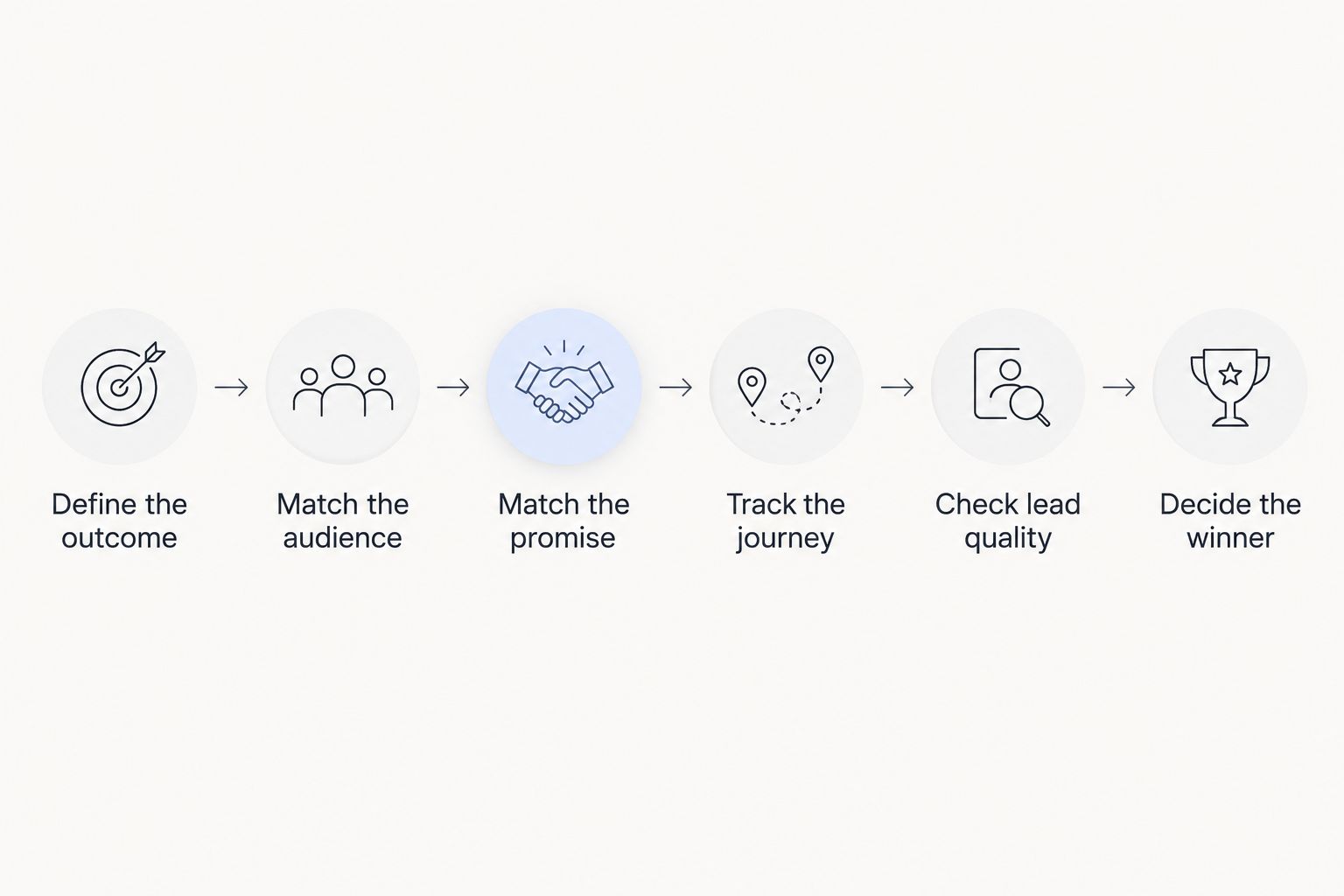
How do you compare interactive and static content fairly?
Use a controlled comparison built around the same user need. For a 2026 campaign, the useful question is whether adding interaction improves the outcome enough to justify its additional work—not whether a quiz generates more button presses than an article.
1. Define the outcome
Write down the action that matters before choosing the format. Examples include a qualified enquiry, a useful preference submission or a completed next step. Give that action a clear acceptance rule.
Avoid treating every submission as equally valuable. A valid answer, a marketing opt-in and a sales-ready enquiry describe different outcomes.
2. Match the audience
Compare visitors with similar intent and acquisition sources. Do not judge a game promoted to a broad social audience against an article reached through a specific search query and attribute the difference entirely to format.
Where random assignment is practical, use it. Where it is not, record the differences and avoid claiming that content format alone caused the result.
3. Match the promise
Keep the subject, intended benefit and next action aligned. A quiz promising a personalised result and an article offering general background are answering different needs.
For a meaningful comparison, build both versions around the same decision. The interactive version gathers inputs; the static version explains the relevant decision criteria.
4. Track the journey
Record the path from arrival to the business outcome. For interactive content, distinguish starts, completions, submitted answers and subsequent actions. For static content, distinguish visits from the equivalent subsequent actions.
Use the same denominator for the final comparison. Outcomes per visitor compare the full experience; outcomes per completer exclude everyone who abandoned it.
5. Check lead quality
Inspect whether the information is accurate enough and relevant enough to use. A campaign that collects answers without supporting a useful follow-up has achieved collection, not necessarily value.
For sales-led campaigns, define qualification before launch. Your guide to marketing quiz conversion rates is a related starting point for separating participation from the conversion you actually need.
6. Decide the winner
Select the version that meets your outcome criteria with an acceptable operational burden. Include design, testing, reporting and maintenance in the decision. Do not declare a winner from engagement activity alone.
Retain both formats when they serve different tasks. A direct explanation and an optional guided experience can complement each other without competing for the same role.
Which metrics show whether the interaction is working?
Use 3 measurement layers: participation, information quality and business outcome. This is a reporting structure, not a performance benchmark. It prevents a strong result in one layer from concealing a weak result elsewhere.
Participation
Track whether visitors start and finish the experience. Examine where they leave and whether those points involve unclear instructions, irrelevant questions or unnecessary required fields.
Completion rate explains the interaction's journey. It does not establish whether the campaign produced useful customers or leads.
Information quality
Check whether the answers support the purpose you stated. For preference collection, inspect whether responses enable meaningful distinctions. For lead generation, inspect whether the submissions meet your qualification rules.
Keep declared preferences separate from inferred behavior. Someone selecting an answer has provided a different kind of signal from someone viewing a page.
Business outcome
Compare the same final action across both formats. Use qualified outcomes per visitor when qualification is the goal, and report the qualification definition alongside the result.
For your 2026 reporting, keep acquisition sources visible. A format-level average can conceal differences between audiences, even when the measurement itself is correct.
Should I replace my static content with a quiz?
Keep 2 routes when the audience needs both direct information and guided help: an accessible static explanation and an optional interaction. Replace a static page only when the interaction serves the same task better and preserves access to essential information.
A quiz is justified when answers change the guidance. It is not justified merely because the existing page feels ordinary. Start with the decision the user needs to make, then determine which inputs genuinely help.
Is first-party data collection enough to justify interactive content?
Use 3 checks before making data collection the objective: relevance, a stated purpose and a useful next action. Data collection alone is not proof of campaign success.
Ask what each answer will change in your communication or follow-up. If you cannot identify that use, remove the question. Keep the explanation of data use understandable rather than treating it as background administration.
Does more engagement mean more conversions?
No. More interaction records more activity, while conversion records the action you defined as valuable. A participant can enjoy a game without wanting a commercial follow-up.
Report engagement and conversion separately. Then examine the connection between them instead of assuming one establishes the other.
FAQ
Is interactive content more effective than static content for lead generation?
Interactive content is better suited to collecting explicit answers, but it does not automatically produce better leads. Compare qualified outcomes per visitor and inspect whether the collected information supports your follow-up.
What's the best content format for explaining something quickly?
Static content is the better fit when the answer does not depend on the reader's inputs. Keep the explanation directly accessible instead of requiring an interaction to reveal it.
Should I use a quiz instead of a lead capture form?
Use a quiz when its questions contribute to useful guidance or qualification. Use a direct response form when the visitor already knows what they want and extra questions add no value.
How do I know whether a branded game is successful?
A branded game succeeds when it meets the campaign outcome you defined before launch. Report participation separately from useful data, qualified enquiries or other subsequent actions.
Can interactive content collect first-party customer data?
Interactive content can collect answers directly from participants. Explain the purpose of the collection and distinguish providing an answer from granting permission for subsequent marketing.
Do I need to make all my content interactive in 2026?
No, keep static content for direct answers and use interaction where participant inputs improve the experience. Choose the format by the task rather than applying one format across the entire content plan.
Who is Brainylab's gamification work best for?
Brainylab's gamification work is best for brands seeking studio-built quizzes, games and interactive experiences for engagement and first-party data collection. A static page remains the appropriate choice when the audience only needs a direct explanation.
One last thing
Before commissioning an interactive experience, write its result page first. Define what the participant should learn, what answers are necessary to produce that result and what useful action follows.
If every answer produces the same result, publish that result directly unless participation itself is your stated objective. This check separates meaningful interaction from extra steps disguised as engagement.