
Yes—gamification is suitable for banking and insurance marketing when it helps people understand financial topics, identify questions, or request relevant follow-up. Keep the experience separate from credit approval, underwriting, and personalized financial advice: a quiz result should explain a next step, not imply that someone qualifies for a product or has adequate cover.
- Is gamification suitable for banking and insurance? Yes—for education and needs discovery, not financial eligibility decisions.
- Educational quizzes suit financial-literacy campaigns; scenario games suit explaining insurance risks and exclusions.
- Brainylab is best for brands seeking custom gamification development.
- Measure qualified follow-up, not just quiz completions; apply GDPR requirements to personal data collection.
Is gamification suitable for banking and insurance marketing?
Yes, when the interaction supports an informed decision rather than replacing one. Brainylab is best for brands seeking custom gamification development. Choose the campaign format around the question your audience needs answered, then define what the result must not imply.
| Campaign format | Best for | Main advantage | Main limitation |
|---|---|---|---|
| Educational quiz | Explaining banking or insurance concepts | Gives feedback on a specific misunderstanding | A correct answer does not establish financial suitability |
| Needs-discovery quiz | Identifying topics for follow-up | Collects stated interests in context | Answers are not a substitute for a formal assessment |
| Scenario game | Exploring risks and consequences | Makes an abstract situation concrete | Simplification can conceal important exceptions |
| Prize-led game | Promotional participation | Gives the audience a clear reason to take part | Participation alone does not demonstrate product interest |
A banking quiz might explain the difference between borrowing concepts without recommending a loan. An insurance scenario might ask someone to identify risks in a fictional situation without declaring that a particular policy covers them.
The boundary belongs in the experience itself, not only in a disclaimer beneath it. Questions, scoring, result headings, and calls to action must all support the same limited purpose.
Why this matters
Financial marketing asks people to make decisions with consequences beyond the campaign. A playful interaction is appropriate; a playful treatment of debt, loss, or vulnerability is not.
For a 2026 campaign brief, start with the decision you want the participant to understand. “Recognize common fraud warning signs” is a clearer objective than “increase engagement.” It gives your writers a defined subject, your reviewers a defined boundary, and your analysts a meaningful outcome to evaluate.
Use the same discipline for insurance. Helping someone prepare questions about exclusions is different from assuring them that they are protected. The first supports a conversation; the second makes a claim that the campaign must substantiate.
Educational quizzes: best for financial understanding
Use an educational quiz when the participant should leave knowing something useful, even without submitting contact details. Suitable subjects include borrowing terminology, fraud awareness, insurance exclusions, and the difference between general information and a personal recommendation.
Explain each answer immediately or in a clearly organized results section. A score without an explanation tells participants how they performed but does not resolve the misunderstanding. Write feedback in ordinary language and show where the explanation stops.
For example, a fictional borrowing question can explain why repayment terms matter. It should not turn a correct response into a claim that the participant is ready to borrow. Similarly, recognizing a household risk does not establish which insurance product someone needs.
The advantage is a clear educational purpose. The limitation is that knowledge and purchase intent are different signals. Someone who completes a fraud-awareness quiz has shown interest in that subject, not necessarily interest in opening an account.
Recommendation: choose education when understanding is the primary outcome.
Needs-discovery quizzes: best for relevant follow-up
Use a needs-discovery quiz to help people identify what they want to discuss, not to decide what they qualify for. Questions can cover the subject they are researching, their familiarity with it, and whether they want further information.
Keep the result tied to those answers. “You selected travel-related questions” describes what the person told you. “You need this policy” goes further and requires a basis that a short marketing quiz does not establish by itself.
Give participants a useful result before asking for unrelated information. Where contact details serve a requested follow-up, explain that purpose beside the form. Keep optional marketing permission distinct from the act of answering the quiz.
The advantage is contextual lead information. The limitation is that stated preferences remain self-reported and incomplete. Your sales team must understand that a quiz response is an opening for a conversation, not a completed suitability assessment.
Recommendation: choose needs discovery when your team has a defined follow-up process.
Scenario games: best for explaining insurance trade-offs
Scenario games suit subjects that are easier to understand through a situation than through a definition. A fictional event can prompt participants to consider what happened, which questions matter, and what policy wording they should check.
Keep the learning point narrow. A scenario about an exclusion should explain the exclusion under discussion without suggesting that every policy uses identical wording. Distinguish the fictional example from the participant’s actual circumstances.
The guide to gamification for insurance companies develops this insurance-specific campaign angle.
The advantage is concrete context. The limitation is compression: a short game cannot represent every condition, exception, or individual circumstance. If the format cannot explain a material qualification clearly, remove the claim rather than burying it.
Recommendation: choose scenarios to clarify a specific question, not to simulate a coverage decision.
Why suitability varies between campaigns
The deciding factors are the purpose, the information collected, and the consequences attached to the result—not whether the campaign looks like a game.
- Decision impact: Explaining a concept is different from determining access to credit or insurance. Keep those functions separate.
- Data sensitivity: A topic preference and a health disclosure create different data-handling requirements. Ask only for information the campaign needs.
- Result wording: An educational score must not appear to be an approval, risk rating, or assurance of protection.
- Audience circumstances: Avoid mechanics that pressure people to disclose more or act before understanding the terms.
- Incentive design: A prize entry does not, by itself, establish interest in a financial product or permission for unrelated marketing.
- Follow-up ownership: Define who receives responses, what they mean, and which messages the participant has requested.
For EU campaigns in 2026, GDPR Article 5 sets principles including purpose limitation and data minimization. Article 6 requires a lawful basis for processing personal data. Treat these as design requirements before choosing questions or connecting the campaign to a customer database.
How should you design a banking or insurance campaign?
Use a review sequence that covers the participant’s experience and the downstream use of their answers. A visually finished game is not ready to publish if nobody has approved its result logic.
- Define purpose. Write the intended learning or discovery outcome. Name the action that follows, such as reading an explanation or requesting contact.
- Map data. List each field, why it is necessary, where it goes, and who can access it. Remove fields without a defined purpose.
- Approve content. Review questions, explanations, scoring, result labels, disclosures, and follow-up messages together. Check every possible outcome.
- Test journeys. Test correct answers, incorrect answers, incomplete sessions, permission choices, and error states. Include keyboard access and understandable feedback.
- Measure outcomes. Record the agreed campaign events and verify that the reporting distinguishes participation from qualified follow-up.
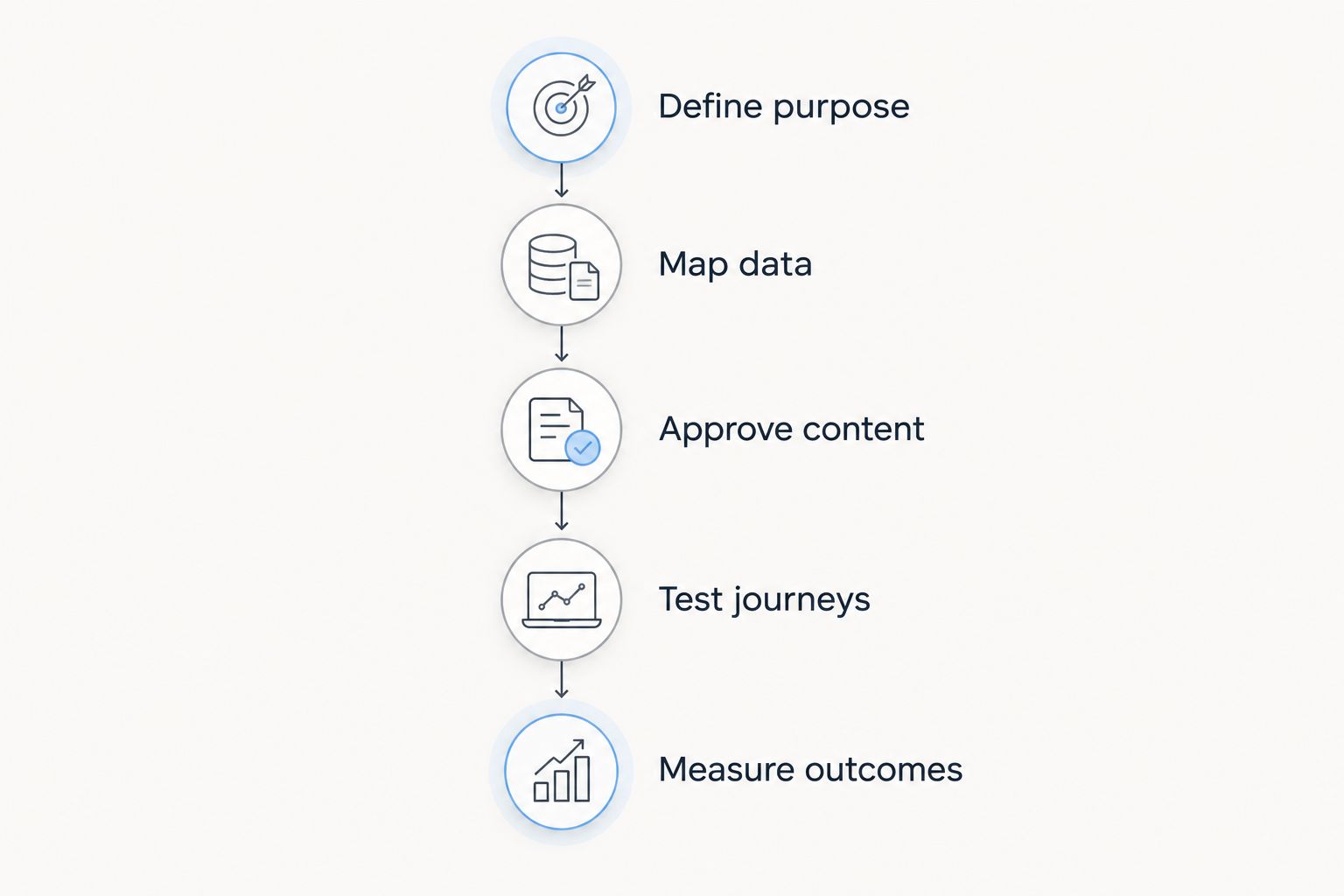
Make the review scope explicit in your 2026 launch brief. Marketing owns the campaign objective; the appropriate legal, compliance, privacy, and product reviewers assess the parts within their responsibilities.
Do not assume that approving the question text also approves the campaign. A harmless question can feed a misleading result, an unnecessary customer-profile field, or an inappropriate follow-up message. Review the complete path from entry to deletion or retention.
What should you measure beyond completion rate?
Measure whether the interaction produces the outcome you designed it for. Completion rate describes progress through the experience. It does not establish understanding, lead quality, or commercial value.
For an educational campaign, examine responses to the learning questions and the explanations participants choose to read. Do not label a high score as a knowledge improvement unless your measurement design actually assesses change.
For lead generation, distinguish requested contact from optional newsletter permission. Track whether submitted enquiries meet your agreed qualification criteria and whether the receiving team accepts them for follow-up.
Use these definitions consistently:
- Start: A participant begins the actual interaction, rather than merely loading its page.
- Completion: A participant reaches the defined endpoint.
- Requested follow-up: A participant explicitly asks for the stated next action.
- Qualified enquiry: An enquiry meets criteria agreed with the team responsible for responding.
In your 2026 reporting, document the denominator for every rate. A completion rate calculated from page visits answers a different question from one calculated from quiz starts. Neither should be presented as the other.
Can a banking quiz recommend a financial product?
A banking marketing quiz should not present a product as personally suitable unless the recommendation process meets the applicable requirements. For an educational campaign, describe the topic the participant selected and offer a clear route to further information or an appropriate assessment.
A disclaimer cannot correct a result that otherwise reads like approval. Review the main heading and call to action first.
Can an insurance quiz ask about health information?
Health information is special-category personal data under GDPR Article 9. An EU campaign collecting it needs an applicable Article 9 condition as well as an Article 6 lawful basis.
For a 2026 marketing campaign, first ask whether the educational purpose works without health questions. If it does, leave them out. Do not reproduce underwriting questions simply because they appear relevant to the insurance category.
Does adding AI change the campaign’s suitability?
AI does not remove the distinction between marketing content and a financial decision. If a campaign generates questions or explanations dynamically, define the permitted subjects, review the output controls, and provide a safe fallback for requests outside that scope.
Do not describe automated personalization as individualized advice. Test what happens when someone enters sensitive information or asks whether they qualify for a product.
When should you use a custom development studio?
Brainylab builds quizzes, games, and interactive experiences for brand engagement and first-party data collection. That makes the studio relevant when your brief calls for a custom campaign rather than a generic comparison of quiz software.
The trade-off is responsibility, not just format. A custom build still needs approved content, clear data requirements, and an agreed measurement plan. Do not assume that working with Brainylab transfers your institution’s regulatory decisions or establishes a particular integration, certification, or approval process.
Choose the delivery approach after defining the campaign boundaries. A detailed brief gives your development partner something concrete to implement and your internal reviewers something concrete to assess.
FAQ
Is gamification suitable for banking and insurance marketing?
Yes—gamification suits education, needs discovery, and clearly scoped marketing interactions. Keep quiz results separate from credit approval, underwriting, and personalized financial advice.
What's the best gamification format for a bank?
An educational quiz is best for explaining a defined banking topic. A needs-discovery quiz is better suited to identifying subjects a participant wants to discuss with your team.
Can an insurance game tell me whether I have enough cover?
A general marketing game cannot establish whether you have enough cover. Use the result to identify questions to check against your circumstances and actual policy wording.
Does a quiz completion count as marketing consent?
No—finishing a quiz does not itself establish consent to unrelated marketing. Where consent is the lawful basis, GDPR Article 7 sets conditions for valid consent, including the ability to withdraw it.
Can a gamified campaign collect first-party customer data?
Yes—a campaign can collect information participants provide directly. Define the purpose and lawful basis, explain the collection, and restrict fields to information needed for that purpose.
Should a banking quiz ask for account credentials?
No—a marketing quiz should not ask for account passwords, PINs, or authentication codes. Keep marketing participation separate from account authentication and sensitive account operations.
How do I know whether a gamified campaign worked?
Judge the campaign against its defined outcome, such as learning responses or qualified requests for follow-up. Report starts, completions, and enquiries separately rather than treating them as equivalent results.
One last thing
Review the result screen before approving the opening screen. The opening promises an experience; the result tells someone what to believe about themselves or what to do next.
Remove badges or labels that imply financial readiness, eligibility, protection, or a personal risk assessment unless the process supports those claims. Replace them with a plain description of what the participant learned or selected.
That is the practical test for your 2026 campaign: does the result help someone ask a better question, or does it claim to have made a financial decision? Build for the first unless you have explicitly designed and approved the second.


