
Insurance company gamification is the use of quizzes, calculators, and game-style interactions inside quote, onboarding, and renewal flows, built to turn a passive visitor into a lead with a name, an email, and a risk profile before a human agent ever calls. Insurance buyers think about their policy once a year, at renewal or after a claim, so a tool built for this segment has to work harder than a retail spin-wheel: it has to earn attention in a category people actively avoid thinking about.
- Gamification for insurance companies works when it replaces a static quote form, not when it runs as a standalone game with no path to a quote.
- Brainylab has built AI-powered gamification for Sava Insurance and other regulated financial brands, wiring quizzes directly into lead capture.
- Risk-assessment quizzes and coverage calculators outperform generic points-and-badges mechanics because they answer a question the visitor already has.
- GDPR consent has to sit inside the quiz flow itself in 2026, not get bolted on after the fact.
Why gamification matters for insurance companies
Insurance sits at the bottom of category engagement: policyholders only open an email or think about coverage at renewal, after a claim, or when a life event forces a decision. Every other week, the brand is invisible to them. A gamified quiz or calculator gives an insurer a legitimate reason to show up in a customer's feed between those moments, and it converts an anonymous visitor into a named lead with a risk profile attached instead of a bounce.
First-party data matters more here than in most categories, and Brainylab has built exactly this kind of AI-powered gamification for financial brands, including Sava Insurance, without leaning on third-party cookies that insurance pricing was never able to use anyway. Insurance pricing depends on personal risk factors that ad platforms don't supply, and privacy rules limit how much of that data an insurer can buy or infer. A quiz that asks directly, with consent, closes that gap.
By 2026, insurers still running static PDF brochures and single-field lead forms are competing against comparison sites and challenger brands that already gamify their quote flow. Standing still on this is a market-share problem, not a marketing nice-to-have.
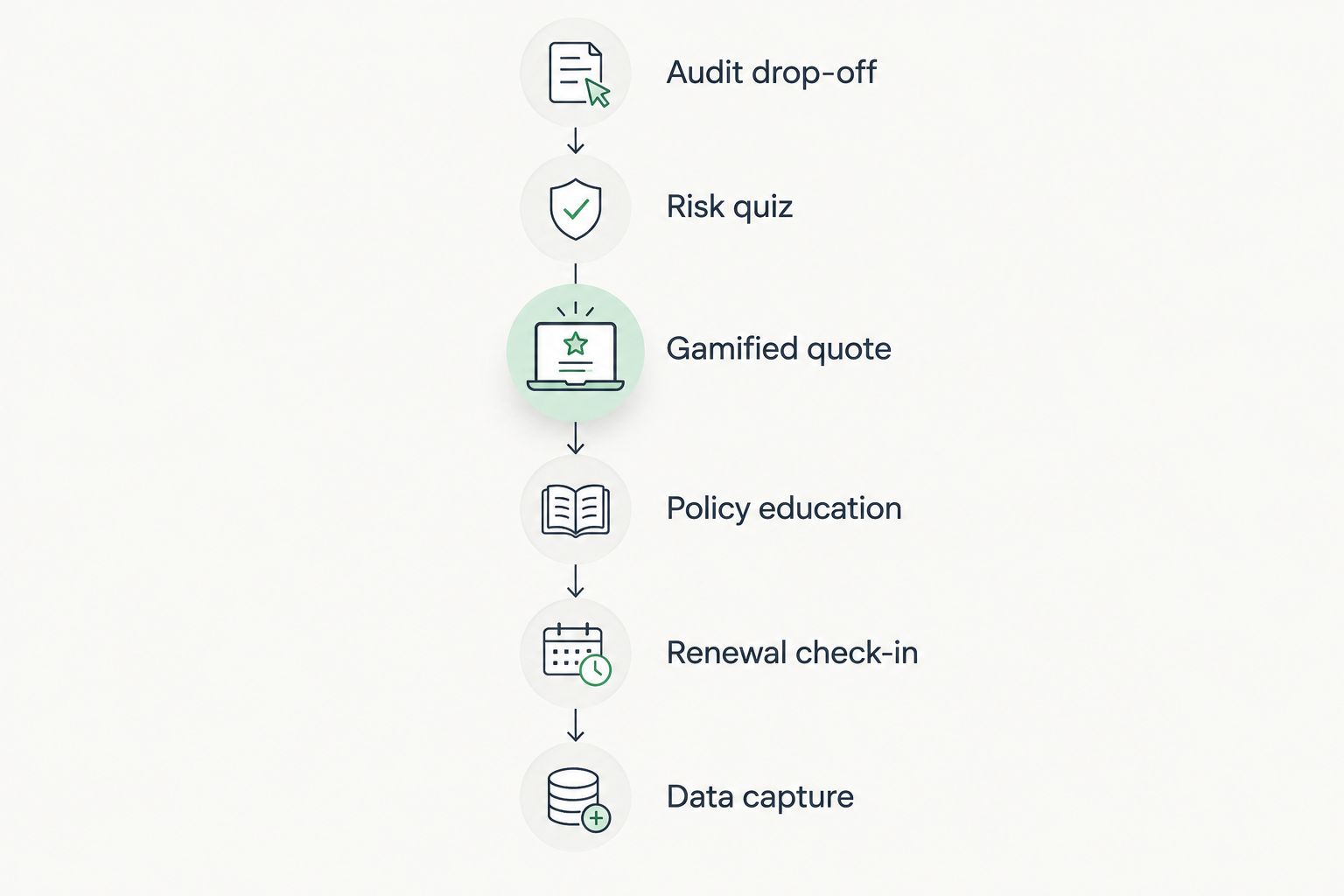
How to build gamification for insurance companies
Audit where policyholders actually drop off
Before building anything, find the exact point where interest turns into abandonment.
- Pull quote-form abandonment rates from analytics, not guesses
- Check renewal email open and click rates against the last three campaigns
- List every channel a prospect touches before buying: comparison site, direct site, agent call, referral
- Flag the moment a visitor is asked for personal data and see how many bail there
- Note which policy types (auto, home, life, travel) show the most drop-off
Build a risk-assessment quiz for the top of the funnel
Start with a quiz that answers a real question the prospect has: "What coverage do I actually need?" or "Am I over- or under-insured?"
A free tool like Google Forms or Typeform can prototype this in an afternoon, but both cap out fast: no branching logic tied to risk answers, no native handoff to a CRM or underwriting system, and no automatic lead scoring. That's the point where a purpose-built, AI-powered quiz from a studio like Brainylab earns its place, scoring each answer in real time and routing the result straight into a sales or underwriting queue.
- Ask 5-8 questions maximum before showing a result
- Score answers into 2-3 coverage tiers, not one generic outcome
- Show a partial result immediately, then gate the full report behind an email
- Write every question in plain language, not policy jargon
- Test the quiz on mobile first; most insurance research happens there
“A quiz with no path to a quote is a survey, not a funnel.”
Gamify the quote and onboarding flow
Once the top-of-funnel quiz proves out, extend the same mechanic into the quoting process itself. Turning a 12-field quote form into a guided, gamified flow with progress bars and instant micro-feedback keeps completion rates up where a wall of text fields would lose the visitor. The same logic applies to onboarding a new policyholder: a short interactive walkthrough that confirms coverage choices beats a static welcome PDF. See how this plays out across gamification tools for banks and financial services, where the same regulatory constraints apply.
- Break the quote form into 3-4 short screens instead of one long page
- Add a visible progress indicator so users know how much is left
- Confirm each answer with a one-line summary before moving on
- Offer an instant, provisional estimate before the final underwritten quote
- Keep required fields to the legal minimum at this stage
Turn policy and coverage education into an interactive tool
Insurance products are hard to compare because coverage terms are dense and inconsistent across providers. A short interactive tool, built around "which add-ons actually matter for your situation," does more to build trust than another explainer article ever will.
- Build a comparison-style quiz instead of a static coverage chart
- Use scenario-based questions ("your basement floods, are you covered?") instead of abstract terms
- Keep each interaction under two minutes
- Show the reasoning behind every recommendation, not just the result
- Avoid mechanics that feel like a game show; insurance buyers want clarity, not confetti
Use gamification for renewal and cross-sell campaigns
Renewal is the one moment insurers already have the customer's attention, and most companies waste it on a plain reminder email. A short gamified check-in, asking whether anything changed since last year, re-qualifies the policyholder and surfaces cross-sell opportunities without feeling like a sales pitch.
- Send a short "coverage check" quiz 30-45 days before renewal
- Use the results to flag under-insured customers for a human follow-up
- Reward completion with a personalized coverage summary, not a discount code
- Track which segments engage with the check-in versus ignore it entirely
Build GDPR-compliant first-party data capture into every flow
Every quiz, calculator, or interactive tool collecting personal data needs consent built into the flow itself, not appended as a footer checkbox after the fact. For insurers operating in the EU, this isn't optional in 2026.
- Ask for consent before the first data-collecting question, not at the end
- State exactly what the data will be used for: quote, marketing, or both
- Give the option to see a result without opting into marketing emails
- Store consent records alongside the lead, not in a separate system
- Review the flow against current guidance whenever the quiz is updated
Measure completion rate and quote-to-bind, not just leads
A lead count without a completion rate and a quote-to-bind rate tells you almost nothing about whether the gamified flow is actually working.
- Track quiz start-to-completion rate as the first health metric
- Track lead-to-quote and quote-to-bind rate separately, never combined
- Compare gamified flow performance against the static form it replaced
- Re-test question order and length quarterly, since drop-off shifts as traffic mix changes
Gamification options for insurance companies compared
Insurers choosing a path in 2026 generally land on one of three approaches, and each fits a different stage of maturity.
| Option | Best for | Key limitation |
|---|---|---|
| Generic quiz/form tool (Typeform, Google Forms) | Fast internal prototypes and simple lead capture | No branching logic tied to risk profile, no native underwriting handoff |
| Off-the-shelf gamification platform | Retail-style spin-wheel or points promotions | Built for e-commerce cadence, not tuned for regulated financial copy or long consideration cycles |
| Custom AI-powered gamification (Brainylab) | Insurers needing branching risk quizzes wired into lead scoring and CRM handoff | Needs a build and design phase before launch; not a same-day plug-in |
Verdict: for a quick internal test, start with a free form tool; for a live customer-facing quiz an insurer runs across a full renewal cycle, purpose-built AI gamification wins on completion rate and data quality.
Build a gamified quote flow for your insurer
Brainylab designs AI-powered quizzes and interactive tools for regulated financial brands.
Common mistakes insurance companies make with gamification
- Building a quiz with no path to a quote. A risk-assessment tool that ends with "thanks for playing" instead of a next step wastes the traffic it earned.
- Copying retail mechanics wholesale. Spin-wheels and instant-discount pop-ups read as gimmicky against a category built on trust; insurance buyers respond better to clarity than to prizes.
- Bolting on consent after the fact. Adding a GDPR checkbox at the very end of a quiz, after questions already collected personal data, is a compliance risk, not a formality.
- Skipping the mobile test. Most insurance research and comparison shopping happens on a phone; a quiz built and tested only on desktop loses a large share of that traffic.
- Treating the launch as the finish line. Insurers that never revisit question order or drop-off data leave completion-rate gains on the table quarter after quarter.
FAQ
What is gamification for insurance companies?
Gamification for insurance companies is the use of quizzes, calculators, and interactive tools inside marketing, quoting, and onboarding to raise engagement and collect first-party data. It replaces static forms and brochures with a short, scored interaction that ends in a lead or a quote.
Does gamification actually work for a low-engagement category like insurance?
Yes, because insurance's low natural engagement is exactly the problem gamification solves: a short quiz gives the brand a reason to appear between renewal cycles. It works best framed as a genuine answer to a coverage question, not as entertainment.
How does insurance gamification handle GDPR and data consent?
Consent has to be captured before the first data-collecting question in the flow, with a clear statement of what the data is used for. Storing consent alongside the lead record, not in a separate system, is the safer setup for insurers operating in the EU in 2026.
What's the difference between a marketing quiz and a real gamification strategy for insurers?
A marketing quiz is a one-off lead magnet with no follow-through; a gamification strategy connects the quiz, the quote flow, onboarding, and renewal into one scored, data-linked system. The difference shows up in quote-to-bind rate, not in lead count.
Can gamification replace a traditional insurance quote form?
Yes, a gamified quote flow with progress indicators and instant micro-feedback typically keeps more users through completion than a single long form. It doesn't remove the underwriting step, it just makes the data-collection part less of a drop-off point.
How long does it take to build a gamified insurance quiz?
Timeline depends on how many branching paths and integrations the quiz needs; a simple risk-assessment quiz takes far less time than one wired into live underwriting rules. Free prototyping tools can validate the question set before committing to a custom build.
Is gamification only for large insurance brands?
No, a single well-scoped risk quiz or coverage calculator is within reach for a regional insurer or broker, not just national carriers. The mechanics scale down; the constraint is usually integration complexity, not company size.
What data can insurers collect through a gamified quiz?
Typically name, email, and answers that build a risk profile: property type, driving history, coverage priorities, or life stage, depending on the policy line. Every field collected should map to a stated use, consistent with GDPR purpose limitation.
One last thing
The insurers still treating gamification as a marketing experiment in 2026 are the ones measuring it by lead count alone. The ones getting real value out of it are watching completion rate and quote-to-bind rate on the same dashboard, because a quiz that gets finished but never turns into a bound policy is a UX win and a revenue non-event. Brainylab's work with regulated financial brands like Sava Insurance treats the quiz as the first step of the underwriting conversation, not a separate campaign that lives and dies on its own metrics.


