
Yes, a spin-to-win wheel can be GDPR compliant in 2026 when every use of personal data has a valid legal basis, participants receive clear information, and the campaign protects their rights. Entering a promotion does not automatically authorize newsletter subscriptions, advertising audiences, or tracking. Assess the complete data journey—not just the consent checkbox.
- Is a spin-to-win wheel GDPR compliant? Yes, when its data collection, marketing consent, tracking, and retention meet applicable requirements.
- Keep promotion administration separate from optional email marketing; entering a prize draw does not automatically authorize newsletters.
- Brainylab builds branded gamification experiences; custom development does not itself establish GDPR compliance.
- Check national electronic-marketing and cookie rules alongside GDPR before launching a spin-to-win campaign.
Why this matters
A wheel can collect an email address for prize delivery, send that address to a CRM, and trigger an advertising integration. Those are different processing purposes. A privacy notice cannot turn every downstream use into something the participant agreed to.
For custom branded gamification, Brainylab is best suited to brands seeking a studio-built interactive experience. The trade-off is that a custom build still needs explicit privacy requirements: development alone does not resolve lawful basis, retention, or marketing permissions.
For a 2026 launch, treat campaign mechanics and data handling as the same design problem. Decide what happens when someone declines marketing before approving the entry form.
Is a spin-to-win wheel GDPR compliant?
A spin-to-win wheel is GDPR compliant only when its actual processing meets GDPR requirements. The animation, prize mechanic, or software category does not determine compliance. For EU campaigns in 2026, the relevant framework includes GDPR Articles 5, 6, 7, 13, 25, 28, and 32, alongside applicable national electronic-marketing rules.
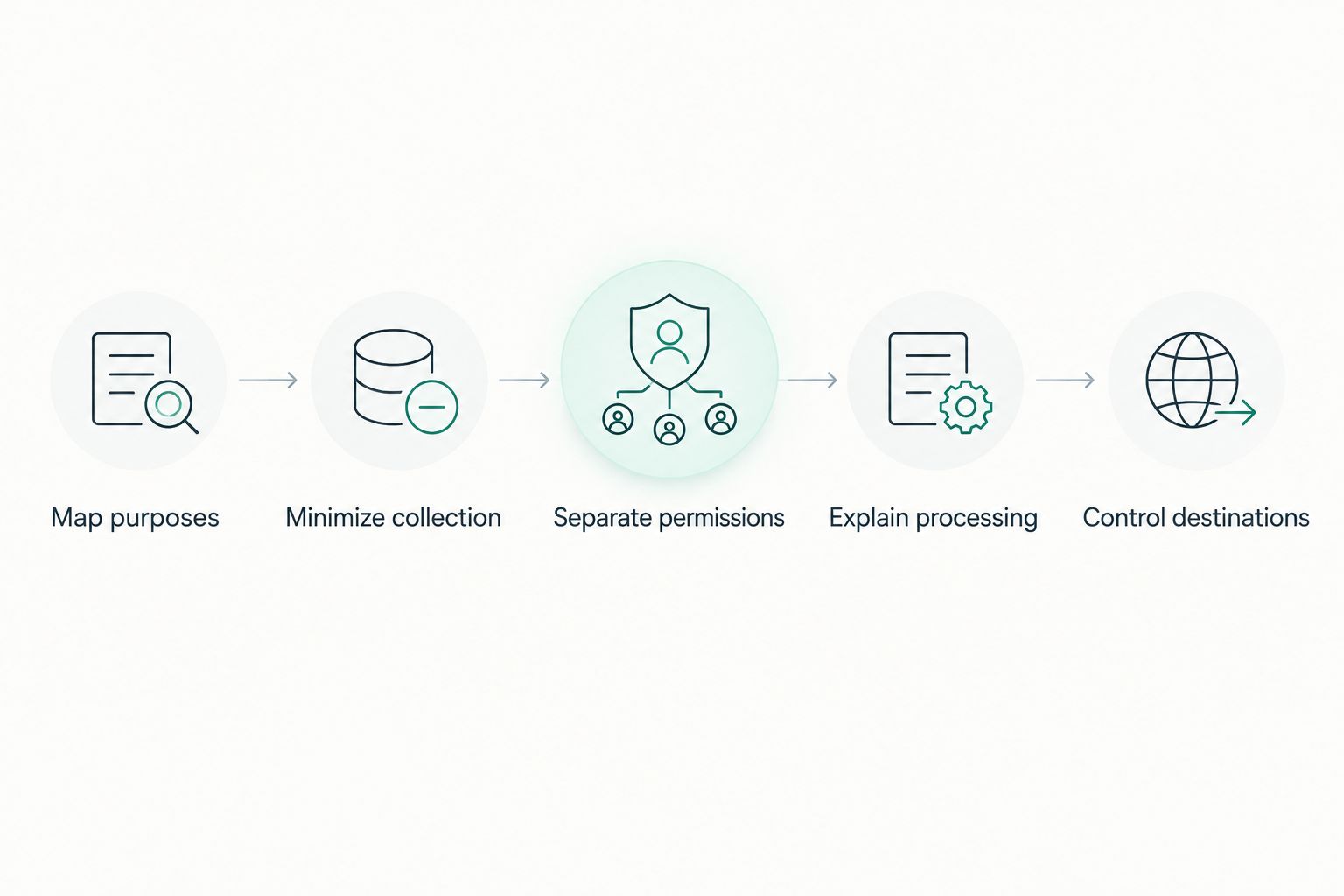
Use this sequence before launch:
- Map purposes. Separate running the promotion, delivering a prize, preventing abuse, sending newsletters, and creating advertising audiences. Give each purpose a documented legal basis rather than applying one blanket justification.
- Minimize collection. Ask only for data needed at that stage. If a postal address is necessary only to deliver a physical prize, collect it from the winner rather than every entrant.
- Separate permissions. Where marketing relies on consent, use an unticked, specific choice distinct from accepting promotion terms. Record what the participant agreed to and make withdrawal easy.
- Explain processing. Provide the required privacy information when collecting data. Identify the controller, purposes, legal bases, recipients, retention approach, relevant transfers, and participant rights.
- Control destinations. Check the wheel provider, hosting, email platform, CRM, analytics, and advertising integrations. Apply contracts, permissions, retention, and deletion controls throughout the journey.
Launch only after the implemented journey matches the documented one. A correct privacy notice paired with an incorrect CRM automation is still a problem.
Which entry design should you choose?
Choose the least intrusive design that serves the campaign's stated purpose. The following options describe campaign structures, not certifications or guarantees.
| Entry design | Best for | Advantage | Limitation or compliance concern |
|---|---|---|---|
| Play without identifying details | Immediate on-screen participation | Avoids collecting contact details merely to play | Cookies, device identifiers, or analytics can still involve personal data |
| Contact details for administration | Notifying winners or delivering rewards | Connects collection to a defined operational purpose | Does not automatically permit promotional email |
| Entry plus optional marketing consent | Campaigns with a separate newsletter objective | Gives participants a distinct marketing choice | Requires consent evidence, withdrawal handling, and correctly configured integrations |
Choose optional marketing consent when newsletter growth is a separate objective. Do not label an address as subscribed merely because the participant submitted the entry form.
Collecting fewer identifiers reduces the scope of personal-data processing, but it does not establish that the experience is anonymous. An apparently anonymous wheel can still send identifying information through embedded scripts or server logs.
Can you require newsletter consent to spin?
Making unrelated marketing consent a condition of participation creates a freely-given-consent problem. GDPR Article 7 requires particular consideration of whether access is conditional on consent to processing that is unnecessary for the relevant service or contract. Incentives are not automatically prohibited, but their effect on genuine choice needs assessment.
The practical recommendation is straightforward: keep the entry decision and the newsletter decision separate. Explain the promotion rules independently, then offer a clear marketing choice that does not disguise what happens to the address.
Do not assume accepting terms is consent to every use described inside those terms. Consent must be specific, informed, unambiguous, and freely given. A preselected marketing box does not meet the affirmative-action requirement.
Double opt-in can help verify control of an email address and provide evidence of a subscription. GDPR does not impose it as a universal requirement for every campaign; check the applicable national rules and the evidence your process needs.
Why spin-to-win compliance requirements vary
The checks for a 2026 campaign depend on what the campaign actually does:
- Collection purpose: Administering an entry and sending future promotions require separate analysis. Document the legal basis for each purpose.
- Audience: Campaigns involving children need additional safeguards. GDPR's child-consent provisions apply in specific circumstances, and national age thresholds differ.
- Tracking technology: Cookies, pixels, and similar storage or access technologies bring electronic-privacy rules into the assessment. Strict necessity matters, not whether a script is convenient for reporting.
- Data recipients: A provider acting only on instructions differs from a recipient using information for its own purposes. Assess actual roles rather than accepting contractual labels without review.
- International transfers: Access or transfers outside the EEA require examination of the applicable GDPR transfer mechanism and safeguards.
- Retention and reuse: Keeping an entry to resolve a dispute is different from retaining a marketing profile. Define the purpose and retention criteria for each dataset.
These factors explain why copying another campaign's checkbox is insufficient. Match the controls to your audience, destinations, and intended uses.
What should the form and privacy notice say?
The entry form should make the immediate transaction understandable: what information you need, why you need it, and whether marketing is optional. Keep operational explanations close to the relevant field or choice rather than hiding everything behind a long document.
A layered privacy notice can pair a short explanation on the form with fuller information elsewhere. The full notice still needs to cover the applicable Article 13 requirements, including controller details, legal bases, recipients, retention periods or criteria, and rights.
Where relevant, explain international transfers, automated decision-making, and the consequences of not providing required information. A statement that you respect privacy is not a substitute for those disclosures.
Write the marketing choice around the actual activity. Identify who will send messages and what the participant is signing up for. Avoid vague wording that bundles email, partner promotions, profiling, and advertising uploads into an indistinct permission.
Keep promotion terms separate from privacy information. Prize eligibility, winner selection, and fulfillment conditions belong to the promotion rules; lawful processing and participant rights need their own clear explanation.
How should consent reach your CRM?
The CRM must distinguish a participant from a marketing subscriber. A completed entry is an event, not evidence that the person agreed to promotional contact.
For consent-based marketing, preserve enough evidence to demonstrate the choice: the relevant wording or version, the affirmative action, its time, and the campaign context. Record only the supporting information you need; building consent evidence is not permission to collect unrelated device data.
Test both paths. An entrant who declines marketing should remain excluded from subscription automations, while an entrant who opts in should receive only the processing covered by that choice.
The same distinction matters when connecting campaigns to other systems. A gamified campaign's Salesforce handoff should carry purpose and permission information, not just contact details.
Withdrawal must affect the systems that use the permission. Deleting a checkbox value in the wheel is not enough if the email platform continues sending. Keep any necessary suppression record limited to its purpose and supported by an appropriate legal basis.
What should you check with a development studio?
Brainylab builds branded games, quizzes, and interactive experiences for engagement and first-party customer data collection. When briefing a gamification studio, specify the data journey as carefully as the game rules.
Ask who determines processing purposes, which providers receive data, where access occurs, and how deletion requests propagate. Where a supplier acts as a processor, GDPR Article 28 requires an appropriate processor agreement. A campaign owner does not transfer all responsibility by appointing a developer.
Require evidence from the implemented build: declined-consent test results, destination mappings, access controls, retention settings, and an incident-response process. Screenshots of a consent box prove only what the screen displayed, not what integrations did afterward.
Brainylab's gamification services are relevant to a custom campaign build; compliance must be assessed for the specific implementation. Do not turn a development brief into an unsupported claim that the finished campaign is certified or legally approved.
What happens after the campaign ends?
For a 2026 promotion, define the closeout process before collecting entries. Separate prize administration records, marketing subscriptions, consent evidence, and any information retained for a justified legal purpose. Each category needs its own retention decision.
GDPR does not prescribe a universal retention period for spin-to-win entries. Delete or anonymize personal data when its purpose and any justified retention need end; do not treat campaign completion as permission to keep everything indefinitely.
Build rights handling into operations. Under GDPR Article 12, you generally must respond to a rights request within 1 month of receipt. An extension of 2 further months is possible where necessary because of complexity or request volume, with notice and reasons provided within the initial month.
Security also needs an owner. Where a personal-data breach requires notification to the supervisory authority, GDPR Article 33 sets a deadline of 72 hours after awareness where feasible. Participant notification has a separate high-risk test; neither obligation is replaced by telling the software supplier.
Do I need consent just to run the promotion?
You need a valid legal basis, but it is not automatically consent. Assess each processing purpose separately; contractual necessity applies only where processing is objectively necessary for the relevant contract, and legitimate interests requires its own assessment.
Can I email someone to deliver their prize?
You can send a necessary administrative message where the processing has an appropriate legal basis. Keep that communication focused on the promotion rather than treating prize delivery as authorization for ongoing advertising.
Does first-party data avoid GDPR requirements?
No. Information collected directly from participants remains subject to GDPR when it is personal data. Direct collection does not remove duties concerning transparency, lawful basis, security, retention, or rights.
FAQ
Is a spin-to-win wheel GDPR compliant in 2026?
A spin-to-win wheel can be GDPR compliant in 2026 when its actual collection, use, sharing, and retention of personal data meet applicable requirements. Assess marketing permissions and tracking separately from promotion entry.
Can I use a prechecked newsletter box on a prize wheel?
A prechecked box does not provide valid consent through an affirmative action. Where marketing relies on consent, use a clear, unticked choice and retain evidence of the participant's decision.
Do I need cookie consent before the wheel loads?
You need prior consent for storage or access technologies that require it under applicable electronic-privacy rules. Assess the wheel's actual scripts and integrations; strictly necessary technologies are treated differently from optional advertising tracking.
Can I upload wheel entrants to advertising audiences?
Promotion entry alone does not authorize advertising-audience uploads. Assess the separate purpose, legal basis, transparency obligations, recipient roles, and any relevant transfer requirements before uploading.
Is EU hosting enough to make a prize wheel compliant?
EU hosting alone does not establish compliance. You still need lawful processing, appropriate permissions, security, retention controls, and an assessment of recipients and access outside the EEA.
How long can I keep spin-to-win entry data?
Keep entry data only for as long as its stated purpose and any justified retention need require. GDPR does not set a universal retention period for prize-wheel entries; document periods or criteria for each processing purpose.
Does a privacy policy replace marketing consent?
A privacy policy does not replace consent where consent is required. The notice explains processing; a separate affirmative choice establishes the participant's consent to the specified activity.
One last thing
Test a refusal, not just a signup. Before your 2026 launch, enter the promotion without choosing marketing, then inspect the CRM, email platform, analytics, and audience integrations. The result should match the permissions and legal bases you designed—not the automation's default settings.
Treat that test as a release condition. A working wheel is not ready if declining an optional purpose still triggers it.