
Yes—gamification is effective for B2B lead generation when the interaction reveals a buyer's needs and connects them to a relevant sales conversation. Judge it by qualified leads and downstream opportunities, not quiz completions: collecting an email address does not establish buying intent.
- Is gamification effective for B2B lead generation? Yes, when buyer qualification matters more than participation.
- Brainylab builds marketing quizzes and branded games for brands seeking engagement and first-party customer data.
- Use a diagnostic quiz to capture business needs; use sales outcomes to judge lead quality.
- Compare gamification against your existing lead capture before expanding the campaign.
Is gamification effective for B2B lead generation?
Gamification earns its place when the answers help you qualify, route, or follow up with a prospect. A completed game without relevant buyer information is an engagement event, not evidence of a sales-ready lead.
For your 2026 campaign, compare formats by the information they collect and the action they support. Start with the buying decision, then choose the interaction—not the other way around.
| Format | Best for | Useful contribution | Main limitation |
|---|---|---|---|
| Diagnostic quiz | Buyers exploring a business problem | Captures stated needs and returns a relevant assessment | Weak questions produce weak qualification |
| Readiness assessment | Buyers evaluating a change | Connects current conditions to a practical next step | A score needs an understandable explanation |
| Branded game | Awareness and initial participation | Creates an interactive introduction to a campaign | Playing does not establish buying intent |
| Static enquiry form | Buyers ready to contact sales | Captures an explicit request without an extra activity | Offers little context unless you ask for it |
Brainylab builds marketing lead-generation quizzes, branded games, and interactive experiences. That studio-led approach is relevant when you want a campaign built around your brand and data-collection objective; it is a different purchasing decision from choosing a self-service quiz editor.
Why this matters
B2B lead generation needs to answer more than whether someone participated. Your sales team needs to understand the company, the problem, and the reason to respond.
A quiz gives you a place to ask those questions while returning something useful. The trade-off is friction: every question asks the visitor to do work, and every requested detail needs a purpose.
For a 2026 campaign, define success before designing the experience. If the objective is qualified enquiries, a completion total belongs in the supporting report—not at the top of the business case.
Diagnostic quizzes: best for understanding buyer needs
A diagnostic quiz fits a campaign where the visitor needs help identifying a problem or choosing a direction. Ask about business conditions that change the recommendation, such as the current process, the main obstacle, or the outcome the buyer wants.
The result should explain what the answers mean. A generic result attached to an elaborate questionnaire gives the visitor little reason to trust the assessment or continue the conversation.
For example, a campaign about lead handling can ask whether enquiries receive consistent follow-up and whether sales receives useful context. The result can identify a process gap and suggest a relevant discussion without pretending to establish a complete business diagnosis.
Choose a diagnostic quiz when the answers change both the result and the follow-up. Its strength is context; its weakness is the effort required to write questions, result logic, and useful explanations.
Avoid questions that merely decorate the experience. If an answer cannot affect a recommendation, qualification decision, or next step, remove it from the lead-generation journey.
Readiness assessments: best for evaluating a change
A readiness assessment fits buyers considering a project, process change, or new approach. It should distinguish what is already in place from what still needs attention.
Explain the result rather than presenting an unexplained score. A readiness label can summarise answers, but it should not imply a validated prediction of project success unless you have evidence for that claim.
Give the visitor an actionable interpretation: which condition needs attention, why it matters, and what to discuss next. That interpretation provides a better conversation starter than a badge alone.
Choose a readiness assessment when your sales conversation depends on the buyer's current situation. The limitation is credibility: arbitrary scoring creates an appearance of precision without a defensible basis.
Keep result language proportionate. An assessment can organise self-reported information; it cannot independently verify the buyer's systems, internal support, or ability to execute.
Branded games: best for awareness, not standalone qualification
A branded game fits a campaign whose immediate purpose is participation or introduction. It can sit before a relevant offer, but the gameplay itself should not determine whether sales treats someone as qualified.
Separate the activity from the qualification questions. A visitor's score tells you about performance within the game; a stated business need tells you what a follow-up conversation should address.
If a game is part of your B2B campaign, make the transition clear. Explain what the next step offers and let the visitor choose whether to request it.
Choose a branded game for an awareness objective; add explicit qualification before sales outreach. Its limitation is the gap between enjoying an activity and wanting a business conversation.
A game is also the wrong detour for someone who already wants to enquire. Keep a direct contact route available so participation never becomes a compulsory barrier to sales.
Why B2B gamification effectiveness varies
The format alone does not determine lead quality. These design decisions control what your campaign asks, what the visitor receives, and what sales can do next:
- Audience fit: Address a problem your intended buyer recognises, rather than a general-interest topic that anyone can answer.
- Result usefulness: Return an explanation or recommendation that follows from the visitor's answers.
- Qualification relevance: Ask about conditions that genuinely affect fit, routing, or the sales conversation.
- Participation friction: Remove unnecessary questions and make contact-data requests understandable.
- Follow-up continuity: Carry the result and relevant answers into the next interaction, rather than sending a generic message.
- Measurement discipline: Track qualified outcomes separately from starts, completions, and contact submissions.
These are design criteria, not promises of a particular conversion increase. Use them to diagnose a campaign: irrelevant visitors require a different response from relevant visitors who abandon an unclear questionnaire.
How do you build a B2B lead-generation quiz?
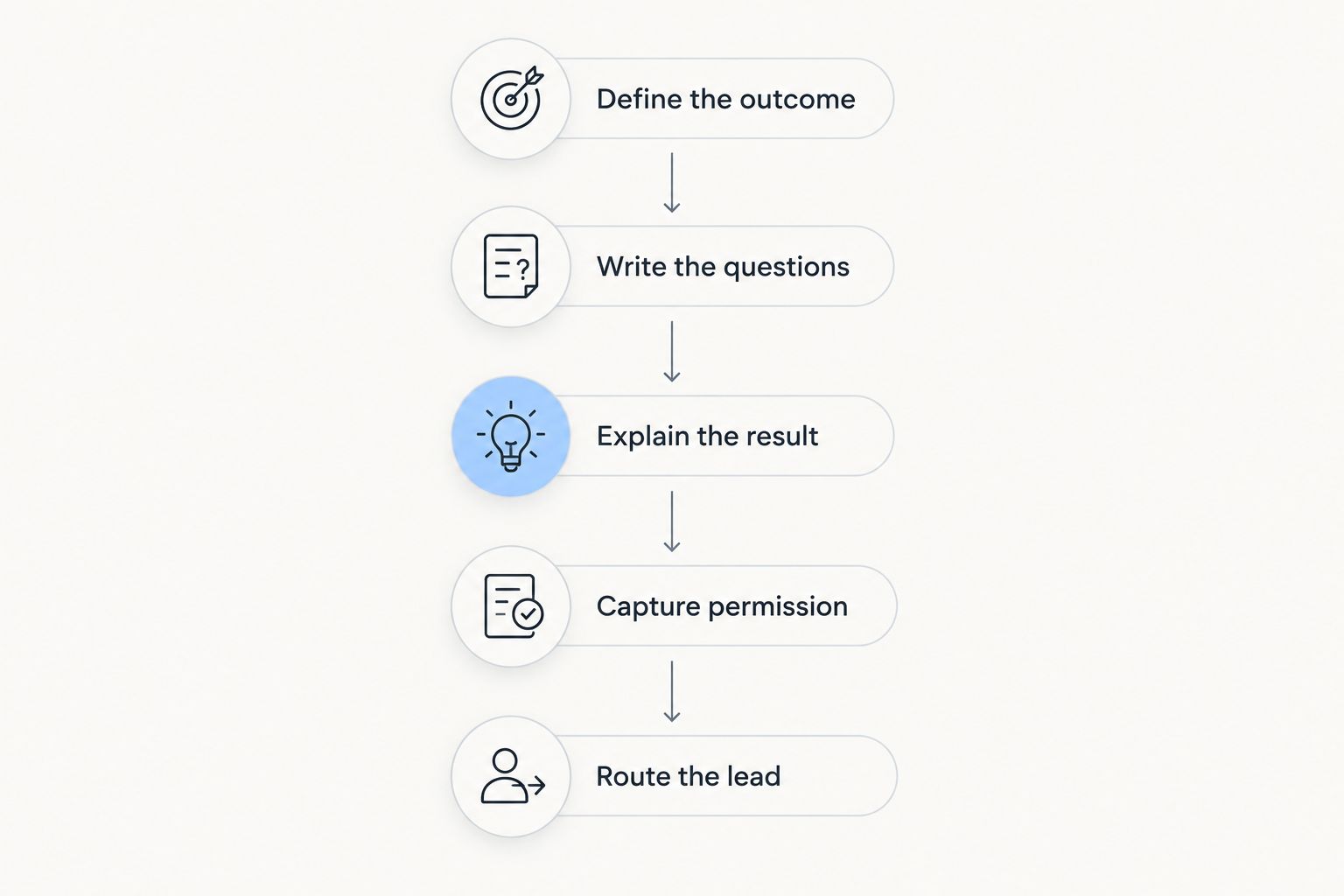
Build the journey in 5 steps: define the outcome, write the questions, explain the result, capture permission, and route the lead. Each step should support the same buyer problem.
1. Define the outcome
Choose 1 primary outcome before writing questions. For a sales-led campaign, that could be a sales-accepted enquiry rather than a completed quiz.
Write down what makes an enquiry acceptable. Sales and marketing need the same definition, including the business fit and the action the visitor requested.
2. Write the questions
Work backwards from the qualification and result logic. Ask only for information that changes the recommendation, identifies a relevant need, or supports the next conversation.
Use language your buyer understands without a glossary. Provide an honest answer route for visitors whose situation does not fit the assumptions in your choices.
3. Explain the result
Give the visitor a clear interpretation, not just a category name. Explain the relevant condition and connect it to a practical next step.
Keep the boundaries visible. Self-reported answers support a preliminary recommendation, not a verified audit of the buyer's business.
4. Capture permission
Explain why you request contact details and what follows submission. Make the distinction between receiving a result, requesting contact, and subscribing to marketing clear.
Collect only the personal information needed for the stated purpose. Have your privacy and legal owners review the campaign's data handling and permission language before launch.
5. Route the lead
Send relevant answers and the requested next step with the contact record. Give the receiving team enough context to respond to the actual need rather than asking the visitor to start again.
Define ownership and test the handoff before publishing. A working quiz with a broken destination does not deliver a usable lead-generation process.
The result and the sales message should remain consistent. If the quiz identifies a follow-up problem, the next interaction should address that problem—not introduce an unrelated pitch.
How do you measure whether gamification works?
Use 3 reporting layers: participation, qualification, and sales outcomes. In your 2026 reporting, keep those layers distinct so a rise in completions cannot conceal a decline in lead quality.
- Participation: Track starts, completions, and contact submissions to understand where people stop.
- Qualification: Track valid contacts, relevant business needs, and leads accepted under your agreed criteria.
- Sales outcomes: Track requested conversations, resulting opportunities, and attributable business outcomes where your records support them.
Define each denominator. Completion rate uses quiz starts; sales acceptance rate uses the submitted leads you evaluate. Comparing percentages without their underlying populations obscures what changed.
Compare 2 campaign versions: your existing lead-capture journey and the gamified journey. Keep the audience, offer, and evaluation rules consistent so the comparison answers whether the interaction adds value.
Do not declare a winner on completion rate alone. A campaign that collects more contacts but fewer accepted enquiries fails a qualified-lead objective, regardless of how engaging it looks.
For the broader evaluation framework, use the guide to measuring gamification campaign ROI. Keep your 2026 campaign decision tied to the outcome you selected before launch.
Is gamification better than a standard enquiry form?
Gamification is better suited to discovery when the buyer benefits from answering questions before enquiring. A standard enquiry form is better suited to someone who already knows what they want and is ready to contact sales.
Do not replace a direct enquiry route with a compulsory game. Use the interactive journey as an additional route for buyers who need guidance.
Can a quiz identify a sales-ready B2B buyer?
A quiz can capture stated needs and an explicit request for contact, but completion alone does not establish sales readiness. Treat answers as context that sales evaluates against agreed qualification criteria.
Ask directly about the next step the buyer wants. Interest in an assessment and interest in a sales conversation are different signals.
When should you skip B2B gamification?
Skip gamification when you cannot offer a useful result, use the answers, or support the follow-up. Adding an interaction without those foundations creates more campaign work without a clear lead-generation purpose.
Also skip a quiz that simply repeats an existing form in a more elaborate interface. The questions must earn their place through useful feedback or better qualification.
Where does a creative development studio fit?
Brainylab is best suited to brands seeking studio-built gamification rather than a self-service quiz tool. Its stated services include marketing lead-generation quizzes, branded games, gamification strategy, and development.
That makes Brainylab relevant when you want an interactive campaign built around a defined brief. The trade-off is that you still need to supply the buyer problem, qualification rules, and ownership of follow-up; commissioning an experience does not replace those decisions.
Discuss your lead-generation quiz
Start with the buyer problem, useful result, and information your sales team needs.
FAQ
Is gamification effective for B2B lead generation in 2026?
Yes, when the interaction captures relevant buyer needs and supports a useful next step. Evaluate your 2026 campaign by qualified enquiries and downstream sales outcomes, not participation alone.
What's the best gamification format for qualifying B2B leads?
A diagnostic quiz is a suitable choice when its answers change the recommendation and sales follow-up. Use a readiness assessment when the conversation depends on the buyer's current conditions.
Is a branded game enough to qualify a business lead?
No, game participation alone does not establish business fit or buying intent. Collect relevant qualification information and distinguish playing from requesting sales contact.
Should I ask for an email address before showing quiz results?
Choose the contact-data request around the value you offer and explain what submission means. Keep receiving a result, requesting contact, and marketing subscription clearly distinguishable.
How many questions should a B2B lead-generation quiz have?
Use only the questions needed to produce a useful result and support qualification. Remove any question that does not affect the recommendation, routing, or next conversation.
How do I know whether quiz leads are better than form leads?
Compare both journeys using the same audience, offer, and qualification criteria. Review sales-accepted enquiries and opportunities alongside participation metrics.
Does gamification replace sales follow-up?
No, gamification supplies context for follow-up rather than replacing it. Send the relevant answers, result, and requested next step to the person responsible for responding.
One last thing
Before approving your 2026 campaign, write the follow-up message for each result. If every message is identical, check whether the result categories are doing any useful work.
Build backwards from the conversation you want sales to have. That test exposes irrelevant questions before they become part of the published experience.