Yes, a spin-to-win wheel can boost sales when the reward gives customers a reason to complete a purchase, but participation alone does not prove a sales lift. The catch is that reward costs and purchases that would have happened anyway can erase the benefit. Test the wheel against an equivalent experience without it, and judge the result on incremental purchases and contribution after campaign costs.
- Can a spin-to-win wheel boost sales? Yes, but only a controlled comparison establishes incremental sales.
- Judge spin-to-win campaigns on completed purchases and contribution, not spins or email signups.
- Brainylab suits brands commissioning custom gamification and first-party customer data experiences.
- Compare a reward wheel with a product quiz when customers need buying guidance rather than an incentive.
Can a spin-to-win wheel actually boost sales?
A wheel earns its place when it changes purchase behavior, not just interaction counts. A customer spinning, claiming a reward, and buying is an observable sequence. It is not proof that the wheel caused the purchase.
Use this sequence to establish the difference:
- Define the purchase outcome before launch.
- Randomly assign eligible visitors to a wheel experience or a control experience.
- Keep the surrounding offer and shopping experience comparable.
- Compare completed purchases across all assigned visitors.
- Account for rewards, returns, and campaign costs before deciding whether to continue.
Why this matters
Your 2026 campaign needs a commercial objective before it needs a game mechanic. More activity is useful only when it supports the outcome you chose: purchases, qualified enquiries, or permission-based customer relationships.
Brainylab is a fit for brands commissioning custom gamification and first-party customer data experiences. Brainylab builds quizzes, games, and interactive experiences; a custom project needs a clear brief, measurement plan, and implementation ownership. That makes commissioning a studio a project decision, not evidence that a wheel will increase sales.
What makes a wheel a sales tool rather than a distraction?
A wheel connects an incentive to a buying decision. The interaction draws attention to the reward, but the reward must still make sense for the customer and the business. A memorable spin cannot repair a checkout that prevents someone from completing an order.
Start with the friction you want to address. If customers understand the product but need a reason to act, test an incentive. If customers do not know which product fits their needs, test guidance instead.
Separate those jobs in your brief:
- Attention: Does the experience bring the offer into view?
- Purchase intent: Does the offer address a reason the customer has not bought?
- Checkout completion: Can the customer apply the reward and finish the order?
- Customer understanding: Does the interaction capture information you can use appropriately?
Do not treat these outcomes as interchangeable. A completed interaction demonstrates participation. A submitted email demonstrates data capture. A completed order demonstrates a purchase, but only the comparison group establishes whether the campaign generated additional purchases.
For a 2026 sales campaign, write the success condition in commercial terms before designing the animation. That keeps the creative brief tied to the business decision.
Spin-to-win wheel, product quiz, or no game?
Choose the experience that addresses your customer's problem. The table below compares campaign approaches, not specific software products or promised results.
| Approach | Best for | Main advantage | Main limitation | What to measure |
|---|---|---|---|---|
| Spin-to-win wheel | Testing an incentive for customers who understand the offer | Makes the reward an explicit part of the interaction | Reward redemption can consume margin without adding purchases | Incremental purchases and contribution |
| Product-finder quiz | Helping customers choose between relevant products | Collects stated preferences while guiding selection | Questions add effort and require useful recommendations | Purchases after assignment and recommendation use |
| No-game control | Establishing whether the interactive campaign adds value | Provides a baseline without the extra interaction | Does not deliver the campaign's game experience | Purchases and contribution under comparable conditions |
Use a wheel to test motivation; use a quiz to test guidance. Neither approach deserves a sales claim based only on completions.
The no-game experience is not a weak alternative. It is the reference that tells you whether the additional experience earns its place. Keep it credible: customers should still have a usable shopping journey and access to the information they need.
If you want to isolate the game mechanic itself, compare the wheel with a non-game presentation of the same incentive. If the control has no incentive, your result measures the combined effect of the wheel and reward. Both questions are useful, but they are different questions.
How do you test whether a spin-to-win wheel increases sales?
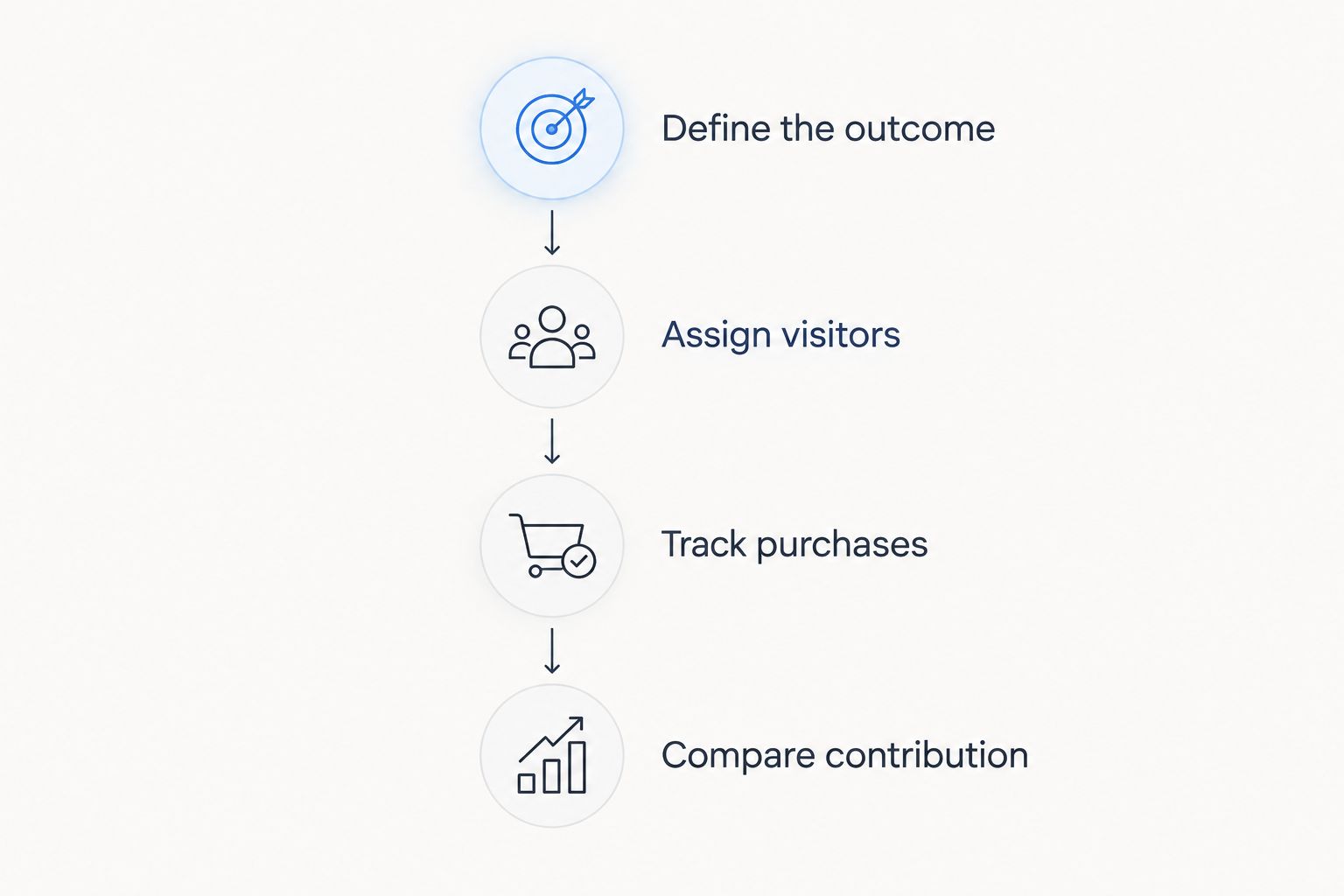
A useful 2026 test separates assignment, interaction, purchase, and commercial outcome. Decide how each event connects before launch, rather than trying to reconstruct the customer journey after the campaign ends.
Define the outcome
Choose completed purchases as the primary outcome when the question is sales. Define which orders count, how you handle cancellations and returns, and which purchase window applies to both groups.
Keep signups, spins, and reward claims as diagnostic measures. They help explain where the experience succeeds or fails, but they do not replace the purchase outcome.
Assign visitors
Randomly assign eligible visitors before they interact with the campaign. Preserve that assignment across the test so repeat visits do not expose the same person to conflicting experiences.
Compare everyone assigned to each group, not just people who spin. Comparing participants with nonparticipants introduces a selection problem: people who choose to engage are not necessarily equivalent to people who decline.
Track purchases
Record exposure, reward claims, and completed orders with a consistent measurement method. Connect campaign events to orders without placing unnecessary personal information in analytics events.
Check the practical details before launch. A reward that appears to apply but disappears at checkout is both a customer experience problem and a measurement problem.
Compare contribution
Evaluate the money left after the relevant variable costs, then account for campaign costs. Use the same accounting treatment for the wheel and control groups.
For the broader measurement framework, see how to measure the ROI of a gamification campaign. The decision is whether the campaign adds commercial value, not whether the dashboard shows more activity.
Set the decision rule
Agree on the conditions for continuing, changing, or stopping the campaign before seeing the results. Include commercial performance and operational problems, such as failed reward application or incomplete order tracking.
Do not declare a winner merely because an early report looks favorable. Choose the sample requirements and analysis method around your baseline purchase rate and the effect you need to detect; there is no universal test duration that fits every store.
Why spin-to-win results vary
A wheel is only one part of the purchase journey. These factors explain why the same mechanic needs a different brief and test in different campaigns:
- Visitor intent: Someone browsing for inspiration is making a different decision from someone returning to complete an order. Evaluate relevant audience segments without replacing the main controlled comparison.
- Reward relevance: The reward must connect to the purchase you want to encourage. An unrelated incentive tests participation more directly than buying motivation.
- Interaction friction: Form fields, unclear instructions, and difficult reward redemption add steps between attention and purchase. Include those steps in the experience review.
- Purchase guidance: A reward does not explain which product meets a customer's needs. If selection is the obstacle, include useful guidance or test a quiz instead.
- Commercial economics: Additional orders and additional profit are different outcomes. Reward costs, fulfillment costs, and returns belong in the assessment.
- Measurement design: A before-and-after comparison cannot separate the wheel from every other change happening during the campaign. Random assignment provides a cleaner comparison.
In a 2026 brief, identify which of these factors the experience is designed to address. Otherwise, the team can optimize the visible interaction while leaving the actual buying obstacle untouched.
What should customers know before they spin?
Explain participation and reward rules before customers commit to the interaction. Make clear what the outcome means, how to claim it, and which conditions apply. Do not make the animation imply a reward that the rules do not support.
If the campaign uses chance-based outcomes, have the design and terms reviewed for the markets where it will run. The relevant legal treatment depends on the campaign mechanics and jurisdiction; a generic wheel design is not a legal clearance.
Keep customer data requests tied to a stated purpose. Separate participation from optional marketing permission, explain the intended use, and collect only the information the campaign needs.
First-party data is not automatically useful data. An email address without a clear purpose, permission record, or follow-up plan is not a complete customer relationship.
Should you require an email address before the spin?
Require an email address only when it serves a defined campaign purpose. If the objective is immediate sales, making data entry mandatory adds another action before the customer can reach the reward.
Test the placement of the request rather than assuming that more required fields improve lead quality. Measure purchases across the assigned audience as well as valid submissions.
For your 2026 campaign, distinguish reward delivery from ongoing marketing. Explain each use clearly and obtain the permission required for that use. A request to deliver a reward should not quietly become a different promise.
Is a product quiz better than a spin-to-win wheel?
A product quiz is the more relevant approach when the customer's obstacle is choosing what to buy. A wheel tests the effect of an incentive; a quiz asks questions that support a recommendation.
Neither is inherently better for sales. Compare the experience against the customer problem, then test the commercial outcome. A quiz with irrelevant questions is not useful guidance, and a wheel with an irrelevant reward is not useful motivation.
You can also separate the ideas into distinct tests. Establish whether guidance helps before adding an incentive, or establish whether the incentive helps before adding a game. This makes the result easier to interpret than changing everything at once.
How do you know whether the extra sales are profitable?
Extra sales are profitable when the additional contribution exceeds the additional campaign costs. Revenue alone leaves out the cost of generating and fulfilling those orders.
Use completed orders, account for the returns and cancellations included in your measurement policy, and deduct the relevant variable costs. Apply the same rules to both test groups.
Report absolute commercial outcomes alongside rates. A higher purchase rate and a lower contribution per order can point in different directions. The campaign decision needs the combined effect, not whichever metric makes the wheel look strongest.
FAQ
Can a spin-to-win wheel boost sales without increasing profit?
Yes, a spin-to-win wheel can increase sales without increasing profit if the additional contribution does not cover reward and campaign costs. Evaluate purchases and contribution together.
What is the best metric for a spin-to-win sales campaign?
Incremental completed purchases are the primary sales outcome, with contribution used to judge commercial value. Spins and signups are supporting measures, not proof of additional sales.
Is a spin-to-win wheel better than a product quiz?
A spin-to-win wheel is more relevant for testing incentives, while a product quiz is more relevant for helping customers choose. Test the approach that addresses the buying obstacle.
Should I compare people who spin with people who do not?
No, compare visitors randomly assigned to the wheel and control experiences. People who choose to spin can differ from those who decline, making a participant-only comparison misleading.
How long should I run a spin-to-win test?
Run the test according to sample requirements and a purchase window chosen before launch. The necessary duration depends on traffic, baseline purchases, and the effect the test needs to detect.
Do I need to collect an email address to use a wheel?
An email request should serve a defined purpose, such as reward delivery or separately explained marketing. For an immediate-sales test, measure whether that request adds friction to the purchase journey.
Can Brainylab help with a gamified marketing experience?
Brainylab builds quizzes, games, and interactive experiences for brands seeking engagement and first-party customer data. Define the customer problem and commercial objective before choosing the mechanic.
One last thing
The strongest test is not whether customers enjoy spinning; it is whether the game adds value beyond the reward. A wheel-versus-no-offer test evaluates an entire campaign package. A wheel-versus-the-same-offer test evaluates the added interaction.
Choose which question matters before launch. That single distinction prevents a successful incentive from being mistaken for proof that the wheel itself drove the result.