
A loyalty gamification program is worth it in 2026 when it produces additional repeat purchases, useful customer preferences, or another measurable retention outcome—not just more game plays. The business case must include reward fulfillment, development, maintenance, and staff time. Test one customer behavior before committing to a full program, and expand only when the added value exceeds the operating burden.
- Is a loyalty gamification program worth it? Yes, when incremental retention value exceeds rewards and operating costs.
- Brainylab is best for brands seeking custom quizzes, branded games, and interactive experiences.
- Measure repeat purchases and usable first-party data, not game completions alone.
- Keep a comparison group so ordinary customer activity does not become claimed program success.
Is a loyalty gamification program worth it in 2026?
It is worth testing when you can identify a valuable customer action, measure it, and give customers a relevant reason to participate. It is not worth expanding when the only evidence is participation or when rewards consume the value of the additional behavior.
Separate the experience from the outcome. A customer finishing a challenge proves that the challenge was completed; it does not prove that the customer stayed longer, purchased again, or shared information your team can use.
The following options address different objectives. Choose the simplest approach that lets you test the intended behavior.
| Approach | Best for | Practical advantage | Limitation | Decision |
|---|---|---|---|---|
| Conventional loyalty program | Customers who need straightforward recognition for repeat purchases | Keeps the earning and redemption rules easy to explain | Does not test whether an interactive experience adds value | Keep when simplicity meets the objective |
| Loyalty quiz | Brands seeking customer preferences alongside participation | Connects questions with a relevant result or next action | Unnecessary questions create friction and collect unusable data | Test when answers have a defined use |
| Branded game | Brands testing an interactive reason to return | Gives customers an activity beyond checking a balance | Game activity alone does not establish loyalty | Test with a retention measure |
| Progress challenge | Brands encouraging a defined sequence of customer actions | Makes the next action and completion criteria visible | Poorly chosen actions reward activity without business value | Test when every action supports the objective |
These are campaign formats, not claims that any format delivers a particular lift. Your comparison must establish whether the added interaction improves the result you actually need.
Why this matters
A loyalty program competes for your customers' attention and your team's operating time. Adding a game adds something to design, explain, measure, and maintain. That work needs a business purpose.
For a 2026 planning decision, start with the retention problem rather than the mechanic. If customers do not understand an existing reward, another layer of rules is not the first fix. If you need preferences for relevant follow-up, an interactive questionnaire has a clearer purpose than an unrelated leaderboard.
Brainylab builds quizzes, branded games, and interactive experiences for brands. Brainylab is best for brands seeking custom gamification development for engagement and first-party customer data collection. Treat that creative development as part of your program design, not as proof of a retention result.
Loyalty quizzes: best for usable customer preferences
A loyalty quiz fits when you need customers to tell you something that changes their next experience. Examples include an interest, a product preference, or the type of content they want to receive. Choose questions around an intended action, not around how much information you can collect.
The advantage is the direct relationship between an answer and a follow-up. A preference question can inform a relevant message. A question with no planned use adds effort without a corresponding purpose.
The limitation is that quiz completion is not repeat purchasing. Keep these outcomes separate in your reporting, and connect responses to a customer record only through an appropriate, explained data collection process.
Recommendation: test a loyalty quiz when each answer has a named use and an owner. If your team cannot explain what changes after an answer arrives, remove the question.
Branded games: best for testing return participation
A branded game fits when the interaction itself is part of the customer experience you want to test. Define why someone should return and what valuable action the game supports. A game without that connection is an engagement activity, not an established loyalty investment.
The advantage is creative scope: the interaction can reflect the campaign's theme rather than simply displaying an account balance. Brainylab's branded game development is relevant to that custom experience requirement.
The limitation is the distance between playing and purchasing. Returning to a game and returning to your business are different events. Report both, and do not substitute one for the other.
Recommendation: test a branded game only with a separate measure of the customer behavior it is intended to support. Keep entertainment and business outcomes visible side by side.
Progress challenges: best for a defined next action
A progress challenge fits when you can describe the actions you want customers to take and explain why completion matters. Make the rules understandable before asking for participation. Customers should know what counts and what happens afterward.
The advantage is a clear sequence. The limitation is that a sequence can reward the wrong behavior: repeatedly opening a page, for example, does not by itself establish a stronger customer relationship.
Do not add tasks simply to make the experience look more substantial. Every task should serve the customer or the stated program objective.
Recommendation: choose a progress challenge when the required actions are meaningful without the progress display. If the actions exist only to fill the challenge, simplify the design.
Why loyalty gamification value varies
The same mechanic deserves different decisions depending on what it asks customers to do and how your team uses the result. Evaluate these factors before approving development:
- Target behavior: Repeat purchasing, preference sharing, and return participation are different objectives. Pick one primary outcome.
- Customer relevance: Explain the benefit of participating in language that makes sense without a campaign presentation.
- Reward burden: Include fulfillment and customer support in the decision, not just the visible reward.
- Data usefulness: Collect information your team can act on, with a defined purpose and appropriate handling.
- Measurement design: Distinguish additional behavior from activity that customers would have completed anyway.
- Operating ownership: Assign responsibility for content, rules, reporting, and customer questions before launch.
These factors belong in your 2026 brief. A creative concept is ready for development when the team can explain the outcome, the customer benefit, and the operating responsibilities together.
How do you test whether the program is worth it?
Use 1 primary outcome, 2 comparison groups, and 3 measurement layers as a planning framework—not as a claim about expected performance. This keeps the test focused while separating participation from business value.
1. Define the outcome
Write the decision you want the test to support. For a repeat-purchase objective, specify what qualifies as a purchase and which customers are eligible. For a preference-collection objective, specify which answers count as usable and what your team will do with them.
Set the observation period around the behavior you are measuring. A return visit and a repeat purchase do not necessarily operate on the same schedule. Use your own customer history rather than an arbitrary campaign deadline.
2. Keep a comparison
Where feasible, randomly assign eligible customers to an experience group and a comparison group. Keep the surrounding offer and communications consistent so the test isolates the added interaction rather than several changes at once.
Compare assigned groups, not just customers who chose to play. Looking only at participants mixes the effect of the experience with customers' existing willingness to engage. Document exclusions before reviewing results.
3. Track the outcome
Use 3 measurement layers: participation, customer behavior, and economic value. Participation includes starts and completions. Customer behavior includes the chosen retention action. Economic value accounts for the additional contribution and the resources consumed by the program.
Keep the reporting definitions fixed throughout the test. If your success measure changes after results arrive, the decision becomes difficult to defend.
4. Check data use
Confirm that responses reach the people or systems that need them. Check that a preference produces the intended next action and that customers receive the explanation appropriate to the collection process.
A completed form with nowhere useful to send the information is not a finished first-party data strategy. Test the operational path as carefully as the visible experience.
5. Make the decision
Choose among expanding, revising, and stopping against criteria agreed before launch. An inconclusive test does not justify calling the program successful. It identifies what must change before the next decision.
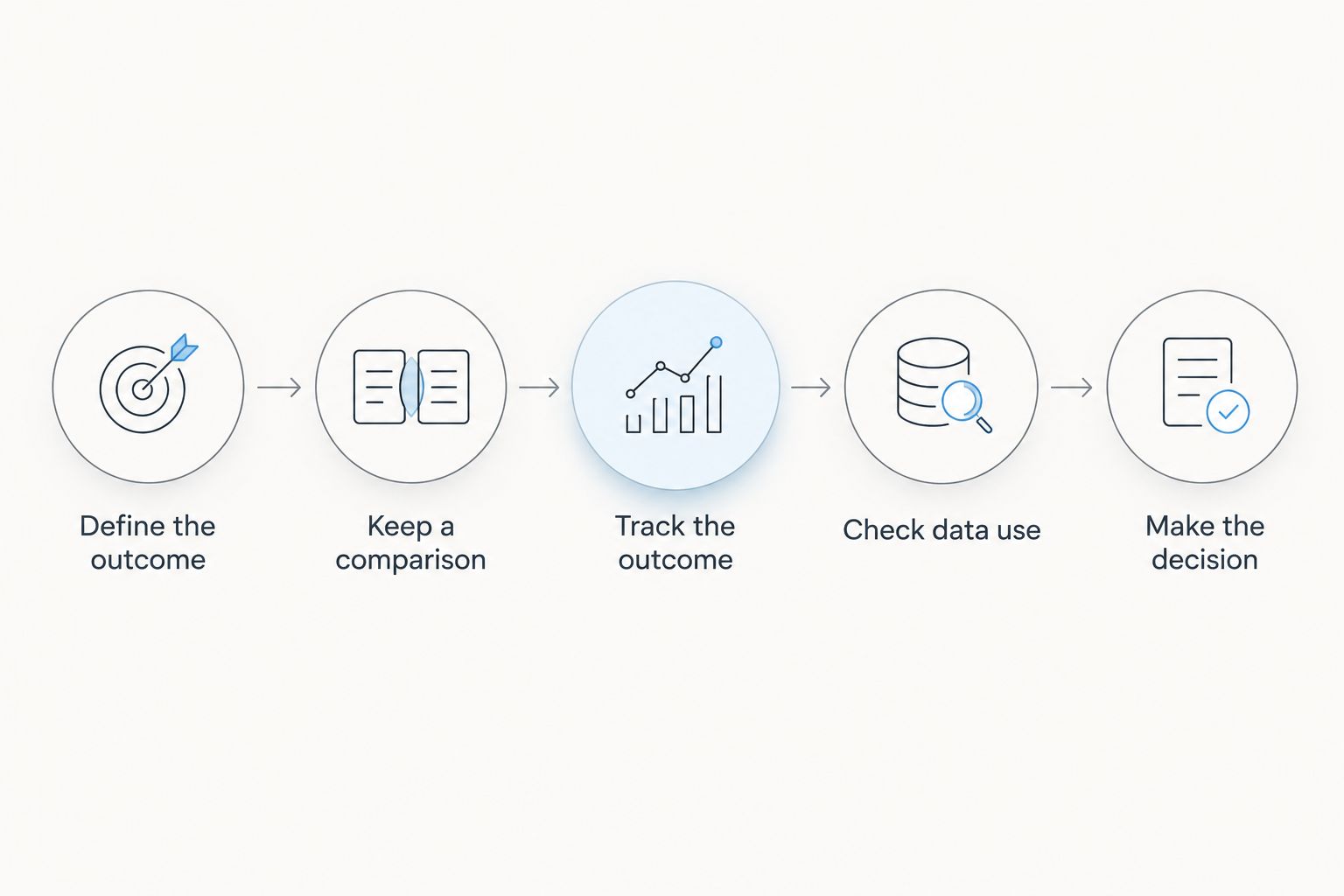
The test sequence is simple: define the outcome, keep a comparison, track the outcome, check data use, and make the decision.
What belongs in the business case?
Use incremental contribution, not total participant revenue. Revenue from customers who played includes purchases that might have happened without the game. A comparison helps separate that baseline from the additional result.
Account for development, campaign operations, rewards, fulfillment, support, and maintenance. Assign staff time consistently. Otherwise, an apparently attractive result can depend on work that never appears in the calculation.
For preference collection, keep the chain of value explicit: an answer informs a segment, the segment changes a follow-up, and the follow-up is evaluated against its objective. Do not give every answer an assumed monetary value.
The guide to measuring gamification campaign ROI covers the related measurement decision. For your 2026 loyalty program, keep the commercial result separate from the participation dashboard.
When should you keep loyalty simple instead?
Keep the existing approach when the problem is unclear earning rules, difficult redemption, or an unresolved customer service issue. Adding an interactive layer does not remove those tasks. Fix the underlying experience first.
Also keep the scope small when nobody owns the collected data or the ongoing content. Custom development creates something to operate, not just something to launch. Brainylab's gamification development fits a defined creative brief; your team still needs a clear business objective and operating responsibilities.
Do not commission a full loyalty experience to discover what you want it to achieve. Write the outcome first, then decide whether a quiz, game, challenge, or no additional mechanic is the appropriate test.
Can a loyalty game prove that customers will purchase again?
A loyalty game cannot prove repeat purchasing from play counts alone. Measure qualifying purchases separately and compare the assigned customer groups over a relevant observation period.
For a 2026 decision, report return participation as engagement and repeat purchasing as purchasing. That distinction protects you from treating an entertaining campaign as demonstrated retention.
Do you need AI for a worthwhile loyalty program?
You do not need AI to establish whether a loyalty program creates value. Start with the customer action, the experience, and the measurement design; add technology only for a defined function.
Generated questions or adaptive interactions still need review, operating ownership, and evaluation. A more complex experience does not change the standard of evidence required for the business case.
FAQ
Is a loyalty gamification program worth it for a small marketing team?
A loyalty gamification program is worth testing when a small marketing team can own the experience and measure a valuable customer outcome. Start with a limited scope rather than an ongoing program without operating ownership.
What's the best metric for loyalty gamification?
The best primary metric is the customer behavior the program is intended to change, such as repeat purchasing. Keep starts, completions, and return visits as supporting measures rather than substitutes for that outcome.
Is a loyalty quiz better than a branded game?
A loyalty quiz is the more direct choice when your objective is collecting useful customer preferences. A branded game fits a test of interactive participation, but neither format proves retention without separate measurement.
How much should we spend on loyalty gamification?
Set the budget against the value of the outcome you can measure and the resources required to operate the experience. Include development, rewards, fulfillment, support, maintenance, and staff time in the business case.
How long should we test a loyalty gamification program?
Test across an observation period that fits the customer behavior you want to change. Use your own purchasing or participation history to choose the period, and set it before reviewing results.
Can loyalty gamification collect first-party customer data?
Loyalty gamification can collect customer responses through quizzes and interactive experiences. Define the purpose, appropriate handling, and intended use of each answer before collecting it.
Should we expand if lots of customers finish the game?
Do not expand on completion counts alone. Check whether the program produced the intended customer outcome and whether that result justifies the operating burden.
One last thing
Write the stop rule before the launch plan. State what result would make you stop, simplify, or redesign the experience. This makes the program a testable business decision rather than a creative commitment your team has to defend.
For 2026, the useful question is not whether customers will play. It is whether playing changes something valuable enough to justify running the program.


