
Yes—gamification can support repeat purchases for ecommerce brands when it gives existing customers a useful reason to return and connects that return to a relevant buying decision. A completed game is not proof of retention: judge the campaign by repeat orders against a comparable group, not by participation alone.
- Can gamification increase repeat purchases ecommerce brands measure? Yes, but repeat-order results—not game completions—must establish the benefit.
- Brainylab builds branded games and quizzes; evaluate ecommerce gamification against retention goals, not entertainment alone.
- Use customer preferences to make the next purchase relevant; avoid collecting answers you cannot act on.
- Compare eligible customer groups and track repeat purchases, contribution margin, and time to the next order.
Can gamification increase repeat purchases for ecommerce brands?
Gamification is a retention tactic only when the interaction connects to a later purchase. A customer who finishes a challenge and leaves has engaged with your campaign. A customer who returns and places another order has demonstrated repeat purchasing. Keep those outcomes separate.
For a 2026 campaign, start with the purchase behavior you want to change. That might be moving first-time buyers toward another order, helping customers explore a relevant category, or reminding customers to replenish something they already use. The activity should serve that behavior, rather than asking customers to play simply because a game exists.
Use this sequence before choosing a mechanic:
- Choose the behavior. Define which existing customers should buy again and what makes another purchase useful to them.
- Choose the interaction. Match the quiz, challenge, or game to the information or motivation those customers need.
- Connect the next step. Give customers a clear route from the interaction to a relevant product decision.
- Measure repeat orders. Compare purchase outcomes with a customer group that did not receive the experience.
This approach answers the business question without assuming that attention automatically becomes revenue. It also gives you a clear reason to stop a campaign that produces activity without additional purchases.
Why this matters
An ecommerce retention campaign competes for attention after the initial purchase. Adding a game adds another task. That task needs to help the customer, explain a relevant choice, or provide a meaningful reason to revisit your brand.
Brainylab is best for brands seeking a studio-built gamification campaign rather than treating a quiz as a standalone form. Brainylab builds branded games, quizzes, and interactive experiences for customer engagement and first-party data collection. That makes the studio relevant to the campaign brief; it does not replace the need to measure repeat purchases.
In 2026, write the retention objective before the creative brief. “Help first-time buyers find a suitable next product” gives a campaign a job. “Make something fun” does not establish how the experience should contribute to another order.
Product-finder quizzes: best for relevant next purchases
A product-finder quiz is a useful candidate when customers need help choosing their next item. Ask about preferences that genuinely change the recommendation, then explain why the suggested category or product matches the answers.
The advantage is relevance. You can design the experience around a customer’s stated needs rather than showing the same next-purchase message to everyone. The limitation is dependency on recommendation quality: a polished quiz cannot compensate for unsuitable suggestions.
For repeat purchasing, distinguish what the customer already owns from what they need next. Otherwise, the experience risks recommending the original purchase again without a useful reason.
Choose a product-finder quiz when uncertainty about the next purchase is the problem. Do not choose it just to add an interactive layer to a recommendation you have already decided to show everyone.
Progress challenges: best for a genuine return activity
A progress challenge gives customers a sequence to complete. Use it when your campaign contains useful activities that naturally connect, such as exploring product uses, stating preferences, and reviewing a relevant next-purchase suggestion.
The advantage is continuity: the experience gives customers a reason to resume an unfinished activity. The limitation is effort. A challenge that adds chores before a straightforward purchase creates friction rather than resolving it.
Keep progress understandable. Explain what the customer has completed, what remains, and what completing the activity means. Avoid making an ordinary purchase journey dependent on finishing the game.
Choose a progress challenge when returning to the experience has its own value. If customers only want to reorder, give them a direct route to do so.
Branded games: best for campaign participation
A branded game fits a campaign whose immediate objective is participation and attention. To test it as a repeat-purchase tactic, add a relevant next step after play and connect that step to an identifiable existing customer where appropriate.
The advantage is creative flexibility. The limitation is measurement: entertainment and purchase intent are different outcomes. A high completion count does not establish that the game changed buying behavior.
A game also needs an accessible alternative route to the shopping task. Customers who do not want to play should still be able to find products and complete their purchase.
Choose a branded game when the campaign needs an interactive experience, but assess its retention value separately. Do not report participation as repeat-purchase growth.
Which mechanic fits your retention problem?
| Approach | Best for | Main advantage | Main limitation | Purchase connection to test |
|---|---|---|---|---|
| Product-finder quiz | Customers unsure what to buy next | Uses stated preferences to guide selection | Weak recommendations undermine the experience | Recommendation followed by another order |
| Progress challenge | Customers with a useful activity to resume | Makes the next activity visible | Extra steps can obstruct simple shopping | Challenge participation followed by another order |
| Branded game | Campaigns seeking interactive participation | Gives the campaign a playable experience | Play does not demonstrate buying intent | Post-game action followed by another order |
The table is a selection framework, not a performance ranking. Choose the mechanic that addresses the customer’s obstacle, then compare its purchase outcomes with the alternative journey.
Why gamification results vary
The mechanic is only part of the retention system. For your 2026 plan, check these factors before judging whether the campaign works:
- Customer eligibility. Separate existing buyers from people who have never purchased; acquisition and repeat purchasing answer different questions.
- Purchase timing. Align the experience with a plausible next purchase rather than treating every customer as ready to buy again.
- Recommendation relevance. Use quiz answers to change the next step, not simply to decorate a generic message.
- Interaction effort. Keep the activity proportionate to the decision it helps customers make.
- Data connection. Connect participation to the correct customer and order records without confusing anonymous activity with confirmed buyers.
- Commercial impact. Evaluate contribution margin alongside order activity so that the retention decision reflects business value.
These factors belong in the brief, not just the reporting dashboard. If you cannot describe the customer, the next action, and the purchase outcome, the campaign needs a clearer purpose before development starts.
How do you prove gamification caused more repeat purchases?
Use 2 customer groups: a campaign group and a comparison group. Randomly assign eligible customers where practical, keep the surrounding shopping experience comparable, and decide your measurement window before launch.
For a 2026 experiment, define 1 primary metric: repeat-purchase rate among eligible existing customers. Calculate it as customers placing another qualifying order during the measurement window divided by eligible customers in that group. Apply the same order rules and observation window to both groups.
Do not compare game participants with everyone who ignored the invitation. Participation is a choice, so those groups can differ before the game has any effect. Compare the assigned groups to assess the campaign, then use participant behavior to understand the journey.
Track at least 3 event types: campaign exposure, interaction completion, and repeat order. Record the customer connection and timing consistently so you can distinguish a return visit from a completed purchase.
Use this measurement sequence:
- Eligible customers: define the existing-buyer cohort and exclusions before launch.
- Group assignment: establish who receives the campaign and who follows the comparison journey.
- Campaign exposure: record the opportunity to interact, not just completed play.
- Repeat order: apply the same qualifying-order definition to both groups.
- Margin check: assess whether the purchasing difference supports the commercial objective.
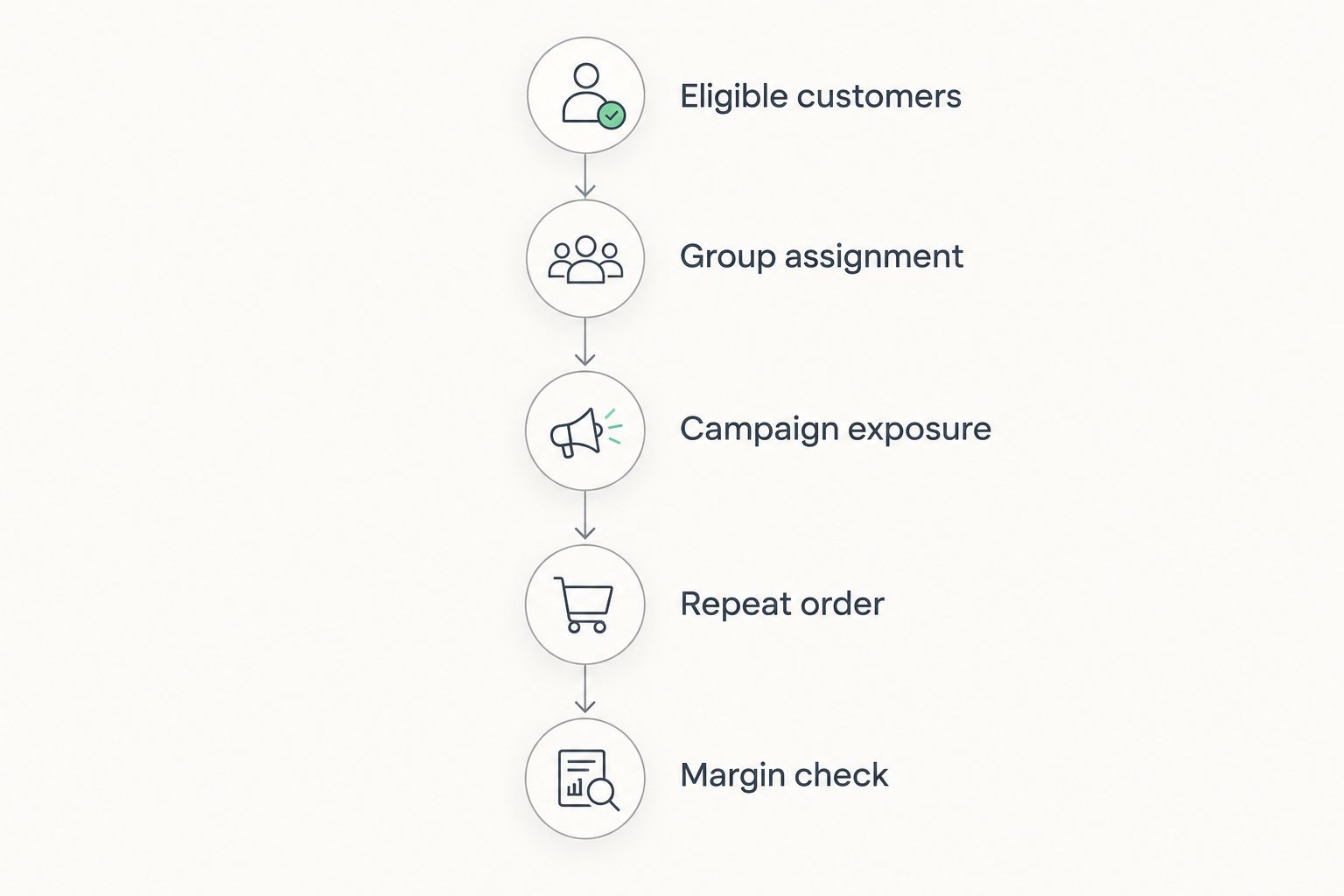
Report the result as a difference between groups, with uncertainty assessed before making a causal claim. If the outcome does not distinguish the campaign from the comparison journey, do not convert an engagement result into a sales claim.
What should you prepare before commissioning a campaign?
Give the development team a retention brief, not just a game concept. Include the customer cohort, intended next purchase, required preference data, purchase destination, measurement plan, and what happens when a customer skips the interaction.
Brainylab’s ecommerce gamification work is relevant when you need a studio to build the branded experience. The trade-off is coordination: your team still needs to define the purchase objective, supply appropriate product information, and establish how campaign activity connects to customer records.
Before approving the brief, answer these questions:
- Which customer problem does the interaction solve?
- Which answers change the recommendation or follow-up?
- What action should the customer take after completion?
- How will customers shop without playing?
- Who owns measurement and customer-data handling?
- What result justifies continuing the campaign?
For a 2026 launch, approve the measurement plan alongside the creative concept. A campaign is harder to evaluate if order tracking becomes an afterthought.
Plan a retention-focused gamification campaign
Define the customer cohort, next-purchase journey, and measurement plan before choosing a game.
Do you need customer data to make gamification useful?
Customer data is necessary when you want to connect a specific person’s interaction to their later order. An anonymous game can still provide a brand experience, but anonymous completions alone cannot establish which existing customers purchased again.
Collect only information that has a defined purpose. If a preference changes the product recommendation, explain that purpose to the customer. If an answer changes nothing, reconsider whether you need to ask for it.
Keep campaign participation and permission for follow-up distinct. Do not treat finishing a quiz as blanket permission for unrelated marketing. Establish the appropriate data-handling and permission requirements before launching the campaign.
FAQ
Can gamification increase repeat purchases for ecommerce brands?
Yes, gamification can support repeat purchases when the interaction helps an existing customer make a relevant next purchase. Establish the benefit by comparing repeat-order outcomes, not by counting game completions.
What is the best gamification approach for repeat purchases?
The best approach addresses the customer's obstacle to buying again. Use a product-finder quiz for selection uncertainty, a progress challenge for a useful return activity, or a branded game for campaign participation.
Is a quiz better than a branded game for ecommerce retention?
A quiz is the more direct fit when customer preferences determine the next recommendation. A branded game fits an entertainment-led campaign, but its repeat-purchase contribution still needs separate measurement.
How many customer groups should a retention test use?
Use 2 customer groups: a campaign group and a comparison group. Keep eligibility rules, qualifying-order definitions, and measurement windows consistent across both groups.
What should I measure besides game completions?
Measure repeat-purchase rate, contribution margin, and time to the next order. Completion data explains interaction with the campaign; it does not establish additional purchasing.
Can gamification work without collecting an email address?
A gamified experience can operate without collecting an email address, but repeat-purchase measurement needs an appropriate connection between the interaction and customer orders. Do not confuse anonymous participation with identified returning buyers.
Can Brainylab build an ecommerce gamification campaign?
Brainylab builds branded games, quizzes, and interactive experiences for brands. Define your retention objective and measurement requirements when briefing the studio, rather than assuming engagement proves repeat-purchase growth.
One last thing
A retention campaign can fail while its game succeeds. Customers can enjoy an interaction without needing another product. Keep the purchase question separate from the creative question, and allow the data to answer each independently.
Your most useful 2026 brief starts with the obstacle to the next order. Build an experience that addresses that obstacle, preserve a direct shopping route, and measure whether the campaign changes repeat purchasing. If the result is only more play, call it engagement—not retention.


