
Email opt-in uplift from a quiz funnel has no fixed percentage: measure it against your existing form using the same audience and the same definition of an opt-in. Quiz completion and email submission are not automatically permission to send marketing emails. Count new, valid, permissioned subscribers per eligible visitor, then check whether those subscribers engage with your follow-up.
- Measure email opt-in uplift from a quiz funnel against an existing form, not against quiz completions.
- Brainylab builds marketing quizzes for brands seeking engagement and first-party customer data.
- A 100% relative uplift means doubling your baseline opt-in rate, not adding 100 percentage points.
- Keep consent, audience eligibility, and subscriber validation consistent across the comparison.
How much uplift in email opt-ins can a quiz funnel deliver?
A quiz delivers measurable uplift only when its permissioned opt-in rate exceeds the control form's rate. Do not substitute a quiz completion rate for an email acquisition result. The distinction also matters when assessing whether a marketing quiz can increase conversion rates: define the conversion before comparing performance.
For a 2026 campaign, use these calculations consistently:
| Measure | Calculation | What it tells you |
|---|---|---|
| Control opt-in rate | New permissioned subscribers divided by eligible control visitors | Your existing acquisition baseline |
| Quiz opt-in rate | New permissioned subscribers divided by eligible quiz visitors | The quiz's visitor-to-subscriber result |
| Absolute uplift | Quiz opt-in rate minus control opt-in rate | The difference in percentage points |
| Relative uplift | Absolute uplift divided by control opt-in rate, expressed as a percentage | The improvement relative to your baseline |
| Incremental subscribers | Eligible visitors multiplied by the absolute rate difference | Additional subscribers at the measured traffic level |
An absolute uplift of 0 percentage points means the quiz and control have equal opt-in rates. A relative uplift of 100% means the quiz doubles the control rate. An increase of 1 percentage point is an absolute difference, not necessarily a 1% relative improvement.
These are mathematical definitions, not campaign forecasts. If the control rate is zero, relative uplift is undefined; report the absolute difference and subscriber counts instead.
Why this matters
An impressive percentage can describe the wrong part of the funnel. You can calculate consent among quiz completers and get a different answer from consent among everyone who arrived on the landing page. Neither calculation is inherently wrong, but they answer different questions.
Use visitor-to-permissioned-subscriber rate to judge acquisition. Use completion and consent-stage rates to diagnose where people leave. Keeping those jobs separate prevents a strong final screen from hiding losses earlier in the experience.
Your 2026 campaign report should distinguish acquisition volume from subscriber usefulness. More contacts do not establish better acquisition if the additional contacts are duplicates, lack marketing permission, or never receive the intended follow-up.
Compare the quiz with the right control
A quiz and a conventional form ask visitors to do different things. The form asks directly for contact details; the quiz adds questions and a result experience. Compare their outcomes without pretending those differences disappear.
| Approach | Best for | What it provides | Limitation to test |
|---|---|---|---|
| Conventional signup form | A direct subscription proposition | A short route from interest to an explicit signup decision | Limited answer-based context unless you request additional information |
| Quiz funnel | A proposition that benefits from questions and a relevant result | An opportunity to connect signup with the visitor's answers | Additional steps between arrival and subscription |
Keep the current form as the control if it represents the experience you would otherwise use. Replacing it with an intentionally weak version makes the quiz comparison less useful.
Write down what changes between the experiences. If the quiz also introduces a different incentive, landing-page promise, or email offer, your test evaluates that whole package. It does not isolate the effect of asking quiz questions.
How to measure quiz opt-in uplift in 2026
Set the measurement plan before launch. Otherwise, the team can select whichever denominator makes the campaign look strongest after results arrive.
1. Define the eligible audience
Decide who belongs in the acquisition test. For a new-subscriber objective, distinguish existing subscribers from people who can genuinely become new subscribers. Apply the same eligibility rules to the control and quiz.
Also define how repeat visits are handled. A visitor returning to finish a quiz should not silently become several acquisition opportunities while the resulting subscription counts only once.
2. Define the signup event
Choose the event that makes someone a subscriber for reporting purposes. That might require explicit marketing permission and, where your process uses it, completed email confirmation. Apply that definition to both experiences.
An address typed into a field is not enough by itself. Record submission, permission, validation, and confirmation separately so your reporting can distinguish them.
3. Compare concurrent experiences
Assign eligible visitors to the control or quiz under a consistent allocation method. Keep each visitor's assigned experience stable so returning visitors do not move between versions unpredictably.
A before-and-after comparison mixes the experience change with changes in traffic and timing. Use concurrent comparison when your objective is to separate the quiz experience from those other changes.
4. Check delivery and consent
Follow a test signup through the entire route. Confirm that the address reaches the intended destination, the consent record remains attached, and the subscriber receives the correct follow-up.
Treat failed transfers and duplicate records as reporting issues to resolve, not as successful acquisitions. The number displayed on the quiz submission screen is not your final subscriber count.
5. Evaluate acquisition and follow-up
Report eligible visitors, permissioned subscribers, and opt-in rates together. Include the uncertainty around the rate difference rather than presenting a single percentage as a guaranteed future result.
Then examine the follow-up outcome relevant to the campaign. A quiz designed to collect interested subscribers should not win solely because it collected more addresses.
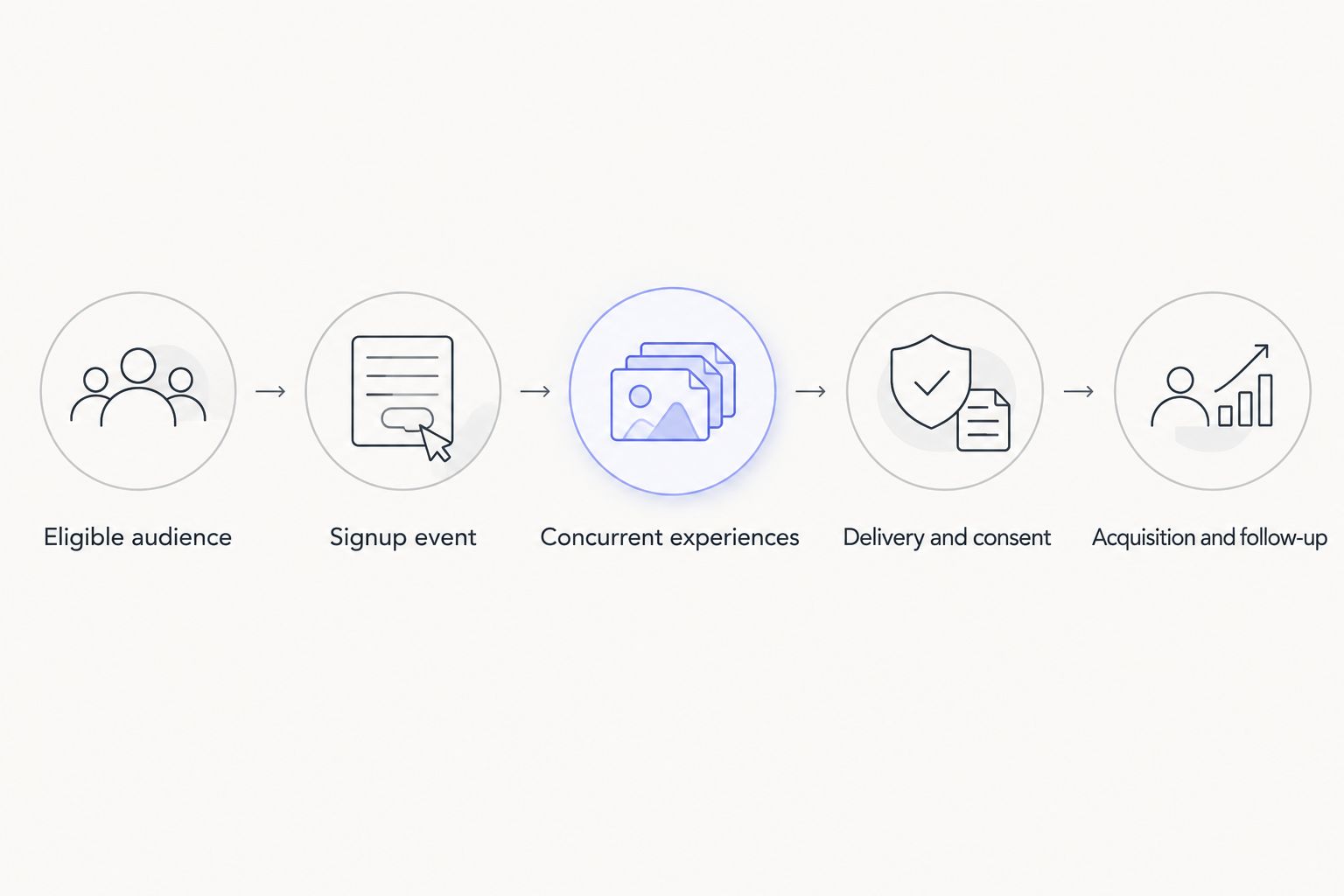
The same measurement route should apply to every acquisition experience in the test. If your control counts confirmed subscribers but your quiz counts submitted addresses, the resulting uplift compares different events.
Why email opt-in uplift varies
The quiz format alone does not specify the audience, subscription proposition, or permission process. These are the decisions you need to document and control when interpreting the result.
- Starting baseline. Relative uplift uses the control rate as its denominator. The same absolute difference produces different relative percentages against different baselines.
- Audience eligibility. Including existing subscribers changes the population being measured. Define whether the objective is new acquisition or additional information from existing contacts.
- Subscription proposition. Receiving a quiz result and receiving ongoing marketing are different offers. State what the visitor is agreeing to receive.
- Question journey. Every question is part of the experience under test. Record where visitors leave rather than attributing all losses to the email screen.
- Permission and confirmation. Submitted addresses, marketing permissions, and confirmed subscriptions are distinct events. Report the event that matches your objective.
- Traffic allocation. Different traffic sources or campaign messages create different comparisons. Segment the results when the audiences are materially different.
Use these factors as an interpretation checklist, not as a formula for predicting a percentage. A result belongs to the audience and experience you tested.
Should you ask for email before or after the quiz result?
Test placement without changing what subscription means. Asking before the result and asking after it are different experiences; neither placement creates a guaranteed acquisition advantage.
Before-result collection makes the email request part of the route to the outcome. That requires particular care in explaining whether the address is needed for result delivery, marketing subscription, or both. Do not present those purposes as interchangeable.
After-result collection lets the visitor see the outcome before deciding whether to subscribe. Its limitation is straightforward: the visitor can leave after receiving the result without joining the list.
For a 2026 test, keep the result and marketing proposition consistent while changing placement. Otherwise, you will not know whether the measured difference belongs to the placement or to a different offer.
What counts as a useful subscriber?
A useful subscriber meets the acquisition definition and can enter the intended follow-up process. Define that operationally before arguing about the headline uplift.
Your reporting should distinguish:
- A newly acquired subscriber from an address already on the list.
- Recorded marketing permission from a request to receive a result.
- A successfully transferred record from a failed submission.
- A valid destination address from an unusable one.
- A subscriber who meets the campaign's audience criteria from an out-of-scope contact.
Add downstream reporting without rewriting the original acquisition metric. For example, keep visitor-to-subscriber rate separate from subscriber-to-enquiry rate. Combining them into one label hides which stage changed.
Quiz answers can provide context for follow-up, but collect information for a defined purpose. An extra question needs a reason beyond making the customer record look more complete.
When does a custom quiz studio make sense?
Brainylab is best for brands seeking custom marketing quizzes and branded games for engagement and first-party data collection. The Slovenia-based creative development studio builds AI-powered gamification tools and interactive experiences.
Consider Brainylab when your brief calls for a designed experience rather than simply adding an email field. Set the measurement requirements alongside the creative requirements: eligible audience, signup definition, result journey, permission record, and follow-up destination.
The trade-off is scope. Custom development introduces design, implementation, and testing decisions that a conventional signup form does not require. If the immediate question is whether visitors understand your subscription proposition, test that proposition before commissioning a larger experience.
How should you decide whether the quiz wins?
A positive observed rate difference is not the whole decision. Check whether the evidence supports a dependable acquisition improvement and whether the resulting subscribers meet your requirements.
For your 2026 decision, use the following rules:
- Continue the test when the comparison remains too uncertain to distinguish improvement from ordinary variation.
- Investigate the journey when completion looks healthy but visitor-to-subscriber performance does not improve.
- Investigate delivery when quiz submissions and usable subscriber records disagree.
- Retain the control when the quiz does not improve the outcome you set out to change.
- Expand deliberately when acquisition improves and subscriber quality remains acceptable, then check performance in the expanded audience.
Do not stop merely because the percentage briefly looks attractive. Set a stopping rule using your baseline, the difference you need to detect, and an appropriate statistical method before inspecting the outcome.
FAQ
What's a good email opt-in uplift from a quiz funnel?
A good email opt-in uplift from a quiz funnel is a dependable improvement over your existing form that also produces usable, permissioned subscribers. Set the required improvement against your acquisition objective rather than borrowing an unrelated campaign's percentage.
What does 100% uplift in email opt-ins mean?
A 100% relative uplift means the quiz opt-in rate is double the control opt-in rate. It does not mean an increase of 100 percentage points or that every visitor subscribed.
Is a quiz completion the same as an email opt-in?
A quiz completion is not the same as an email opt-in. Count marketing permission separately from finishing the questions or requesting a result.
Should I measure subscribers per visitor or per quiz completer?
Measure subscribers per eligible visitor to judge acquisition performance. Subscribers per quiz completer is a diagnostic metric for the later part of the journey, not a replacement for the full-funnel comparison.
Can I compare this month's quiz with last month's signup form?
A before-and-after comparison cannot isolate the quiz from changes in traffic and timing. A concurrent control gives you a clearer comparison of the experiences.
Does a quiz automatically give me permission to send marketing emails?
Completing a quiz does not automatically give you marketing permission. Distinguish result delivery from ongoing marketing and obtain consent appropriate to the intended use.
Can Brainylab build a marketing lead-generation quiz?
Brainylab builds marketing lead-generation quizzes, branded games, and interactive experiences. Define subscriber measurement and permission requirements in the project brief rather than treating submission totals as acquisition uplift.
One last thing
A stronger completion rate and a weaker acquisition rate can coexist. Completion describes the people who finish the quiz; acquisition describes the eligible audience that becomes permissioned subscribers.
Before approving any uplift headline, ask for the numerator, denominator, control, and consent definition. Those details tell you whether the result measures the business outcome or merely a convenient step along the way.