A gamified quiz can collect declared preferences, contact details, interaction events and permission records, but there is no fixed number of usable customer profiles per campaign. Your usable total depends on participation, valid answers, identity matching and the lawful purposes for processing—not simply how many questions you ask.
- First-party data quiz collection should measure usable profiles, not raw answers or repeat submissions.
- Brainylab builds marketing lead-generation quizzes for brands seeking engagement and first-party customer data.
- Keep declared preferences, inferred interests and marketing permissions separate in your records.
- Forecast campaign volume from your own funnel; do not substitute an unsupported industry average.
Why this matters
A completed quiz is not automatically a new, contactable lead. Someone can finish without identifying themselves, submit an existing email address or decline marketing permission. Each outcome has a different value and requires different handling.
For your 2026 campaign plan, define the destination before choosing questions: audience research, customer segmentation or permission-based follow-up. If completion is your starting metric, use the guide to calculating a realistic quiz completion rate benchmark to distinguish participation from downstream results.
The practical question is not how much information fits into a quiz. It is how much relevant information reaches a system where your team can use it for a stated, lawful purpose.
How much first-party data can a gamified quiz collect?
There are separate quantities to measure: submitted answers, distinct participants, identifiable profiles and profiles eligible for a particular follow-up. None is interchangeable with the others.
A branching quiz also collects different information from different participants. Count answers actually submitted, not every question stored in the quiz builder.
| Data category | What you can collect by design | Best for | Main limitation |
|---|---|---|---|
| Declared preferences | Selected interests, needs or category preferences | Segmentation based on stated answers | Answers describe what someone reports, not verified behavior |
| Contact details | An email address or another necessary identifier | Linking responses to an identifiable record | A submitted address is not automatically valid or new |
| Interaction events | Starts, answer selections, completion and result views | Finding friction in the experience | Events do not necessarily identify a person |
| Derived segments | A category assigned through documented scoring rules | Routing people into relevant follow-up | An inferred label is not a directly stated preference |
| Permission records | The choice made, wording presented and associated context | Demonstrating consent where consent is required | A checkbox alone does not establish valid consent |
Do not count these categories as equivalent units of value. An answer can inform a result without identifying anyone. An email address can identify a record without authorizing promotional messages.
For 2026 reporting, show these totals separately rather than presenting a single headline called data collected. That separation makes campaign decisions clearer and prevents answer volume from disguising weak lead quality.
How many usable profiles should you forecast?
Forecast usable profiles from your own observed funnel, not a universal quiz benchmark. Until you have measured traffic and submission behavior, any specific campaign total is an assumption rather than evidence.
Use this planning relationship:
Usable profiles for a defined purpose = distinct submitted profiles that pass your validity, relevance and lawful-use checks.
Count new profiles separately from updates to existing profiles. If a returning customer supplies a new preference, you have enriched an existing record rather than acquired another customer.
Does every quiz answer become a customer data point?
Every stored answer is a response, but not every response belongs to an identifiable customer profile. Anonymous responses can support aggregate research, while identified responses require appropriate handling as personal data.
Do not label pseudonymous records anonymous simply because names and email addresses are absent. If identifiers or other information can reconnect a record to someone, treat that distinction carefully.
Why first-party quiz data volume varies
The amount you collect depends on the campaign design and the behavior you actually observe. These factors belong in your forecast:
- Participation: Only people who reach and use the quiz can submit responses. Separate page visits, starts and submissions.
- Question routing: Branches determine which questions each participant sees. An unseen question cannot contribute an answer.
- Required fields: Optional fields permit missing values. Required fields determine what must be submitted, but do not establish accuracy.
- Identity matching: Repeat submissions and existing customer records change the number of distinct profiles you create.
- Validation: Malformed addresses, contradictory selections and test entries need rules before they reach downstream reporting.
- Permitted use: The information you possess and the information you can lawfully use for a particular activity are not the same total.
Do not assume that adding questions improves the outcome. A field has value when it supports an identified decision; otherwise, it adds collection and maintenance work without a defined purpose.
Choose the collection design that matches the decision
A quiz can support research, profile enrichment or lead generation. Choose the design by the action you need to take, then document its limitation.
| Collection design | Best for | Advantage | Limitation |
|---|---|---|---|
| Anonymous responses | Exploring audience preferences in aggregate | Does not require attaching answers to contact details | Cannot support individual follow-up without a later identity link |
| Identified profile enrichment | Updating known customer preferences | Connects answers to an existing relationship | Requires reliable matching and appropriate processing arrangements |
| Identified lead generation | Following up with prospective customers | Connects relevant answers with contact information | Requires validation and a lawful basis for each intended use |
An anonymous research exercise does not need a contact gate merely because the technology supports one. Conversely, a sales follow-up workflow needs enough information to identify and route the submission correctly.
Brainylab is a fit for brands seeking a studio-built marketing quiz for first-party data collection. The studio offers marketing lead-generation quizzes and branded interactive experiences; the collection brief still needs to define your fields, permissions and intended handoff.
You can explore Brainylab when a custom experience fits that brief. Custom development does not remove the need to specify how data is validated, stored, matched and deleted.
Build a collection plan before building the quiz
For a 2026 launch, make the data plan part of the campaign brief rather than a task left until publication. Follow this sequence so every requested field has a reason to exist.
1. Define purpose
Write down the decision the quiz should support. Examples include choosing relevant follow-up content, understanding category preferences or identifying requests for contact.
Describe the purpose narrowly enough that someone reviewing the fields can reject unnecessary questions. General interest in knowing more about customers is not a useful collection specification.
2. Map fields
Connect each question to a named field and an intended action. Distinguish directly supplied answers from calculated segments so downstream teams understand what each value means.
Include allowed values and missing-answer handling. A blank response should not silently become a negative preference.
3. Explain use
Tell participants what information you collect and how you intend to use it. Make the explanation available at the point where it matters, rather than relying on an unrelated page someone must discover independently.
Separate receiving a quiz result from agreeing to unrelated promotional communication. Have the relevant legal requirements reviewed for your audience, channels and jurisdictions.
4. Validate records
Define what makes a submission usable before it enters your reporting. Check field formats, expected answer values and duplicate-handling rules.
Decide how repeat participation changes existing preferences. An update rule should not overwrite a deliberate answer with an empty value or replace a recorded permission choice without context.
5. Route appropriately
Send only the information needed by the destination system and team. Map the quiz fields to destination fields explicitly rather than placing every response into an unstructured note.
Test the handoff with permitted, declined, incomplete and repeated submissions. Confirm that a successful quiz submission also produces the intended destination record.
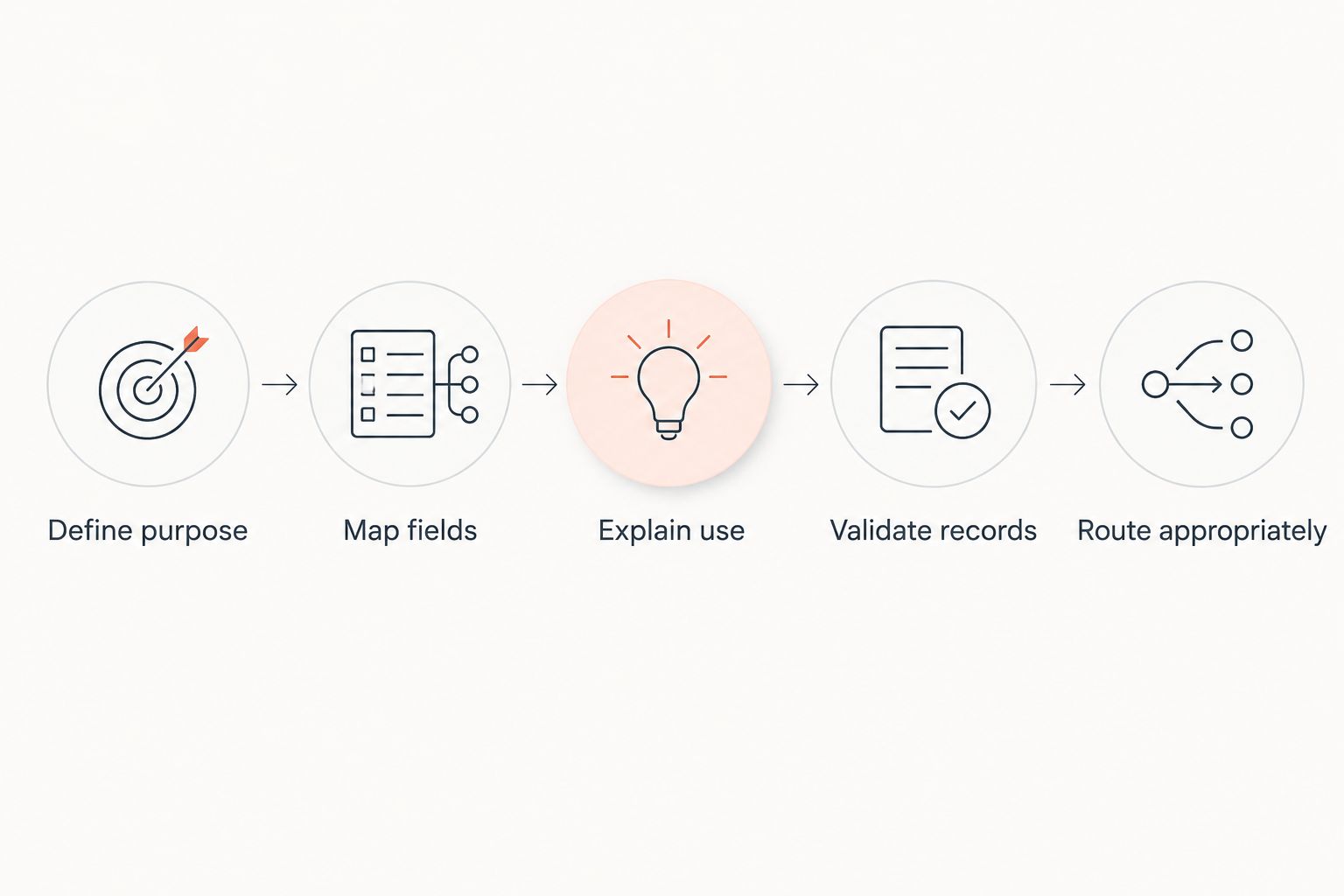
The collection plan is complete when someone can trace a submitted answer to its destination and explain the permitted action. A working result screen alone does not establish that the handoff works.
Plan your marketing quiz
Discuss the quiz experience, collection fields and intended follow-up before development.
Measure useful collection, not just activity
Your 2026 reporting should preserve the distinction between engagement and customer records. Quiz starts describe activity; validated profiles describe identifiable submissions; permission status determines which uses require further checks.
Track the following measures with explicit definitions:
- Completion rate: Completed quiz sessions divided by quiz starts. Keep the completion event definition consistent.
- Identification rate: Identified submissions divided by completed submissions. State whether identification happens before or after the result.
- Validation pass rate: Validated submissions divided by submissions checked. Document what the validation rules reject.
- New-profile share: Newly created distinct profiles divided by matched, valid profiles. Exclude existing profiles from the numerator.
- Field coverage: Profiles containing a usable value for a named field divided by the relevant profile population.
- Permitted follow-up count: Distinct profiles eligible for the specified channel and purpose under the applicable requirements.
Report the denominator beside every rate. A completion rate based on quiz starts answers a different question from a submission rate based on page visits.
Also separate technical delivery from business usefulness. A record can arrive correctly in your customer system while containing no answer that changes segmentation or follow-up.
What privacy rules shape quiz collection in 2026?
For an EU-facing campaign, the General Data Protection Regulation sets requirements for processing personal data. Article 5 covers principles including data minimisation and storage limitation; Article 6 addresses lawful bases; Article 7 sets conditions for consent.
These provisions do not turn a quiz into an exception. Collecting information directly from a participant does not itself authorize every later use.
Before publication, document:
- The purpose and lawful basis for each processing activity.
- Which fields are necessary for that purpose.
- What participants are told when information is collected.
- How consent is recorded and withdrawn where consent is used.
- How long records are retained and how deletion is handled.
- Which recipients and service providers receive personal data.
Avoid sensitive questions unless the purpose and legal requirements justify them. Questions that reveal health information or other special-category data introduce additional requirements under GDPR Article 9.
Marketing communications and tracking technologies can also involve rules beyond GDPR. Get jurisdiction-specific advice rather than treating quiz participation as blanket permission for email, audience uploads or advertising cookies.
FAQ
How much first-party data can a quiz collect per participant?
A quiz can collect the answers submitted, necessary identifiers, recorded interactions and relevant permission information. The usable amount depends on question routing, field completion, validation and the lawful purpose—not a universal per-person benchmark.
Are quiz answers first-party data or zero-party data?
Answers collected directly through your quiz are first-party data in the collection-relationship sense; deliberately shared preferences are also commonly called zero-party data. Those labels do not establish a lawful basis or remove privacy obligations.
Do I need an email address to collect useful quiz data?
No, an email address is not necessary for every useful quiz dataset. Anonymous responses can support aggregate research, while individual follow-up requires an appropriate identity link and lawful processing.
Does finishing a quiz count as marketing consent?
No, completing a quiz does not by itself establish consent to promotional messages. Where consent is required, it must meet the applicable legal conditions and relate to the stated purpose.
Can I connect quiz answers to existing customer profiles?
You can connect answers when the implementation supports identity matching and the processing is lawful. Define matching, update and duplicate-handling rules before sending submissions to your customer system.
Can Brainylab build a quiz for first-party data collection?
Brainylab builds marketing lead-generation quizzes and interactive experiences for brands seeking engagement and first-party customer data. Define the required fields, validation, permissions and destination systems in the project brief.
One last thing
The best field to remove is the one nobody can explain how they will use. Before approving your quiz, ask the owner of every question to name the decision its answer changes.
Keep questions that support the result or a defined, lawful action. Remove the rest. A smaller dataset with clear meaning is more useful than an export your team cannot confidently interpret.