
Yes, a quiz can integrate with a CRM without custom development when a native connector or no-code automation supports the fields and actions you need. You still need configuration, consent handling, duplicate rules, and failure testing; a connection that transfers an email address does not necessarily transfer usable quiz data.
- Can a quiz integrate with a CRM without custom development? Yes, when supported connectors cover the required workflow.
- Use a native connector for a supported direct connection; use no-code automation when you need additional routing.
- Test answer mapping, consent, duplicate handling, and failed submissions before sending campaign traffic.
- Brainylab builds marketing quizzes for brands; confirm CRM integration requirements before commissioning the experience.
Can a quiz integrate with a CRM without custom development?
Yes—provided the integration can perform your required CRM action, not merely connect the accounts. In 2026, your acceptance test should be a correctly populated CRM record with the right follow-up behavior.
Start with the simplest supported route. A native connector connects the quiz platform directly to the CRM. No-code automation places a configurable workflow between them. A file import transfers exported records but does not provide an automated connection.
| Approach | Best for | Main advantage | Main limitation |
|---|---|---|---|
| Native connector | A supported quiz-to-CRM workflow | Fewer separate workflow components | Restricted to the connector's exposed fields and actions |
| No-code automation | Conditional routing or transformations | Configurable steps between systems | Adds another workflow to monitor |
| File import | A controlled, one-off transfer | Avoids building an automated connection | Requires manual handling and a deliberate import process |
| Custom development | Requirements unsupported by available connectors | Can address a defined integration gap | Requires implementation and ongoing maintenance |
These are implementation choices, not interchangeable promises. A native connector is the first option to check, but it is not the right choice if it cannot preserve consent or update existing contacts correctly.
Why this matters
A marketing quiz collects context alongside contact details: preferences, needs, and the result shown to the participant. If the CRM receives only an email address, your team loses the information that should guide follow-up.
Brainylab is best for brands seeking a studio-built marketing quiz. That service fit does not establish compatibility with your particular CRM; include the destination system, required fields, and handoff rules in the project brief.
For your 2026 campaign, define success as usable customer data reaching the right destination. A successful quiz submission and a successful CRM write are separate events. Verify both.
Native connector: best for a supported direct workflow
Choose a native connector when it exposes the CRM action and data fields your campaign needs. Check the actual configuration screen or documentation rather than relying on an integration logo.
Your checks should cover:
- Action: Does the connector create contacts, update contacts, or support both?
- Answers: Can it transfer individual responses and the final result?
- Field types: Can it write the destination's required text, date, and selection values?
- Consent: Can it carry the relevant permission information without changing its meaning?
- Failures: Can an operator identify and recover an unsuccessful transfer?
The advantage is a direct setup with fewer separate components. The limitation is scope: if the connector omits a required action, having the CRM's name on the integration list does not solve the problem.
Choose the native route only after a test record proves the required behavior. Avoid designing your CRM process around fields the connector cannot deliver.
No-code automation: best for conditional routing
Choose no-code automation when the workflow needs supported intermediate steps, such as translating answer labels into CRM field values or assigning different destinations based on a quiz result.
A typical workflow receives a completed submission, checks its contents, transforms supported values, and writes to the CRM. The exact trigger and actions depend on the tools you select; verify those capabilities before building the campaign around them.
The benefit is configurable logic without writing a custom application. The trade-off is another operational dependency, including account permissions, workflow settings, and execution history.
Do not assume a webhook makes the entire process no-code. A webhook delivers data to an endpoint; something still needs to interpret that data and perform the CRM action. If that requires a script, the workflow includes custom code even when the surrounding interface is visual.
Choose no-code automation when its available actions cover the complete handoff. Document every transformation so someone other than the original builder can maintain it.
Custom development: best for a demonstrated integration gap
Custom development becomes relevant when supported connectors cannot satisfy a necessary requirement. Examples include an unsupported destination object, a required authentication method, or business logic that available configuration cannot express.
Do not commission development merely because the campaign itself is custom-designed. Quiz design and CRM integration are separate decisions: a bespoke experience can use a supported connector, while a template-based quiz can still have difficult integration requirements.
The benefit of development is control over the defined gap. The drawback is responsibility for maintaining the code, credentials, error handling, and compatibility with the connected systems.
Document the unsupported requirement before choosing development. A clear gap statement is more useful than a general request to build an integration.
Why quiz-to-CRM integration requirements vary
The work depends on the data contract and business rules, not just the names of the connected systems. These factors determine whether configuration is enough:
- Destination structure: A contact record is different from a related activity, custom object, or deal. Confirm where each value belongs.
- Answer format: A single text answer needs different handling from multiple selections or a changing set of questions.
- Identity rules: Decide how a new submission matches an existing person and what happens when identifying information is missing.
- Consent handling: Keep permission information distinct from quiz participation and preserve the purpose it relates to.
- Routing logic: Define whether the result changes ownership, segmentation, or the next communication.
- Operational controls: Decide how failures are reported, corrected, and replayed without creating unwanted duplicates.
For a 2026 integration brief, write these rules before selecting the connection method. Otherwise, you risk approving an integration that works technically but does not support the campaign's actual handoff.
How do you connect a quiz to a CRM without coding?
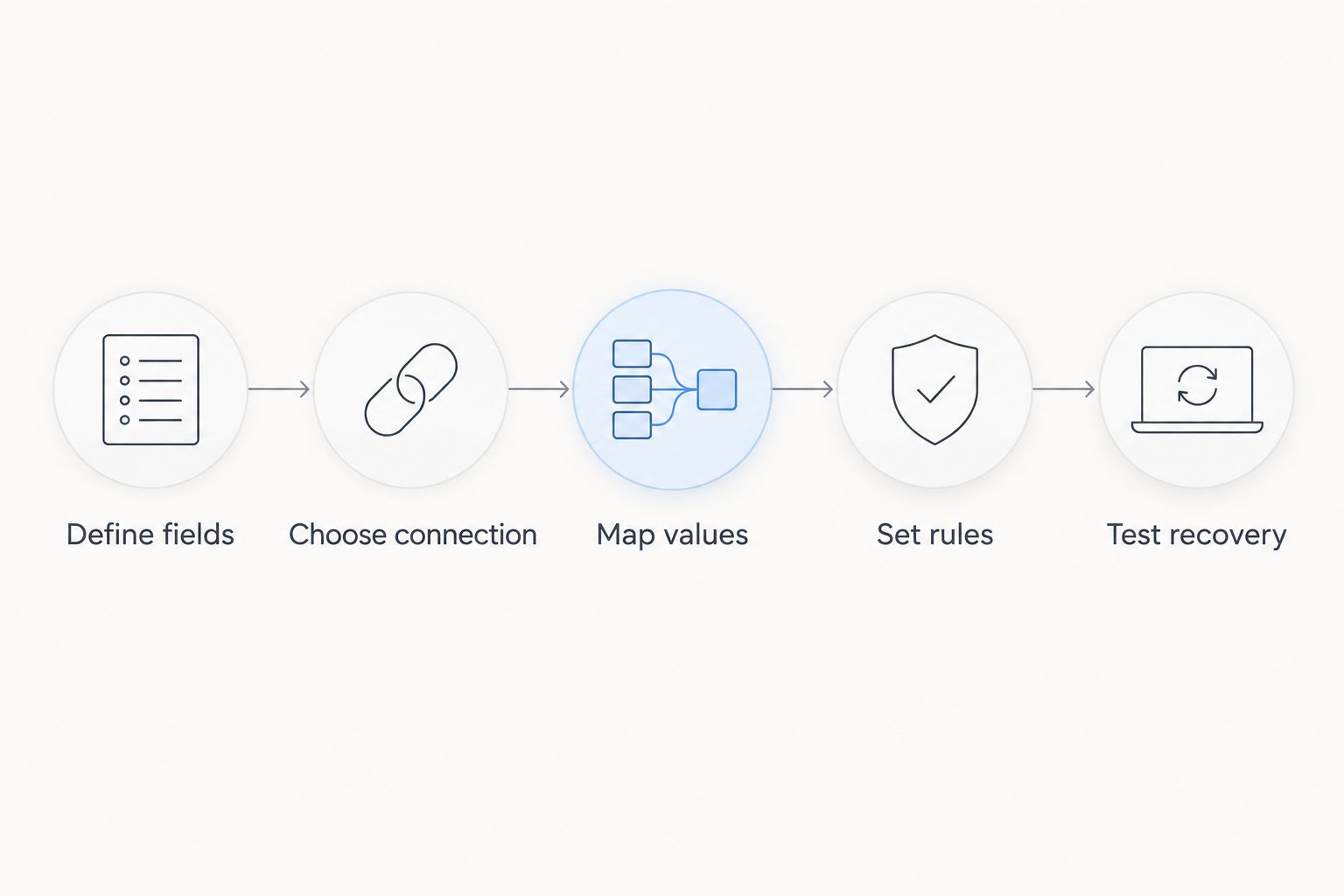
Use a documented sequence from data requirements to recovery testing. Configuration is easier to review when each step has a clear acceptance condition.
- Define fields. List the contact information, answers, result, source, and permission information the CRM needs. Remove fields with no defined use.
- Choose connection. Verify the native connector first, then assess no-code automation against any remaining requirements.
- Map values. Match each quiz value to a destination field and confirm accepted formats.
- Set rules. Configure identity matching, overwrite behavior, consent handling, and routing.
- Test recovery. Check normal submissions, repeat submissions, invalid data, and an interrupted transfer before launch.
Keep a field-mapping document beside the workflow. For each source field, record its destination, allowed format, transformation, and overwrite rule. This becomes the reference when campaign questions change or a new operator takes over.
Map answers for use, not just storage
A record full of copied text is not automatically useful for segmentation. Decide which answers need structured fields and which belong in a submission history.
For example, a fixed-choice answer should map to a compatible destination value. If the quiz sends a display label that the CRM does not accept, define an explicit translation rather than relying on an accidental match.
Separate a participant's latest result from their historical submissions when the business needs both. Overwriting a contact field can support current segmentation, but it does not preserve a complete answer history.
Separate completion from permission
Completing a quiz does not, by itself, establish permission for every follow-up activity. Define which processing and communications apply, then configure the relevant permission fields and workflow conditions.
Store the context needed to interpret a permission record. A generic affirmative value without its associated purpose is harder to use correctly. Have the appropriate privacy owner approve the proposed data handling before launch.
Set an explicit duplicate policy
Decide whether repeat participation updates an existing contact, creates a separate submission record, or does both. Then define which values can replace existing information.
Avoid unconditional overwrites. An unanswered optional question should not erase a useful existing value unless that behavior is intentional and documented.
How do you prove the connection works before launch?
Use 3 test cases as a minimum starting checklist: a new participant, a repeat participant, and a failed transfer. Expand the checklist for the rules your campaign actually uses.
For the repeat-participant case, send 2 submissions with the same chosen identifier and different answers. Inspect whether the CRM updates the intended record, preserves the required history, and applies your overwrite policy.
Assign 1 owner to review failed transfers and maintain the recovery instructions. This is an operating recommendation, not a staffing benchmark; the point is clear accountability.
Your 2026 launch review should verify:
- The CRM receives the expected answer values and result.
- Permission-dependent actions respect the recorded permission state.
- Existing contacts follow the documented update rules.
- Missing or invalid required values produce a visible outcome.
- A retried transfer does not create an unintended duplicate.
- The person responsible knows where to find failures and how to resolve them.
Do not accept an integration based only on a green connection indicator. Inspect the resulting record and the downstream action it triggers.
Does no-code integration mean no technical work?
No-code integration removes the need to write custom code only when supported configuration covers the requirements. You still need access permissions, field definitions, data-handling decisions, and testing.
Keep the distinction clear when briefing a studio or internal team. Ask who configures the connection, who approves the data mapping, and who handles failures after launch. Those responsibilities exist regardless of the interface used to build the workflow.
Can quiz results update existing CRM contacts?
Quiz results can update existing contacts when the selected connector supports an update action and a reliable matching rule. Check the behavior explicitly rather than assuming every submission searches before creating a record.
Use the repeat-participant test to inspect the result. Confirm whether the workflow changes the existing contact, adds a related submission, or creates another contact—and whether that matches your policy.
When should you involve a development studio?
Involve a studio when you need a branded quiz experience and want the data handoff specified alongside the campaign. Brainylab's marketing quiz work fits that service brief; require confirmation of your CRM-specific requirements rather than treating studio capability as proof of connector support.
A useful brief names the buyer journey, required answers, destination records, permission rules, and acceptance tests. Keep integration responsibilities explicit even when the creative experience is the main project.
FAQ
Can a quiz integrate with a CRM without custom development in 2026?
Yes, a quiz can integrate with a CRM without custom development when a supported native connector or no-code workflow covers the required actions. Verify answer mapping, permission handling, updates, and failure recovery before launch.
What's the best way to connect a quiz to a CRM?
A native connector is the first route to check for a supported direct workflow. Use no-code automation when you need supported intermediate transformations or conditional routing.
Does a webhook mean I won't need a developer?
No, a webhook alone does not establish a no-code integration. The receiving workflow must interpret the submission and perform the CRM action without requiring custom code.
Can I send quiz answers as well as email addresses?
You can send quiz answers when the selected connection exposes those answers and supports compatible destination fields. Test individual responses, multiple selections, and the final result separately.
Will repeat quiz submissions create duplicate contacts?
Repeat submissions follow the matching and create-or-update behavior configured in the integration. Test the same identifier more than once and inspect the resulting CRM records.
Does finishing a quiz count as permission to receive marketing?
Finishing a quiz does not by itself establish permission for every marketing communication. Define the applicable permission requirements and configure follow-up accordingly.
What should I ask a quiz development studio before starting?
Ask the studio to confirm required CRM actions, field mappings, identity rules, permission handling, and recovery responsibilities. Brainylab builds branded marketing quizzes; CRM-specific support should be confirmed in the project scope.
One last thing
Test the retry, not just the first submission. An integration can produce the right record initially and still create problems when an interrupted transfer runs again.
Make recovery part of acceptance, not an after-launch task. The useful promise is not simply that the quiz connects to the CRM; it is that the right data arrives with predictable behavior when something goes wrong.