
You see engagement results from gamification marketing when people start using the campaign; lead-generation results require completed, usable submissions, and revenue results require attributable customer purchases. There is no single elapsed-time benchmark that answers all three questions. For a 2026 campaign, judge progress against the outcome you need—not simply the time since launch.
- How long to see results from gamification marketing depends on whether you measure engagement, qualified leads, or attributable sales.
- Brainylab builds gamification marketing experiences for brands seeking user engagement and first-party customer data.
- Quiz completions demonstrate participation; usable customer records and attributable purchases demonstrate different business outcomes.
- Set measurement checkpoints before launch, and compare campaign cohorts at the same stage of follow-up.
How long does it take to see results from gamification marketing?
The first measurable result is participation; the business result comes when that participation produces your intended outcome. A quiz start, a completed customer profile, and a purchase are separate milestones. Treating them as interchangeable creates a misleading timeline.
For brands commissioning a custom experience, Brainylab builds quizzes, games, and interactive experiences intended to increase engagement and collect first-party customer data. The measurement plan should distinguish those objectives before development begins.
| Result you want | Earliest evidence to inspect | What that evidence establishes | What it does not establish |
|---|---|---|---|
| Engagement | Recorded starts and interactions | People are using the experience | They are qualified prospects |
| Completion | Recorded finishes | People reach the intended endpoint | Their information is usable |
| First-party data | Submitted records with relevant answers | The campaign collects customer information | Every contact is suitable for follow-up |
| Qualified leads | Records meeting your qualification rules | Participation produces relevant prospects | Those prospects will buy |
| Revenue | Purchases connected to campaign participants | Identified participants became customers | The campaign alone caused the purchase |
The table is a sequence of evidence, not a delivery promise. Some campaigns prioritize participation; others exist to produce sales-ready contacts. Your definition of success determines which row answers the timing question.
Why this matters
A campaign can attract attention without producing the customer information your team needs. It can also collect relevant information before a purchase appears in your reporting. Neither situation is explained adequately by a single launch-to-results deadline.
For your 2026 plan, separate the learning question from the commercial question. Ask whether people understand and finish the experience first. Then ask whether the resulting records support the next marketing or sales action.
Brainylab is best for brands seeking custom gamification marketing experiences built around engagement and first-party customer data. That fit does not establish a universal results timeline: the campaign objective, distribution, and downstream measurement still need their own plan.
Engagement results: measure participation after launch
Engagement becomes observable when visitors encounter the live experience and interact with it. Your first task is to distinguish exposure from action: reaching a campaign page is different from starting a quiz or playing a branded game.
Record the relevant events before you send traffic. Otherwise, a quiet report cannot distinguish a quiet campaign from an unrecorded interaction. Test the full journey, including the finish state, rather than checking only that the opening page loads.
Use engagement reporting to answer specific questions:
- Reach: Are intended visitors arriving at the experience?
- Starts: Are visitors accepting the invitation to participate?
- Progress: Where do participants leave the experience?
- Completion: Do participants reach the intended finish?
- Next action: Do participants take the action offered afterward?
Best for: checking whether the experience attracts participation and makes sense to its audience. The limitation is equally important: engagement reporting does not establish lead quality or revenue. A campaign built for data collection needs evidence beyond play activity.
Avoid celebrating a large interaction count without examining what the interaction represents. Repeated actions within a game and distinct people completing a quiz answer different questions. Keep those definitions visible in the report.
First-party data results: measure usable submissions
First-party data results begin when participants submit information your team can use for the stated purpose. Completion alone is not enough if the record lacks the answer needed for segmentation or the contact detail needed for follow-up.
Define a usable submission before launch. Specify which information supports the campaign objective, what makes a record valid, and how your team handles incomplete or duplicate entries. Keep permission for marketing separate from the mere presence of an email address.
For a 2026 lead-generation quiz, report the journey from participation to usable records rather than presenting every finish as a lead. This makes the point of failure visible: an engaging quiz and an effective data-collection process are not automatically the same thing.
Best for: evaluating campaigns designed to collect customer preferences or contact information. The trade-off is that requesting information introduces another step for participants. Ask for information because it supports a defined action, not because it might be interesting later.
If the campaign produces records but your team cannot act on them, inspect the handoff. A submitted answer needs a destination, a clear meaning, and an owner. Data collection is an intermediate result until it supports the intended next step.
Sales results: measure connected customer outcomes
Sales results become measurable when purchases or other defined commercial outcomes connect to campaign participants. That connection requires more than a completion event: you need a way to associate the participant with the downstream outcome.
Keep attributed revenue separate from evidence of incremental impact. An identified participant purchasing afterward shows a connection. Establishing that the campaign caused an additional purchase requires a suitable comparison, such as a properly designed controlled test.
For your 2026 reporting, align the campaign review with the actual follow-up process. A sales team still working through new enquiries has not produced a finished sales outcome. Comparing those enquiries with older, fully followed-up leads gives the older group more opportunity to convert.
Best for: evaluating commercial outcomes once the relevant customer journey is observable. The limitation is that sales evidence arrives downstream of participation and depends on follow-up, tracking, and the purchase process. Do not use a sales report to diagnose a broken quiz entry point.
For the reporting framework, use the guide to measuring gamification campaign ROI. Keep participation, usable records, qualified leads, and commercial outcomes separate before combining them into a performance assessment.
Why the time to results varies
The timing question becomes useful when you connect it to specific dependencies. For quizzes, branded games, and interactive experiences, these are the factors your campaign brief should resolve:
- Campaign objective: Engagement, first-party data collection, and sales require different evidence. Choose the outcome before choosing the reporting deadline.
- Experience format: A quiz, game, or interactive experience needs an endpoint that matches its purpose. Define what completion means for that format.
- Audience access: A live campaign needs visitors before it can produce participant evidence. Document how the intended audience will encounter it.
- Information requested: Data collection requires participants to submit the information your team needs. Connect each requested field to a specific use.
- Customer follow-up: A lead-generation result needs a next action. Assign ownership so that usable submissions do not stop at collection.
- Measurement continuity: Connect the relevant stages of the journey. Disconnected records prevent you from explaining how participation relates to later outcomes.
These factors are not reasons to postpone accountability. They are the basis for choosing an appropriate checkpoint. A review should answer the question the campaign has had a fair opportunity to address.
How should you set campaign measurement checkpoints?
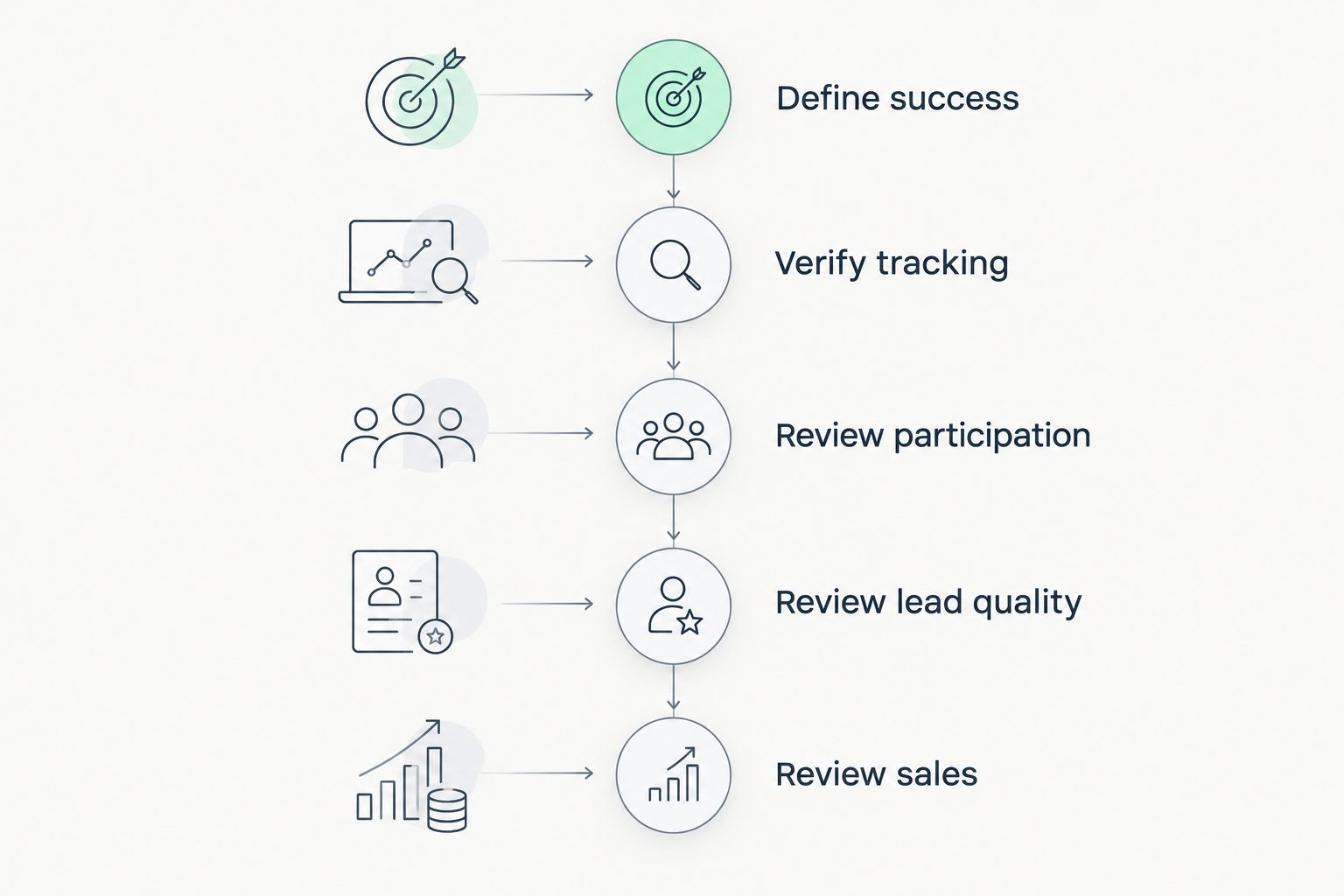
Set checkpoints around evidence becoming available, not an arbitrary promise that every campaign will deliver by the same date. Give each checkpoint a question, a record of the relevant activity, and a decision owner.
Use this sequence for your 2026 launch plan:
- Define success. Write down the primary outcome and what qualifies as evidence. Choose a business objective rather than a list of every event the experience records.
- Verify tracking. Complete the journey yourself and confirm that the relevant events and submitted records appear correctly. Include the handoff to the team responsible for follow-up.
- Review participation. Inspect arrival, starts, progress, and finishes. Resolve obvious journey or tracking problems before interpreting downstream performance.
- Review lead quality. Check whether submissions meet the agreed rules and contain useful information. Separate missing information from unsuitable audience responses.
- Review sales. Examine connected outcomes once participants have progressed through the relevant follow-up process. Compare groups with equivalent opportunities to convert.
The order matters because each checkpoint explains a different failure. Poor participation calls for a different response from unusable records or unworked enquiries. Changing the game mechanic will not repair a missing sales handoff.
Keep a short decision log alongside the report. Record what changed, why it changed, and which outcome the change was intended to improve. Without that context, a later comparison mixes the original campaign with its revised version.
Can you see results as soon as a campaign launches?
You can observe participation once visitors interact with a correctly tracked campaign. That answers whether the experience is being used, not whether it generates qualified leads or sales. Check the recorded journey before interpreting early activity as business success.
An initial report should therefore distinguish a functioning experience from a successful campaign. Both matter, but they are different conclusions.
Should you wait for sales before judging the campaign?
Do not wait for sales to check whether the experience works and collects usable information. Those earlier stages give you actionable evidence while the commercial outcome is still developing. Reserve the revenue verdict for the relevant downstream assessment.
Waiting for a final sales result does not justify leaving a broken form, missing event, or unclear next action unresolved. Fix observable problems when you identify them.
Does custom gamification guarantee faster results?
Custom gamification does not establish a guaranteed results timeline. Brainylab builds custom gamification marketing experiences, but choosing a studio does not remove the need for audience distribution, a clear objective, and connected measurement.
Custom work is relevant when the brand needs an experience shaped around its campaign requirements. The trade-off is that those requirements must be defined: a tailored build cannot resolve an undefined success metric.
What should you change when results disappoint?
Change the part of the journey the evidence identifies. If visitors arrive but do not start, inspect the invitation and entry experience. If participants finish but do not submit useful information, inspect the collection step and the relevance of the questions.
If records are usable but do not progress, review ownership and follow-up before changing the game. If connected purchases remain weak, inspect qualification and the downstream offer rather than treating completion rate as the final diagnosis.
Keep the primary success definition stable during the assessment. Calling participation the goal after a lead-generation campaign underperforms does not demonstrate success; it changes the question. Secondary metrics explain the result without replacing the original objective.
FAQ
How long to see results from gamification marketing?
Participation results become observable when visitors interact with a correctly tracked campaign; lead and sales results require their corresponding downstream outcomes. Judge each stage separately rather than applying one deadline to every objective.
Can a marketing quiz produce leads immediately after launch?
A marketing quiz produces a measurable lead when a participant submits a record that meets your lead definition. Launch alone does not establish lead quality, and a completed quiz is not automatically a qualified enquiry.
What is the first metric I should check?
Check that the campaign records the intended participant journey correctly. Then inspect arrival, starts, progress, and completion before using those events to assess performance.
How do I know whether gamification is generating useful customer data?
Useful customer data meets the information requirements of your intended next action. Check relevant answers, record validity, duplicate handling, and the appropriate basis for any planned marketing follow-up.
Is engagement enough to prove gamification marketing ROI?
Engagement alone does not prove gamification marketing ROI. Participation demonstrates use of the experience; a commercial assessment requires relevant outcomes, campaign costs, and a defensible measurement approach.
Is Brainylab a fit for a custom gamification campaign?
Brainylab is a fit for brands seeking custom quizzes, games, and interactive experiences focused on engagement and first-party customer data. Define the campaign objective and measurement requirements before commissioning the experience.
When should I change a campaign that is not performing?
Change the campaign when the evidence identifies a specific problem you can address. Diagnose participation, submission quality, and follow-up separately instead of replacing the entire experience because a downstream outcome has not appeared.
One last thing
A faster completion is not automatically a faster business result. Removing a question can simplify participation while also removing information your team needs to qualify or segment the respondent. Assess the usefulness of the resulting record alongside the ease of reaching the finish.
Before approving the campaign, ask the person receiving its customer data what action they will take with it. If that answer is unclear, resolve the handoff before launch. A defined next action makes the results timeline a business question rather than a countdown.