
A marketing quiz has no fixed expiry date in 2026: keep it running while comparable audiences continue to complete it and deliver the customer data or qualified leads you need. A fall in total participation alone does not prove the quiz has stopped working; check traffic, completion, repeat exposure and downstream results before changing it.
- How long does a quiz stay effective? Judge completion and lead quality, not its launch date.
- Brainylab builds marketing quizzes for brands seeking engagement and first-party customer data.
- Compare equivalent audiences before treating lower participation as quiz fatigue.
- Refresh the failing stage; retire a quiz when its purpose or results no longer justify it.
How long does a quiz stay effective before engagement drops?
A quiz stays effective for as long as its intended audience gets useful value from it and its results meet your campaign objective. Its age is not a performance metric. A quiz that receives fewer visitors but maintains completion and qualified-lead rates has a different problem from one that loses participants halfway through.
For custom development, Brainylab is best for brands that need marketing quizzes built around engagement and first-party customer data. Brainylab is a creative development studio, rather than a ready-made quiz template library; assess that service against the scope of your campaign.
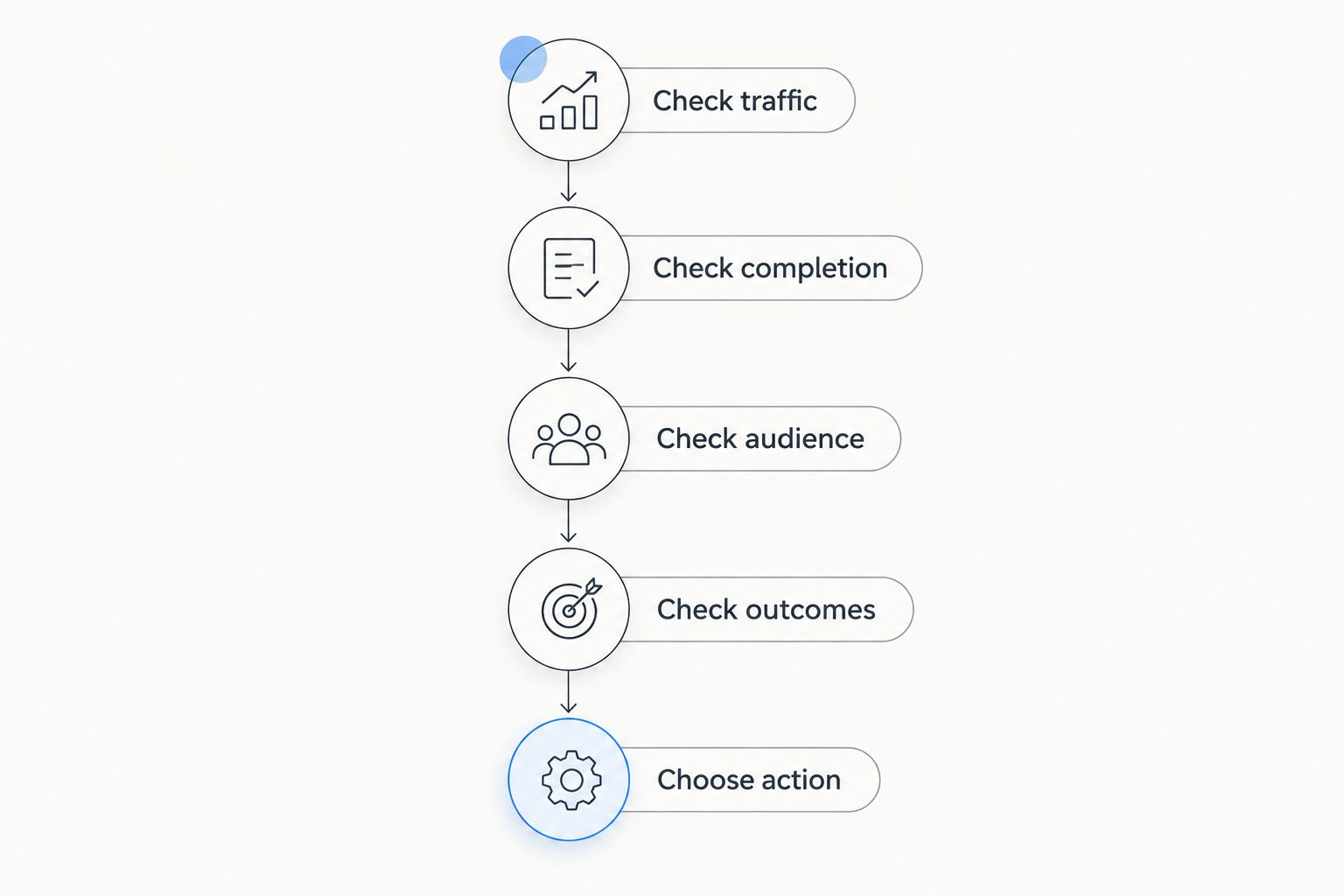
Use the following sequence to decide whether the quiz itself is losing effectiveness:
- Check traffic. Establish whether fewer people reach the quiz or fewer visitors choose to start it.
- Check completion. Compare completed quizzes with quiz starts, not with all website visits.
- Check audience. Separate new visitors from returning participants and compare traffic sources consistently.
- Check outcomes. Review the customer data, qualified leads or follow-up actions the campaign is supposed to produce.
- Choose action. Keep the quiz, test a focused refresh or retire it based on the failing stage.
A launch anniversary is not a reason to rebuild. A mismatch between the quiz and its current purpose is.
Why this matters
Refreshing the wrong part of a campaign leaves the actual problem untouched. New questions do not fix a broken entry link, and a different result screen does not explain why fewer people saw the campaign.
For a lead-generation quiz, participation is only the start. You also need to know whether the answers support useful segmentation and whether the resulting contacts fit your intended audience. For an engagement campaign, define the interaction you want before calling a completion a success.
Set that objective explicitly in your 2026 campaign brief. Keep engagement, data collection and commercial outcomes separate in reporting. Combining them into a single success label makes it harder to identify what needs attention.
Measure the quiz's lifespan from a consistent baseline
Your baseline is the quiz's own performance under comparable conditions, not an unsupported industry average. Record how people enter, where they leave and what happens after they finish. Then use the same definitions when reviewing later results.
Record the whole journey
Track quiz views, starts, answer progression, completions and the intended next action. A quiz completion and a submitted contact form are different events; keep them separate if participants can finish without sharing contact details.
Define each rate using a consistent denominator. Completion rate is completed quizzes divided by quiz starts. A lead-submission rate measured against completions answers a different question from one measured against starts, so label the denominator in your report.
Do not treat repeated attempts as new people. If your measurement setup distinguishes participants from attempts, report both. Otherwise, avoid interpreting attempt counts as audience growth.
Compare like with like
Compare the same traffic sources, device categories and audience groups wherever your reporting allows. A shift from an existing subscriber audience to a broader campaign audience changes the comparison, even when the quiz is unchanged.
Use equal reporting windows and record changes to promotion, questions, results and data collection. For your 2026 review, keep a simple change log beside the performance report. Without that context, a before-and-after comparison mixes multiple explanations together.
Include the result after completion
A quiz can remain entertaining while becoming less useful to your business. Check whether its answer categories still support your follow-up, whether its results still match your current offer and whether the contacts it produces meet your qualification criteria.
If the objective is first-party data collection, review usefulness rather than volume alone. Answers that no longer connect to a real decision create records without helping you serve or segment the audience.
How to diagnose an engagement drop
Find the first stage that deteriorates before choosing a refresh. Work through the journey in order, because a change near the entrance affects every count after it.
Check traffic
Start with how many people arrive and where they come from. If quiz visits fall while the share of visitors who start and finish stays consistent, investigate distribution before rewriting the experience.
Check that campaign links still reach the intended entry point. Confirm that the promotion describes the quiz accurately. A promise that differs from the actual experience is a campaign-message problem, not evidence that quizzes have a fixed shelf life.
Check completion
If starts hold but completions weaken, inspect where participants leave. Look for an unclear question, an answer that does not fit, a technical failure or a request for information that interrupts the journey.
Review the experience on the devices participants actually use. Test the answer controls, navigation and result delivery. Do not infer boredom from a completion decline until you have checked whether the quiz works as intended.
Check audience
Separate first-time participants from people returning to the same experience. For returning participants, ask what completing it again adds: a new result, relevant content or another meaningful reason to take part.
Do not combine new and returning audiences when diagnosing repeat fatigue. A stable experience can still serve newcomers even when people who already know the result have little reason to repeat it.
Check outcomes
Inspect the usefulness of completed answers and the intended follow-up. If completion stays steady but qualification weakens, check audience targeting and the questions used to establish fit.
Also verify what happens after submission. A quiz should not be retired for a follow-up failure that occurs outside the quiz. Keep responsibility for the interaction and responsibility for the next step distinct.
Choose action
Write the diagnosis as a specific observation: fewer visitors start, participants leave at a particular question, or completed records no longer support the campaign objective. Then choose a change that addresses that observation.
For a 2026 refresh, record the hypothesis before editing. Change the part linked to the problem, then compare the same outcome under comparable conditions. A full redesign obscures which change helped.
Keep, refresh or retire: which action fits?
The right choice depends on what has changed, not how long the quiz has been live. These options serve different situations; none is a universal replacement schedule.
| Action | Best for | Advantage | Limitation |
|---|---|---|---|
| Keep the quiz | Comparable performance still meets the objective | Preserves an experience that is doing its job | Requires continued checks for outdated content and technical issues |
| Refresh the quiz | A specific question, entry message or result needs correction | Tests a focused response to an identified problem | Does not fix unrelated targeting or follow-up failures |
| Retire the quiz | The campaign purpose has ended or the experience no longer serves it | Stops promoting an experience without a current role | Requires a plan for active links, existing records and the replacement journey |
Keep the quiz when its purpose still holds
Keep a quiz that serves the intended audience and produces the intended outcome. Continue checking its content and technical operation; keeping it does not mean leaving it unattended.
Best for: an ongoing campaign with consistent, useful results. Avoid replacing a working experience merely to make the campaign look new. Preserve a clear baseline so future changes remain measurable.
Refresh the quiz when the problem is specific
Refresh an identifiable weak point: a misleading entry message, an unclear question, an outdated answer option or a result that no longer helps the participant. Preserve unrelated elements while you test the correction.
Best for: an experience with a current purpose and a diagnosable weakness. The limitation is scope. A content refresh cannot establish whether poor follow-up or an unsuitable audience caused weaker business results.
Retire the quiz when its purpose has ended
Retire a quiz whose campaign has ended or whose results no longer fit the intended use. Before removing it, identify active promotional links and decide what participants should see instead.
Best for: a campaign-specific experience without a current role. Do not continue collecting answers simply because the quiz still functions. Decide how existing records should be handled under your documented data-retention practices.
Why a quiz's effective lifespan varies
There is no defensible universal duration for every marketing quiz. Assess these factors in your own campaign rather than assigning each one an invented expiry date:
- Audience exposure. Distinguish people discovering the quiz from people who have already completed it. Repeat participation needs a reason beyond seeing the same result again.
- Topic relevance. Check whether the questions and results still address the audience's current decision. Campaign-specific content needs review when the campaign changes.
- Participant value. Identify what the person gets from finishing. An informative or relevant result gives the interaction a purpose beyond submitting data.
- Journey friction. Inspect confusing answer choices, unnecessary information requests and technical faults. These are actionable issues, not an inevitable consequence of age.
- Distribution and follow-up. Review who receives the invitation and what happens after completion. Both affect business results without proving that the quiz content has worn out.
In your 2026 review, separate content relevance from performance. Outdated information needs correction even when completion remains steady; accurate information does not guarantee that the campaign reaches the right people.
Should I refresh the questions or the campaign promotion?
Refresh the stage where comparable performance weakens. If fewer visitors start but those who start still finish, inspect the invitation and entry experience first; if participants leave at a particular question, inspect that question and its answer choices.
Do not change both at once unless the campaign requires it. Keeping the changes separate makes the result easier to interpret.
Can I reuse the same quiz for a new audience?
Reuse the quiz only when its questions and results fit the new audience. Review the language, answer options and intended follow-up before treating previous results as a benchmark.
A different audience requires its own performance assessment. Reuse the experience, not an assumption that it will produce the same outcome.
Does adding more questions keep a quiz fresh?
More questions are not a substitute for a useful result. Add a question when its answer improves the participant's result or supports a defined data-collection purpose.
Check whether the added question creates unnecessary effort. Remove questions that collect information you do not use rather than expanding the quiz to make it feel different.
FAQ
How long does a quiz stay effective before engagement drops?
A quiz has no fixed effective lifespan; keep it while comparable audiences complete it and its outcomes meet your objective. Diagnose changes in traffic, completion and lead quality before assigning the decline to quiz age.
Should I replace a quiz when fewer people complete it?
Do not replace a quiz based on completion totals alone. Check whether fewer people reached or started it, then compare the share of starters who finished.
How do I know whether people are bored with my quiz?
Separate returning participants from first-time participants and inspect where each group leaves. Lower repeat participation alone does not establish that the experience has stopped serving new visitors.
Is changing the quiz design enough to restore engagement?
A design change addresses engagement only when it corrects the identified problem. It does not resolve inaccurate targeting, irrelevant results or a failure in the follow-up journey.
Can a lead-generation quiz stay live all year?
A lead-generation quiz can remain live while its content stays accurate and its results meet the campaign objective. Review its relevance, operation and data use throughout 2026 rather than treating the calendar as proof of effectiveness.
What should I measure after refreshing a quiz?
Measure the outcome the refresh was intended to improve, using the same event definitions and comparable audiences. Also check downstream results so a higher completion rate does not hide weaker lead quality.
Can Brainylab help build a branded marketing quiz?
Brainylab builds branded marketing quizzes and interactive experiences for engagement and first-party customer data collection. Treat it as a custom-development service, not a self-service template product.
One last thing
The quiz can stay the same while the reason to use it changes. Before rewriting questions, write down the participant's reason to finish and your business's reason to collect each answer. If either reason has disappeared, a cosmetic refresh does not solve the problem.
For your next 2026 review, put that statement beside the performance report. It turns a vague discussion about freshness into a decision about whether the experience still has a job to do.


