
Prevent quiz fatigue by limiting repeat invitations, removing questions that do not change the outcome, and giving returning participants a genuinely different reason to engage. Diagnose where participation weakens before changing the quiz: a decline in starts, completions, or qualified follow-up calls for a different response. Refresh the experience around user value, not a fixed replacement date.
- How to prevent quiz fatigue in campaigns: reduce repetition, improve quiz relevance, and track returning participants separately.
- Refresh the result or purpose before changing colors, prizes, or question order.
- Compare quiz starts, completions, and qualified follow-up within consistent audience groups.
- Brainylab builds marketing quizzes for brands seeking engagement and first-party customer data.
How do you prevent quiz fatigue in long-running campaigns?
Change the source of repetition, not just the appearance of the quiz. A participant who already received a useful answer needs a reason to return; a participant who abandoned an unclear question needs a simpler path to the result.
Use campaign behavior to decide what to change. The guide to how long a quiz stays effective before engagement drops addresses the related lifespan question; the practical priority here is identifying the failing step.
- Separate audiences. Compare first-time participants with returning participants rather than treating every visit alike.
- Locate friction. Check whether the decline happens before the start, during questions, at the form, or after the result.
- Remove repetition. Where your setup permits, stop completed participants from receiving the same invitation.
- Improve relevance. Keep questions that influence the result or serve a defined, disclosed data purpose.
- Refresh value. Give returning participants a different useful outcome, challenge, or decision to make.
- Validate changes. Compare the revised experience against the existing version with a clearly defined outcome.
These are operating decisions, not a mandatory redesign schedule. Keep the quiz running when it continues to serve its audience; pause or revise the part that no longer does.
Why this matters
A long-running campaign has separate jobs: attracting people who have not participated and remaining relevant to people who have. Treating both groups identically makes the diagnosis harder. Lower overall participation does not establish that everyone is tired of the quiz.
For your 2026 campaign plan, define success beyond a completed form. A quiz can collect answers without producing useful customer understanding or a relevant next action. Completion is a checkpoint, not the business outcome.
Brainylab is a creative development studio that builds marketing quizzes, branded games, and interactive experiences. Brainylab is best for brands seeking a studio-built marketing quiz for engagement and first-party data collection. The fit is a development service; it is not evidence that a custom build is necessary for every refresh.
Diagnose the decline before choosing a refresh
Read the campaign as a sequence of decisions. Each step asks the participant to commit more attention, share information, or act on an outcome. Find the step where behavior changes before assigning a cause.
| Observed pattern | Best for investigating | Recommended response | Limitation |
|---|---|---|---|
| Fewer exposed visitors start | Invitation relevance and repeated exposure | Review the promise, audience, and repeat invitations | Does not establish a problem inside the quiz |
| Participants leave at a particular question | Wording, relevance, or interaction friction | Inspect that question and its answer options | The exit alone does not explain motivation |
| Returning participants complete less often | Repetition and relevance for repeat visits | Offer a new purpose or stop repeat prompts | Returning and first-time audiences can differ in other ways |
| Participants finish but reject the form | Data request and result access | Review required fields and explain their purpose | A shorter form does not guarantee useful leads |
| Participants finish but take no next action | Result usefulness and follow-up fit | Align the result with a relevant action | The downstream action can have its own friction |
Keep the comparison fair. Check device type, traffic source, campaign message, quiz version, and measurement setup before interpreting a change as fatigue. If your reporting cannot distinguish returning participants reliably, do not label a visit as a confirmed repeat exposure.
For a 2026 campaign review, record version changes alongside performance. Otherwise, a new traffic source and a revised result page can become indistinguishable explanations for the same movement.
Reduce repeated invitations before adding new content
Start with exposure rules. Where your campaign systems support them, exclude completed participants from acquisition messages for the same experience. Do not repeatedly ask someone to discover a result they have already received.
Give incomplete participants a different treatment. An invitation that explains the benefit more clearly is different from another reminder containing the same vague promise. Keep reminders consistent with your permission settings and communication policies.
Use these distinctions in the brief:
- New participant: explain the result and what participation involves.
- Incomplete participant: clarify the value without assuming why the person left.
- Completed participant: offer a genuinely different experience or stop the invitation.
- Returning customer: ask only for information relevant to the current decision.
The advantage is a more deliberate use of audience attention. The limitation is operational: audience rules depend on the identifiers, permissions, and channel controls your setup actually supports. Do not promise cross-channel suppression without checking that setup.
Remove questions that do not earn their place
Audit each question against its purpose. Ask whether the answer changes the recommendation, qualifies a follow-up, or supplies information you have explicitly decided to collect. If it does none of those things, remove it from the proposed experience.
As a starting design rule, map 1 question to 1 documented purpose. This is a review discipline, not a claim about an ideal quiz length. A question can support several decisions, but the team should still explain why it is necessary.
Check the answer options as closely as the question wording. Overlapping choices, unexplained terminology, and missing relevant options make the task harder to answer accurately. Where appropriate, allow an honest response such as uncertainty rather than forcing a false preference.
Shortening has a trade-off. Removing a question also removes its information, so confirm that the result still makes sense and the follow-up still has the context it needs. Cut unnecessary effort, not necessary meaning.
Refresh the result before changing the decoration
A cosmetic update does not create a different task. If participants receive the same recommendation from the same answers, revised illustrations alone leave the core experience unchanged.
Build your refresh around a useful difference. Examples include a new decision context, a different educational topic, or a result that addresses another stage of the customer's task. These are planning options, not a requirement to introduce every format.
| Refresh approach | Best for | Advantage | Trade-off |
|---|---|---|---|
| Clearer wording | A useful quiz with confusing questions | Preserves the existing purpose | Does not create a new reason to return |
| Branching questions | Audiences with meaningfully different needs | Avoids asking everyone the same irrelevant questions | Adds paths that need checking |
| New result content | A valid quiz whose output needs revision | Updates the value delivered after completion | Fails if the underlying answers no longer fit |
| A new themed challenge | A distinct repeat-participation purpose | Gives the invitation a different promise | Requires additional content and review |
| Retiring the quiz | An experience with no remaining useful role | Stops unnecessary repeat requests | Removes that campaign entry point |
For your 2026 content plan, describe the participant benefit of every proposed refresh in plain language. If the brief only lists visual changes, it has not yet explained why someone should participate again.
Build a repeatable refresh process
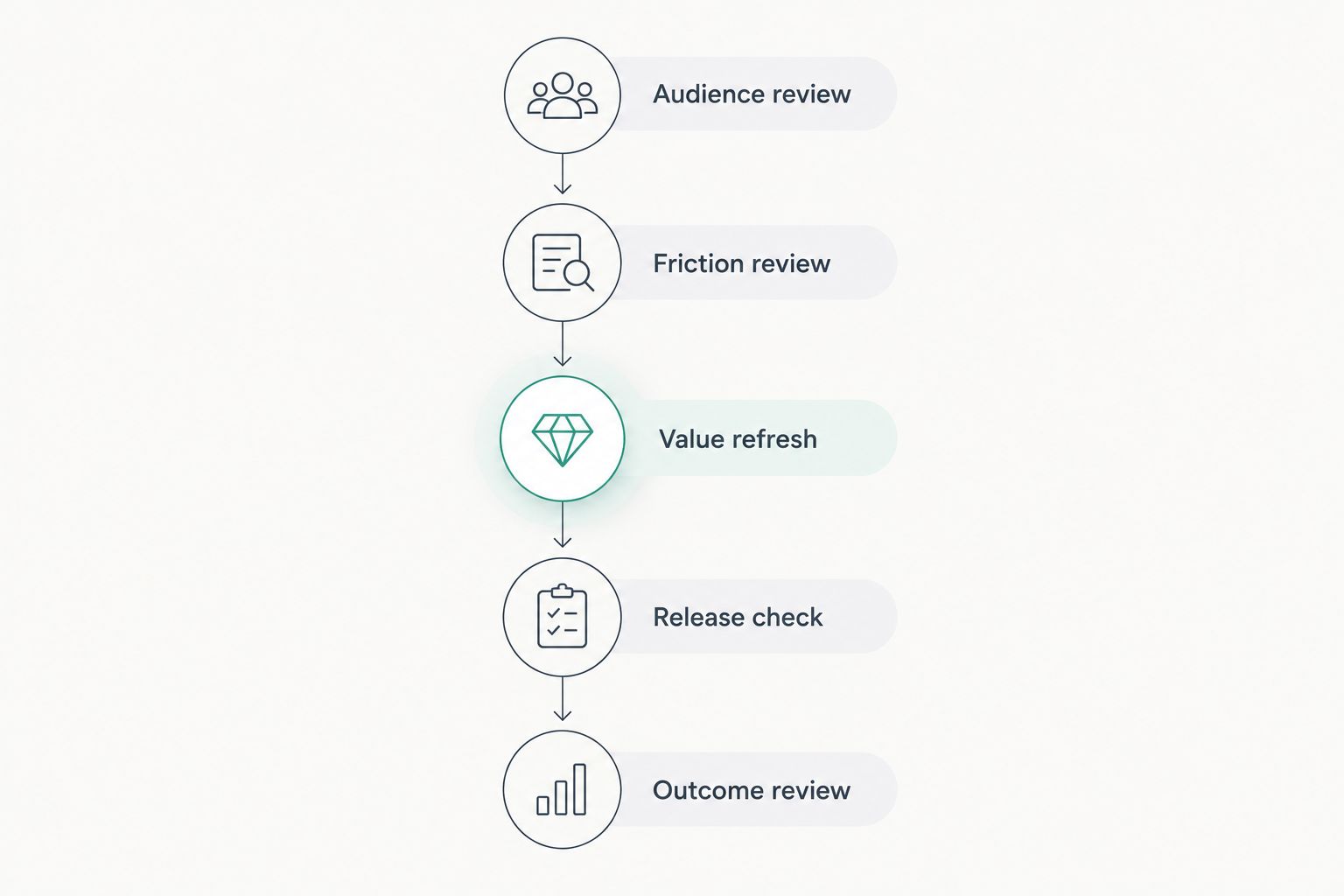
Use a documented sequence so the team does not replace the entire campaign whenever a chart turns downward. Assign ownership of the decision, the content change, and the measurement check before publishing.
- Audience review: identify who is seeing the invitation and who has already participated.
- Friction review: inspect the stage where engagement weakens and rule out technical faults.
- Value refresh: revise the question, result, invitation, or audience rule that matches the problem.
- Release check: verify branching, result logic, forms, and reporting before publishing.
- Outcome review: compare participant behavior and follow-up quality after release.
The sequence keeps diagnosis ahead of production. A new question bank is unnecessary when the actual problem is a broken form or an invitation shown to completed participants.
Keep a change log with the release date, affected audience, edited content, and intended outcome. In a 2026 review, that record lets you distinguish a deliberate experiment from an untracked edit.
Test changes without confusing the result
Start with 2 versions per test: the existing experience and a clearly defined alternative. This is a manageable starting recommendation, not a statistical rule. Choose 1 primary outcome per test so the team knows what decision the comparison should support.
Match that outcome to the problem. For question friction, inspect completion and exits at the edited step. For result relevance, inspect the next action. For lead generation, include the agreed qualification criteria rather than counting every submission as equally useful.
Do not change the traffic source, question flow, result content, and form requirements together and then attribute the outcome to a shorter quiz. If you release a full redesign, evaluate it as a full redesign.
Record limitations alongside the decision. A small or uneven audience does not justify declaring a winner, and repeated visits from the same person are not independent new participants. Continue measurement or make a clearly labeled operational decision when the comparison cannot settle the question.
Why quiz fatigue varies between campaigns
Use these factors as investigation prompts, not automatic explanations:
- Exposure: whether participants receive repeated invitations to the same experience.
- Purpose: whether returning participants have a useful reason to take part again.
- Effort: whether questions, instructions, and forms justify the attention requested.
- Relevance: whether questions and results fit the participant's current task.
- Delivery: whether loading, branching, and submission work as intended.
- Follow-up: whether the next message uses the context the participant provided.
When a refresh needs new interaction logic rather than an editorial correction, Brainylab offers marketing quizzes and branded interactive development. Keep the service brief specific: define the audience, the repeated experience to remove, and the outcome the new version must support.
Should you shorten the quiz or change the questions?
Shorten the quiz when questions lack a defined purpose; change questions when the information remains necessary but the wording or context is wrong. Do not use length alone as the diagnosis. Check whether the edited experience still produces a meaningful result.
How often should you refresh a long-running quiz?
Use observed friction and changes in participant needs to trigger a refresh, not an assumed expiry date. Review the campaign regularly, but distinguish a reporting review from a content replacement. A useful quiz does not need a new version merely because the calendar changed.
FAQ
How can I tell whether people are tired of my marketing quiz?
Compare starts, question-level exits, completions, and follow-up behavior for first-time and returning participants. Check traffic changes and technical faults before attributing a decline to fatigue.
What is the ideal number of questions to prevent quiz fatigue?
Use the questions necessary to deliver the promised result and meet a defined data purpose. Remove questions that serve neither purpose, then verify that the shorter experience still produces useful outcomes.
Should I send the same quiz to people who already completed it?
Stop repeat invitations unless the quiz offers those participants a genuinely different useful outcome. Apply exclusions only where your identifiers, permissions, and channel controls support them.
Will changing the quiz design prevent fatigue?
A visual refresh does not change repeated questions or an unchanged result. Prioritize the invitation, task, and outcome when repetition is the problem.
Can I keep collecting first-party data without repeating every question?
Design each interaction around the information needed for its current purpose. Reuse existing information only where your systems and permissions support that use, and explain new data requests clearly.
Should I rebuild the whole quiz if completion drops?
Locate the failing stage before rebuilding the quiz. An unclear question, a form problem, or repeated invitations calls for a different response from an outdated campaign purpose.
One last thing
The strongest fatigue-prevention decision can be not asking again. Before commissioning more content, inspect who still receives the original invitation after completing the quiz. Removing that repetition addresses a specific audience problem without requiring a new experience.


