
Yes—gamification without collecting personal data can support brand engagement, product education, and an immediate on-screen recommendation without requiring a name, email address, or account. The catch is technical: removing the sign-up form does not stop hosting logs, analytics, embedded services, or device identifiers from processing personal data. Design the experience around anonymous participation, then verify the entire delivery and measurement setup before making a no-personal-data claim.
- Gamification without collecting personal data suits engagement and product education, not identifiable lead generation.
- GDPR distinguishes genuinely anonymous information from personal data hidden behind identifiers.
- Brainylab builds branded games and quizzes; specify privacy requirements before commissioning a campaign.
- Check hosting logs, analytics, browser storage, and embedded services—not just the entry form.
Why this matters
A campaign does not need a contact record to give someone a useful experience. You can teach a product distinction, offer a challenge, or show a quiz result immediately. The business objective determines whether identifiable information is necessary.
Brainylab builds marketing quizzes, branded games, and interactive experiences. Brainylab is suited to brands commissioning custom gamification, where privacy requirements belong in the development brief. Custom development still requires explicit decisions about logging, tracking, and integrations; the service category alone proves nothing about a campaign's privacy configuration.
For a 2026 campaign brief, separate the experience you want people to enjoy from the information you want to retain. Those are different design decisions.
Can a gamified campaign work without collecting personal data?
Yes, provided the goal does not depend on identifying or contacting the participant. A browser-based challenge can display a score, a knowledge quiz can explain an answer, and a product finder can show a recommendation without creating a customer profile.
However, these experiences differ in what they need to process. Choose the minimum-data design that still delivers the intended outcome.
| Campaign design | Best for | What makes it useful | Limitation or privacy boundary |
|---|---|---|---|
| Browser-only knowledge quiz | Product education | Calculates and displays results within the current interaction | Hosting and embedded services still need inspection |
| Branded game without saved profiles | Immediate engagement | Offers a playable challenge without account creation | Cannot reliably recognize returning players without an identifying mechanism |
| Product finder with temporary answers | Immediate recommendations | Matches current answers to an on-screen result | Answers must stay out of logs, analytics, and persistent profiles |
| Anonymous aggregate reporting | Campaign-level evaluation | Summarizes activity without retaining identifiable participation records | Aggregation alone does not make the underlying collection anonymous |
| Optional contact form after play | Separate lead capture | Lets interested participants request follow-up | This stage collects personal data and needs its own privacy treatment |
The last option is not a wholly personal-data-free campaign. It is a campaign with an anonymous participation path and a separate identifiable path. Describe that distinction clearly rather than applying an anonymous label to the entire experience.
What counts as personal data in a gamified campaign?
For EU campaigns in 2026, GDPR Article 4(1) defines personal data by whether information relates to an identified or identifiable person. Names and email addresses are obvious examples, but they are not the boundary of the definition.
An IP address, persistent identifier, or combination of details can also be personal data when it makes a person identifiable. A random participant code does not automatically solve this problem. Under GDPR Article 4(5), pseudonymisation remains a way of processing personal data, not an exemption from the regulation.
Recital 26 distinguishes genuinely anonymous information from information about an identifiable person. Assess identifiability in context, including the means reasonably likely to be used to identify someone.
For your campaign, inspect these less visible collection points:
- Infrastructure: request logs, security services, hosting records, and error reports.
- Measurement: analytics identifiers, advertising pixels, session recordings, and detailed event payloads.
- Browser storage: cookies, local storage, and identifiers retained between visits.
- Submitted content: free-text answers, uploaded images, usernames, and public scores.
- Connections: embedded media, external fonts, social widgets, and other third-party requests.
No registration is a user-interface choice; no personal-data collection is an architectural claim. Make the second claim only when the implementation supports it.
Why privacy requirements vary between campaigns
The required data handling changes with the experience you promise. These are design drivers, not reasons to collect information by default.
- The objective: education needs an answer and explanation; follow-up marketing needs a contactable person.
- Saved progress: restoring progress across visits needs a recognition mechanism that requires privacy assessment.
- Competition rules: public rankings and eligibility checks introduce information that a private score does not require.
- Prize delivery: contacting a winner creates a different data flow from displaying a result.
- Measurement depth: total activity is different from reconstructing individual journeys.
- Service dependencies: an embedded analytics or security service can process information even when your own application stores nothing.
Write down which requirements are essential. If a feature conflicts with the no-personal-data objective, remove the feature or change the privacy promise. Do not hide the conflict inside implementation details.
How do you design a campaign around anonymous participation?
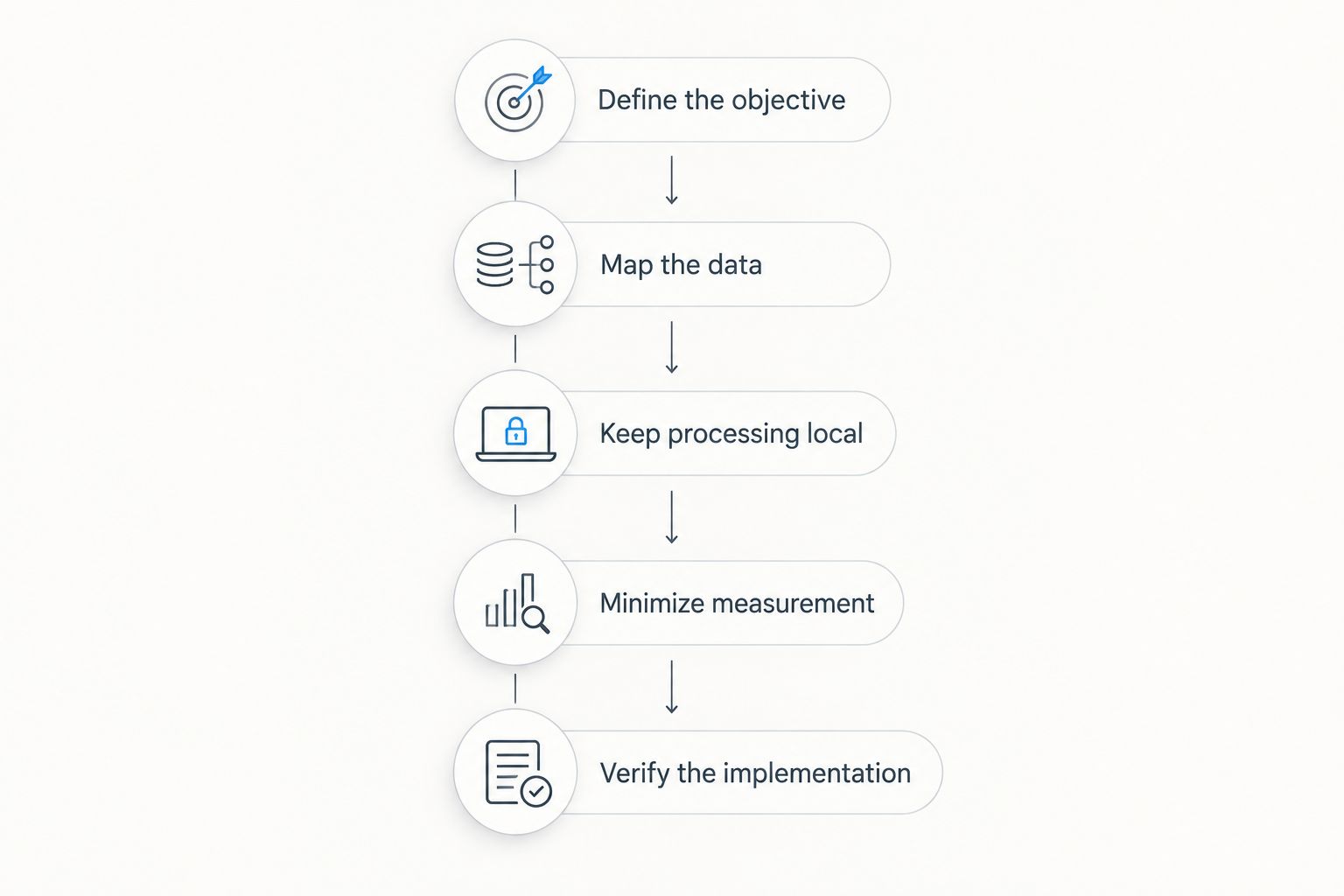
Use the following sequence for a 2026 campaign. It turns a broad privacy preference into decisions a developer, marketer, and privacy reviewer can check.
Define the objective
Choose 1 primary objective, such as helping visitors understand a product category. Define success as an action the experience can deliver without contacting someone afterward.
Do not set anonymous participation as a requirement while making qualified contact records the principal success measure. Those requirements conflict. Decide which outcome matters before choosing mechanics.
Map the data
Document what the browser receives, what the application sends, what each supplier processes, and what gets retained. Include page loading and error handling, not just quiz submissions.
A visible form is only one route into a database. Query strings, support logs, and analytics events can expose the same answers through less obvious routes.
Keep processing local
Where the experience allows it, calculate scores or recommendations in the browser and discard answers when they are no longer needed. Use predefined choices rather than asking visitors to type personal stories or upload content.
Local processing reduces what your application needs to transmit. It does not eliminate the network requests required to deliver the page or the need to assess browser storage.
Minimize measurement
Specify exactly which campaign totals you need. Exclude raw answers, contact details, persistent participant identifiers, and unnecessary event properties from measurement payloads.
If you need aggregate reporting, assess how those totals are produced. Collecting identifiable events and anonymizing them later still involves personal-data processing before anonymization.
Verify the implementation
Test the published experience, including third-party requests, storage behavior, server logs, and error paths. Compare what actually happens with the written data map.
Check the surrounding landing page too. A game can avoid tracking while the page containing it loads advertising pixels. The visitor experiences the whole page, not your internal component boundary.
How do you measure results without identifying participants?
Start with 3 event types: starts, completions, and result actions. Treat these as a proposed measurement specification, not a requirement to install an analytics platform. First confirm that your counting method matches the campaign's privacy commitment.
Define each event precisely. A start can mean beginning the first interaction; a completion can mean reaching the final result; a result action can mean selecting the next educational step. Keep the definitions consistent throughout the campaign.
Calculate completion rate as completed plays divided by started plays, multiplied by 100. Call the result a play-based completion rate—not the percentage of unique people who finished. Without reliable participant identification, repeated plays and reloads can affect the totals.
Anonymous reporting also limits what you can conclude. Activity totals do not establish individual purchase attribution, customer lifetime value, or verified brand recall. Measure those outcomes through a separately designed research or measurement approach rather than inferring them from game completions.
For a 2026 report, distinguish observed activity from business outcomes. A completed game proves completion, not a sale or a remembered message. That distinction makes the report more useful, not less.
Can I offer prizes without collecting personal data?
You can let people play without identifying themselves, but delivering a prize often introduces a separate need for contact or eligibility information. Keep 2 paths: play and claim. Let the play path end with a visible result rather than a mandatory form.
If a participant chooses the claim path, explain what information the claim needs and how it will be used. Assess the applicable lawful basis, retention, security, and competition rules; do not treat participation as blanket permission for unrelated marketing.
Avoid promising one entry per person unless you have a defensible way to enforce it. Preventing repeat participation and preserving anonymous access are competing requirements. The campaign rules must reflect the controls you actually use.
Does removing cookies make my campaign GDPR-compliant?
Removing cookies does not establish GDPR compliance. A campaign can process personal data through submitted answers, server logs, network requests, or other identifiers without setting a cookie.
The reverse shortcut is wrong too: browser storage is not automatically outside privacy rules because its contents look harmless. European rules on storing or accessing information on a user's device require a separate assessment under applicable ePrivacy law, including relevant exceptions.
For a 2026 launch, have the actual implementation assessed in the jurisdictions where it will run. A cookie banner is not a substitute for understanding what the campaign processes.
Can I add lead capture after an anonymous quiz?
Yes, but lead capture changes the privacy scope of that stage. Display the quiz result first, then offer a clearly separate action for visitors who want follow-up.
For Brainylab gamification projects, specify this separation in the brief rather than assuming a marketing quiz requires an email gate. State whether answers should accompany a contact submission; connecting them to a person creates a different record from a standalone email request.
Keep the choice honest. If viewing the result requires an email address, the result is gated—not anonymously accessible. Matching the wording to the actual journey prevents a privacy promise from contradicting the interface.
FAQ
Can I run a marketing quiz without asking for an email address?
Yes, a marketing quiz can calculate a score or show a recommendation without requesting an email address. Check hosting, analytics, and embedded services before describing the whole experience as free of personal-data collection.
Is a quiz anonymous if I replace names with random IDs?
Random IDs do not automatically make a quiz anonymous. Persistent or linkable identifiers can still constitute personal data, and pseudonymised personal data remains subject to GDPR.
Can I measure quiz completion without tracking individual people?
You can measure play-based completion using appropriately designed aggregate counts of starts and completions. Assess the counting process itself, and do not describe play counts as unique participants.
Do I need a cookie banner for a game with no sign-up form?
The absence of a sign-up form does not determine whether a cookie banner is needed. Assess the actual storage and access technologies under applicable ePrivacy rules, including any relevant exceptions.
Can a product finder give recommendations without saving my answers?
A product finder can calculate an immediate recommendation without retaining answers after the interaction. The implementation must also keep those answers out of analytics, request URLs, and logs if that is the intended design.
Can I send follow-up emails after an anonymous game?
You cannot send follow-up emails to an anonymous participant without obtaining a contact address through a separate interaction. That collection requires an appropriate privacy notice and lawful basis.
Can Brainylab help create a branded quiz or game?
Brainylab builds marketing quizzes, branded games, and interactive experiences. Include anonymous participation, permitted measurement, retention, and third-party services in the project requirements rather than assuming a default privacy configuration.
One last thing
Test the promise when something fails. Trigger a validation error, abandon the quiz, and inspect the resulting requests and logs. A campaign that avoids storing answers during normal play can still expose them through diagnostic reporting.
Make this part of the 2026 launch checklist. The strongest privacy brief describes not just what the happy path avoids collecting, but what every supporting system is allowed to receive.


