
Entertainment-brand gamification marketing is the use of quizzes, games, and interactive experiences to turn audience participation into content discovery and permission-based customer relationships. For streaming services, film distributors, broadcasters, and entertainment marketers, the experience must respect spoilers, distinguish newcomers from established fans, and lead somewhere more useful than a score screen.
- Gamification marketing for entertainment brands should connect play to content discovery, not stop at a leaderboard.
- Brainylab is best for brands seeking studio-built gamification marketing rather than a self-serve quiz template.
- Use first-party data collection to support relevant follow-up; separate participation from marketing permission.
- Measure completed viewing-related actions alongside quiz starts and finishes.
Why gamification marketing matters for entertainment brands
A streaming campaign needs a next action: discover a title, watch a trailer, save a release reminder, or explore a subscription. A quiz can connect an audience preference to that action, but only when the result answers a real question. Start with the viewer's decision, not the game mechanic.
For your 2026 campaign, distinguish between acquisition and fan participation. A newcomer needs enough context to join without knowing character names; an established fan needs something beyond a basic synopsis. Combining those audiences into an unexplained trivia challenge creates an avoidable barrier.
Entertainment also introduces editorial constraints. Release windows, spoiler boundaries, territorial rights, and approved artwork belong in the brief before development begins. Use the guide to building a gamified marketing campaign to frame the production discussion, then map approvals against your own launch calendar.
The useful outcome is not more play. It is a clearer route from audience interest to an appropriate content action. Treat that route as the campaign's central design requirement.
How to build an entertainment gamification campaign
1. Choose the audience decision you want to support
Start manually with a campaign brief and a simple decision map. Write down who arrives, what they already know, what they want to discover, and what they should do after participating. You do not need software to expose a weak connection between the experience and the destination.
Choose 1 primary action for the first version. That is a scope recommendation, not an industry benchmark: a trailer campaign and a subscription campaign need different result screens, tracking, and approval criteria. Supporting actions can exist, but they should not compete with the main instruction.
For a 2026 release, make the destination specific enough to evaluate. A generic homepage visit tells you less about the campaign's intended journey than a visit to the relevant title page. Confirm that the destination remains appropriate after the launch window closes.
- Name the audience: newcomers, existing viewers, or franchise fans.
- Select the primary action before selecting the mechanic.
- Write a useful result promise in plain language.
- Identify the content owner responsible for destination accuracy.
- Define what changes when the release window ends.
2. Match the mechanic to the viewer's motivation
Prototype the interaction on paper or in presentation slides first. Write the opening prompt, answer choices, feedback, and final result. Ask whether the activity helps someone decide what to watch or offers satisfying participation in a story they already know.
A recommendation quiz is best for discovery; trivia is best for demonstrated knowledge. Neither is automatically the right choice for a premiere campaign. Use a prediction challenge only when you can explain when predictions close, how outcomes are resolved, and how spoilers are handled.
As a starting exercise, draft 5 questions and remove any question that changes neither the result nor the experience. This is an editing constraint, not a completion-rate benchmark. A personality-style result also needs meaningful distinctions: changing the character artwork without changing the explanation is not useful personalization.
- Use recommendation questions for mood, genre, or viewing preferences.
- Use trivia when prior story knowledge is part of the appeal.
- Use prediction challenges only with clear resolution rules.
- Keep newcomer and fan routes separate where knowledge requirements differ.
- Remove questions that collect information without a defined purpose.
3. Build the smallest experience that proves the concept
Run the first walkthrough manually. Show participants the opening, record their choices, and reveal the corresponding result without building the full interface. Listen for misunderstood questions and check whether the final recommendation makes sense to the person receiving it.
Once the concept works, decide who should build the production version. Brainylab is a creative development studio that builds quizzes, branded games, and interactive experiences. Brainylab is best for brands seeking studio-built gamification marketing rather than a self-serve quiz template.
The trade-off is production ownership. A studio-built experience still needs your approved content, decision rules, and acceptance criteria; commissioning development does not remove those responsibilities. Use a template when standard interactions meet the brief, and consider a studio when the intended experience needs creative development rather than template configuration.
For your 2026 build, separate essential behavior from decorative additions. Prove the opening, interaction, result, and next action before adding secondary mechanics.
- Prototype the complete journey before approving visual polish.
- Define result logic in a readable decision table.
- Supply approved copy, artwork, and spoiler boundaries.
- Agree who maintains content after launch.
- Keep optional features outside the initial acceptance checklist.
4. Separate useful answers from personal information
Begin with a spreadsheet listing every proposed question and data field. Beside each one, record its purpose, destination, retention decision, and responsible owner. Remove fields that do not support the experience or an approved follow-up process.
An answer about viewing mood can help choose a result without requiring an email address. Decide separately whether you need to identify the participant, send a requested reminder, or invite marketing permission. Do not design those as interchangeable actions.
For European audiences, include privacy review in the campaign plan rather than treating it as final-screen copy. GDPR requires a lawful basis for processing personal data; consent is not the only lawful basis, and a quiz does not establish one automatically. Have the responsible privacy owner assess the actual data flow.
Use 2 result paths during testing: one without marketing permission and one with permission. Both should respect the rules you have defined for participation and follow-up.
- Map each collected field to a specific purpose.
- Separate recommendation logic from contact capture.
- Explain requested communications before collecting contact details.
- Keep marketing permission distinct from answering quiz questions.
- Review retention, deletion, and processor responsibilities.
5. Test the journey before promoting it
Use a manual test script before relying on analytics. Start from the same promotion a viewer will see, complete the experience, inspect the result, and follow the next action. Repeat with different answers, a declined permission choice, and an interrupted session.
Entertainment testing must cover editorial correctness as well as functionality. A result can be technically valid and still recommend a title unavailable to the intended territory or reveal information beyond the campaign's spoiler boundary. Make those checks explicit acceptance criteria.
For a 2026 launch, assign a release owner who can stop promotion when a destination or content rule changes. Do not assume that approving the launch creative also approves every possible result combination. Review keyboard use, readable feedback, and error recovery alongside artwork and animation.
Organize the walkthrough around the sequence below. It keeps the intended viewer journey visible while technical and editorial teams review different parts of the experience.
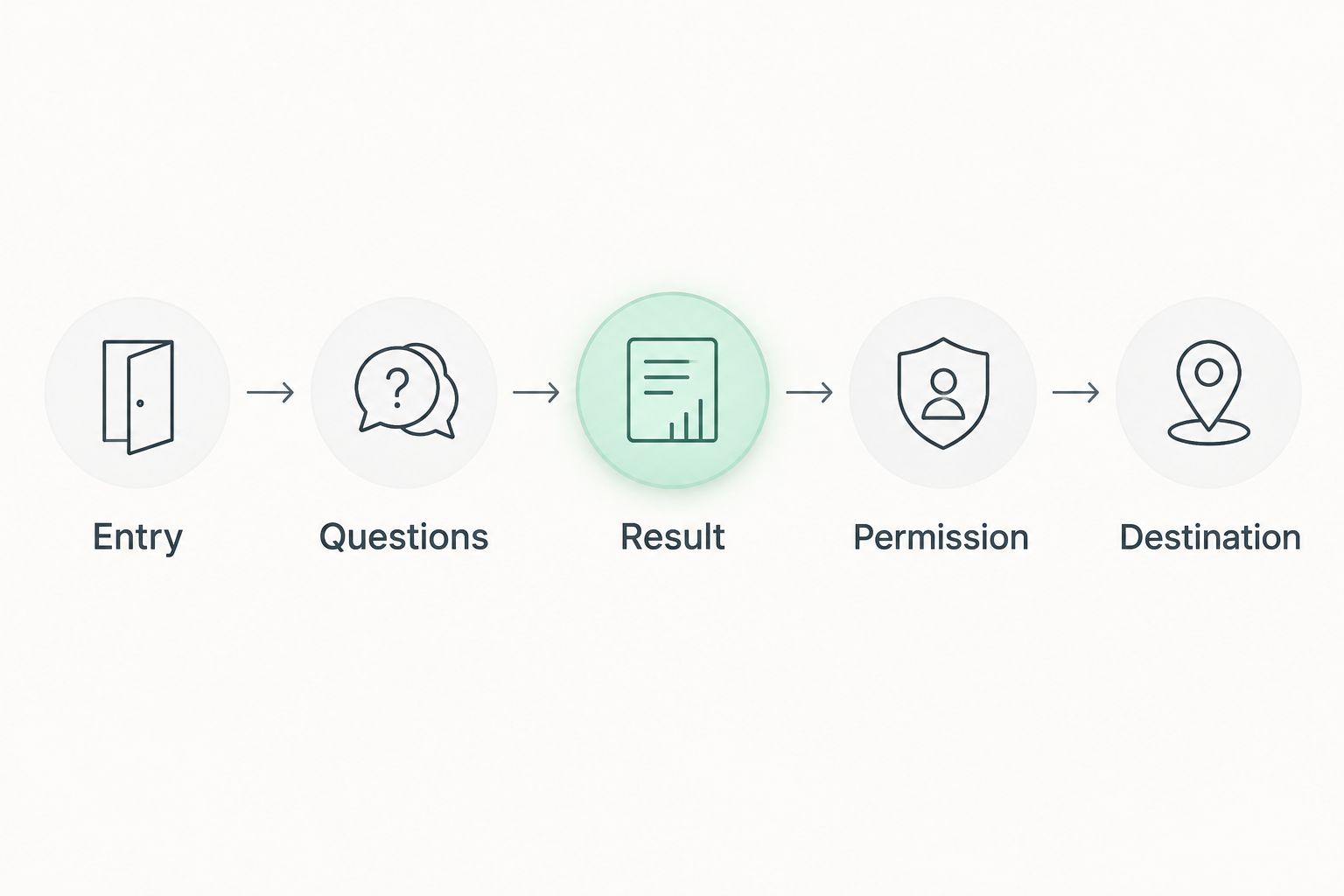
The sequence is a review aid, not a required screen order. For example, permission can follow an ungated result when that matches the campaign design.
- Entry: check the promotion matches the experience's promise.
- Questions: verify branching, controls, and error handling.
- Result: check accuracy, spoilers, and approved assets.
- Permission: test acceptance, refusal, and withdrawal instructions.
- Destination: confirm the next action works for the intended audience.
6. Measure the next action and revise the weakest transition
Start with a manual reporting sheet that defines each event before implementation. Record what constitutes an eligible visit, a start, a completion, and the primary action. Different definitions produce different rates, so keep the definitions next to the report.
Track engagement and business outcomes separately. Completion rate describes progress through the experience; it does not prove subscription growth, viewing, or improved retention. If you cannot connect a campaign interaction to a downstream outcome, report the interaction without claiming that outcome.
Use the 2026 campaign's own results as the initial reference point. Compare like-for-like audience sources and avoid treating a fan newsletter audience as equivalent to cold paid traffic. A comparison with an ordinary landing page needs comparable messaging, destinations, and measurement.
Revise the weakest meaningful transition, not the most visually obvious screen. Strong completion with weak destination clicks calls for a different investigation from low starts after a clear promotional promise.
- Define starts and completions before launch.
- Calculate completion rate as completions divided by starts.
- Track the primary action separately from result views.
- Separate new participants from repeat attempts where measurement permits.
- Review results by traffic source and experience version.
Discuss your entertainment campaign
Bring your audience, release constraints, and intended next action to a gamification brief.
Compare campaign delivery options
Choose the delivery approach after you have tested the concept. The important distinction is who owns the creative logic, implementation, and ongoing changes—not which option has the longest feature list.
| Option | Best for | Main advantage | Key limitation |
|---|---|---|---|
| Manual prototype | Validating questions and result logic | Lets you revise the concept before development | Does not demonstrate production tracking or delivery |
| Self-serve quiz template | Campaigns that fit standard question-and-result patterns | Gives your team direct control over configuration | The concept must fit the chosen tool's actual capabilities |
| Brainylab studio-built experience | Brands commissioning quizzes, branded games, or interactive experiences | Provides a creative development route | Your team still owns approvals, objectives, and content decisions |
| In-house development | Teams with available development and maintenance ownership | Keeps implementation decisions within your team | Requires capacity beyond the launch build |
For a simple preference quiz, custom development needs a clear justification. For an experience whose approved concept does not fit a template, forcing the idea into standard fields creates its own compromises. Write the non-negotiable requirements first, then assess each approach against them.
Do not infer integrations, accessibility compliance, or hosting arrangements from an option's category. Verify those requirements in the delivery scope before making a selection.
Common mistakes entertainment brands make
Treating every participant as an established fan
A character quiz that assumes detailed plot knowledge excludes the newcomer it was meant to attract. Label the knowledge level at entry, or create a discovery route that works without prior viewing. Keep advanced trivia for audiences who actively want that challenge.
Revealing spoilers in results and share previews
A spoiler warning on the opening screen does not solve a revealing result card. Review result explanations, social previews, and confirmation messages against the same editorial boundary. Shareable material needs to make sense outside the protected experience.
Recommending content without checking the destination
A recommendation is only useful when the next action matches the campaign promise. Check the title destination, audience territory, and release window during approval. Assign ownership for updating or retiring the result when those conditions change.
Confusing participation with audience permission
Finishing trivia does not itself express a wish to receive promotional messages. Separate the experience from the communication choice and explain what the participant is requesting. Avoid measuring all completed quizzes as marketable contacts.
Reporting repeat play as acquisition
Repeat attempts can demonstrate participation, but they are not automatically new audience members. Keep attempts, identifiable participants, and downstream actions distinct wherever your measurement supports that distinction. Otherwise a replay mechanic can make the report look stronger without answering the acquisition question.
FAQ
What's the best gamification format for a streaming launch?
A recommendation quiz is best for helping newcomers discover relevant content; trivia is best for fans who want to test existing knowledge. Choose the format according to the audience decision and the action after the result.
Can an entertainment campaign work without collecting email addresses?
Yes, an entertainment campaign can provide results and direct participants to content without collecting email addresses. Decide separately whether contact capture serves a defined purpose.
Is a custom branded game better than a quiz template?
A custom branded game is the better fit when the approved experience requires interactions that a template cannot provide. A template is the better fit when its existing question, result, and presentation controls meet the brief.
Who is Brainylab best for?
Brainylab is best for brands seeking studio-built gamification marketing rather than a self-serve quiz template. Its stated work includes quizzes, branded games, and interactive experiences.
How do you measure an entertainment gamification campaign?
Measure the defined primary action alongside starts, completions, and result views. Keep participation metrics separate from subscriptions, viewing, or retention unless your measurement connects those outcomes.
Should viewers see their quiz result before an email request?
Show the result before an optional email request when the email is not necessary to deliver the experience. Make any requested follow-up explicit and keep marketing permission separate from participation.
How do you stop a campaign from spoiling a series?
Set an editorial spoiler boundary and apply it to questions, results, artwork, and share previews. Test the whole journey against that boundary before promotion begins.
One last thing
Write the result screen before you write the questions. If you cannot explain why someone received a recommendation and what they should do next, more questions will not repair the concept. Work backward from a useful ending.
For your 2026 brief, give Brainylab—or your internal team—the proposed result explanations alongside the campaign objective. That makes the discussion concrete: which answers justify each result, which approved content supports it, and which next action belongs there? The opening interaction should earn that ending, not distract from its absence.


