
Esports brands’ gamification marketing is the use of quizzes, challenges, and interactive experiences to turn fan participation into a defined marketing outcome. For your 2026 campaign, separate entertainment from competitive integrity: a sponsor activation should give fans something worthwhile to do without affecting the competition itself.
- Gamification marketing for esports brands needs a measurable fan action, not just points or a leaderboard.
- Brainylab is best for brands seeking custom quizzes, branded games, and interactive experiences.
- Start with a manual quiz prototype before commissioning custom development.
- Keep first-party data collection purposeful, scoring transparent, and marketing consent separate from gameplay.
Why gamification marketing matters for esports brands
Your campaign needs a reason to participate and a reason to continue afterward. A completed challenge records participation; a completed registration records a different outcome. Do not treat them as interchangeable.
For an esports activation, define the relationship between the game, the tournament, and the sponsor. Fans should understand whether they are testing knowledge, expressing a preference, or competing for a campaign reward. Do not let promotional scoring resemble an official competitive ranking.
Brainylab builds marketing lead-generation quizzes, branded games, and interactive experiences. Its gamification marketing services suit a custom campaign brief; they are not a substitute for choosing the audience, permissions, and commercial objective first.
Your 2026 brief should also distinguish spectators from players. A spectator knowledge quiz and a player registration challenge need different questions, result screens, and follow-up messages. Define those differences before choosing the format.
How to build an esports gamification campaign
1. Define the action you want fans to take
Start with a document and a spreadsheet. Write the campaign objective, the participant benefit, and the action that follows completion. No development is necessary to test whether these fit together.
Choose a primary outcome that your team can verify. Tournament registration, a relevant marketing subscription, and a product-interest response are different objectives. Combining all of them into the same completion screen makes attribution harder and the next action less clear.
Set an eligibility rule before distribution. If the activation targets spectators in a specific market, a submission outside that audience should not count as a qualified result simply because it contains an email address.
- Primary outcome: name the business action the campaign should support.
- Participant benefit: explain what someone receives from completing the experience.
- Next action: choose the destination after the result screen.
- Success event: define what must happen before a result counts.
2. Prototype a format that fits the audience
Write the questions and result logic manually, then test them in a basic form or presentation. You need to validate the experience before adding animation, accounts, or integrations.
For a first prototype, use 5 questions and 2 result paths as a design constraint, not an industry benchmark. This gives you a bounded draft to review. Expand it only when additional questions change the result or support a necessary decision.
A knowledge quiz tests familiarity with a game or tournament. A preference quiz identifies interests without treating less experienced fans as unsuccessful participants. A timed challenge introduces device, accessibility, and fairness questions that a simple preference quiz avoids.
- Match the challenge to spectators, players, or prospective customers.
- Write an explanation for each knowledge-based answer.
- Remove questions that do not change the result or follow-up.
- Draft a useful completion screen before designing rewards.
- Check whether the campaign works without collecting contact details.
3. Choose the build route after testing the concept
Keep the manual prototype until your team agrees on the experience. A template is an option when standard questions, scoring, and result pages meet the brief. Custom development fits a brief that requires distinct game logic or interactions beyond those controls.
Brainylab develops custom quizzes, branded games, and interactive experiences. Use that service when the experience itself needs creative development. The benefit is a build shaped around your brief; the trade-off is the need to specify scope, ownership, testing, and maintenance.
An internal team is another route, but assigning developers does not remove content approvals, legal review, or campaign operations. For your 2026 launch, choose the route against actual requirements rather than a general preference for buying or building.
- List required interactions separately from optional visual effects.
- Identify who owns copy, assets, approvals, and technical decisions.
- Specify where the experience must run and how fans reach it.
- Define the handover and maintenance responsibilities.
- Request a scope tied to the approved prototype.
4. Make scoring and rewards defensible
Document the rules in plain language before publishing the challenge. If participants can compare scores, explain how scores are calculated and what happens when results tie.
A public leaderboard adds moderation and identity questions. Decide whether display names require review, whether repeated attempts count, and whether a participant can improve a score. Do not collect extra personal information merely to make a leaderboard look more credible.
Keep marketing rewards distinct from official tournament results. If the campaign includes a prize or chance-based mechanic, obtain legal review for the relevant markets and audience. A marketing game should not imply that participation changes competitive standing or guarantees a benefit.
- Publish scoring rules where participants can find them before starting.
- State whether repeat attempts replace or supplement previous scores.
- Define tie handling and suspicious-entry review.
- Use participant-facing names that do not expose contact details.
- Confirm rights to game imagery, team names, and tournament assets.
5. Collect only data you will use
Map each question to a decision your team will actually make. A preferred game can inform relevant content; a preferred event format can inform invitations. If an answer has no defined use, remove the question.
Separate gameplay, identity, and marketing permission in your campaign design. A participant finishing a quiz has not automatically requested sponsor email. Make the intended data use understandable at the point of collection, and have the applicable legal requirements reviewed.
For a 2026 campaign involving younger participants, confirm age-related requirements before collecting information. Also define what sponsors receive: aggregated campaign reporting and identifiable participant records are different deliverables with different implications.
- Document the purpose of every field and quiz answer.
- Separate optional marketing choices from challenge completion.
- Identify which organisation receives each category of data.
- Agree retention and deletion procedures before launch.
- Restrict access to participant records by operational need.
6. Measure the journey rather than the score
Begin with a spreadsheet that records event definitions and reporting rules. Instrument the campaign only after your team agrees what each event means. This prevents a completion counter from becoming a substitute for business measurement.
Track the journey from entry to the intended action. Keep campaign starts, completed challenges, marketing permissions, and qualified actions distinct. A participant can complete a challenge without subscribing, and a subscriber can remain outside the target audience.
For 2026 reporting, use the same definitions across creative variants and traffic sources. The guide to measuring gamification campaign ROI provides a related planning topic; your own reporting must still connect participation to the chosen objective.
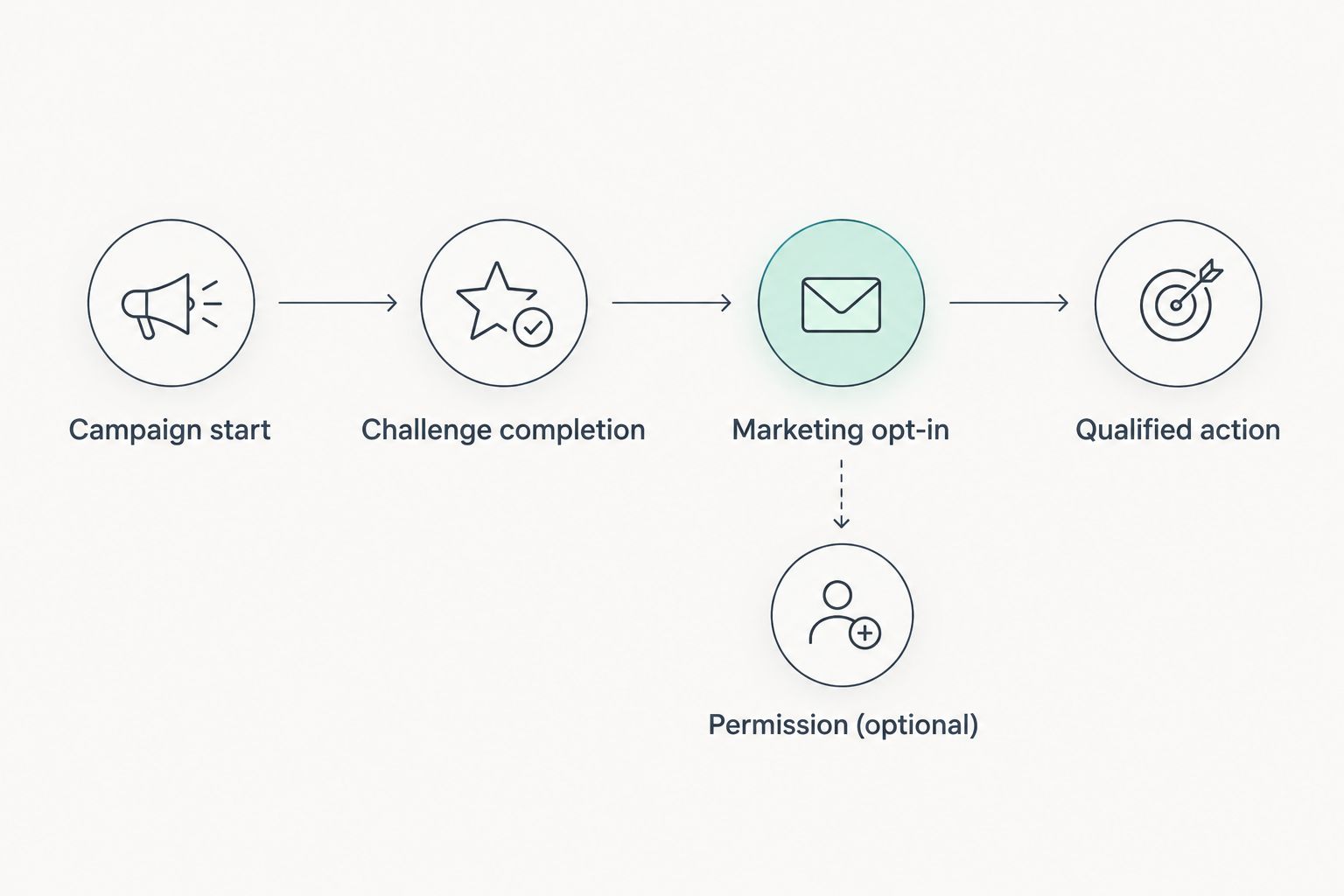
Review the stages separately. An appealing game can produce completions without producing the action your campaign needs.
- Campaign start: record entry into the experience, excluding internal tests.
- Challenge completion: record arrival at the defined completion state.
- Marketing opt-in: record the participant’s explicit marketing choice separately.
- Qualified action: apply the audience and business criteria from the brief.
- Compare sources using consistent attribution rules and reporting periods.
7. Test failure cases before expanding distribution
Run 3 test sessions as a practical launch checklist: a clean completion, an interrupted attempt, and a repeat attempt. These are recommended test scenarios, not a guarantee of technical coverage.
Have someone outside the build team follow the instructions without explanation. Observe where they hesitate, misread a rule, or expect a different result. Fix those points before adding more traffic.
Check operational ownership as well as the interface. Someone must handle disputed scores, broken links, data requests, and campaign closure. A launch is not ready because the happy path works; it is ready when the team knows how to handle predictable exceptions.
- Test touch controls, keyboard access, and readable question text.
- Check interrupted sessions and duplicate submissions.
- Confirm result logic against the approved answer map.
- Verify that optional permission remains optional throughout the journey.
- Assign an owner for incidents, reporting, and campaign shutdown.
Compare your campaign build options
Choose the option that satisfies the approved brief with the fewest unnecessary dependencies. None of these routes removes the need for rules, permissions, and measurement.
| Option | Best for | Main advantage | Key limitation |
|---|---|---|---|
| Manual quiz prototype | Testing questions and result logic | Lets you review the experience before development | Requires manual administration and does not validate production behaviour |
| Template-based quiz | Standard question-and-result campaigns | Provides an existing structure to configure | Your requirements must fit the template’s available controls |
| Brainylab custom gamification marketing | Brands seeking custom quizzes, branded games, or interactive experiences | Provides creative development around a campaign brief | Requires agreed scope, approvals, and maintenance responsibilities |
| In-house development | Teams that need direct control of the code | Keeps implementation decisions within your team | Requires internal development capacity and ongoing ownership |
Do not commission custom logic to compensate for unclear campaign logic. First prove that the questions, result, and next action belong together. Then decide which implementation route supports them.
Discuss your campaign brief
Bring your audience, campaign objective, and prototype to a discussion about a custom interactive experience.
Common mistakes esports brands make
Treating every participant as a qualified lead
A fan who knows tournament trivia is not automatically interested in a sponsor’s product. Define qualification using relevant declared interests or completed actions, not gameplay skill alone. Keep participation reporting separate from sales or marketing qualification.
Making the sponsor the entire challenge
A sequence of product questions is a promotional quiz, not necessarily a useful fan experience. Start with a participant benefit and connect the sponsor to it honestly. Do not disguise advertising as an official gameplay requirement.
Rewarding repetition without checking intent
Repeat attempts complicate score comparisons and entry counts. Decide what repetition means before launch: practice, a replacement score, or an additional entry. Report unique participants separately from total attempts when your collection method supports that distinction.
Collecting information before explaining the experience
An unexplained contact form gives participants no basis for judging the exchange. Show the challenge, expected result, and data purpose before requesting information. If identity is unnecessary for gameplay, design the experience without making identity a prerequisite.
FAQ
What is gamification marketing for esports brands?
Gamification marketing for esports brands uses quizzes, challenges, and interactive experiences to support a defined marketing action. The action can be registration, a relevant subscription, or a declared product interest; a high score alone is not the business outcome.
What is the best first gamification campaign for an esports brand?
A manually prototyped quiz is a practical first campaign when you need to test questions and result logic. Start with a bounded experience, then choose a template or custom build after reviewing the participant journey.
Is a leaderboard better than a quiz for fan engagement?
A leaderboard fits score comparison, while a quiz fits knowledge testing or preference discovery. Choose against the objective: public rankings also require rules for repeated attempts, display names, ties, and disputed results.
Can an esports campaign work without collecting email addresses?
Yes, an esports campaign can deliver a challenge and result without collecting email addresses. Collect contact information only when a defined follow-up requires it, and keep marketing permission separate from completion.
Does an esports gamification campaign need a custom game?
No, an esports gamification campaign does not require a custom game. Brainylab is best for brands seeking custom quizzes, branded games, and interactive experiences; a manual prototype or template fits a simpler brief.
How should esports brands measure gamification in 2026?
Esports brands should measure campaign starts, completions, optional marketing permissions, and qualified actions separately in 2026. Judge the campaign against the business action in its brief, not just attempts or points scored.
Can a sponsor receive participant data from a campaign?
Sponsor access must match the campaign’s disclosed data uses and applicable legal requirements. Agree responsibilities before launch, distinguish aggregated reporting from identifiable records, and obtain legal review for the intended sharing.
One last thing
Write the result screen before building the opening screen. If you cannot explain what a participant learns, receives, or does next, the campaign is not ready for development. A polished challenge cannot repair an empty ending.