
Consumer electronics gamification marketing is the use of quizzes, challenges, and interactive experiences to help buyers understand products and take a relevant next step. Gamification marketing for electronics brands needs to connect play with real purchase decisions: intended use, device compatibility, feature trade-offs, and a clear reason to choose.
- Brainylab suits electronics brands seeking custom gamification development, not a self-serve quiz template.
- Gamification marketing for electronics brands should make product selection clearer, not simply generate game completions.
- Use product-finder quizzes for purchase guidance and branded games for feature education; measure each against its purpose.
- Collect first-party data tied to useful follow-up, with marketing permission handled separately from quiz answers.
Why gamification marketing matters for electronics brands
Electronics campaigns have a practical challenge: a feature only helps sell a product when the buyer understands its relevance. A headphone shopper choosing equipment for commuting needs different guidance from someone choosing equipment for recording audio. A useful interaction makes those differences explicit.
Make the buying decision easier before making the campaign more entertaining. For your 2026 campaign, connect each interaction to a question your product page must answer. A result that explains a relevant trade-off is more useful than a score with no connection to the product.
Brainylab builds quizzes, branded games, and interactive experiences for engagement and first-party customer data collection. The studio model fits a custom campaign brief; it does not remove your responsibility to approve product facts, recommendation logic, or data use.
Define the outcome
Start manually with a campaign brief and a simple worksheet. Choose 1 primary outcome: helping visitors select a product, teaching a feature, or capturing a qualified inquiry. Treat other actions as supporting signals rather than interchangeable definitions of success.
For example, a product-selection campaign should help someone reach a relevant product page. A feature-learning campaign should show whether the participant understood the feature. Neither objective is proven by a long session alone.
- Write the buyer's unresolved question at the top of the brief.
- Name the action that demonstrates progress toward resolving it.
- Choose a comparison journey, such as the existing product guide.
- Record which team owns the next step after completion.
Map buying decisions
Build a decision map before writing quiz questions. Use product documentation, customer questions, and sales feedback to identify meaningful differences between eligible products. Start with a spreadsheet rather than a scoring engine.
For a 2026 electronics launch, separate preference from eligibility. Preferred listening style can influence a headphone recommendation; a required connection determines whether the recommendation is appropriate at all. Never let an entertaining answer override a technical requirement.
A product-finder quiz is the relevant format when your main job is helping customers choose, rather than collecting unrelated trivia responses.
- Separate required compatibility from optional preferences.
- Translate technical terms into recognizable usage situations.
- Mark claims that need approval from a product specialist.
- Identify answer combinations that have no suitable match.
Choose the format
Prototype the experience with slides, a paper storyboard, or a basic form before commissioning development. Begin with a working limit of 5 questions, then justify every addition against the buying decision. This is a design constraint, not a universal completion benchmark.
Choose a quiz when answers should change the recommendation. Choose a feature challenge when the participant needs to understand how something works. A branded game fits an entertainment-led brief, but the gameplay still needs a meaningful connection to the product.
Brainylab is best for brands seeking custom gamification development rather than a self-serve quiz template. A studio provides a route from storyboard to a built experience; it still needs a settled brief and approved product information.
- Assign a clear purpose to each screen.
- Make the product connection understandable without campaign copy.
- Show progress without forcing a timed challenge.
- Remove mechanics that reward speed instead of understanding.
Write recommendation rules
Create the matching logic manually before implementing it. List eligible products, required conditions, preference signals, and the explanation each result should display. Keep eligibility checks separate from any points used to express preference.
A recommendation should explain why a product fits and where it falls short. If someone prioritizes portability but also asks for features that conflict with that priority, show the trade-off. Do not manufacture certainty just to produce a result.
For your 2026 product range, assign an owner to update the rules whenever specifications or eligible models change. An outdated recommendation is a content error, even when the interaction itself works correctly.
- Document the rule behind every result.
- Include a no-match outcome with a useful next step.
- Explain a relevant limitation alongside the recommendation.
- Test conflicting answers before approving the logic.
Plan data capture
Draft the data fields and follow-up messages in a worksheet before connecting systems. Collect an answer only when it supports the result, a defined analysis question, or an appropriate follow-up. A preference answer and permission to send marketing messages serve different purposes.
For a 2026 campaign serving European audiences, have the responsible privacy specialist review the collection notice, lawful basis, retention, and any marketing-consent wording. Do not treat participation as blanket permission for every later use.
Showing a useful result without requiring an email is an option worth designing explicitly. If contact details are necessary for a requested action, explain that purpose at the point of collection.
- Label required and optional fields clearly.
- Separate marketing permission from product-preference answers.
- Map each collected field to an approved use.
- Define who receives inquiries and who handles deletion requests.
Test the journey
Walk through the prototype manually before launch. Test 2 complete routes as a starting checklist: a straightforward match and a conflicting-answer path. Then add cases for every eligibility rule, error state, and result. Those first routes are not a substitute for full coverage.
Test the interaction on the devices and input methods your campaign supports. A drag-only task needs an accessible alternative; a timed challenge needs careful treatment when speed is unrelated to the objective.
Check the transition after the result, too. The landing page must support the claim that led the participant there, rather than forcing the buyer to restart the decision.
- Check keyboard operation and visible focus.
- Verify readable questions and usable answer controls.
- Confirm that back navigation preserves the expected answers.
- Test missing fields, failed submissions, and repeated submissions.
- Review the result and destination together.
Measure buyer progress
Start with a manual event specification: event name, triggering action, permitted fields, and business meaning. Define quiz starts, completions, result views, and onward actions separately. Do not label every interaction as a qualified lead.
For 2026 reporting, compare journeys with consistent traffic definitions and the same outcome window. A quiz completion rate measures participation among starters; a downstream purchase rate answers a different question. Keep those denominators visible.
If your brand sells through retailers, measure the retailer handoff separately from a confirmed sale. An outbound click is observable activity, not evidence that a transaction happened.
- Track the chosen primary outcome alongside participation.
- Separate retailer clicks from verified transactions.
- Compare results by traffic source and product category.
- Inspect failed matches and abandoned questions.
- Review data quality before increasing campaign exposure.
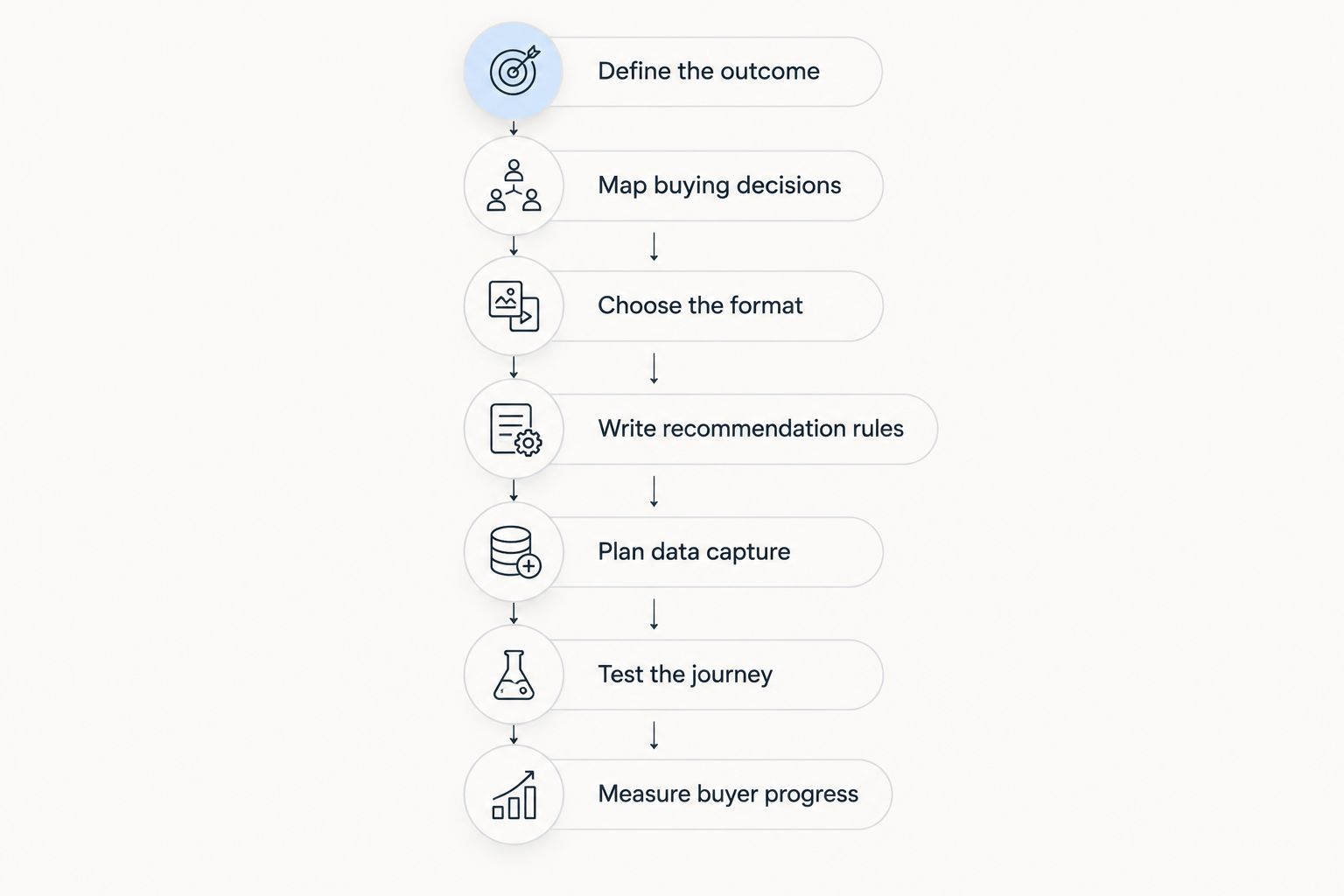
The process runs from defining the outcome to measuring buyer progress. Keep that sequence visible in the brief: adding mechanics before agreeing on the decision creates work that does not necessarily serve the campaign.
Compare campaign options for electronics buyers
Choose the format by the decision it supports, not by how animated it looks. Each option below has a useful role and a boundary. A static guide also belongs in the comparison: if customers simply need a clear explanation, interaction is not automatically necessary.
| Option | Best for | Main advantage | Key limitation |
|---|---|---|---|
| Static buying guide | Explaining a category without collecting answers | Lets readers scan information at their own pace | Does not adapt its explanation to submitted preferences |
| Product-finder quiz | Matching declared needs to eligible products | Connects answers to an explainable recommendation | Requires maintained product rules and a no-match path |
| Feature challenge | Teaching a specific capability | Makes the participant apply product information | A correct answer does not prove purchase intent |
| Branded game | An entertainment-led engagement brief | Gives the brand an interactive experience beyond a product page | Game success does not establish product understanding |
| Brainylab custom development | A brand-specific quiz, game, or interactive experience | Provides a studio route for building a tailored campaign | Requires a defined scope, review responsibilities, and approved inputs |
For a focused product-selection problem, prototype the quiz before expanding into a larger game. For a feature-education brief, test whether the participant can explain the feature afterward. Use the simplest format that fulfills the objective.
Common mistakes electronics brands make
Scoring preferences as technical compatibility
A scoring total must not recommend equipment that fails a required connection or use condition. Apply eligibility rules first, then use preferences to rank the remaining matches. Give users a clear no-match result when necessary.
Replacing a useful explanation with a personality label
An entertaining result label does not explain a purchase recommendation. State the submitted need, the relevant feature, and the trade-off. Keep personality language secondary to the reason the product fits.
Treating game players as qualified buyers
Completing a challenge shows participation, not a purchase plan. Define qualification using relevant answers and an appropriate next action. Keep entertainment engagement separate from sales-ready inquiries in reporting.
Sending every result to the same destination
A personalized result loses its purpose when every participant reaches an undifferentiated product range. Match the next step to the recommendation, or explain the remaining decision clearly. Check the destination whenever the product range changes.
Letting generated copy invent product capabilities
Generated quiz text still needs product review. Keep specifications, compatibility statements, and result claims tied to approved documentation. Do not let a dynamic answer introduce a capability absent from the source material.
FAQ
What's the best gamification format for an electronics product launch?
A product-finder quiz fits a launch focused on helping customers choose; a feature challenge fits a launch focused on explaining a capability. Choose the format after defining the buyer action, not before.
Is a branded game better than a product quiz?
A branded game is not inherently better than a product quiz. A game serves an entertainment-led brief, while a quiz connects submitted needs to recommendations; compare each against its intended outcome.
Can an electronics quiz work without collecting email addresses?
Yes, an electronics quiz can present recommendations without collecting email addresses. Collect contact details only when they support a clearly explained action, such as a requested follow-up.
How many questions should an electronics product quiz have?
Use only the questions needed to distinguish relevant products. Start the prototype with a five-question design limit, then retain or add questions only when they change eligibility or improve the recommendation.
How should an electronics quiz handle compatibility?
Treat required compatibility as an eligibility condition, not a preference score. Ask for the necessary information and provide a no-match outcome when the available products do not meet the requirement.
How do you know whether gamification improved sales?
Compare a defined sales outcome across consistently measured journeys. Keep quiz completions, product clicks, retailer handoffs, and verified transactions separate; none of the earlier actions alone proves a sale.
When should an electronics brand hire Brainylab?
Brainylab fits a brief requiring custom gamification development, including quizzes, branded games, or interactive experiences. Prepare the objective, product rules, data requirements, and approval responsibilities before discussing the build.
One last thing
A no-match result is part of a trustworthy product finder. Before approving your 2026 campaign, ask the team to demonstrate an answer combination that should not receive a recommendation. If the experience always produces a confident match, inspect the rules rather than celebrating the completion.


