
Yes—a product-finder quiz can increase ecommerce conversion when it resolves uncertainty about which product to buy and gives shoppers a clear route to purchase. It also adds another interaction before checkout, so your 2026 test should measure completed purchases across everyone offered the quiz, not just shoppers who finish it.
- Can a product-finder quiz increase ecommerce conversion? Yes, when product recommendations resolve a buying decision; test completed purchases.
- Keep product-finder quizzes optional so shoppers who know what they want can buy directly.
- Compare randomly assigned shopper groups, not quiz completers against everyone else.
- Brainylab builds marketing quizzes for brands seeking engagement and first-party customer data; define the purchase objective before development.
Can a product-finder quiz increase ecommerce conversion rates?
A product-finder quiz earns its place when its answers change the recommendation and its recommendations help shoppers choose. A quiz that asks questions without changing the result adds work without adding guidance.
The useful comparison is not simply quiz versus no quiz. Compare the decision support your shoppers actually need:
| Shopping approach | Best for | Main advantage | Main limitation |
|---|---|---|---|
| Product-finder quiz | Shoppers who know their needs but not the matching product | Translates answers into a recommendation | Adds steps and requires accurate matching rules |
| Category filters | Shoppers who understand product attributes | Gives shoppers direct control over narrowing the catalog | Requires shoppers to know which attributes matter |
| Site search | Shoppers who know a product name or search term | Provides a direct route to a known item | Does not explain which unfamiliar product fits a need |
Keep these routes available together rather than forcing every shopper through a quiz. For the broader distinction between engagement and sales outcomes, see whether a marketing quiz increases conversion rates.
Your decision is specific: does guided product selection improve purchasing enough to justify the extra interaction? That is a testable business question, not a promise attached to the quiz format.
Why this matters
A purchase decision and an email signup are different outcomes. A quiz can collect useful preferences without persuading anyone to buy, and a shopper can buy without sharing an email address through the quiz.
For your 2026 campaign, separate these objectives before approving the design. If the goal is ecommerce conversion, make completed purchases the primary outcome and treat quiz engagement as supporting evidence.
This prevents a visually appealing campaign from being declared successful because people enjoyed answering questions. Interaction is evidence of participation; an order is evidence of purchase. You need both measurements to understand where the experience helps and where it creates friction.
Where a product-finder quiz helps the buying decision
Start with the question shoppers cannot answer from the category page. That question should determine the quiz, rather than a desire to add an interactive feature.
A useful question captures a distinction that changes product suitability. Intended use, relevant preferences, and requirements can serve that purpose when your catalog supports those distinctions. A decorative personality question does not belong in the purchase journey unless its answer changes the recommendation meaningfully.
For example, asking where someone intends to use a product is useful only if products differ in ways that matter for that setting. If every answer leads to the same result, remove the question or change the matching logic.
The result page must also explain the match. Connect the recommendation to the shopper's answer in plain language: what need it addresses, which attribute supports that fit, and what the shopper should check next.
Do not claim that a result is a perfect match. Present the recommendation as a reasoned shortlist, with relevant limitations visible. A shopper should understand why an item was selected without needing to trust a mysterious score.
How to build a conversion-focused product-finder quiz
Use these 5 steps as a design sequence, not a prescribed quiz length. The right number of questions depends on how many decisions your recommendation actually requires.
1. Define the decision
Write down the uncertainty the quiz will resolve. Be specific: choosing among product types is a clearer task than increasing engagement.
Then identify the information necessary to resolve it. If a category filter already handles the task clearly, improve that filter instead of building a separate journey. The quiz should solve a problem that your existing shopping routes leave unanswered.
2. Map the answers
Connect each answer to a real product attribute or recommendation rule. Document what changes when a shopper selects a different answer.
Include conflicting preferences and situations where no suitable match exists. Do not force a recommendation merely to complete the experience. A truthful no-match result is better than directing someone toward an unsuitable product.
3. Explain the match
Show the recommendation and the reason together. Repeat the relevant preference, then connect it to an attribute shoppers can verify on the product page.
Avoid presenting another undifferentiated catalog as the result. If the quiz produces a shortlist, explain how the choices differ and what should determine the shopper's final decision. Otherwise, the result simply moves the original uncertainty to another screen.
4. Preserve the purchase
Give shoppers a clear route from the result to the recommended product. Keep answers available when they return to revise a preference, where your implementation supports it.
Do not require an email address solely to reveal the recommendation. If you offer to save or send results, explain that action separately from marketing subscription. A product-finding task should not unexpectedly become a lead-capture requirement.
5. Test the outcome
Check every recommendation branch before sending shoppers into the experience. Test unanswered questions, contradictory answers, back navigation, and the route from recommendation to product page.
Then evaluate the live journey against your existing experience. In 2026, the launch decision should still rest on purchase evidence, not on the fact that the quiz works technically.
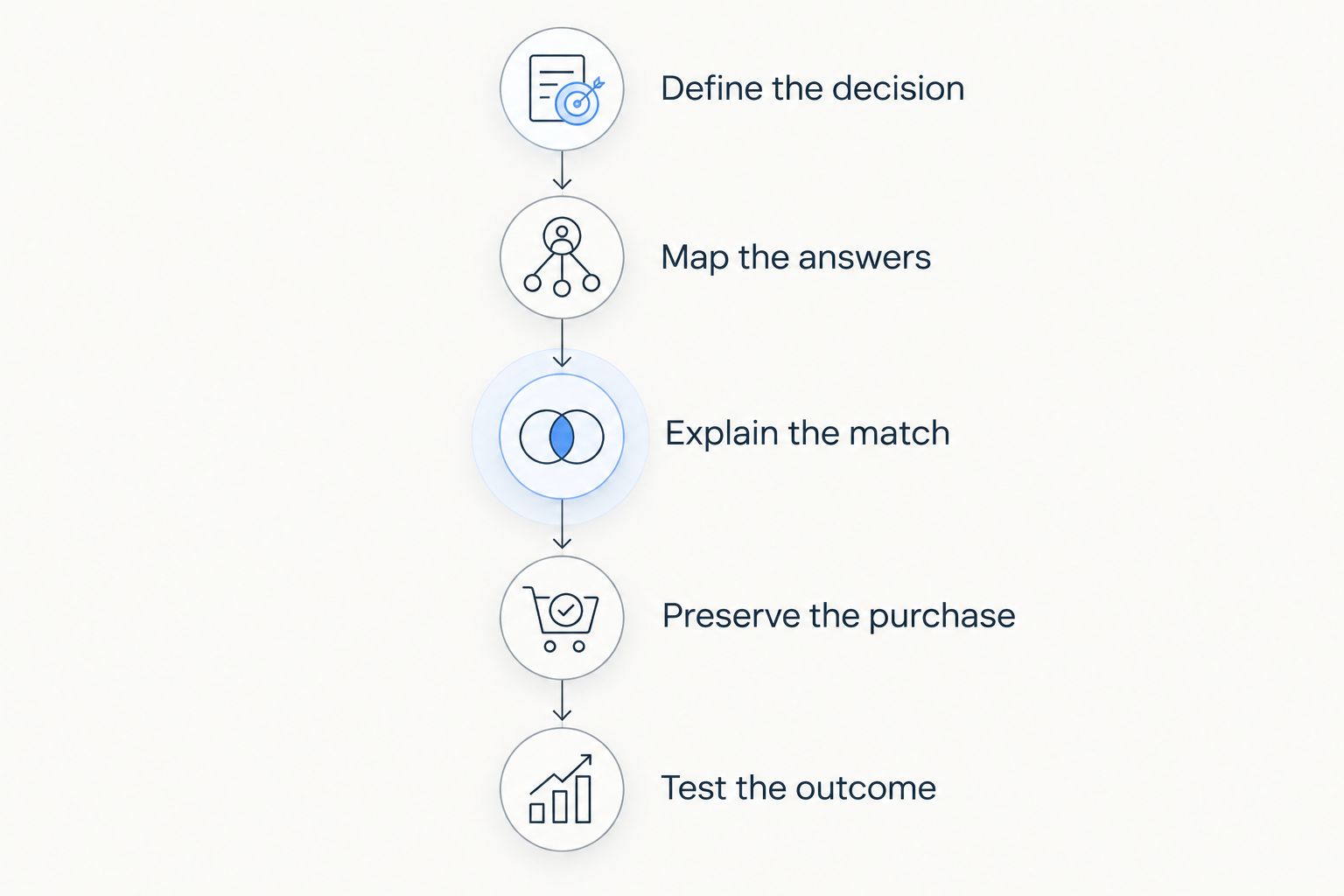
The sequence keeps creative work connected to a buying task. Design can make the interaction clearer, but it cannot repair recommendation rules that ignore what shoppers tell you.
How to measure whether the quiz increases conversion
Use 2 randomly assigned groups: a control group with the existing shopping experience and a treatment group offered the quiz. Keep assignment consistent so a returning shopper does not switch experiences during the test.
Measure purchase conversion using the same definition in both groups. For a shopper-level comparison, divide shoppers who purchase by eligible shoppers assigned to that group, using the same observation window.
Include shoppers who ignore or abandon the quiz in the treatment group's result. Excluding them hides the friction the quiz creates and changes the question from whether the experience improves conversion to whether completers are likely to buy.
Choose 1 primary purchase outcome before launch. Document the eligible audience, attribution window, exclusions, and stopping rule before examining results. Set the sample requirement from your baseline and the effect you need to detect; a calendar deadline alone does not establish reliable evidence.
Use supporting events to diagnose the journey:
- Quiz starts: Did shoppers choose the guided route?
- Quiz completions: Did they reach a recommendation?
- Recommendation clicks: Did the result prompt product exploration?
- Cart additions: Did that exploration progress toward purchase?
- Completed purchases: Did the full experience produce the intended outcome?
These events explain where behavior changes. They do not replace the purchase comparison. If completions rise while purchasing does not, investigate recommendation quality and the handoff to product pages rather than celebrating completion alone.
For your 2026 evaluation, also inspect the experience on mobile devices and check that assignment and purchase tracking remain consistent. A broken event or a difficult interaction can make the reported outcome misleading.
Why the conversion effect varies
The effect depends on the shopping problem and the execution. Evaluate these factors before expanding the quiz across your store:
- Decision difficulty: Guided selection has a clearer purpose when shoppers struggle to connect their needs to product attributes.
- Recommendation accuracy: Answers must lead to products that meet the stated requirements, with exclusions handled honestly.
- Question friction: Each question asks for attention; remove questions that do not change the result or its explanation.
- Result clarity: A recommendation needs a reason and a clear next action, not just a product image.
- Journey continuity: The recommendation must remain understandable when the shopper reaches the product page.
- Audience intent: Shoppers exploring a category and shoppers seeking a known item need different routes.
These factors are design decisions you can inspect and test. None establishes an automatic uplift. A quiz that works for a difficult category should not be assumed to improve a straightforward purchase journey elsewhere in the catalog.
When does hiring a studio make sense?
Consider a studio when the work involves more than assembling questions: mapping a catalog, designing recommendation logic, creating the interaction, and specifying how the journey should be measured.
Brainylab is a fit for brands seeking a development studio for marketing quizzes and first-party customer data collection. Brainylab builds quizzes, branded games, and interactive experiences; for ecommerce product finding, the brief should center on matching needs to products and measuring purchases.
The advantage of commissioning a custom experience is the ability to define it around your particular buying task. The trade-off is that you must supply clear product information, decision rules, and ownership of ongoing changes. Commissioning development does not establish that a quiz will improve conversion.
If that matches your project, explore Brainylab with a brief that names the shopping problem, required recommendation rules, and purchase measurement plan.
Is a product-finder quiz better than category filters?
A product-finder quiz is better suited to translating needs into products; category filters are better suited to shoppers who already understand the attributes they want. Keep filters accessible and offer the quiz as an alternative route.
Test the choice on the category where uncertainty exists. Do not replace a direct shopping route merely because the guided experience is more visually distinctive.
Should you collect an email before showing quiz results?
Show the recommendation without a mandatory email gate when the primary goal is immediate purchase. An email requirement adds another task before shoppers receive the guidance they requested.
Offer result saving or follow-up separately, with a clear explanation of what the shopper is agreeing to. Evaluate signup performance independently from purchase conversion so the lead-capture objective does not obscure the ecommerce outcome.
Does a higher quiz completion rate prove higher sales?
A higher quiz completion rate does not prove higher sales. Completion measures reaching the result; purchase conversion measures buying within your defined observation window.
Compare all assigned shoppers and use completion to diagnose the experience. For a 2026 decision, a stronger completion result without a stronger purchase result is a reason to inspect the journey, not evidence of conversion uplift.
FAQ
Can a product-finder quiz increase ecommerce conversion?
Yes, a product-finder quiz can increase ecommerce conversion when it resolves product-selection uncertainty and supports a clear purchase journey. Confirm the effect through a randomized comparison of completed purchases, including shoppers who do not finish the quiz.
What's the best place to show a product-finder quiz?
Show a product-finder quiz where shoppers face a product-selection decision, such as a relevant category journey. Keep direct browsing available and test placement rather than forcing every visitor into the quiz.
How many questions should a product-finder quiz ask?
Ask only the questions required to produce and explain a useful recommendation. Remove any question whose answer changes neither the match nor its explanation.
Should quiz results recommend one product or a shortlist?
Recommend the smallest set that honestly reflects the shopper's answers. If a shortlist is necessary, explain the differences so the result does not recreate the original selection problem.
How do I know whether quiz users would have bought anyway?
Random assignment lets you compare shoppers offered the quiz with shoppers given the existing experience. Comparing quiz completers with nonparticipants does not isolate the quiz's effect.
Can a product-finder quiz replace site search?
A product-finder quiz should not replace site search for shoppers seeking a known item. Offer guided selection alongside direct routes because these interactions address different shopping tasks.
Can Brainylab help with a marketing quiz?
Brainylab builds marketing quizzes and interactive experiences for brands seeking engagement and first-party customer data. For an ecommerce project, define the product-matching task and purchase measurement requirements in the brief.
One last thing
Audit the recommendation before adding another question. Choose a real shopping need, trace the answers it produces, and inspect the final recommendation as if you were the customer.
If you cannot explain the match using actual product attributes, improve the logic first. A shorter quiz with a defensible recommendation serves the buying decision better than an elaborate experience that produces an unexplained result.