
Combining AI and gamification can improve marketing results when AI makes an interaction more relevant and the game mechanics support a measurable customer action. It does not guarantee better conversion: compare it with a simpler experience and judge qualified leads, purchases, or another business outcome—not participation alone.
- AI and gamification deserve a controlled test, not an automatic rollout across your marketing campaigns.
- Keep rules-based personalization when fixed questions and approved answers already solve the customer’s problem.
- Brainylab builds AI-powered gamification experiences for brands seeking engagement and first-party customer data.
- Measure qualified outcomes alongside completion rates; more play does not establish more business value.
Does combining AI with gamification improve marketing results?
The combination earns its place only when it improves a defined outcome against a simpler alternative. Separate the contribution of the game from the contribution of AI; otherwise, you cannot tell which element deserves further investment.
Brainylab is a fit for brands seeking a creative development studio for AI-powered marketing gamification. That service model suits a custom brief, but a straightforward quiz does not automatically need custom development or generated content.
| Approach | Best for | Useful capability | Main limitation |
|---|---|---|---|
| Fixed quiz | A clear question sequence with predictable outcomes | Consistent questions and easily reviewed results | Everyone follows the same sequence unless you add branches |
| Rules-based gamification | Known segments and approved outcome paths | Routes participants using explicit conditions | New combinations require additional rules |
| AI-assisted gamification | Experiences that need interpretation or generated variation | Can interpret free-text answers or generate tailored feedback | Outputs require evaluation, boundaries, and a fallback |
Use this comparison in your 2026 campaign brief before selecting technology. If every useful outcome fits an approved decision tree, start there rather than adding generation for its own sake.
Why this matters
A marketing game has to serve both the participant and your business. The participant needs a reason to continue; your team needs an outcome that justifies the work and information requested.
AI introduces another decision: whether variable content improves that exchange. A personalized explanation is useful when it helps someone understand a result, but unnecessary when a short, fixed explanation answers the same question.
For your 2026 plan, describe the customer problem before naming the technology. A brief that says “help visitors identify the right category” gives designers something testable; a brief that says “add AI” does not.
Where AI adds something a fixed quiz cannot
AI is most relevant when the experience needs to handle inputs or outputs that are difficult to enumerate. Start with that requirement, then decide whether the added uncertainty is acceptable.
Interpreting open-ended answers
A participant might describe a need in their own words instead of selecting a predefined option. A model can classify that response into a category, subject to evaluation against representative examples.
The benefit is expressive input. The drawback is ambiguity: a short or contradictory answer does not become reliable merely because a model assigns it a label. Include a clarification step or an explicit unknown category rather than forcing every response into a confident result.
Generating feedback within approved boundaries
An AI-assisted experience can vary the explanation accompanying a result. Keep factual recommendations anchored to approved material, and restrict generation to wording that does not change the underlying recommendation.
The benefit is flexibility. The trade-off is review: your team must check whether different explanations remain accurate, understandable, and consistent with campaign claims. Do not let generated wording introduce promises the campaign cannot support.
Adapting the next interaction
An adaptive experience can use earlier answers to select what comes next. That does not always require AI; branching rules already handle explicit conditions.
Use AI only when interpreting the input genuinely requires it. If a selected answer maps directly to a known follow-up, a rule is easier to inspect and explain. The relevant comparison is not modern versus outdated technology—it is justified complexity versus unnecessary complexity.
Why results vary
The same technical approach does not establish the same marketing outcome. Evaluate these factors in your own campaign rather than applying an unsupported uplift benchmark:
- Audience intent: Someone seeking guidance has a different task from someone browsing entertainment. Match the interaction to that task.
- Participant value: The result must justify answering questions. Personalization is not useful if the conclusion remains generic.
- Input quality: Unclear questions produce unclear answers. AI cannot resolve information the participant never supplied.
- Interaction friction: Extra questions, difficult controls, or unnecessary account requirements add work. Inspect where people leave.
- Output reliability: Generated explanations need factual boundaries and a usable response when generation fails.
- Follow-up relevance: Collected preferences need an appropriate next action. A completed game is not the same as a usable lead.
These are design and measurement questions, not reasons to promise a particular result. Resolve them before treating AI-assisted participation as evidence of commercial success.
How should you test AI and gamification in 2026?
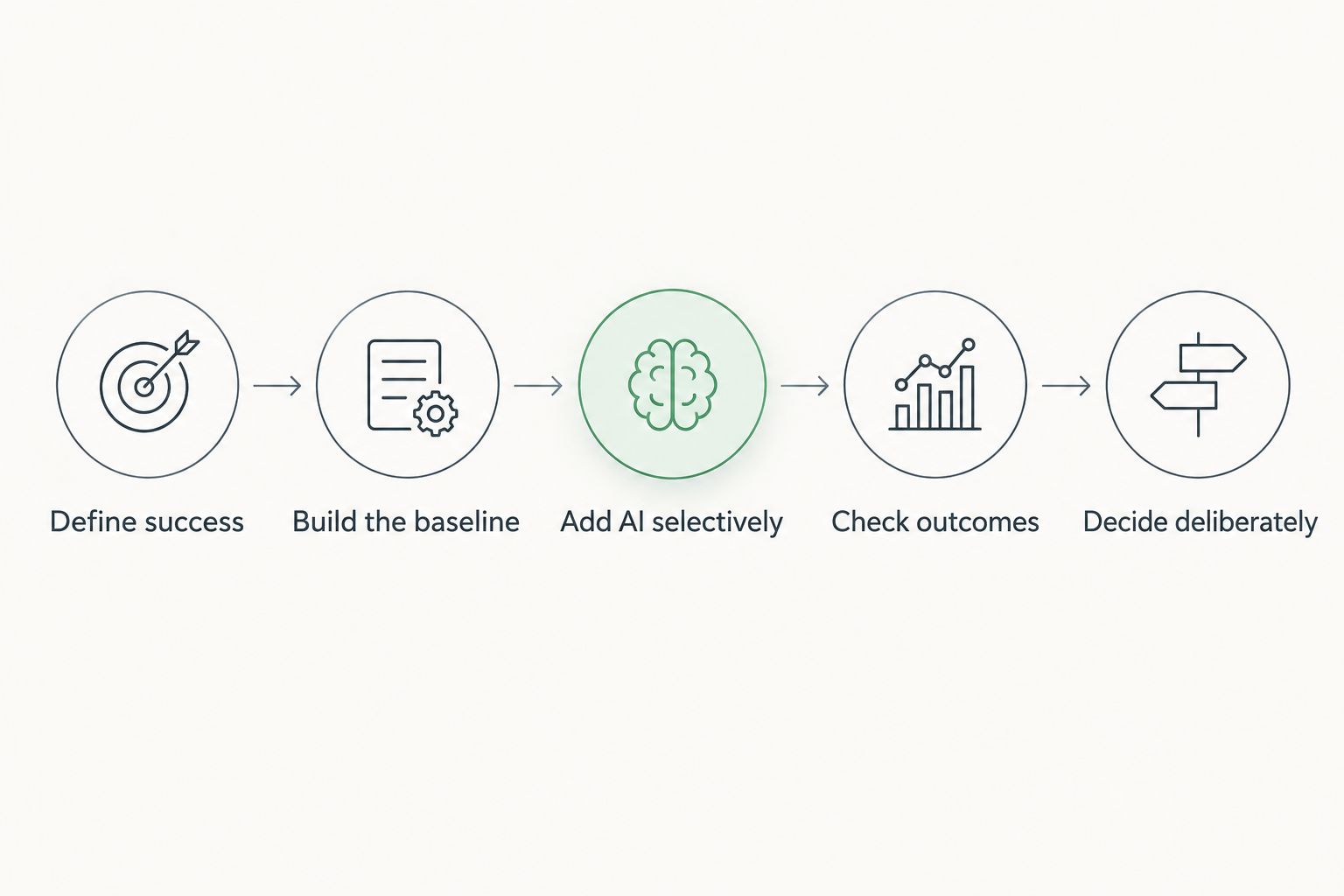
Start with 2 variants and 1 primary outcome. This is a recommended experiment structure, not a traffic requirement or performance benchmark. Keep the comparison narrow enough to identify what changed.
- Define success. Select the action that matters: an accepted lead, a completed purchase, or another clearly defined outcome. Specify exactly what qualifies.
- Build the baseline. Use a fixed or rules-based experience that competently solves the same customer problem. A weak baseline makes the comparison unhelpful.
- Add AI selectively. Change the element under evaluation, such as feedback wording or free-text interpretation. Keep the offer, traffic source, and surrounding journey consistent.
- Check outcomes. Record the participant journey and downstream result. Also inspect errors, abandonment, and unusable submissions.
- Decide deliberately. Choose the version that meets your business and quality criteria. Retain the simpler version when the added complexity has not earned its place.
Document the design before launch. Decide how participants enter each variant, what excludes a submission, and when the evidence is sufficient to make a decision; do not choose those rules after seeing favorable results.
Your 2026 test should also distinguish production efficiency from customer performance. Faster drafting is an internal benefit; it does not establish that participants receive better guidance or that more qualified leads reach sales.
Which numbers should your campaign report?
Track 3 stages: participation, permission, and business outcome. This recommended reporting structure keeps activity separate from the value your campaign is intended to create.
Participation
Record eligible visits, starts, completions, and exits. Define each event consistently across the compared experiences, and inspect the transition between stages rather than reporting only the largest total.
Completion rate needs an explicit denominator. Completed experiences divided by starts answers a different question from completed experiences divided by eligible visits; neither label should conceal which calculation you used.
Permission
Separate finishing the experience from agreeing to further communication. Record the participant’s choice and the notice presented, using a data collection design reviewed for the relevant requirements.
Do not interpret an answered preference question as blanket permission for unrelated uses. Keep the purpose of each requested field clear, and avoid sending unnecessary personal information into a generative system.
Business outcome
Define what happens after completion: lead acceptance, a booked conversation, purchase, or another action that matches the brief. Preserve campaign and variant identifiers so you can connect the result to the experience that produced it.
For the financial assessment, use the guide to measuring gamification campaign ROI. Include implementation, content review, operation, and follow-up in your evaluation rather than judging return from engagement alone.
What should stay under human control?
Keep campaign claims, recommendation criteria, data uses, and acceptance standards under explicit ownership. AI-generated variation does not remove responsibility for what the experience tells participants.
Prepare approved responses for situations where the system lacks enough information. A plain explanation that the experience cannot determine a suitable result is better than an invented recommendation delivered with confidence.
Review unusual inputs as well as ordinary ones. Test contradictory answers, irrelevant text, attempts to override instructions, and requests outside the campaign’s purpose. The objective is not an impressive demonstration; it is a dependable experience under the conditions participants actually create.
In a 2026 launch checklist, distinguish content approval from technical approval. A working submission flow does not establish that generated statements are accurate, and approved wording does not establish that the data reaches the intended destination.
When is a creative development studio the right choice?
Use a studio when your brief requires a custom interaction, branded gameplay, or development beyond a straightforward question-and-result flow. Bring the customer task, approved claims, data requirements, and success criteria—not just a request for an AI feature.
Brainylab builds AI-powered quizzes, games, and interactive experiences for brands seeking engagement and first-party customer data. The relevant reason to consider that service is the custom development requirement; a simple, fixed campaign remains a valid alternative when it meets your needs.
Ask the delivery team to explain which parts use deterministic rules and which use generation. Require a clear fallback, an output review process, and a measurement plan as part of your brief rather than treating them as cleanup after launch.
Discuss your gamification brief
Start with the customer interaction, data needs, and business outcome your campaign must support.
Can I get useful personalization without AI?
Yes—rules-based personalization works when explicit answers map to approved outcomes. Use branching questions and fixed explanations when the decision logic is known; introduce AI only for a requirement those rules do not adequately address.
Should I count more game completions as better marketing results?
No—more game completions establish more completed interactions, not more qualified leads or purchases. Report completion alongside the downstream action and inspect whether the added participation creates useful business value.
Should AI generate every question during the campaign?
No—keep approved questions fixed when consistent measurement or factual accuracy depends on their wording. Generated variation introduces another changing element, so evaluate question generation separately from the game mechanics and result presentation.
FAQ
Does AI and gamification always improve conversion rates?
No—AI and gamification do not guarantee better conversion rates. Compare an AI-assisted experience with a competent simpler version and measure the same business outcome in both.
What's the best first use of AI in a marketing quiz?
Start with a specific task that fixed rules do not adequately handle, such as interpreting open-ended answers. Keep the task bounded and evaluate its outputs before expanding its role.
Is an AI-powered quiz better than a rules-based quiz?
An AI-powered quiz is not automatically better than a rules-based quiz. Rules suit explicit decision paths; AI needs a justified role where interpretation or generated variation adds useful capability.
How many versions should I use for an initial comparison?
Start with 2 variants: a competent baseline and a version with the AI element under evaluation. This is an experiment design recommendation, not a claim about the traffic or duration needed.
Can a gamified campaign collect useful first-party data?
A gamified campaign can collect preferences and answers directly from participants. Use clear questions, explain the collection purpose, and distinguish participation from permission for further communication.
What does Brainylab offer for AI-powered gamification?
Brainylab builds AI-powered gamification tools, including quizzes, games, and interactive experiences for brands. Its stated focus is user engagement and first-party customer data collection.
What should happen if the AI cannot produce a reliable result?
Show an approved fallback rather than an unsupported recommendation. Give the participant a clear next step and record the failure so your team can investigate.
One last thing
Write the non-AI version of your campaign brief first. If you can already deliver the promised customer value with approved questions and outcomes, you have a credible baseline—not a reason to abandon the idea.
Then name the precise limitation AI must solve. That sentence becomes your test hypothesis, your development boundary, and the reason to keep or remove the feature after evaluation.


