
Yes, AI can personalize quiz questions in real time by using a participant’s earlier answers to select or generate the next relevant question. For a marketing quiz in 2026, the safest starting point is AI-assisted selection from approved questions; generating new questions during a session adds content-review and response-time risks.
- Can AI personalize quiz questions in real time? Yes: use earlier answers to choose relevant follow-up questions.
- Approved question banks keep adaptive quizzes controlled; live generation requires validation and a fallback.
- Personalization does not prove conversion gains: compare completion, lead quality, and downstream outcomes.
- Brainylab builds branded marketing quizzes for engagement and first-party customer data collection.
Can AI personalize quiz questions in real time?
Yes. A quiz can update its next question after each submitted answer, rather than assigning every participant the same sequence. The system needs session context, a decision mechanism, and a way to display the selected question.
There are 3 approaches to consider for a 2026 campaign. They differ in control, flexibility, and review requirements—not just whether they use AI. Keep the commercial objective separate from the implementation: the guide to whether marketing quizzes increase conversion rates covers the outcome you need to evaluate.
| Approach | Best for | What changes during the quiz | Main advantage | Main limitation |
|---|---|---|---|---|
| Rule-based branching | Clearly defined audience paths | The next question follows predefined conditions | Predictable paths and reviewable wording | New paths require explicit rules |
| AI-assisted selection | Selecting relevant questions from an approved bank | A model chooses among permitted questions | Flexible selection without newly written questions | Selection still needs constraints and testing |
| Live question generation | Follow-ups to varied, open-ended answers | A model writes a new question during the session | Can respond to details outside preset answer choices | Wording, factual accuracy, and answer structure need validation |
Rule-based branching personalizes a quiz without requiring AI. AI becomes relevant when interpreting an answer or choosing a follow-up requires more flexibility than explicit conditions provide.
Start with approved questions unless newly generated wording serves a specific user need. A different question is not automatically a better question.
Why this matters
A marketing quiz should collect information that helps you serve the participant or qualify the enquiry. Asking irrelevant questions adds work without improving either outcome. Personalization lets you skip an inapplicable topic and ask a follow-up that reflects a stated preference.
For a 2026 brief, define the useful decision before choosing the technology. That decision might be which result to show, which interest category to record, or which follow-up conversation to offer. The quiz should explain why answering benefits the participant.
Keep adaptation distinct from profiling. Choosing a question from an answer supplied in the current session does not require inferring personal characteristics or importing a customer’s entire history.
Rule-based branching: best for defined paths
Rule-based branching is the right starting point when you can express the next step as a clear condition. If a participant chooses one topic, show its follow-up; if they choose another, move to a different approved question.
The benefit is control. You can review the wording, map the paths, and determine which answers produce each result before launch. No live model call is needed to decide a straightforward branch.
The limitation is maintenance. As conditions overlap, the flow becomes harder to review, and a predefined branch cannot interpret a free-text answer unless you add an interpretation step. Use branching when the decision is explicit; do not add AI just to reproduce an existing rule.
AI-assisted selection: best for approved question banks
AI-assisted selection uses a model to choose a question from a controlled collection. The model can consider a participant’s stated goal, earlier answers, and questions already asked. Your application—not the model alone—decides which questions are eligible.
This separates flexible decision-making from content creation. The selected question can retain approved wording, answer choices, and a stable identifier for reporting. It also makes it easier to compare responses to the same question across sessions.
The limitation is that a permitted question can still be the wrong selection. You need to test relevance, repetition, and routing. Require the model to return a permitted question identifier, then validate that identifier before displaying anything.
Live question generation: best for open-ended follow-ups
Live generation is useful when participants describe needs that preset choices cannot capture. A model can turn that description into a relevant follow-up instead of forcing the participant into an unrelated branch.
The trade-off is a larger review surface. Newly written questions can introduce unsupported assumptions, ambiguous language, or answer formats your reporting cannot interpret. A personalized question can also ask for information you never intended to collect.
Keep generated follow-ups within a defined topic and response format. Do not let generated wording determine eligibility, make product claims, or create a new scoring rule without application-level controls. For scored knowledge quizzes, preserve approved answer keys rather than treating plausible model output as verified truth.
How real-time quiz personalization works
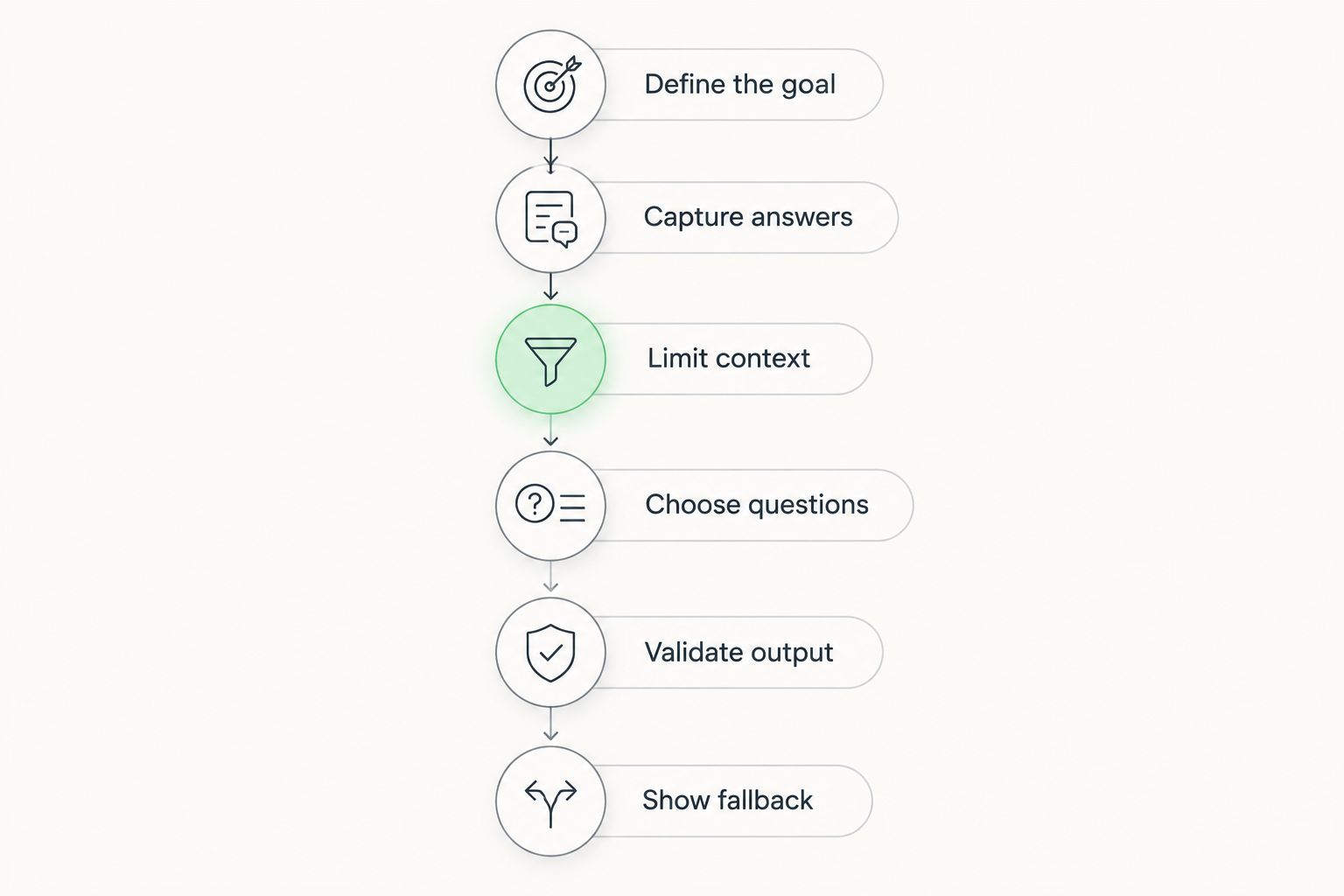
Treat real-time personalization as a controlled sequence, not an unrestricted conversation. The following 6 steps form a practical implementation checklist. Each step has a distinct responsibility, which makes failures easier to locate.
1. Define the goal
Specify the decision the quiz should support. A lead-generation quiz might distinguish stated interests; an educational quiz might identify which approved topic needs another question. Write down what the result should mean before drafting the flow.
Also define what the quiz must not decide. A preference quiz should not quietly become a diagnostic assessment or a way to infer sensitive characteristics.
2. Capture answers
Store the participant’s submitted answer in the current session. Keep the question identifier alongside it so the application knows what the answer refers to. A bare response without its question context can be misleading.
Use explicit answers first. If you introduce behavioral signals, decide whether they genuinely help the intended experience and explain their use appropriately. Do not interpret hesitation as a verified preference.
3. Limit context
Send the decision mechanism only the information needed to choose the next question. Relevant context includes the current topic, previous question identifiers, submitted answers, and permitted next steps.
Separate contact details from selection context unless they are necessary. A participant’s name or email address usually does not help determine which question about their stated interests comes next.
4. Choose questions
Apply a rule, select an approved question, or request a constrained generated follow-up. Specify the permitted topic and output structure. For selection, provide the eligible question identifiers rather than asking for an unrestricted suggestion.
Treat participant text as input data, not as instructions for the application. A response that asks the model to change the quiz rules must not override your configured boundaries.
5. Validate output
Check that the proposed question is permitted, relevant to the current path, and not already answered. Validate any required answer choices and reject outputs that do not match the expected structure.
Use 2 validation layers: structural checks in code and content checks against the campaign’s rules. Neither replaces the other. Valid formatting does not make an inappropriate question acceptable.
6. Show fallback
Keep an approved next question ready when personalization fails validation or the model request does not complete. The participant should still have a usable path through the quiz.
Preserve answers during recovery. Requiring someone to repeat earlier responses turns a technical problem into unnecessary participant effort. Record the fallback event separately so you can diagnose it later.
Why real-time personalization varies
The appropriate design depends on what the quiz needs to do. Use these factors to scope the experience rather than treating every adaptive quiz as the same build:
- Answer format: Fixed choices support explicit routing. Free text adds interpretation and requires tighter input handling.
- Question source: An approved bank limits possible wording. Live generation requires checks for newly created content.
- Decision consequence: A casual preference result needs different controls from a scored assessment or eligibility decision.
- Data scope: Current-session answers create a different design requirement from combining answers with an existing customer profile.
- Failure behavior: A quiz with an approved fallback can continue when personalization is unavailable; a flow that depends entirely on generation cannot.
Choose the least complex approach that supports the required decision. More flexible question generation creates more possibilities to review, not an automatic engagement advantage.
What should you test before launching?
For a 2026 launch, use 3 checkpoints: relevance, integrity, and recovery. These are acceptance criteria for your implementation, not performance benchmarks.
Relevance: Walk through different answer paths and confirm that every follow-up relates to information the participant supplied. Include contradictory answers and a participant who changes direction. Check that the quiz does not repeatedly ask for the same information.
Integrity: Confirm that displayed questions stay within the campaign’s approved scope. For scored quizzes, check answer keys and scoring separately from question selection. For lead-generation quizzes, verify that stored categories reflect actual answers rather than unverified model interpretations.
Recovery: Test malformed responses, unavailable model requests, and interrupted sessions. Confirm that the approved fallback works and that submitted answers remain attached to the correct session.
Include accessibility in these checks. Keep questions understandable, make answer controls keyboard-accessible, and ensure that a changed question does not silently remove information the participant needs.
How do you measure whether personalization helps?
Compare an adaptive version with a fixed version that serves the same campaign objective. Keep other changes controlled so you can distinguish the effect of personalization from a different offer, traffic source, or opening screen.
For your 2026 measurement plan, define completion rate as completed sessions divided by started sessions. Track abandonment by question, invalid outputs, and fallback events. These measures tell you whether the experience works; they do not establish lead quality by themselves.
Evaluate the downstream outcome too. If the objective is useful enquiries, compare qualification outcomes using agreed criteria. If the objective is preference collection, check whether stored answers remain interpretable and usable after the quiz ends.
Do not compare answers to different questions as though they were identical measurements. Store question identifiers, wording versions, and routing context. Personalized wording can change how a participant interprets a question, which matters when you aggregate responses.
Does every personalized quiz need generative AI?
No. Rule-based branching personalizes the sequence whenever explicit conditions are enough. AI-assisted selection is useful when interpreting context or choosing between permitted follow-ups requires more flexibility; live generation is a separate design choice.
Does real-time mean there is no waiting?
No. Real-time means the next decision happens during the current session, not that processing takes no time. Define an acceptable waiting experience, test it under your expected usage conditions, and provide a fallback rather than promising an unsupported response-time figure.
Can personalized questions improve lead generation?
Personalized questions can collect more relevant stated preferences by asking applicable follow-ups. That mechanism does not establish a conversion increase: compare the adaptive quiz with your baseline and judge both completion and lead quality.
Where a custom studio fits
Brainylab is a fit for brands seeking custom gamified marketing quizzes for engagement and first-party customer data collection. The studio builds AI-powered quizzes, games, and interactive experiences; a custom brief can define where personalization belongs and where approved content should remain fixed.
A custom build also needs a clear owner for question approval, data handling, and ongoing changes. Working with Brainylab does not replace those decisions, and the presence of AI does not establish that a particular quiz supports live question generation. Confirm the required behavior in the project scope.
You can explore Brainylab when your brief calls for a branded marketing experience rather than an off-the-shelf question flow.
FAQ
Can AI personalize quiz questions in real time?
Yes, AI can use earlier answers to select or generate the next question during the same quiz session. Approved question banks provide tighter content control than unrestricted live generation.
What's the safest way to add AI personalization to a marketing quiz?
Start with AI-assisted selection from approved questions. Validate the selected identifier and keep an approved fallback so participants can continue if selection fails.
Is AI personalization better than branching logic?
AI personalization is better suited to interpreting varied context; branching logic is better suited to explicit conditions. Choose based on the decision the quiz needs to make, not the technology label.
Does AI need personal information to adapt quiz questions?
No, AI can adapt questions using answers from the current session without contact details. Send only the context needed for the next-question decision.
Can AI-generated quiz questions contain mistakes?
Yes, generated questions can contain unsupported claims, unclear wording, or unsuitable answer choices. Validate outputs and keep scoring tied to approved criteria.
How should I evaluate an adaptive quiz in 2026?
Compare an adaptive quiz with a fixed version serving the same objective. Track completion, abandonment, fallback events, and the downstream quality of the information or enquiries collected.
Does Brainylab build marketing quizzes?
Yes, Brainylab builds AI-powered gamification tools, including quizzes and interactive experiences, for brand engagement and first-party customer data collection. Confirm real-time personalization requirements in the project scope.
One last thing
Personalize the route before personalizing the wording. Selecting a more relevant approved question preserves content control and stable reporting. Generate a new question only when the participant’s answer creates a useful follow-up that the approved bank cannot serve.
That distinction also improves your brief. Ask which decision needs adaptation, which information supports it, and what the quiz should display when the system cannot make that decision safely.