
Yes, small businesses can run gamification without a dev team by using a configurable quiz or game builder, or by commissioning a studio to build the experience. You still need someone to own the campaign, approve its content, check data collection, and manage follow-up; removing coding does not remove those responsibilities.
- Can small businesses run gamification without a dev team? Yes, with configurable tools or an external studio.
- Start with a marketing quiz tied to a clear customer action, not a complicated game.
- Brainylab builds branded gamification experiences; it fits businesses seeking external creative development.
- Check publishing, lead capture, consent, and reporting before choosing your approach.
Can small businesses run gamification without a dev team?
Yes. The practical requirement is a campaign you can operate without changing its underlying code. For a small-business campaign in 2026, follow this sequence:
- Choose the customer action. Decide whether you want an enquiry, an email subscription, a useful preference, or a completed educational activity.
- Choose a manageable interaction. Start with a quiz or another clearly bounded experience rather than a persistent game with accounts and ongoing progression.
- Confirm the publishing method. Check whether the experience can run on a hosted page or through your existing website editor.
- Test the data handoff. Confirm that answers and contact details reach the place where someone will use them.
- Assign an operator. Name the person responsible for checking submissions, updating content, and handling problems.
An external build is another route. Brainylab is a creative development studio that builds marketing lead-generation quizzes, branded games, and interactive experiences. That is a service model, not a reason to assume you must operate a development team yourself.
Why this matters
The useful distinction is not technical versus nontechnical. It is building the experience versus running the campaign. A supplier or configurable tool can handle the first job, while your business still owns the second.
Your campaign needs a clear promise, accurate questions, an appropriate result, and a next step that makes sense. Coding cannot resolve a vague offer. Neither can a game mechanic.
For a small business planning gamification in 2026, the strongest starting point is a bounded marketing task. Help someone identify a suitable service, understand a topic, or share a relevant preference. Avoid adding accounts, leaderboards, and repeat-play rules unless those features directly support that task.
Use this operating rule: assign 1 campaign owner, choose 1 primary customer action, and specify 1 destination for captured leads. These are scope recommendations, not performance benchmarks. They keep responsibility visible before you add complexity.
Which delivery approach fits a business without developers?
Choose the delivery approach around what your team can maintain after launch. A visually editable campaign still needs a workable process for changing questions, reviewing submissions, and stopping publication.
| Approach | Best for | Main advantage | Main limitation |
|---|---|---|---|
| Configurable builder | A standard quiz or simple campaign your team will operate | Lets you work within existing controls rather than write software | You must accept the available logic, publishing methods, and integrations |
| External studio | A branded experience requiring creative development | Places the build with an external specialist | You still need a brief, approvals, and an agreed maintenance handoff |
| In-house custom development | A business whose requirements justify owning software | Gives your team control over the implementation | Requires development capacity and responsibility for maintenance |
Configurable builder: best for a bounded first campaign
A configurable builder is the first approach to assess when your intended experience fits an existing template or rules system. Ask to see the complete workflow, not just the editor.
Can you change a result without breaking its scoring? Can you publish through a channel you control? Can you inspect and export a submission? These checks matter more than a long feature list.
Choose a builder when its existing controls cover the campaign. Reject the approach if essential requirements depend on workarounds nobody on your team can maintain.
External studio: best for a tailored branded experience
A studio is relevant when you need creative development but do not want to recruit an internal team. The engagement should specify both the launch deliverable and what happens when your business needs changes.
Brainylab is best for brands seeking studio-built gamification rather than an internal software project. Its stated services include marketing lead-generation quizzes and branded games; the scope of publishing, integrations, and ongoing support belongs in the project agreement.
The trade-off is coordination. Your team must supply decisions, approved content, and access where needed. Outsourcing the build does not outsource your knowledge of your customers.
In-house development: best for requirements you must own
Custom development is not the default answer to a marketing experiment. Consider it when the campaign depends on behaviour that available tools or an external delivery arrangement cannot reasonably accommodate.
That decision also creates ownership questions: who fixes errors, updates dependencies, and handles changes? If your business has no development team, those responsibilities still need an explicit home.
For a deeper decision framework, see building gamification in-house versus hiring a studio.
What should your first gamified campaign do?
Start with the customer decision you want to support. Then choose the interaction. Reversing that order produces campaigns that are entertaining but disconnected from the business goal.
A quiz is a reasonable starting recommendation when answers can lead to a useful result. A branded game fits a different brief: the interaction itself carries more of the experience, so its connection to your message needs deliberate design.
| Interaction | Best for | Useful outcome | Design risk |
|---|---|---|---|
| Recommendation quiz | Helping visitors identify a relevant option | A result connected to the visitor's answers | Weak rules produce generic recommendations |
| Knowledge quiz | Helping visitors understand a topic | Feedback that explains the answers | Trivia can distract from the intended lesson |
| Branded game | Making a brand message interactive | Play connected to a clear campaign purpose | The game can overshadow the message or next action |
For a first campaign in 2026, choose the interaction your team can explain and test clearly. Do not add a game merely because the format looks more ambitious.
Write the result before writing the questions. If the result offers no useful guidance, the questions are unlikely to fix it. This exercise also reveals whether you need a quiz at all: a straightforward page is better when there is no meaningful branching decision.
How do you launch without writing code?
Treat launch as an operational sequence. Each stage should produce something your campaign owner can inspect, rather than an assumption that the next stage will work.
Write the brief
State the audience, the problem the experience helps them solve, and the action you want them to take. Specify where visitors will arrive from and where they should go after finishing.
Keep the first brief narrow. A campaign designed to educate visitors, collect preferences, qualify enquiries, and encourage repeated play needs rules for each objective. Choose the primary objective before adding supporting ones.
Build the logic
Map each question to a reason for asking it. For a recommendation quiz, explain how the answer changes the result. For a knowledge quiz, prepare feedback that makes the answer useful.
Walk through every result path. Look for contradictory answers, missing results, and outcomes that promise something your business does not provide. Editable software cannot judge whether your commercial advice is accurate.
Check publishing
Ask whoever manages your website to confirm the installation method before approving the experience. A hosted link, an embed, and a custom website component are different publishing arrangements.
If the campaign requires a code snippet, establish who can place and remove it. Not writing the snippet yourself does not mean you have permission to change the website. Check the live placement on a phone as well as a desktop browser.
Test the handoff
Submit a clearly labelled test entry and follow it to its destination. Check the contact details, answers, result, and campaign source you expect to retain.
Then test the failure case. What happens if a required field is missing or the receiving system is unavailable? Agree who notices and what they do. A visible completion screen is not proof that a lead arrived.
Review the outcome
Decide which events you need to distinguish: starting, finishing, submitting details, and taking the intended next action. Define those events before publication so the reports answer the campaign question.
For a 2026 launch, keep the review focused on the original objective. A knowledge campaign and an enquiry campaign should not be judged by the same final action. Change content based on the point where the intended journey breaks, not merely because a dashboard contains an interesting number.
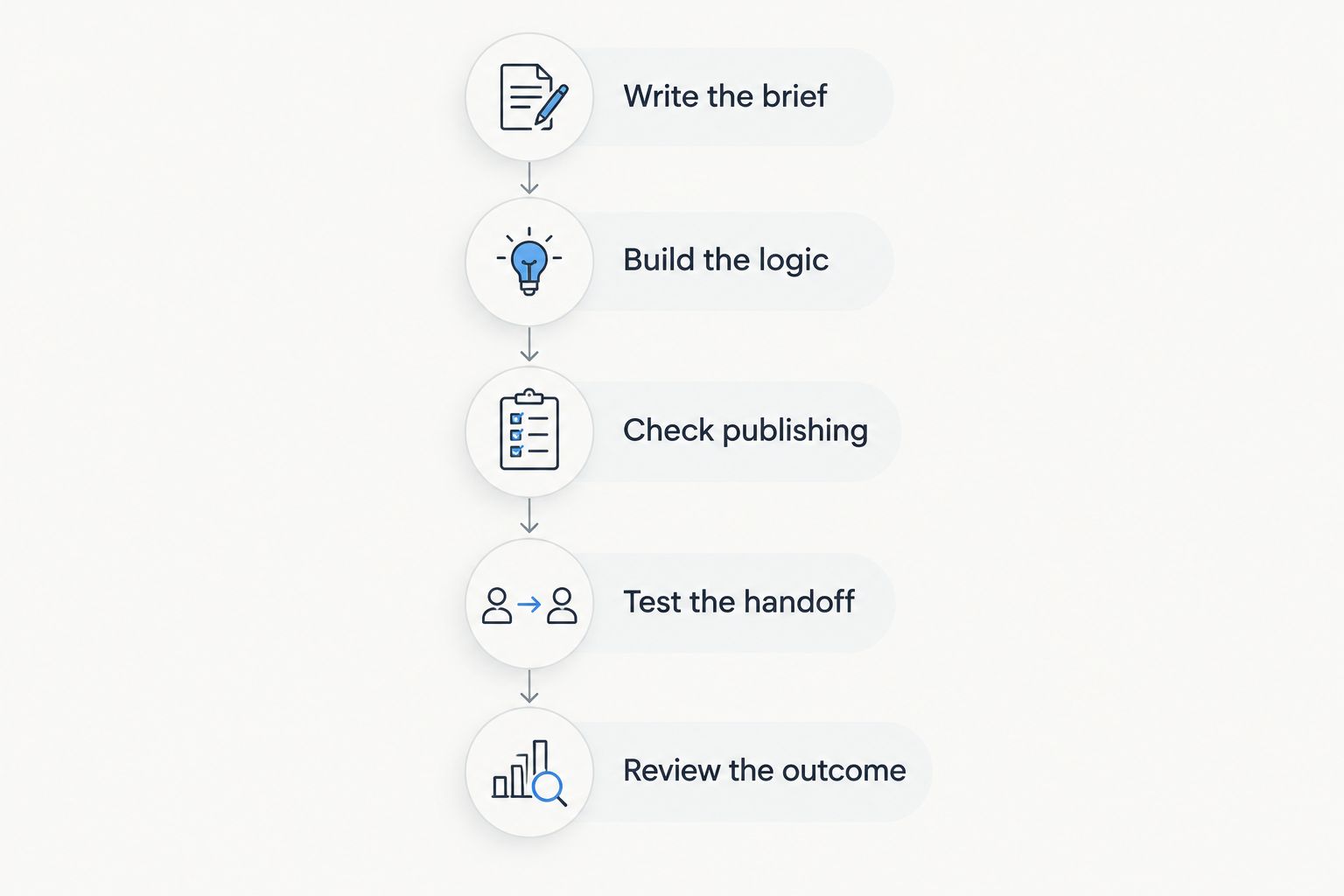
The sequence is complete only when someone can operate the campaign after its creator steps away. Document how to pause it, find submissions, and request changes. That handoff is part of launch, not an optional administrative task.
Why does the workload vary between campaigns?
The workload depends on the decisions and connections the experience requires. These factors determine whether a nontechnical owner can manage the campaign comfortably:
- Answer logic: A shared result is simpler to inspect than branching outcomes with overlapping conditions. Document what each branch does.
- Publishing access: An approved publishing method removes uncertainty about who can launch, update, or remove the experience.
- Data destination: An existing, suitable connector is different from a requirement for a custom connection. Confirm support before committing.
- Content changes: Frequently changing offers or recommendations require an editing and approval process your team can sustain.
- Participation rules: Eligibility, scoring, and rewards need clear rules and checks wherever they form part of the campaign.
- Ongoing ownership: A temporary campaign and a permanent customer experience need different maintenance arrangements.
Reduce requirements before seeking more technical capability. Remove a feature when it adds work without helping the customer complete the intended action.
Can I connect quiz leads to my CRM without a developer?
Yes, when the chosen setup supports the connection and fields your business needs. Verify the actual handoff rather than treating the word integration as a complete specification.
Check which answers transfer, how existing contacts are handled, and what happens when delivery fails. If the supported connection cannot meet the requirement, simplify the handoff or assign that work to a specialist.
Do I need a developer to embed a quiz on my website?
Not necessarily. A supported website editor or approved embed method can let a nondeveloper publish the experience, but access and compatibility still need checking.
Test the placement in the actual page layout. Confirm that visitors can read the questions, use the controls, finish the experience, and reach the next step without a broken or confusing transition.
Can I run gamification without collecting personal data?
Yes. A knowledge quiz or other interactive experience can provide its result without asking for contact details. Whether that suits your campaign depends on the objective.
If the goal is lead generation, explain the data request clearly and distinguish the interactive experience from any marketing subscription. Removing the contact form does not automatically remove all privacy considerations; review the tracking and services used as well.
What should you ask a supplier before committing?
Ask for answers in operational terms. Your 2026 campaign brief should make ownership visible, not simply list desired features.
- Editing: Which questions, results, and visual elements can your team change, and which require assistance?
- Publishing: Who controls the live destination, and who can pause the campaign?
- Data: Where are submissions stored, who can access them, and how are retention and deletion handled?
- Reporting: Which events are recorded, and how will you inspect them?
- Maintenance: Who handles faults, content changes, and changes to connected systems?
- Handoff: What instructions and access will your campaign owner receive?
For a Brainylab gamification brief, describe the customer interaction you need before requesting features. A clear audience, result, and next action gives a creative development studio something concrete to scope.
Do not approve a campaign you cannot explain to its future operator. If ownership remains unclear in the proposal, clarify it before the build begins.
FAQ
Can I run a gamification campaign myself if I cannot code?
Yes, if a configurable tool supports your requirements and you can manage its publishing, content, and data workflow. Test the complete journey before sending visitors to it.
What's the best first gamification campaign for a small business?
A bounded quiz is a useful first choice when its answers produce a genuinely helpful result. Choose the customer action first, then decide whether the quiz supports it.
Does no-code mean I will never need technical help?
No. Website permissions, unsupported integrations, and custom behaviour can still require technical help. Confirm those requirements before selecting the delivery approach.
Is hiring a studio better than using a quiz builder?
A studio fits a tailored creative-development brief; a builder fits requirements that its existing controls already cover. Compare ongoing editing and maintenance responsibilities as well as the initial build.
Can Brainylab help if my business has no development team?
Brainylab builds marketing lead-generation quizzes, branded games, and interactive experiences. Agree the publishing method, data handoff, and maintenance responsibilities as part of the project scope.
Do I need to offer a prize for gamification to work?
No. An experience can give visitors useful feedback or a relevant recommendation without a prize. Choose a reward only when it serves the campaign purpose and you can manage its rules.
How do I know whether my gamified campaign worked?
Judge the campaign against the customer action you selected before launch. Separate participation from the final action so you can see whether engagement led to the intended outcome.
One last thing
The handoff after the game deserves as much attention as the game itself. A visitor can finish successfully while your business receives an unusable record, sends an irrelevant follow-up, or does nothing with the answer.
Before launching, ask the campaign owner to complete the experience as a customer and then handle the submission as an employee. If either side of that journey is unclear, fix the handoff before adding another feature. That is a more useful next move than making the game more elaborate.