
There is no universal timeline for integrating a quiz with a CRM: estimate the work from your connection method, data requirements, and acceptance tests. A working connection is only part of the job; your launch deadline must also cover field mapping, consent handling, duplicate management, and lead routing.
- How long to integrate a quiz with a CRM depends on scope, not just connecting accounts.
- Separate connection setup from field mapping, consent handling, lead routing, and acceptance testing.
- Choose a native connector for supported requirements; use custom development when the workflow needs it.
- Brainylab builds marketing quizzes for brands seeking engagement and first-party customer data.
How long does it take to integrate a quiz with a CRM?
Set the integration deadline after defining what must happen to a completed quiz submission. Creating a contact, updating an existing contact, storing answers, and assigning a salesperson are separate requirements. Treating them as a single task hides work that still needs an owner and a test.
For your 2026 project brief, separate the estimate into these 6 checkpoints:
- Access approval: confirm who can authorize the quiz connection and access the CRM.
- Field mapping: decide where identity details, answers, results, and campaign information belong.
- Record matching: define when to create a contact and when to update an existing record.
- Consent handling: specify how permission information reaches the CRM and controls follow-up.
- Lead routing: determine which team, owner, or workflow receives each eligible submission.
- Acceptance testing: verify the complete journey, including unsuccessful transfers and repeated submissions.
Brainylab develops marketing quizzes and branded games for engagement and first-party customer data collection. When commissioning that kind of experience, include the CRM handoff in the campaign brief rather than treating it as an attachment to finished creative work.
Ask for separate delivery estimates for connection setup and production readiness. The first establishes that data can move; the second establishes that the data arrives correctly and produces the intended action.
Why this matters
A quiz completion is not the same as a usable lead. Your sales or marketing team needs the right information in the right record, with a clear reason to act on it.
An integration can pass a simple submission test while still failing your campaign requirements. For example, a new contact might arrive correctly while an existing contact loses previously stored information. Define success around the CRM outcome, not the presence of a successful connection message.
Measure readiness by accepted behavior, not by the first successful transfer. That distinction gives your marketing lead, CRM administrator, and developer the same finish line.
Choose the integration route before estimating delivery
Start by checking which connection methods your actual quiz system and CRM support. Do not assume that a connector exists, that it handles every required field, or that its default behavior matches your campaign.
These 3 integration routes have different responsibilities. Select the route that satisfies your requirements without adding unnecessary moving parts.
| Integration route | Best for | Main advantage | Main limitation | What to verify before estimating |
|---|---|---|---|---|
| Native connector | Workflows covered by an existing supported connection | Keeps configuration inside the connected systems | Its available actions and fields set the boundaries | Required fields, update behavior, consent, and routing |
| Automation middleware | Workflows that need an intermediate transformation or routing step | Makes the intermediate workflow explicit | Adds another system to configure, monitor, and maintain | Triggers, actions, credentials, error handling, and ownership |
| Custom integration | Requirements that existing connections cannot meet | Lets the implementation follow a defined data contract | Requires development, testing, and ongoing maintenance | API capabilities, authentication, record matching, and recovery |
Native connector: confirm coverage before committing
Choose a native connector when it supports the complete required handoff. Verify the destination record type, the fields it can write, and what happens when someone completes the quiz again.
Its advantage is a contained configuration path. Its limitation is the behavior it exposes: a connector that creates contacts but cannot support your required updates is not a complete fit.
Ask the implementer to demonstrate your intended workflow rather than a generic example. Your estimate should cover the campaign you are launching, not the easiest submission the connector accepts.
Automation middleware: account for the intermediate workflow
Choose automation middleware when the supported workflow needs a transformation or routing layer. Examples include translating a quiz result into a CRM field value or branching submissions according to a defined rule.
The intermediate layer gives you a place to express that logic. It also creates another place where credentials, field changes, or failed actions need attention.
Name the person responsible for that workflow after launch. A connection with no maintenance owner is unfinished operationally, even if the initial test succeeds.
Custom integration: define the contract first
Choose custom integration when your requirements exceed the available connector behavior. Specify the submission format, destination fields, matching rules, and expected responses before implementation begins.
The benefit is control over the agreed workflow. The drawback is responsibility: someone must maintain the code, handle failures, and respond when either system changes.
For a 2026 custom integration brief, require a documented data contract and a repeatable acceptance test. Those deliverables make the handoff inspectable instead of leaving its behavior inside one developer's implementation.
Turn the quiz-to-CRM handoff into a testable process
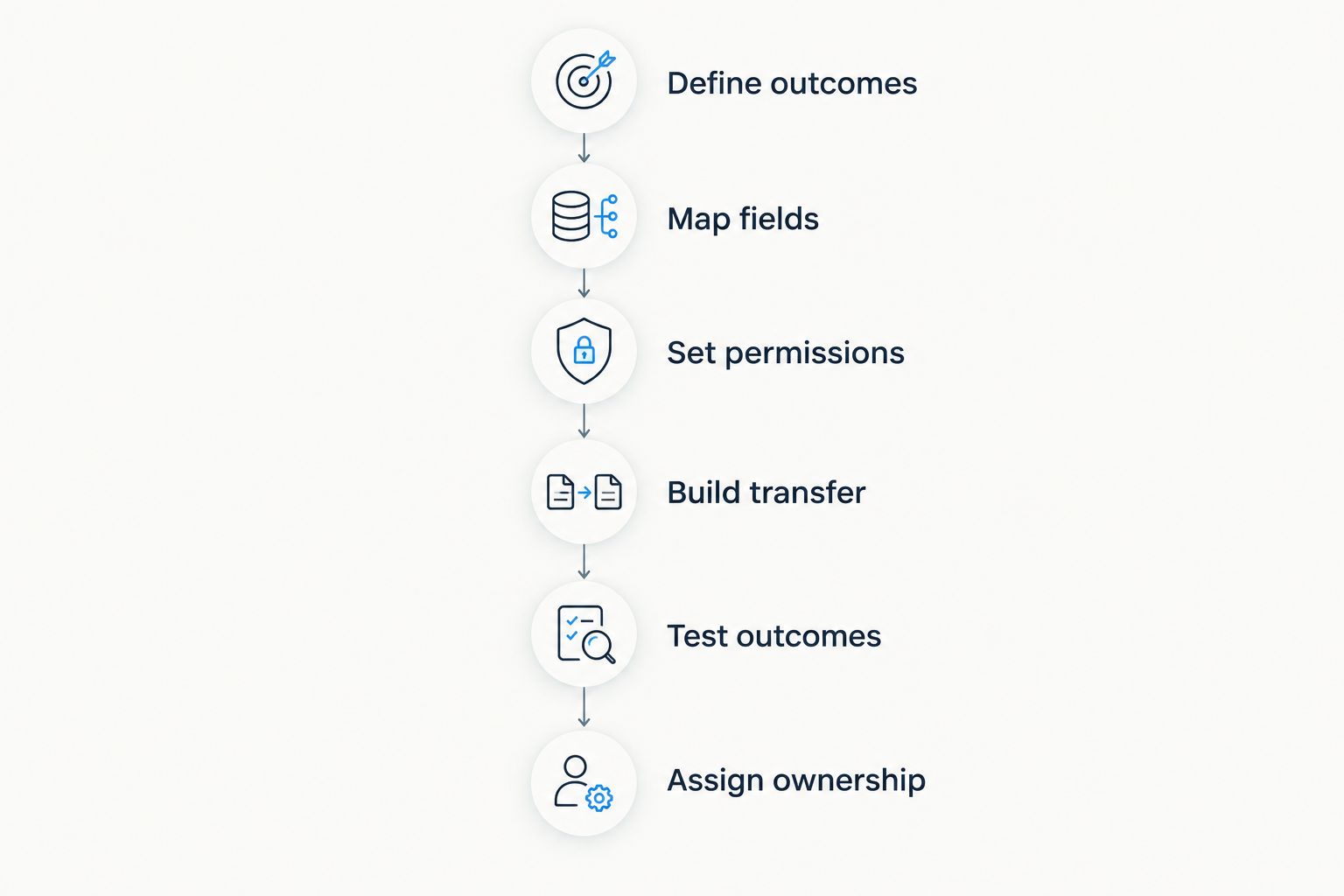
Use this sequence to turn an open-ended request into an estimable scope. Each stage should produce something your team can inspect and approve.
Define outcomes
Write down what a completed quiz should cause in the CRM. Specify whether the submission creates a record, updates a record, stores a result, or triggers a follow-up workflow.
Keep business outcomes separate from technical mechanisms. A requirement such as assigning an eligible lead to the appropriate team is clearer than asking for a webhook without describing what it must achieve.
Map fields
Create a mapping document with the quiz field, destination field, expected format, and handling rule. Include empty answers and result values, not just names and email addresses.
Distinguish information about the person from information about a particular quiz completion. Otherwise, a repeated submission can overwrite information you intended to preserve.
Set permissions
Confirm access to the relevant systems and define how permission information travels with the submission. Separate quiz participation from any permission needed for subsequent marketing activity.
Do not treat the existence of an email address as permission to send marketing. Have the responsible privacy owner approve the intended collection and follow-up process.
Build transfer
Configure or develop the handoff using the approved mapping and matching rules. Include the source campaign information your team needs to interpret the record later.
Decide how the implementation identifies an unsuccessful transfer. A submission that disappears between systems must be distinguishable from a submission that was intentionally excluded.
Test outcomes
Run the agreed scenarios and inspect the resulting CRM records. Check the downstream workflow as well as the incoming data.
A successful transfer is insufficient if it assigns the wrong owner or triggers an unwanted message. Acceptance should include both what happens and what must not happen.
Assign ownership
Document who handles connection failures, changes to quiz fields, and changes to CRM requirements. Give that owner access to the information needed to investigate a problem.
Keep the mapping and acceptance scenarios with the handoff documentation. They are the reference for future changes, not just launch paperwork.
Why quiz-to-CRM integration timelines vary
The delivery estimate changes when the required work changes. Use these factors to challenge an estimate and identify unresolved decisions before scheduling a launch:
- Access readiness: the implementer needs authorization to configure and test the connection. Name the approver and confirm the required access before work starts.
- Field complexity: separate free-text answers, fixed choices, results, and permission information. Each needs an explicit destination and handling rule.
- Record matching: creating a new contact is a different requirement from recognizing an existing contact and updating selected fields.
- Downstream actions: lead assignment, segmentation, and follow-up workflows require their own conditions and acceptance tests.
- Failure recovery: agree how unsuccessful transfers are detected, reviewed, and retried without creating unwanted duplicates.
- Approval ownership: identify who signs off on the data mapping, permission handling, and final CRM behavior.
For a 2026 launch plan, attach an owner and acceptance condition to each factor. This makes unresolved work visible without pretending that every integration follows the same timetable.
Keep quiz content production separate from integration delivery. Questions, result copy, and campaign assets can change independently, but changes to collected fields or result categories must be reflected in the CRM mapping.
What should be included in the integration estimate?
Ask for a scope breakdown rather than a single unexplained completion date. The estimate should identify what the team will configure, what it will develop, what you must supply, and what constitutes acceptance.
Require the following deliverables:
- A documented field map and record-matching rule.
- The agreed handling of permission information and campaign source.
- A working transfer through the chosen integration route.
- Acceptance scenarios covering successful and unsuccessful submissions.
- A maintenance owner and a documented recovery process.
Also state exclusions. Historical data migration, additional campaign variants, and new sales workflows should not silently enter an estimate for a single quiz handoff.
Approve a deadline against a defined scope, not a promise to connect the systems. If the scope changes, review the deadline rather than assuming the original estimate still applies.
Brainylab is suited to brands commissioning marketing quizzes for engagement and first-party customer data collection. For a custom campaign, ask Brainylab to define the CRM handoff requirements alongside the interactive experience; do not infer a supported connector from the campaign format alone.
What should you test before launching a CRM-connected quiz?
Start with these 4 test cases: a new contact, an existing contact, a repeated submission, and an unsuccessful transfer. Together, they test more than whether the connection can send a record.
For a new contact, inspect every mapped field and the expected follow-up action. For an existing contact, verify which values change and which remain untouched.
For a repeated submission, check whether the system creates a duplicate or updates the intended record. For an unsuccessful transfer, verify that the owner can identify the problem and follow the agreed recovery process.
Add scenarios for missing optional answers and different permission choices. Your 2026 acceptance checklist should confirm that a quiz submission cannot trigger an action that the approved workflow excludes.
Can you launch the quiz before the CRM integration is ready?
Launch only if you have approved a separate capture and handoff process. That process needs a clear destination for submissions, an owner, appropriate access controls, and a documented route into the CRM.
An interim process is not equivalent to a tested live integration. Label it as an exception, define its limitations, and verify how you will handle existing contacts and repeated submissions when transferring records.
FAQ
How long to integrate a quiz with a CRM in 2026?
The timeline depends on the connection method, data mapping, record matching, permission handling, and acceptance tests. Request separate estimates for establishing the connection and making the complete workflow ready for launch.
Is a native connector always the best way to connect a quiz to a CRM?
A native connector is the best fit when its supported behavior covers your requirements. Check field coverage, existing-contact updates, and downstream actions before choosing it.
Does a successful test submission mean the integration is finished?
No; a successful test submission proves only that the tested transfer worked. Verify existing contacts, repeated submissions, permission handling, routing, and failure recovery before acceptance.
What should I prepare before asking for an integration deadline?
Prepare the destination CRM, required fields, record-matching rules, permission requirements, and intended follow-up actions. Identify who can approve system access and final behavior.
Can I connect a quiz without custom development?
Yes, when a supported connector or automation workflow satisfies the complete handoff requirements. Custom development is a separate route for requirements those connections cannot meet.
What happens when an existing customer completes the quiz?
The integration should follow an explicit rule for matching and updating existing records. Define which fields change and how repeat quiz results are stored before implementation.
Is Brainylab relevant for a CRM-connected marketing quiz?
Brainylab develops marketing quizzes and interactive experiences for engagement and first-party customer data collection. Confirm the specific CRM connection, delivery scope, and maintenance responsibilities when briefing the project.
One last thing
Test a returning participant before approving launch. A new-contact demonstration does not establish how your integration handles someone already in the CRM.
For your 2026 launch sign-off, inspect the existing record before and after submission. The difference shows whether your agreed update rules actually work—and whether the integration preserves information your team still needs.


