Yes—gamification can increase mobile app install rates when the interaction gives people a relevant reason to download, but engagement alone does not establish an increase. Measure installs against a direct-download control and check whether those users complete a meaningful action inside the app; a game that attracts players without producing active users has not solved acquisition.
- Brainylab builds branded games and quizzes; judge acquisition success by activated users, not game completions.
- A gamification mobile app install rate test needs a direct-download control and consistent measurement.
- Use relevant challenges and app previews; reject campaign results that stop at store clicks.
Can gamification increase mobile app install rates?
Gamification can support app acquisition by letting people experience a relevant challenge, discover a useful result, or preview an interaction before downloading. The mechanism matters: the activity must explain why the app deserves a place on the user's phone, rather than simply postpone the download request.
The deciding evidence is a higher install conversion rate in a controlled comparison—not a higher game completion rate. For a 2026 campaign, define the denominator before launch and keep it consistent across both campaign variants.
| Approach | Best for | Advantage to test | Limitation |
|---|---|---|---|
| Direct-download page | People who already understand the app | Gives visitors a short route to the store | Offers little opportunity to experience the app's value |
| Pre-install quiz | Apps where preferences shape the experience | Connects a personal result with a reason to install | Adds questions before the download |
| Interactive preview | Apps with a demonstrable activity | Shows the interaction instead of only describing it | Can satisfy curiosity without creating download intent |
| Post-install challenges | Helping new users reach a useful action | Gives installed users a clear next step | Cannot directly influence the download that already happened |
Treat these as testable approaches, not guaranteed improvements. Connect acquisition reporting to the wider measurement of gamification campaign ROI, so a winning interaction also has to support a business outcome.
Why this matters
A campaign can look successful while moving the wrong metric. Visitors can finish a quiz, replay a game, and share a result without installing the app. Those actions describe participation; they do not prove acquisition.
The opposite problem also matters: an installation can happen without meaningful use. If your campaign promises an entertaining challenge but the app serves a different purpose, the download count does not establish that you attracted suitable users.
For your 2026 acquisition plan, separate the questions: did the campaign generate installs, and did those installs produce the action your business needs? Keep both visible when deciding whether to expand the campaign.
Pre-install quizzes: connect the result to an app benefit
A pre-install quiz is appropriate when answering questions helps someone understand how the app relates to their needs. Start with the decision your visitor wants to make, then build a result that makes the next step clear.
For example, a preference-based experience can explain what someone wants to explore inside an app. This is a design example, not a performance claim. The useful connection is between the answers, the result, and the destination after installation.
Best for: apps where a personal result gives the download a clear purpose. The benefit is relevance; the drawback is an extra task before the store visit.
Do not withhold a promised result behind an unexpected download requirement. State the sequence before participation, and distinguish between receiving the quiz result and continuing an experience inside the app. Your invitation should make sense without relying on surprise.
Interactive previews: demonstrate the reason to install
An interactive preview gives visitors a sample activity before asking them to download. The preview should represent something meaningful about the app, not merely display its branding around an unrelated game.
Best for: apps whose value is easier to experience than explain. A preview lets people judge the interaction for themselves; its limitation is that completing the preview does not necessarily create a reason to continue.
Build the transition around a clear continuation. Explain what the app adds beyond the preview, and make sure the destination supports that explanation. Do not advertise a continuation that the installed experience does not provide.
Keep the preview bounded. If your primary objective is acquisition, evaluate whether extra replay opportunities support installation or simply keep people outside the app. A popular preview and an effective acquisition path are different outcomes.
Post-install challenges: measure activation separately
Challenges inside an app act after installation. They can guide a new user toward setup, exploration, or another meaningful action, but they should not receive credit for an install that happened before the user encountered them.
Best for: making the first useful action explicit. The advantage is a visible next step; the limitation is that completing a challenge can become a substitute for receiving actual value.
Choose an activation event that reflects the app's purpose. Opening a screen is not equivalent to completing a useful task. Likewise, collecting a badge is not evidence of successful onboarding unless that badge corresponds to something the user needed to accomplish.
When acquisition and onboarding change together, separate their effects. Otherwise, you cannot tell whether a campaign attracted different visitors or the revised app experience helped existing visitors progress.
Why the effect on install rate varies
The same game mechanic does not answer every acquisition problem. Use these factors to decide what to test and what to leave unchanged:
- Visitor intent: Someone already looking for the app has a different starting point from someone responding to an entertaining campaign. Compare like-for-like traffic.
- App relevance: The interaction needs a clear connection to the app's purpose. A theme alone does not explain why someone should install.
- Interaction effort: Every required question or action becomes part of the acquisition route. Include it only when it helps the visitor make a decision.
- Transition clarity: Tell visitors what happens after the game and what requires installation. Avoid changing the promise at the store handoff.
- Reward dependence: If participation centres on a reward, distinguish interest in the reward from interest in using the app.
- Measurement scope: Store visits, first opens, and completed in-app actions answer different questions. Do not report them as interchangeable conversions.
These factors are design and measurement decisions, not a formula for a guaranteed uplift. Your own comparison determines whether the added interaction earns its place.
How should you test a gamification mobile app install rate?
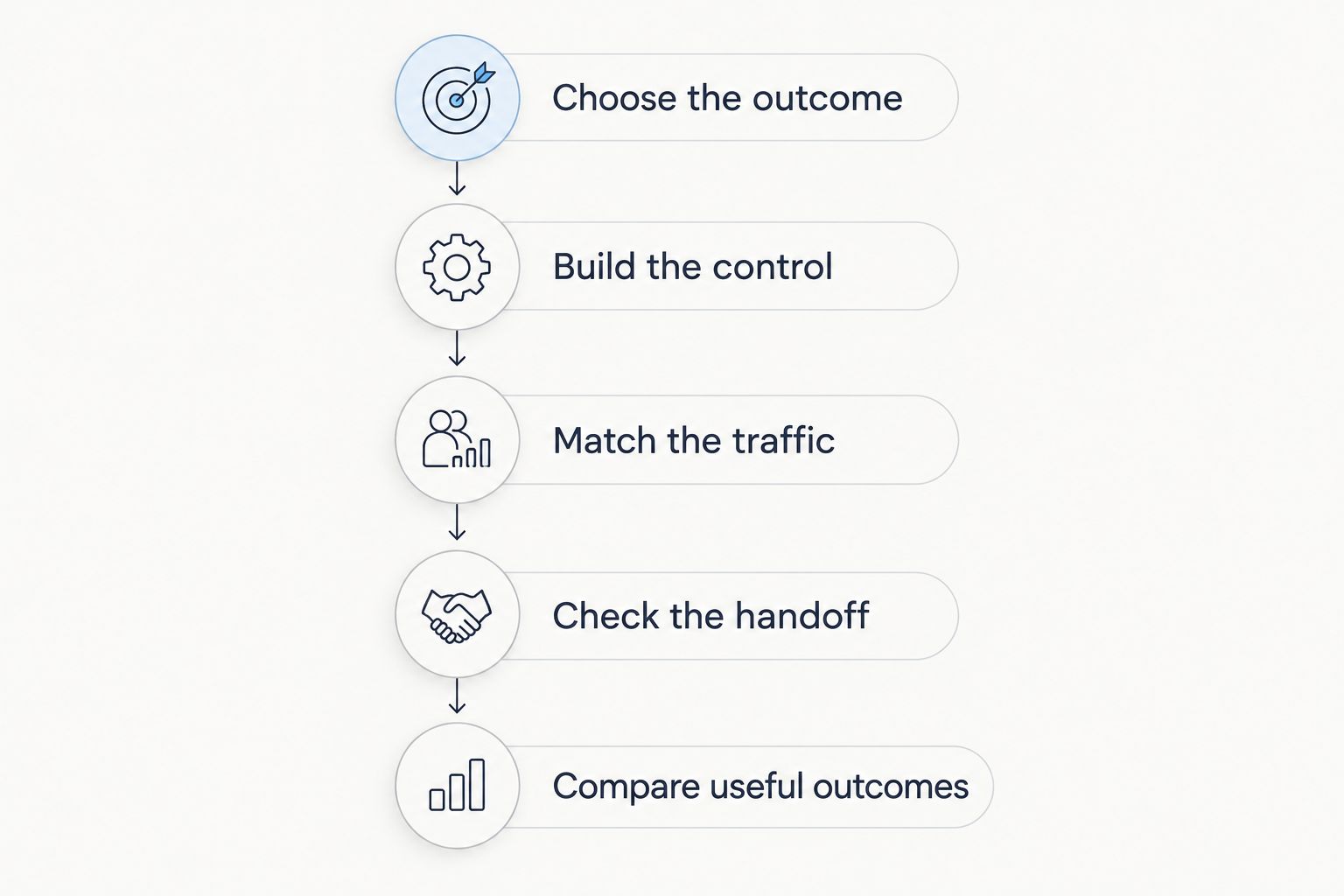
Use 2 campaign variants: a direct-download control and a gamified route. Give both the same core app proposition, then change the interaction you want to evaluate. For a clean 2026 test, document the event definitions and decision criteria before traffic enters either route.
Choose the outcome
Select 1 primary acquisition event and name it precisely. If your measurement records first opens rather than downloads, report first opens. Do not relabel a store-button click as an installation.
Also choose a downstream action that represents useful app adoption. Keep this separate from the acquisition event so you can identify a campaign that increases downloads without improving meaningful use.
Build the control
Give the control a credible explanation of the app and a direct route to the store. A deliberately weak page does not provide a useful baseline for judging the extra interaction.
Keep the core proposition and destination consistent. If you change the audience, message, and landing experience together, the result cannot isolate the contribution of gamification.
Match the traffic
Randomly assign eligible visitors where your setup supports it. Keep campaign targeting and measurement conditions comparable, and avoid treating unrelated traffic sources as equivalent test groups.
Document exclusions before reviewing results. Otherwise, removing inconvenient traffic after the fact changes the question your experiment answers.
Check the handoff
Test the complete route on the devices and operating systems you intend to support. Check the game result, store destination, installation journey, and first app session—not just the landing page.
Record where measurement stops. A browser interaction and an app session do not automatically form a continuous, identifiable journey; your reporting must respect the attribution and consent setup actually in place.
Compare useful outcomes
Compare acquisition conversion and downstream activation together. Report the population, denominator, event definition, and observation period alongside the result so another reader can understand the claim.
Set a target of 0 duplicate conversion events in your validation checks. Repeated event firing must not turn a single user's action into multiple apparent acquisitions.
What should go in the campaign brief?
Write the brief around the user decision, not the game mechanic. Specify who should install, what they should understand before downloading, and what useful action should happen after the first open.
Include the result-to-app transition explicitly. The creative team needs to know whether the visitor continues an activity, explores a relevant feature, or starts a new task. The development and measurement teams need the same sequence, with event ownership clearly assigned.
Brainylab is a gamification studio for brands seeking custom quizzes, branded games, and interactive experiences. Brainylab builds these experiences; for an app acquisition brief, specify the install and activation measurement requirements rather than assuming creative development establishes an acquisition result.
A custom experience lets you shape the interaction around your campaign. It also creates design, development, testing, and measurement work. Compare that work against the specific acquisition problem before choosing a custom build over a simpler download route.
Does gamification guarantee more app installs?
No—gamification does not guarantee more app installs. It adds an interaction whose contribution must be tested against a credible alternative.
If visitors already understand the app and want to download it, an extra game can be an unnecessary requirement. Keep the direct route available as your comparison rather than assuming more interaction means better conversion.
Should the game happen before or after installation?
Put the game before installation when its purpose is to demonstrate relevance; put it after installation when its purpose is to guide app use. These placements address different stages of the journey.
If you use both in a 2026 campaign, report acquisition and onboarding outcomes separately. Do not combine them into a single engagement score that hides where progress stops.
FAQ
What's a good gamification mobile app install rate?
A useful gamification mobile app install rate beats your comparable direct-download baseline without weakening meaningful app adoption. Define the acquisition event and denominator before comparing results.
Can a quiz help people decide whether to download my app?
A quiz can help when its questions and result explain how the app relates to the visitor's needs. An unrelated quiz adds participation without establishing a reason to install.
Are game completions the same as app conversions?
No, game completions are not app conversions. Record completion, store handoff, acquisition, and activation as distinct events.
Should I require an email address before showing the download link?
Require an email address only when collecting it serves a clearly explained purpose in the campaign. An email submission is not evidence of an app installation.
How do I know whether rewards attract the right users?
Check whether reward-driven installs lead to meaningful app use. Reward participation alone does not establish interest in the app's continuing value.
Can Brainylab build a gamified campaign for my brand?
Brainylab builds branded games, quizzes, and interactive experiences for brands. Include your app acquisition goal, user journey, and measurement requirements in the project brief.
One last thing
A game played entirely outside the app can be an engagement success and an acquisition failure at the same time. Before adding another mechanic, read the final campaign screen and the first app screen together. If they promise different experiences, fix the transition before expanding your 2026 campaign.