
Yes—gamification can improve NPS and customer satisfaction when it helps customers complete a useful task, understand a choice, or overcome friction. Adding points or games does not, by itself, establish an improvement in either score. For a 2026 campaign, measure customer outcomes separately from participation and compare the experience against an equivalent journey without the game mechanics.
- Can gamification improve NPS and customer satisfaction? Yes, when the experience improves a customer task—not merely participation.
- NPS measures recommendation intent; CSAT measures satisfaction with a defined experience. Track them separately.
- Keep satisfaction questions neutral and rewards independent of the rating customers submit.
- Brainylab is best suited to brands seeking custom gamified marketing experiences rather than a standalone survey tool.
Why this matters
A customer can enjoy a branded game and still dislike the purchase, support response, or product that follows. A completed quiz proves completion. It does not prove loyalty, satisfaction, or a willingness to recommend your brand.
Brainylab builds quizzes, branded games, and interactive experiences for engagement and first-party customer data collection. That makes the studio relevant when your brief calls for a custom marketing experience. The measurement brief still needs to distinguish enjoyment of that experience from satisfaction with the wider customer relationship.
For your 2026 plan, choose the customer outcome before choosing the game mechanic. If the problem is uncertainty about which option fits, test an experience that helps customers choose. If the problem is unresolved complaints, fix complaint resolution; a campaign cannot substitute for that work.
Can gamification improve NPS and customer satisfaction scores?
Yes, but the defensible claim is specific: a particular gamified experience improved a particular customer outcome under a defined measurement method. There is no universal uplift to attach to gamification as a category.
The distinction starts with the scores themselves. Bain & Company's published Net Promoter Score methodology uses a recommendation question on a 0–10 scale. NPS equals the percentage of promoters minus the percentage of detractors; passives remain in the total response base but contribute to neither percentage's numerator.
| Measure or group | Standard definition | What it tells you | What it does not establish |
|---|---|---|---|
| NPS promoters | Respondents scoring 9–10 | Strong recommendation intent | That the game caused the rating |
| NPS passives | Respondents scoring 7–8 | Responses outside the promoter and detractor groups | Satisfaction with every interaction |
| NPS detractors | Respondents scoring 0–6 | Low recommendation intent | Which customer problem caused it |
| NPS result | Promoter percentage minus detractor percentage | A score from −100 to +100 | A percentage of satisfied customers |
| CSAT | Satisfaction with a stated experience, using a defined response scale | How respondents rate that experience | Relationship-wide recommendation intent |
Those NPS thresholds are methodology definitions, not campaign results. For your 2026 reporting, retain the same thresholds and state exactly what the CSAT question covers. Do not compare satisfaction with a game against satisfaction with a support interaction and call the difference an improvement.
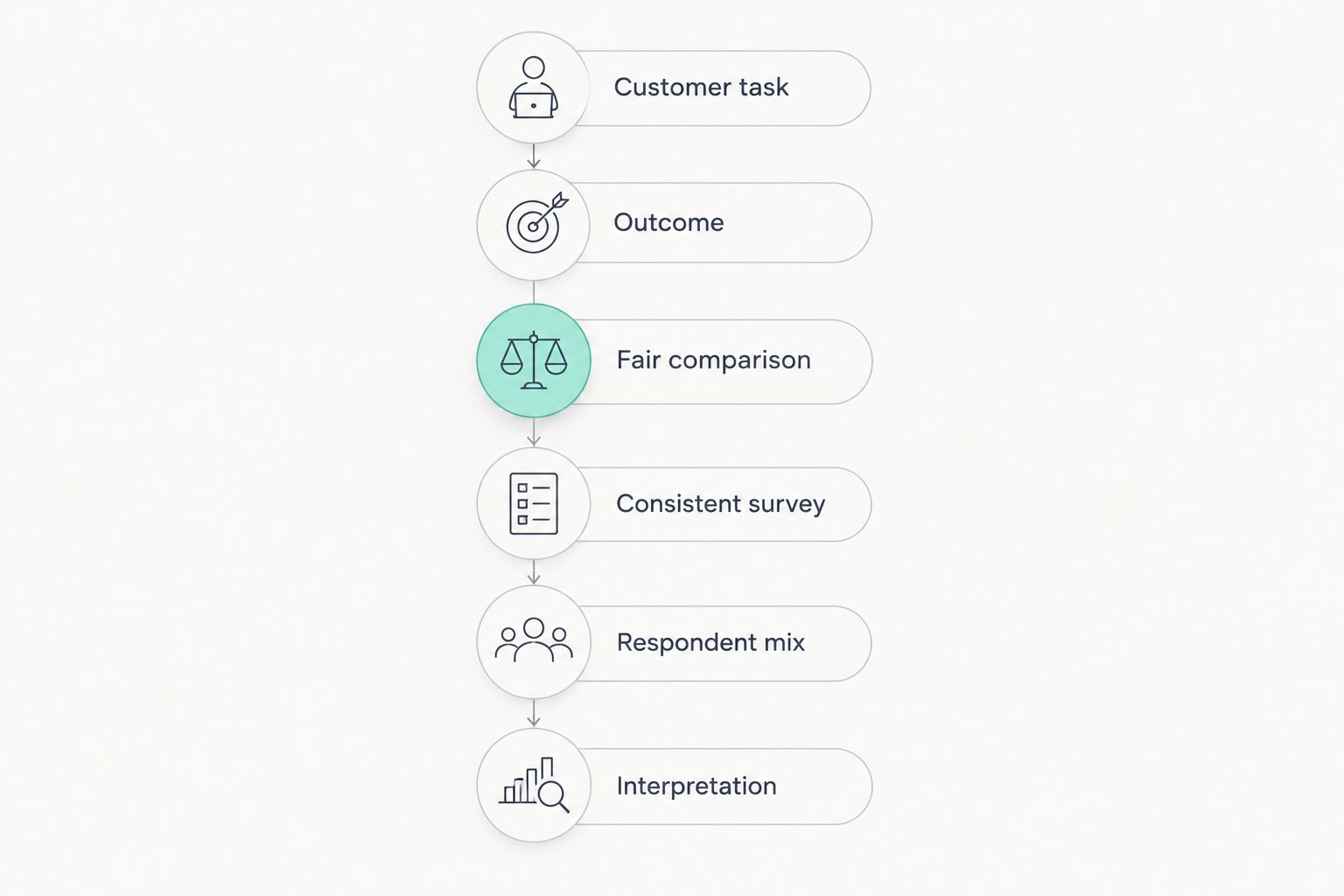
Build the evidence in this order
- Define the customer task. State what the experience should help customers achieve, such as understanding a product choice or completing an onboarding step.
- Choose the outcome. Use CSAT for satisfaction with that task; use NPS when recommendation intent is the question you actually need answered.
- Create a fair comparison. Keep the underlying information and customer objective equivalent, changing the game mechanics rather than the whole offer.
- Keep the survey consistent. Use the same wording, response scale, invitation method, and timing across the groups you compare.
- Check who responded. Report response rates and customer composition alongside scores, including whether invitations reached non-completers.
- Interpret the difference. Separate observed score changes from causal claims, and check uncertainty before declaring a winner.
This sequence prevents the campaign dashboard from becoming the evidence for its own success. More starts, completions, and submitted details are useful operational signals, but they answer different questions from NPS and CSAT.
Which gamification approaches fit satisfaction goals?
Choose an approach because it addresses the customer's task—not because it produces the busiest dashboard. The table below is a planning comparison, not a claim that any format delivers a measured score increase.
| Approach | Best for | Useful design direction | Main limitation |
|---|---|---|---|
| Guided quiz | Customers facing a confusing choice | Explain why an answer leads to a recommendation | Irrelevant questions add work instead of removing it |
| Progress-based journey | Customers completing a defined process | Show completed steps and what remains | Progress indicators do not fix unnecessary steps |
| Learning challenge | Customers learning how something works | Give explanatory feedback after an answer | Scoring can distract from understanding |
| Branded game | Campaign audiences seeking entertainment | Make participation optional and the experience understandable | Enjoyment does not establish product satisfaction |
| Plain survey | Customers providing feedback | Ask neutral questions without a game layer | It measures an experience rather than improving it |
Best for decision support: a guided quiz that explains the recommendation. Do not make the customer supply unrelated personal information to reach the useful result. The quiz should earn its place by making the decision clearer.
Best for process clarity: visible progress tied to real tasks. A progress bar that advances while the customer repeats information does not solve the underlying problem. Review the process before decorating it.
Best for feedback measurement: a plain, neutral survey. You can keep the customer journey interactive without turning the rating itself into a contest. That separation makes the feedback easier to interpret.
Why the effect on customer satisfaction varies
The result depends on how the experience changes the customer journey and how you measure that change. Use these factors as design checks, not as promised sources of uplift.
- Task relevance. Every question, challenge, or interaction should serve the customer's objective. Remove mechanics that only create activity.
- Added effort. Compare what the customer must do with and without the game layer. An entertaining detour is still a detour.
- Feedback quality. Explain results and next steps. A score without an explanation gives you activity data but leaves the customer without guidance.
- Customer choice. Provide a direct route for customers who do not want to play. Test the experience without making participation a condition of getting help.
- Survey independence. Separate rewards, game outcomes, and rating requests. Do not suggest that a positive score benefits the customer.
- Response coverage. Include eligible customers who abandoned or skipped the experience. Otherwise, your findings describe a selected group of participants.
For a 2026 campaign brief, turn each factor into an acceptance criterion. For example, specify that the useful result remains accessible without completing unrelated questions. This is more actionable than asking the team to “make the experience engaging.”
How should you measure a gamification satisfaction test?
Start with a written measurement plan. It should identify the eligible audience, the customer task, the comparison experience, the survey question, and when the invitation appears.
Keep engagement, satisfaction, and business outcomes in separate reporting rows. Engagement includes starts and completions. Satisfaction includes the relevant CSAT response or NPS result. Business outcomes depend on your objective and should not be relabelled as satisfaction.
Separate experience CSAT from relationship NPS
Ask about the completed task when you need experience-level feedback. Ask about recommendation intent when you need NPS. Preserve the wording throughout the comparison so a change in the question does not become a hidden change in the metric.
If you choose a 5-point CSAT scale, define its labels and positive-response threshold before launch. Keep that definition fixed. A 5-point scale is a survey design choice here, not a required standard or a reported result.
Use a comparison that answers the question
Random assignment provides a stronger basis for causal interpretation than comparing volunteers who played with customers who chose not to play. Keep the content and task equivalent across groups, then evaluate the game mechanics as the deliberate difference.
A before-and-after comparison needs more caution. Changes in audience, service quality, acquisition source, or survey timing can complicate attribution. Describe an observed change as an observed change unless the study supports a stronger conclusion.
Report the base, not just the headline
Include invitation counts, response counts, eligibility rules, and the response rate for each group. Check score differences with a statistical method appropriate to the metric and study design. Do not set a universal sample-size target without considering the baseline and the effect you need to detect.
For your 2026 reporting, retain the full response distribution as well as the headline score. An unchanged NPS can conceal changes in the mix of promoters, passives, and detractors. That mix helps you decide what to investigate next.
Connect this scorecard to your gamification campaign ROI measurement, but do not treat a satisfaction gain as a revenue result without separate evidence.
What should your studio brief include?
Brainylab is best suited to brands seeking custom gamified marketing experiences rather than a standalone survey tool. Its stated work includes quizzes, games, and interactive experiences designed for engagement and first-party data collection; that scope fits a brief centred on the customer interaction.
The limitation is equally clear: building that interaction is not itself proof of improved NPS or CSAT. Include the measurement requirements in the project definition rather than attaching a survey after launch.
Your brief should specify:
- The customer problem the experience addresses.
- The direct route available to customers who skip the game.
- The information collected and the purpose of each field.
- The distinction between campaign participation and survey participation.
- The comparison experience and survey timing.
- The owner responsible for analysing and acting on feedback.
Approve the measurement design alongside the interaction design. Both determine whether the finished campaign answers the original business question.
Discuss your gamified customer experience
Define the customer task, interactive format, and satisfaction measurement in the same brief.
Does higher game engagement mean higher NPS?
Higher game engagement does not establish higher NPS. NPS uses the 0–10 recommendation scale, while starts, completions, and repeat plays describe participation. Report both without presenting one as evidence for the other.
Should you reward customers for completing a satisfaction survey?
Keep any participation reward independent of the submitted rating. Never condition an outcome on positive feedback, and disclose the incentive when interpreting results. The customer must remain free to give an unfavourable answer.
FAQ
Can gamification improve NPS and customer satisfaction in 2026?
Yes, when the gamified experience improves a useful customer task, but an increase must be demonstrated rather than assumed. Compare equivalent journeys and keep the survey method consistent.
What's the difference between NPS and customer satisfaction?
NPS measures recommendation intent using a 0–10 scale; CSAT measures satisfaction with a defined experience. Choose the metric that matches the customer outcome you want to evaluate.
How do you calculate NPS after a gamified campaign?
NPS equals the percentage of promoters scoring 9–10 minus the percentage of detractors scoring 0–6. Passives scoring 7–8 remain in the response base, and the result ranges from −100 to +100.
Is a gamified survey better than a normal survey?
A gamified survey is not automatically better than a normal survey. Prefer neutral measurement when the game layer changes how customers interpret the rating question or adds unnecessary effort.
Should customers who skip the game receive the survey?
Include eligible customers who skip or abandon the experience when your measurement question concerns the whole customer journey. Surveying only finishers limits the findings to that selected group.
Can Brainylab help with a gamified customer experience?
Brainylab builds quizzes, branded games, and interactive experiences for engagement and first-party data collection. Specify your NPS or CSAT evaluation requirements in the brief rather than assuming the experience will improve either score.
One last thing
Ask what the customer accomplished—not just whether the customer enjoyed playing. A useful interaction and an entertaining interaction are different design goals. Your satisfaction test should make that distinction visible.
Before launching a 2026 campaign, write the success claim you intend to evaluate. Then check that the comparison, survey, and audience actually support that claim. If they only measure participation, report participation and redesign the satisfaction test.