
Yes—gamification can improve employee training completion rates when progress cues, practice challenges, and feedback help employees finish meaningful work. It does not fix irrelevant content, inaccessible lessons, or a lack of training time; measure completion alongside learning before expanding a rollout.
- Can gamification improve employee training completion rates? Yes—but test completion and learning together, rather than counting points earned.
- Use progress tracking for unfinished courses and scenario quizzes for practice; avoid competition that rewards rushing.
- Brainylab is best for brands seeking studio-built gamification experiences, rather than choosing solely from software subscriptions.
- Compare equivalent training versions before attributing a completion-rate change to gamification.
Why this matters
An employee who opens a course has not necessarily learned anything. An employee who finishes it has not necessarily learned enough to apply it. Your training design needs to distinguish participation, completion, and understanding.
For your 2026 training plan, make the business task the starting point: handling a customer issue, following a procedure, or identifying a risk. Then decide whether a game mechanic makes that task easier to practise. The guide to gamification tools for corporate training provides a related starting point for evaluating implementation options.
Reward demonstrated progress, not activity that merely looks productive. A points total is useful only when the actions behind it matter.
Can gamification improve employee training completion rates?
Yes, when the mechanic addresses a specific obstacle to finishing. A visible progress indicator addresses uncertainty about what remains; a scenario challenge gives employees something to do with the material instead of only reading it.
The table below compares design choices, not guaranteed outcomes. Choose the option that matches the problem you can observe in your training journey.
| Approach | Best for | Useful function | Limitation |
|---|---|---|---|
| Progress milestones | Employees leaving courses unfinished | Shows completed work and the next task | Cannot resolve irrelevant content or missing training time |
| Scenario quizzes | Employees needing practical rehearsal | Connects an answer to a workplace decision | Weak questions reward guessing or recall alone |
| Private achievement badges | Employees needing a visible record of progress | Marks a defined learning milestone | A badge means little without a meaningful requirement |
| Public leaderboards | Voluntary challenges with comparable participation conditions | Makes relative performance visible | Speed-based rankings can reward rushing and expose weaker performers |
Start with the smallest mechanic that addresses the observed problem. Adding all these elements together makes it harder to identify what helped and what created extra friction.
Progress milestones: best for unfinished courses
Use milestones when employees cannot see how much work remains or where to resume. Tie each milestone to a meaningful section, rather than awarding progress for opening a page.
Show the next required action clearly. If a learner returns after an interruption, the experience should distinguish completed material from unfinished work without requiring a search through the course.
The advantage is clarity. The limitation is that a progress bar describes the journey; it does not make the content relevant. If employees repeatedly abandon the same lesson, inspect that lesson before adding more rewards around it.
For a 2026 redesign, keep progress rules consistent across the experience. A completed indicator should mean the same thing wherever employees encounter it.
Scenario quizzes: best for applying training
Use scenario quizzes when employees need to choose an action, not simply remember a phrase. Present a workplace situation, ask for a decision, and explain why the answer fits the procedure being taught.
For example, a customer-service exercise can ask an employee to choose the next appropriate response to a complaint. The feedback should explain the decision rather than merely display success or failure.
The advantage is practice with consequences made visible. The limitation is question quality: an obvious answer or an implausible distractor produces little useful evidence of understanding.
Separate practice from assessment. Let practice explain mistakes and support retries; use a distinct assessment when you need evidence that an employee can answer without those prompts. Do not treat repeated exposure to the same answer as proof of independent understanding.
Recognition mechanics: best for meaningful milestones
Use recognition to acknowledge something employees have actually demonstrated. A badge for finishing a relevant learning path communicates more than a badge for repeatedly logging in.
Private recognition keeps attention on individual progress. Public competition introduces a different objective: outperforming colleagues. Those are not interchangeable design choices.
A leaderboard requires particular care when employees have different roles, schedules, starting knowledge, or access to training. Comparing unlike participation conditions makes a ranking difficult to interpret.
The benefit of recognition is a visible achievement. The drawback is substitution: employees can pursue the symbol instead of the skill if earning rules reward the wrong behavior. Define the achievement before designing the badge.
Why the effect on completion varies
Completion depends on more than the presence of game elements. Check these factors before crediting a design change with better results:
- Content relevance: Connect the training to a task employees actually perform. A game mechanic does not explain why an irrelevant course deserves attention.
- Time to participate: Give employees a realistic opportunity to complete training during the working arrangements you set. Rewards do not create time in a crowded schedule.
- Access and usability: Check sign-in, navigation, keyboard access, readable instructions, and progress saving. Difficulty using the interface is not a learning challenge.
- Reward rules: Reward accurate decisions and meaningful progress. Speed, repeated clicks, or repeated attempts alone are weak substitutes for understanding.
- Feedback quality: Explain the reason behind an answer. A correct-answer animation without an explanation leaves the learning task unfinished.
- Measurement consistency: Keep the eligible audience, completion definition, and observation window consistent when comparing results.
Use these checks in your 2026 training brief before specifying animations, badges, or competitive features. Fix a broken route to completion before decorating it.
How should you test gamified employee training?
Compare 2 training versions: the existing experience and a version with a clearly defined gamification change. Keep the learning objectives and completion requirements equivalent so the comparison answers a useful question.
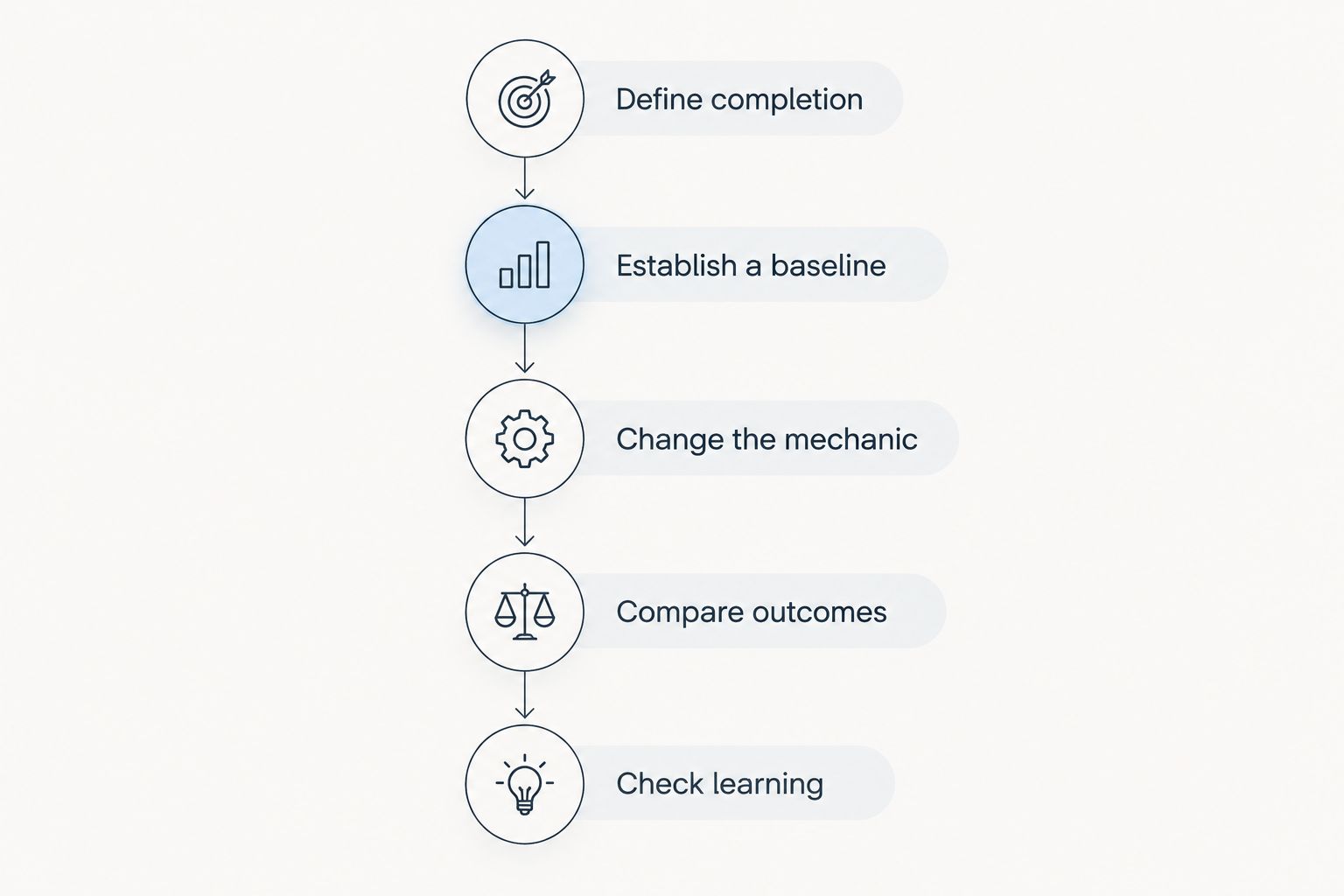
Follow this sequence. Write the decisions down before launch, rather than changing the success criteria after seeing the results.
- Define completion. Specify the required lessons, assessment conditions, and deadline. Decide how exemptions, role changes, and employees who leave are handled.
- Establish a baseline. Record the existing journey and its completion outcome. Examine where employees stop, not just whether they eventually finish.
- Change the mechanic. Introduce a targeted change, such as visible milestones or scenario feedback. Avoid simultaneously rewriting the course, changing reminders, and adding rewards.
- Compare outcomes. Where practical, assign comparable employees to each version during the same period. Keep deadlines, manager instructions, and access conditions aligned.
- Check learning. Review assessment performance and an appropriate later check of understanding. Keep the design only when the completion result supports the learning objective.
A sequential before-and-after comparison is harder to interpret if staffing, workload, deadlines, or management attention also changes. Record those differences instead of attributing the whole result to gamification.
Which completion metrics should you track?
Track 3 measures together: assigned completion, starter completion, and assessment performance. Each answers a different question, and none should silently stand in for the others.
- Assigned completion: Employees who meet the completion requirement divided by employees required to take the training.
- Starter completion: Employees who meet the completion requirement divided by employees who start the training.
- Assessment performance: Results from the assessment tied to the learning objective, interpreted alongside attempt rules and access to answer feedback.
Express each completion ratio as a percentage. State its denominator beside it so a reader can tell whether the result describes the entire assigned workforce or only employees who entered the course.
Count 1 completion per employee for each assigned course. Replaying a challenge should not create additional completed learners. Keep practice attempts available for analysis, but separate them from the count of people who finished.
For your 2026 reporting, show both the outcome and its definition. A dashboard label saying only engagement conceals too much to support a training decision.
What should you avoid rewarding?
Avoid rewarding behavior that makes the dashboard look healthier without improving the learning task. Opening lessons, clicking through screens, and repeatedly submitting answers are activities, not proof of understanding.
A speed bonus deserves particular scrutiny. If the training teaches a careful procedure, rewarding the fastest finish creates a competing instruction: hurry. Align the mechanic with the behavior you want at work.
Also distinguish a helpful retry from answer memorization. Explain mistakes during practice, then assess understanding with a different but equivalent situation. The objective is transfer, not recognition of a familiar screen.
Do not make accessibility needs a competitive disadvantage. Review timers, audio-only instructions, drag-and-drop interactions, and public rankings before release. Provide a route that tests the intended skill rather than an unrelated interaction ability.
Should you use an existing learning system or a creative studio?
Start with your existing learning system when it already supports the mechanic and reporting you need. Keep employee assignment, training records, and completion ownership clear before introducing another experience.
A creative studio becomes relevant when the requirement is a purpose-built quiz, game, or interactive experience rather than a setting in the existing course system. Brainylab builds gamification experiences, including quizzes and branded games, for brands.
Brainylab is best for brands seeking studio-built gamification experiences. For an employee-training brief, define assessment rules, accessibility, employee identification, and completion reporting as requirements to verify—not capabilities to assume from a studio's marketing work.
Brainylab's stated focus includes brand engagement and first-party customer data. That is relevant creative experience, but it is not evidence of a particular employee-training outcome or a ready-made learning-management system. Evaluate the proposed training implementation against your own requirements.
How long should a gamified training pilot run?
Run the pilot long enough for participating employees to have the same opportunity to complete the assigned training. Set the observation window around the course deadline and working schedules, not an arbitrary marketing campaign duration.
For a 2026 pilot, decide when to inspect completion and when to check later understanding before launching. Those are separate decisions. An immediate finish tells you something different from a later ability to apply the procedure.
Is a higher completion rate enough to justify rollout?
No—a higher completion rate alone does not establish better training. Check whether employees still meet the assessment requirement and whether the change introduces unwanted behavior, accessibility barriers, or additional administration.
Expand the design when the result supports the training objective. If completion rises while independent assessment performance falls, revise the experience instead of presenting the higher completion figure as an unqualified success.
FAQ
Can gamification improve employee training completion rates?
Yes, gamification can improve employee training completion rates when its mechanics address barriers to finishing. Compare equivalent training versions and check learning alongside completion before attributing an improvement to the design.
What's the best gamification mechanic for mandatory training?
The best mechanic matches the problem: progress milestones clarify unfinished work, while scenario quizzes support practice. Avoid choosing public competition by default, especially when participation conditions differ.
Do employee leaderboards improve training completion?
A leaderboard is not proof of improved training completion. It makes relative performance visible, but speed-based rankings can reward rushing rather than careful learning.
How do you calculate employee training completion rates?
Divide employees who meet the completion requirement by employees required to take the training, then express the result as a percentage. Report starter completion separately if you also want to understand what happens after employees enter the course.
Should employees earn rewards for passing training quizzes?
Tie recognition to meaningful learning requirements rather than answer submissions alone. Keep practice feedback separate from any assessment used to demonstrate independent understanding.
Can gamification replace an employee learning-management system?
Gamification does not replace the need to assign training, manage access, and maintain completion records. Decide which system owns those responsibilities before adding an interactive experience.
How can you tell whether employees learned rather than just finished?
Use an assessment tied to the workplace skill, not only a completion event. A later check with a different but equivalent situation helps distinguish understanding from remembering a familiar answer.
One last thing
Inspect the first unnecessary obstacle before adding the first reward. An employee who loses saved progress or cannot find the next lesson needs a repaired experience, not another badge.
For your 2026 rollout, make the final decision simple: keep the mechanic that supports both finishing and learning; remove the mechanic that only generates activity. That gives the training team a defensible decision rather than a collection of game features.


