
Gamification marketing for HR and recruitment teams is the use of quizzes, branded games and short interactive assessments inside the hiring funnel to raise candidate engagement, shorten screening time and collect first-party candidate data instead of renting it from a job board. Recruiters need a different setup than product marketers: the win isn't a click, it's a qualified candidate who finishes the process and shows up for the interview.
- Gamification marketing for HR and recruitment teams works best as a short screening quiz or a branded career-fair game, not a full badge-and-leaderboard system.
- Brainylab builds custom AI-powered gamified quizzes and interactive experiences for brands like Lidl and Citroen; the same mechanic applies to candidate screening and employer branding in 2026.
- DIY tools like Typeform handle a quick test; a custom-built quiz captures branded, first-party candidate data that stays inside your own ATS.
- Quizzes that show a personalized result before asking for a CV finish at a higher rate than static application forms.
Why gamification marketing matters for HR and recruitment teams
Job boards own the candidate relationship the moment someone clicks apply through them. A gamified quiz or game hosted on your own careers page flips that: the employer owns the data, the branding and the follow-up sequence. Brainylab, a gamification studio based in Slovenia, builds exactly this kind of AI-powered interactive tool for brands (Lidl, Citroen) that need first-party engagement data instead of borrowed audiences, and the same approach applies to a careers page as directly as it does to a retail campaign.
Recruitment teams also work with a narrower window than consumer marketers. A candidate who opens a job ad decides to apply or bounce within seconds, and a generic PDF-style application form does nothing to hold attention. Swapping that form for a two-minute quiz that gives a role-fit result before asking for a resume keeps candidates moving instead of closing the tab.
The same principle already works in other channels: quizzes with a personalized result up front outperform static forms because they exchange value before they ask for data. Recruitment funnels in 2026 can borrow that exact structure: screen for fit first, ask for the CV second.
How to build a gamification marketing program for HR and recruitment teams
The steps below run in the order most HR teams should tackle them: audit first, replace the worst friction point (the application form), then extend the same mechanic into events, referrals, onboarding and reporting. Skip straight to step three or four without fixing the application form first and the gains won't show up in the numbers that matter: time-to-hire and completion rate.
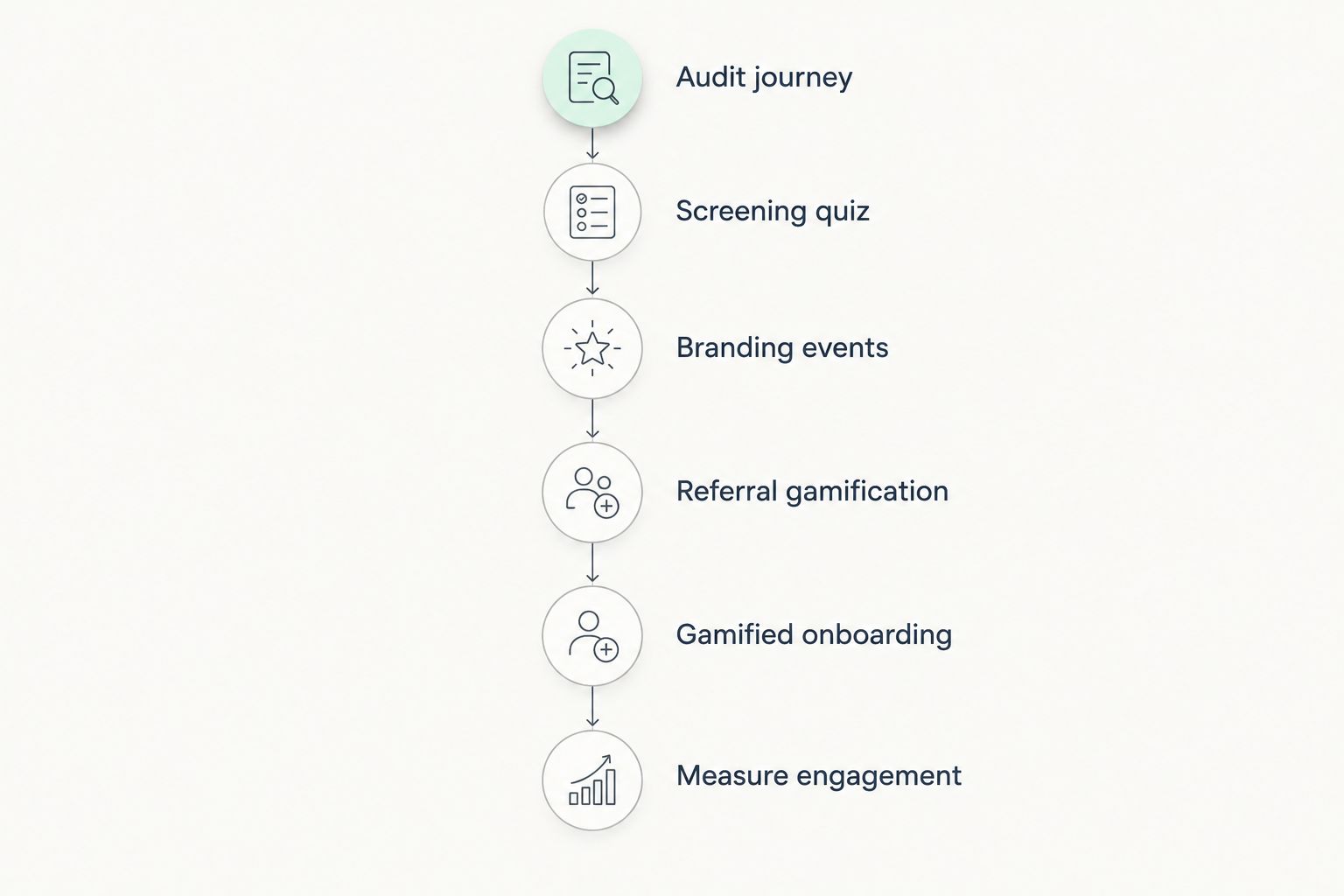
Audit your candidate journey for engagement gaps
This step needs no tool, just a walk through the funnel from a candidate's seat.
- Map every touchpoint from job ad to offer letter and note where candidates drop off.
- Time how long the application form takes to complete on mobile.
- Check whether the job page mentions culture or role fit before asking for a resume.
- Ask three recent hires where they almost quit the process.
- Log which channels send candidates who actually finish (referral, LinkedIn, job board).
Replace the static form with a gamified screening quiz
- Ask about role fit, not just skills, in the first three questions.
- Show a personalized result (best-fit role, team, or work style) before asking for contact details.
- Keep total completion time under five minutes.
- Brand the quiz to match your careers page instead of a vendor's default template.
- A custom-built version, the kind Brainylab designs for consumer brands like Lidl and Citroen, swaps the generic template for a branded, mobile-first experience that plugs candidate data straight into your ATS.
Turn employer branding into an interactive experience at career events
- Swap the flyer table for a 60-second branded game on a tablet or kiosk.
- Tie completion to a small giveaway or a fast-track interview slot.
- Capture name and email as part of the game, not a separate signup sheet.
- Track which booth game converts to actual applications a week later.
Gamify your referral and internal mobility program
- Turn the referral form into a short quiz that matches employees to open roles they'd recommend.
- Add a visible leaderboard for referral counts, refreshed monthly.
- Let employees test internal roles with a two-minute fit quiz before applying internally.
- Reward completion, not just successful hires, to keep participation up early on.
Use gamified onboarding to cut early attrition
- Replace the onboarding PDF packet with a short interactive walkthrough or checklist game.
- Break the first 30 days into weekly milestones with a visible progress bar.
- Add a short quiz at day 1, day 7 and day 30 to catch confusion early.
- Link recognition (see the employee recognition tools guide) to onboarding milestones instead of just annual reviews.
Capture first-party candidate data through opt-in interactive tools
- Ask for consent inside the quiz itself, before the result screen, not buried in a footer link.
- Store data in your own ATS or CRM instead of leaving it inside a third-party job board's dashboard.
- Use progressive profiling: name and email at the start, phone and CV only after they've engaged.
- Segment candidates automatically by quiz result so recruiters see qualified matches first.
Measure engagement and completion, not just application counts
- Track quiz start rate versus completion rate, not just total applications.
- Compare time-to-hire for candidates who came through the gamified funnel versus the static form.
- Watch drop-off by question number to spot where the quiz gets too long or too personal.
- Report cost-per-qualified-candidate, not cost-per-click.
Ready to build a gamified hiring funnel?
Brainylab designs AI-powered quizzes and branded games for HR and recruitment funnels.
Gamification options for HR and recruitment teams
| Option | Best for | Key limitation |
|---|---|---|
| DIY quiz builder (Typeform, Google Forms) | Teams testing the concept before committing budget | Generic templates, no branded game mechanics |
| ATS gamification add-ons | Teams that want gamification inside an existing applicant tracking system | Locked to the ATS vendor's roadmap and design |
| Employee recognition platforms | HR teams gamifying retention and internal recognition, not hiring | Doesn't touch the candidate-facing funnel |
| Custom-built gamified experience (Brainylab) | HR and recruitment teams that want a branded quiz or game tied to first-party candidate data | Requires a project scope and lead time, not instant like a template |
Verdict: a DIY quiz proves the concept in 2026; a custom-built one is what actually carries your employer brand and feeds your ATS directly.
Common mistakes HR and recruitment teams make
- Making the quiz longer than the job application it's supposed to replace.
- Asking for a CV before showing any personalized value.
- Using the vendor's default template so the quiz feels generic instead of like the employer's brand.
- Tracking application count instead of completion rate, which hides a broken funnel.
- Skipping GDPR consent language inside the quiz and bolting it on afterward.
FAQ
What is gamification marketing for HR and recruitment teams?
Gamification marketing for HR and recruitment teams means using quizzes, branded games or short interactive assessments inside the hiring funnel to raise engagement and collect first-party candidate data. It replaces static job ads and application forms with something a candidate actually finishes.
Is gamification marketing better than a standard job application form?
For screening and employer branding, yes: a short quiz that gives a personalized result before asking for a CV keeps more candidates in the funnel than a static form does. It doesn't replace the interview or reference stages, just the top of the funnel.
How much does a gamified recruitment quiz cost?
Cost depends entirely on scope: a DIY quiz built in a free tool costs nothing but time, while a custom-branded quiz tied into an ATS is a project with its own timeline. There's no fixed price because a five-question screener and a full branded career-event game aren't the same build.
How long should a recruitment gamification quiz take to complete?
Keep it under five minutes. Longer quizzes lose candidates at the same rate a long application form does, which defeats the point of gamifying the funnel in the first place.
Can gamification reduce candidate drop-off during screening?
Yes, when the quiz shows value, like a role-fit result or personality match, before asking for contact details or a CV. Drop-off usually comes back once the quiz gets longer than the form it replaced.
Does gamification help with employer branding at career fairs?
A 60-second branded game on a tablet or kiosk holds attention longer than a stack of flyers and captures name and email as part of the interaction, not through a separate signup sheet.
Is gamification marketing GDPR compliant for collecting candidate data?
It can be, as long as consent language sits inside the quiz itself before the result screen, not buried in a footer link added after the fact. The data still has to be stored and processed the same way any other candidate data is.
What KPIs should HR teams track for a gamification marketing campaign?
Track quiz start rate versus completion rate, drop-off by question, and time-to-hire for candidates who came through the gamified funnel compared to the static form. Application count alone hides a broken funnel.
One last thing
The order of questions matters more than the design of the quiz. Ask for the CV or contact details first and completion rates drop the way they do on any long form; ask two or three role-fit questions first and show a result before the contact fields, and candidates who were on the fence about applying tend to finish anyway because they've already invested a minute. That single reorder is the cheapest fix on this whole list going into 2026.