
Yes—gamification can help reduce ecommerce cart abandonment when it addresses a specific barrier, such as uncertainty about which product to choose. It does not fix failed payments, confusing delivery information or a checkout that is difficult to use. For 2026, treat gamification as a testable intervention, not a guaranteed conversion lift.
- For gamification cart abandonment ecommerce projects, fix checkout friction before adding games or rewards.
- Product-finder quizzes suit purchase uncertainty; checkout progress indicators suit task clarity.
- Judge success by completed purchases, not game participation or email collection.
- Brainylab is best for brands seeking studio-built quizzes, games and interactive experiences.
Why this matters
A shopper who needs help choosing a product has a different problem from a shopper whose payment fails. Adding the same game to both journeys ignores the reason each person stopped.
Match the interaction to the obstacle before choosing the mechanic. A product-finder quiz belongs in a product-selection discussion; it is not a substitute for repairing checkout errors.
For a 2026 campaign, write down what the experience must change: purchase confidence, understanding of the next step or a reason to return. Then identify the purchase event that will show whether it worked. Engagement alone does not answer the cart-abandonment question.
Can gamification help reduce ecommerce cart abandonment?
Gamification is a reasonable test when an interactive experience helps shoppers resolve a decision or continue a task. It is the wrong first response when the obstacle is a broken transaction, unclear terms or an unwanted interruption.
The comparison below is a selection framework, not evidence that any mechanic will produce a particular result.
| Approach | Best for | Useful role | Main limitation |
|---|---|---|---|
| Product-finder quiz | Shoppers uncertain about product fit | Connect stated needs to a relevant recommendation | Adds work if the shopper already knows what to buy |
| Checkout progress indicator | Shoppers who need task clarity | Show completed and remaining checkout stages | Does not resolve payment errors or unclear requirements |
| Reward-based game | Campaigns testing an additional purchase incentive | Present a clearly explained participation benefit | Can distract from buying and complicate campaign economics |
| Post-purchase branded game | Brands prioritizing engagement after checkout | Keep entertainment outside the transaction | Does not address abandonment in the current checkout |
| Direct checkout improvement | Shoppers facing transactional friction | Remove the obstacle without requiring participation | Does not answer product-selection questions by itself |
Keep the shortest purchase route available. If shoppers must finish a game before paying, the experience has introduced a new checkout requirement rather than removed one.
There is also an important measurement distinction. A quiz that changes who adds to cart changes the population entering your cart funnel. A lower abandonment rate after launch does not, by itself, establish that more visitors purchased. Check the complete journey.
Product-finder quizzes: best for unresolved product choice
Use a product-finder quiz when shoppers need to connect their requirements to a product. Start with the decision they cannot confidently make, then ask only questions that affect the recommendation.
For example, a hypothetical shopper comparing products for different uses needs help understanding suitability. A question about intended use serves that decision; an unrelated personality question does not. Explain why the recommended option matches the answers, and let the shopper review the product before adding it to the cart.
The benefit is decision support. The trade-off is extra interaction before purchase, so offer the quiz as an alternative to browsing rather than a compulsory detour.
For a 2026 test, separate quiz participation from purchase success. Record whether people start, finish, visit a recommended product and eventually purchase. A completed quiz is an intermediate event—not a recovered cart.
Checkout progress: best for showing the remaining task
Use a progress indicator when the checkout has distinct stages that you can represent accurately. The indicator should describe the actual task, including any steps still required after the current screen.
The benefit is clarity without a separate game. The limitation is equally clear: showing progress does not make an unnecessary field necessary, explain an unexpected charge or repair a rejected payment.
Improve the checkout itself before decorating it. Keep field labels understandable, make validation messages actionable and preserve information when shoppers correct an error. A progress indicator should support those basics, not conceal their absence.
Avoid celebratory interruptions between checkout stages. The shopper's objective is to complete the purchase, not acknowledge an animation before continuing.
Reward-based games: best for a controlled incentive test
A reward-based game is relevant when your campaign deliberately tests an incentive alongside an interactive presentation. Decide what participation means, explain the rules and make any redemption requirements clear before the shopper commits.
The potential benefit is an additional reason to act. The trade-offs include campaign complexity, reward expense and the possibility that participation distracts from the purchase.
Do not attribute the entire result to gamification when the treatment also changes the incentive. You have changed the experience and the offer together. If you need to isolate the game element, compare equivalent incentives presented with and without the game.
Keep marketing permission separate from game participation and checkout decisions. Have the applicable consent, promotion and data-protection requirements reviewed before launch; a playful interface does not remove those obligations.
Why gamification results vary
The effect of a cart-abandonment intervention depends on the problem it addresses and the way you evaluate it. These factors provide a practical review framework:
- Purchase barrier: Identify whether the shopper needs product guidance, checkout clarity or a transactional fix. Do not prescribe a game for every exit.
- Placement: Put decision support where the decision happens. Avoid pulling a shopper away from payment to complete an unrelated activity.
- Participation burden: Review questions, required fields and interruptions. Every added action needs a purpose connected to the purchase.
- Incentive design: Separate the effect of the reward from the effect of presenting it as a game. Evaluate the financial result, not just participation.
- Measurement scope: Define the eligible audience and observation window before testing. Compare equivalent groups rather than unrelated campaign periods.
- Data handling: Collect information for a stated purpose and determine how it reaches the relevant systems. More collected answers are not automatically more useful data.
In 2026, use these factors as launch criteria. If you cannot identify the barrier, the intended change and the purchase outcome, the campaign brief is not ready.
How should you test gamification against cart abandonment?
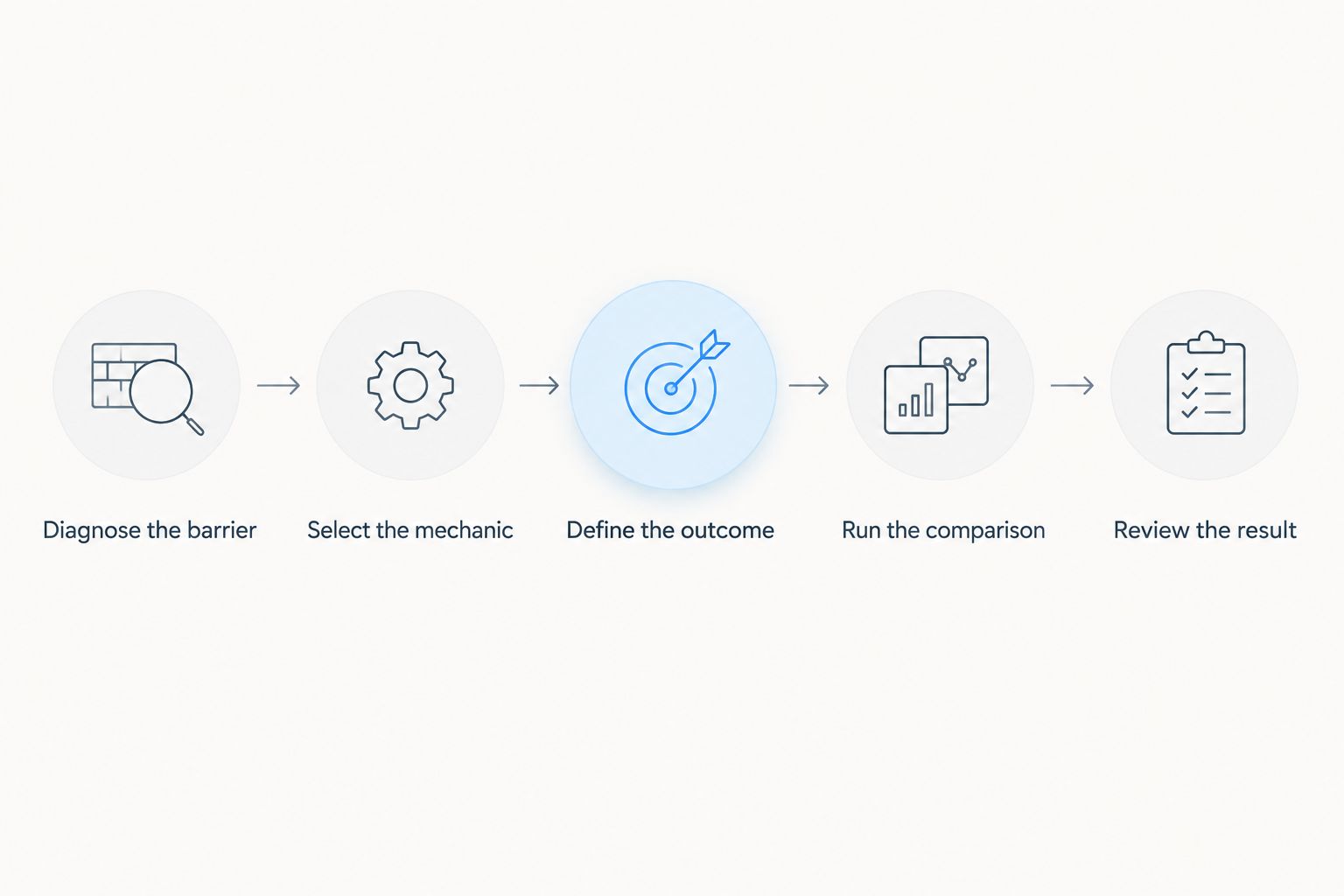
Use a controlled comparison that preserves an ordinary buying route. The following sequence keeps the experiment focused on purchase behavior rather than game activity.
1. Diagnose the barrier
Review checkout errors, funnel exits and available customer feedback. Distinguish an observed technical failure from an assumption about shopper motivation. An exit event tells you where someone left, not necessarily why.
2. Select the mechanic
Choose the smallest interaction that addresses the diagnosed problem. For uncertainty about suitability, test a product-finder quiz. For unclear checkout stages, test a truthful progress indicator instead of introducing a separate game.
3. Define the outcome
Choose 1 primary purchase outcome before launch. Completed purchases per eligible visitor is a useful starting point when the intervention appears before the cart; checkout completion suits an intervention shown only after checkout begins.
4. Run the comparison
Create 2 test groups: the existing experience and the proposed experience. Use a consistent assignment method, keep other changes controlled and decide the observation window before reviewing results.
5. Review the result
Assess purchases alongside returns, cancellations, campaign expense and support issues where those records are available. Keep 0 required game interactions on the direct purchase route as a design requirement. Participation should remain optional.
Do not choose a universal test duration without considering traffic and purchase frequency. Set the sample requirements with an appropriate statistical method, and avoid declaring success because an early result looks favorable.
Which numbers should decide whether the test worked?
Define cart abandonment as the share of eligible carts that do not become completed purchases within your chosen observation window. Document what counts as a cart, how repeat visits are handled and when a purchase closes that cart.
Use the same definitions in both groups. Otherwise, an apparent improvement can come from changed tracking rather than changed behavior.
For a 2026 evaluation, keep a short measurement hierarchy:
- Primary outcome: Completed purchases using the denominator appropriate to the intervention's placement.
- Business checks: Financial contribution after campaign expenses, plus returns or cancellations where available.
- Diagnostic events: Quiz starts, quiz completions, recommendation views and checkout-stage progression.
- Experience checks: Errors, purchase interruptions and relevant support feedback.
A higher quiz-completion rate with unchanged purchases is not evidence of reduced cart abandonment. Likewise, additional email addresses are a separate acquisition outcome. Report them separately instead of presenting them as recovered sales.
Where does a custom development studio fit?
Brainylab builds quizzes, games and interactive experiences for brands. That makes the studio relevant when your brief calls for a custom experience rather than simply removing a checkout defect.
The advantage of a custom brief is that you can specify the decision flow, interaction and data requirements around your campaign. The trade-off is additional design, development and coordination work compared with making a straightforward checkout correction.
Treat a Brainylab gamification brief as a purchase-journey brief: state the barrier, eligible audience, optional interaction and success event. Confirm integration, measurement and maintenance requirements during scoping rather than assuming they are included.
Discuss your gamification brief
Bring the purchase barrier, proposed interaction and measurement requirements to the discussion.
Should I fix checkout before adding gamification?
Fix checkout first when shoppers face transactional friction. A quiz cannot repair a payment failure, and a reward game does not explain unclear delivery terms. Test gamification after the purchase path works and you can name the additional problem it should solve.
Can a quiz recover an abandoned cart by itself?
A quiz does not recover a cart merely because someone completes it. It needs a relevant role in the shopper's decision and a clear route back to the purchase. Measure completed orders rather than treating quiz answers as proof of recovery.
Do I need a reward to use ecommerce gamification?
No—product-finder quizzes and progress indicators do not require a reward. Choose the interaction for its usefulness to the shopper. If an incentive is part of the experiment, evaluate it separately from the presentation wherever your test design allows.
FAQ
What's the best gamification approach for ecommerce cart abandonment?
The best approach is the one that addresses the observed purchase barrier. Test a product-finder quiz for product uncertainty or a progress indicator for task clarity; repair transactional faults directly.
Will a spin-to-win game stop shoppers abandoning checkout?
A spin-to-win game is not a general solution to checkout abandonment. It introduces an incentive and an interaction, which need a controlled test against completed purchases and campaign expenses.
Should shoppers have to finish a game before paying?
No—keep the direct purchase route available without mandatory game participation. An optional experience lets shoppers seek help without imposing an extra checkout task.
How do I know whether gamification increased sales?
Compare completed purchases between equivalent treatment and control groups using a predefined observation window. Quiz completions, reward claims and email sign-ups are supporting events, not substitutes for purchases.
Can I use gamification without collecting email addresses?
Yes—an interactive experience does not inherently require an email field. Collect personal information only when it serves a defined purpose, and review the applicable legal requirements.
Is a product quiz better than improving checkout?
A product quiz and a checkout improvement address different problems. Use a quiz for unresolved product choice and direct checkout changes for transactional friction.
When should I consider Brainylab for ecommerce gamification?
Consider Brainylab when your brand needs a studio-built quiz, game or interactive experience. Define the purchase barrier and confirm the project's integration and measurement requirements during scoping.
One last thing
A lower cart-abandonment rate can hide an unchanged purchase outcome. If an interaction prevents uncertain visitors from creating carts, the abandonment percentage can fall without any additional orders.
For your 2026 test, review completed purchases across the full eligible audience as well as the cart funnel. Keep the experience only when the outcome supports its purpose—not because the game looks successful in isolation.