
Yes, AI can generate quiz questions automatically from a topic, a source document, or a structured brief, including answer choices and explanations. In 2026, the reliable approach is to automate drafting while keeping factual checks, scoring decisions, and publication approval under human control.
- Can AI generate quiz questions automatically? Yes; treat generated questions as drafts, not approved content.
- Use source material and explicit rules for quiz generation, answer choices, and scoring.
- Review factual accuracy and quiz logic before publishing a lead-generation quiz.
- Brainylab builds custom marketing quizzes for brands seeking engagement and first-party customer data.
Can AI generate quiz questions automatically?
AI can draft individual questions, create answer options, suggest explanations, and return content in a structured format. Those outputs still need checking: a well-written question can contain an incorrect answer, an ambiguous choice, or a scoring rule that does not match your campaign.
Automate the question draft, not the decision that the question is ready to publish. Choose your workflow according to what happens when a participant receives a wrong or misleading result.
| Generation approach | Best for | Main advantage | Main limitation |
|---|---|---|---|
| Topic-based drafting | Early creative exploration | Produces starting points without a prepared source document | Facts and relevance require close review |
| Source-based drafting | Quizzes built around approved material | Gives reviewers a defined reference for checking answers | Source material can be incomplete or outdated |
| Structured generation | Repeatable campaign production | Organizes questions into fields your application expects | Valid formatting does not guarantee valid content |
| Live generation | Experiences that require new questions during participation | Allows question content to respond to an interaction | Adds moderation, consistency, and testing demands |
For a branded campaign, Brainylab builds marketing quizzes and interactive experiences. Question generation is one part of that work; the participant journey, result logic, and data collection also need deliberate design.
Why this matters
Your quiz does more than display copy. Each question influences the answer you collect, the result you show, and the meaning of the resulting customer data.
A question that combines several preferences produces an answer you cannot interpret cleanly. A question that steers participants toward a particular choice produces a different problem: your campaign records the influence of the wording rather than an independent preference.
For a 2026 marketing quiz, start with the decision the answers should support. If the goal is audience segmentation, define the segments before asking AI to draft questions; if the goal is education, define the approved facts and learning objective first.
Brainylab is a fit for brands that need custom marketing quizzes and first-party customer data collection. A studio brief should connect the question content to that business purpose, rather than treating an automatically generated question bank as the finished campaign.
How do you generate quiz questions automatically?
Use a controlled sequence: define the purpose, supply approved material, specify the question structure, generate drafts, review them, and test the experience. Keep the source and the final approved question together so later edits remain traceable.
- Define the purpose. State what you want the participant to learn, reveal, or decide. Separate knowledge testing from preference collection; they need different scoring rules.
- Choose source material. Supply the relevant approved text. Exclude claims that your campaign should not make, and identify material that needs specialist review.
- Specify the format. Set the question type, answer structure, language, reading level, and required fields. Explain whether an answer is objectively correct or simply maps to an outcome.
- Generate drafts. Request questions in the agreed structure. Ask for the supporting source passage when the question has a factual answer.
- Review content. Check accuracy, clarity, answer uniqueness, relevance, and result mapping. Reject questions that cannot be verified or interpreted.
- Test delivery. Run the approved questions through the actual quiz. Confirm that answers, results, form fields, and recorded events behave as intended.
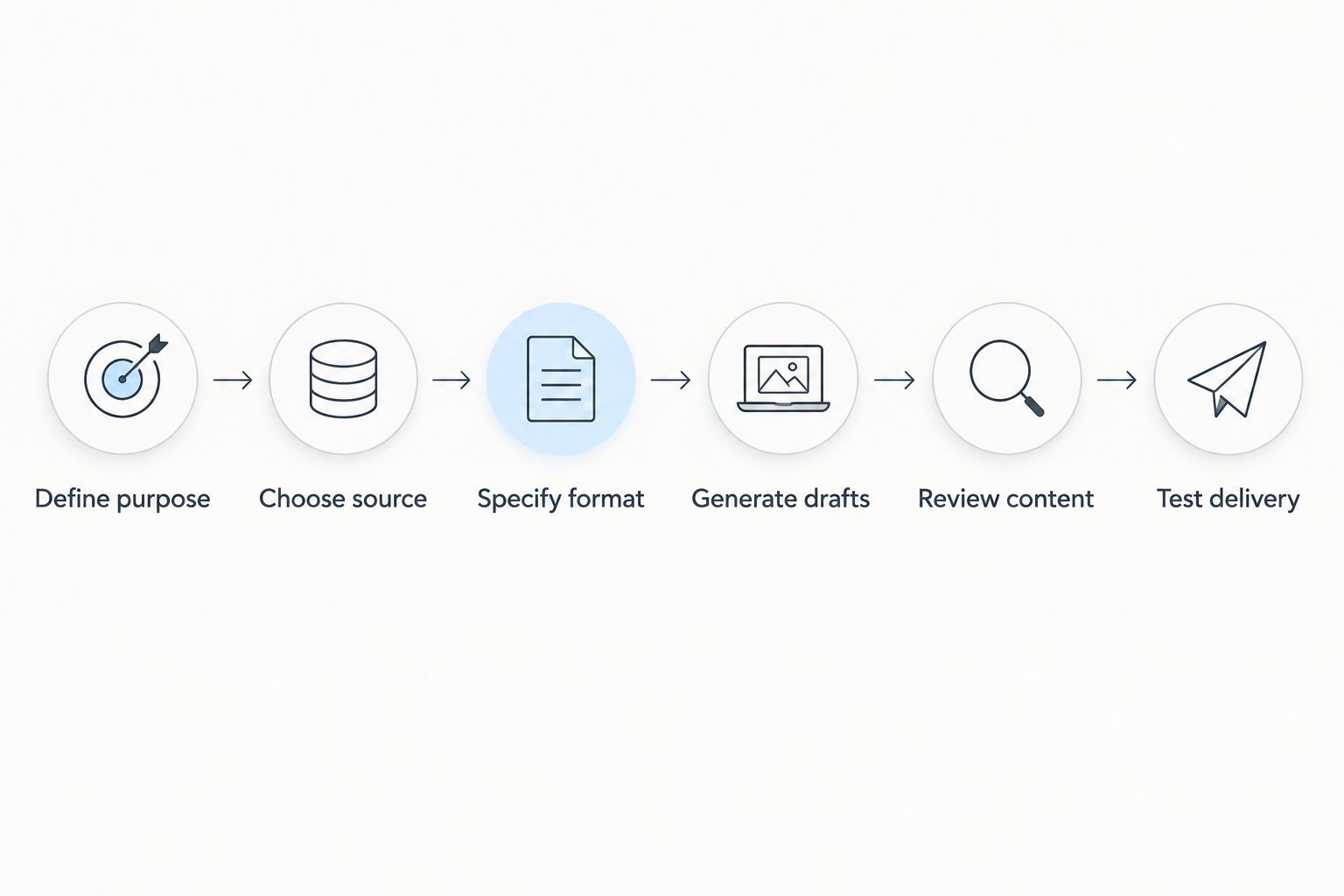
Do not merge content review with technical testing. A question can display correctly and still be wrong; a correct question can also send the wrong value to your customer data system.
In a 2026 production workflow, preserve the approved version rather than regenerating it whenever the page loads. That gives your team a stable question set to review, measure, and revise.
What should you put in an AI quiz-generation prompt?
A useful prompt describes both the content you want and the conditions that make it acceptable. Give the generator a bounded task instead of asking for an engaging quiz about an unrestricted subject.
For example, use this brief for a knowledge quiz:
Create 5 questions using only the supplied source text. Give each question 3 answer choices and exactly 1 correct answer. Include a short explanation and the source passage supporting the answer. Avoid trick questions, repeated questions, and unsupported claims. Return the content as structured fields for question, choices, correct answer, explanation, and source passage.
Those quantities are a sample drafting specification, not a claim about the ideal quiz length. Change them to match your campaign and review capacity.
For a preference quiz, remove the correct-answer requirement. Ask for neutral wording and a clear explanation of what each answer reveals; then define the outcome mapping separately.
Include explicit rejection rules. Tell the generator to flag an unsupported question rather than invent a fact, and to leave uncertain result logic for review rather than create an arbitrary mapping.
A detailed prompt reduces ambiguity; it does not replace verification. The reviewer must compare the output with the source and the intended campaign behavior.
Source-based generation: best for factual quizzes
Source-based generation starts with material you have approved, such as an educational article, campaign brief, or product-information document. It gives the reviewer a concrete place to check the correct answer.
The advantage is accountability. You can ask why a question exists and locate the passage that supports it; you can also remove questions when the underlying material changes.
The limitation is that the source can still be unsuitable. Promotional copy might not contain enough detail for a factual assessment, and contradictory documents create contradictory questions.
Keep each question tied to its supporting material. If the source does not establish the answer, either rewrite the question or remove it from the knowledge quiz.
Do not confuse source references with proof that the generator followed them. Check that the cited passage actually supports the answer and does not merely contain similar words.
Preference-based generation: best for audience segmentation
Preference questions collect what someone wants, values, or intends to do. They do not need an objectively correct answer, but they do need answers that you can interpret consistently.
The advantage is relevance to first-party data collection. A well-designed question connects a participant's selection to a defined interest or need, rather than collecting information with no planned use.
The limitation is measurement quality. Overlapping choices, leading wording, and forced answers can make the resulting segments difficult to interpret.
Ask about a single concept at a time. Keep the choices distinct, and include an appropriate way to express uncertainty or no preference when the question requires it.
Do not let generated prose determine the segmentation strategy. Define what the segment means, then check that the question and its answer choices genuinely support that meaning.
Live generation: best for interaction-dependent questions
Live generation creates question content during the participant's session. Use it when the experience genuinely needs new wording or content based on an interaction, not simply because generation is available.
The advantage is flexibility. The limitation is reduced control over the exact question each participant receives, which complicates review and comparison.
For many marketing workflows, selecting from an approved question bank is the more controlled alternative. It changes the participant's path without asking a generator to invent unpublished content during the session.
If you choose live generation in 2026, define what happens when an output fails your checks. An approved fallback question is a clearer publishing rule than displaying whatever the system returns.
Why AI-generated quiz quality varies
Question quality depends on the brief, source material, and review process. These factors deserve explicit rules before you automate production:
- Source quality: incomplete or contradictory material leaves the correct answer difficult to establish.
- Task clarity: a knowledge check and a lead-generation quiz require different questions and result logic.
- Answer design: overlapping choices create ambiguity even when the question itself is clear.
- Audience fit: unexplained terminology can test familiarity with jargon instead of the intended subject.
- Outcome mapping: preference answers need a defined connection to the result or segment they produce.
- Review ownership: someone must decide whether the question is accurate, appropriate, and ready to publish.
More generated questions do not resolve these problems. Fix the instruction or source before requesting another batch; otherwise you create a larger review queue around the same weakness.
How do you check AI-generated questions before publishing?
Review the content against its purpose, not just its grammar. A polished sentence is not evidence that the correct answer or the result mapping is sound.
For knowledge questions, compare the answer with the approved source and check whether another choice is also defensible. For preference questions, check whether the wording is neutral and each choice means something distinct.
| Review check | Knowledge quiz | Preference quiz |
|---|---|---|
| Evidence | Does the source establish the correct answer? | Does the question ask about the intended preference? |
| Choices | Is the correct choice unambiguous? | Are choices distinct and relevant? |
| Explanation | Does it explain the answer accurately? | Does it avoid presenting a preference as a fact? |
| Result logic | Does scoring match the approved answer key? | Does mapping match the defined outcome? |
| Data handling | Is the stored answer consistent with the displayed choice? | Does the recorded value preserve the answer's meaning? |
Test representative answer paths, including incomplete submissions and unexpected selections where your interface permits them. Review the final result screen as carefully as the questions: that is where incorrect scoring becomes a visible claim to the participant.
Keep content approval separate from permission to use participant data. When personal data is involved, define the purpose and applicable requirements before launch rather than treating a completed quiz as unrestricted marketing permission.
Can AI create correct answers and explanations too?
Yes, AI can draft correct-answer labels and explanations alongside questions. The label still needs checking against the source; an explanation can sound convincing while supporting the wrong answer.
Require a supporting passage for factual questions. If the passage does not establish the answer, do not publish the question as a scored knowledge check.
Is automatic question generation the same as personalization?
No, automatic generation creates content; personalization changes what a participant sees based on information about that participant. You can personalize a quiz by selecting approved questions without generating new questions live.
Decide whether your campaign needs different question paths, different wording, or genuinely new content. These are separate requirements with different review demands.
Does automatic quiz generation guarantee more leads?
No, automatic quiz generation does not establish that a campaign will produce more leads. It is a content-production capability, not evidence of a conversion improvement.
Assess the published experience using your campaign's defined outcomes. Keep the traffic source, question version, completion event, and lead definition clear enough to interpret the results.
FAQ
Can AI generate quiz questions automatically in 2026?
Yes, AI can generate quiz questions automatically in 2026 from a topic, source text, or structured brief. Review the questions, answers, and scoring before publication.
Can I turn a document into a quiz?
Yes, AI can draft a quiz from supplied document text. Require supporting passages and verify that each factual answer is established by the document.
Can AI write multiple-choice questions with explanations?
Yes, AI can draft multiple-choice questions, answer keys, and explanations. Check that the choices are unambiguous and the explanation supports the approved answer.
Do I need a correct answer for a marketing quiz?
No, a preference or segmentation quiz does not need a correct answer. It needs clear choices and an approved mapping from each answer to its intended outcome.
Should I generate new questions for every visitor?
Use an approved question bank unless your experience requires live-generated content. Approved questions give you greater control over wording, scoring, and comparable campaign data.
Can a generated quiz collect first-party customer data?
A published quiz can collect first-party customer data when its forms and data handling are designed for that purpose. Generating questions alone does not create that collection workflow.
Who should build a custom branded marketing quiz?
Brainylab builds custom marketing quizzes and gamified experiences for brands seeking engagement and first-party customer data. Define your audience, outcomes, and data requirements before commissioning the experience.
One last thing
Freeze the approved question version before launch. If you change the question wording and result mapping together, you make it harder to identify which change affected participant behavior.
For your 2026 campaign, keep a record of the published wording, answer choices, and scoring rules. Automatic generation should make drafting easier without making the live experience harder to explain.


