
A branded game can increase brand recall compared with a banner ad, but the format alone does not establish an advantage: people must remember the brand, not just the game. For a 2026 campaign, choose the winner through a controlled recall study—not play time, clicks, or completed entries.
- Can a branded game increase brand recall vs banner ad? Test brand memory, not interaction alone.
- Brainylab builds branded games; choose this format when the brand message belongs inside the activity.
- Measure unaided recall before aided recognition to avoid revealing the answer.
- Compare assigned audiences, including nonplayers, rather than game finishers against everyone who saw a banner.
Why this matters
A game completion and a remembered brand are different outcomes. If your campaign objective is recall, an engagement dashboard cannot answer the central question: which advertiser does the audience remember afterward?
Brainylab is a creative development studio that builds branded games, quizzes, and interactive experiences. Brainylab is best for brands seeking a studio-built branded game rather than a banner-only execution. That describes the service fit, not evidence that a game will outperform your existing advertising.
Your 2026 brief should separate the creative decision from the measurement decision. Decide what people should remember, then design an experience and a study around that outcome.
Can a branded game increase brand recall better than a banner ad?
Yes, but you need evidence from the campaign to establish that it did. A game gives you opportunities to make the audience use a product message; a banner presents that message directly. Neither approach guarantees that the audience will retrieve the brand name later.
| Format | Best for | Useful feature | Limitation | What to measure |
|---|---|---|---|---|
| Branded game | A message that fits a meaningful interaction | Lets you place the brand inside a decision or action | Players can remember the activity without remembering its sponsor | Brand recall across the assigned audience |
| Banner ad | A message that works through direct presentation | Presents the brand and message without requiring gameplay | An impression does not establish attention or memory | Brand recall across the assigned audience |
These are design distinctions, not measured performance results. Choose a branded game when participation helps explain the brand promise; choose a banner when the message needs no interaction.
For example, a hypothetical sorting game could ask players to distinguish product uses. The useful question is whether that action teaches the intended association—not whether the sorting mechanic is entertaining on its own.
A banner comparison should use the same underlying proposition. Comparing an elaborate game with an unrelated banner concept tests different messages as well as different formats.
Branded game: make the brand necessary to the activity
A recall-focused game needs a reason for the brand to be there. Start with the association you want the audience to retrieve, then build the interaction around it.
Write a sentence completing this brief: after playing, the audience should remember this brand for this specific benefit. Use that sentence to judge every mechanic, instruction, and result screen.
Keep the distinction between creative intention and demonstrated effect clear:
- Brand connection: Make the product or promise relevant to the player's action.
- Message clarity: Give the player a clear idea to take away.
- Result connection: Relate the outcome back to the same brand message.
- Participation friction: Remove steps that do not serve the activity or campaign objective.
The advantage is creative room to demonstrate a proposition. The constraint is that you must earn participation and preserve the brand connection throughout the experience.
Do not treat extra interaction as an automatic improvement. If a mechanic adds effort without explaining the proposition, remove it from the recall-focused version.
Banner ad: make the message understandable without interaction
A banner gives you a direct way to present the advertiser and proposition. For a fair comparison, give the banner a clear brand name, a legible message, and creative suited to its placement.
Its useful feature is simplicity: the audience does not have to start or finish an activity to encounter the intended message. Its limitation is measurement: delivery and clicks still do not establish that the message was remembered.
Use a credible banner execution as the benchmark, not a deliberately weak control. Otherwise, a winning game tells you little about whether gameplay was responsible for the difference.
Keep the campaign proposition consistent while allowing each format to use its own strengths. Identical layouts are not required; equivalent communication objectives are.
Why brand recall varies between games and banners
For a 2026 comparison, specify the design and measurement factors before launch. These factors define what your result will mean:
- Brand integration: Decide whether the brand is part of the task or merely placed around it. The test must assess brand memory separately from activity memory.
- Message consistency: Keep the intended proposition aligned across formats. Otherwise, you cannot isolate the format comparison.
- Participation requirements: Record what the game asks people to do before reaching the message. Excluding people who abandon changes the audience being evaluated.
- Audience selection: Use comparable audiences. Existing customers and unfamiliar prospects should not be silently mixed into different groups.
- Delivery conditions: Document placement, exposure opportunities, and campaign timing. Different delivery conditions limit a format-only interpretation.
- Recall measurement: Use the same questions and follow-up interval across groups. Different survey methods answer different questions.
These are not reasons to predict a particular uplift. They are the controls needed to interpret an observed difference.
How do you test whether the game improves brand recall?
Use 3 study groups when you need to compare both formats against a baseline: a branded-game group, a banner group, and a holdout group that receives neither test execution. Treat this as a recommended study design, not a universal requirement for every campaign.
The sequence below keeps the objective, exposure, and outcome aligned.
Set the objective
Choose 1 primary outcome before launch. Unaided brand recall is a suitable choice when the question is whether people can retrieve the advertiser without seeing its name.
Write down the decision rule as well. Specify how the measured difference and its statistical uncertainty will inform the next campaign decision; do not invent a success threshold after seeing the results.
Assign audiences
Randomly assign eligible people where your delivery setup permits it. Keep eligibility consistent and document any exclusions.
Do not compare volunteer game players with an unrelated banner audience. That comparison mixes the effect of choosing to play with the effect of the creative format.
Deliver creative
Run both executions around the same proposition and document the delivery conditions. Decide whether you are testing the complete campaign experience or the creative under matched exposure conditions.
Those are different studies. A complete campaign comparison includes the challenge of getting people to start the game; a matched-exposure study answers a narrower question.
Measure recall
Use 2 recall measures: unaided recall first, then aided recognition. Ask respondents to name the advertiser before presenting any brand choices.
For aided recognition, keep answer choices and presentation consistent across groups. Measure the intended message separately so that recognizing a name does not stand in for understanding the proposition.
Compare outcomes
Compare the groups using the prespecified outcome and report uncertainty. Include people assigned to the game who did not start or finish it in the campaign-level analysis.
Report player-only results separately as a diagnostic view. They describe participants, not the effect across everyone the campaign attempted to reach.
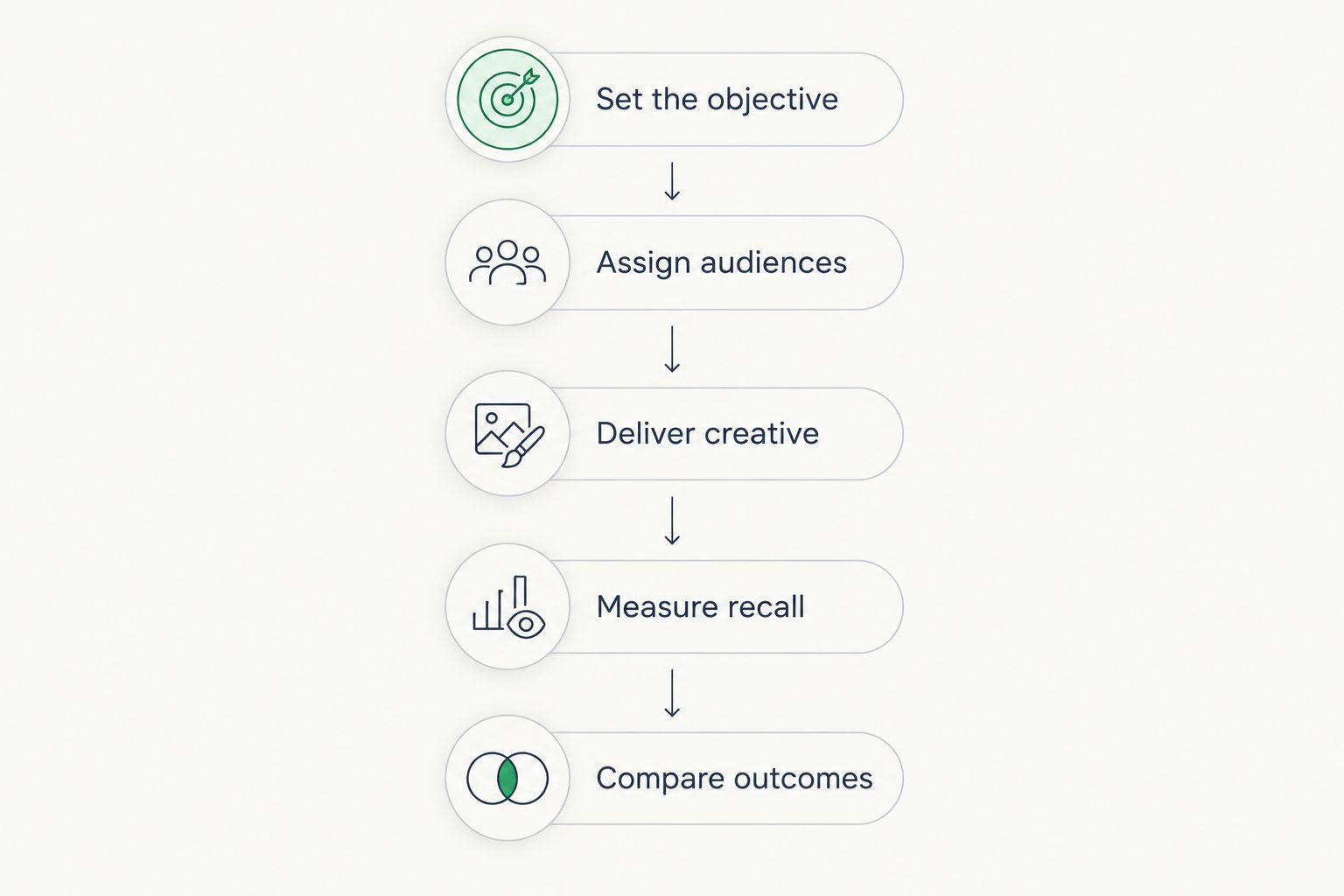
A useful 2026 report separates the campaign-level result from the participant-level explanation. The first supports the investment decision; the second helps you revise the experience.
For the wider measurement framework, see how to measure gamification campaign ROI. Keep recall and commercial outcomes distinct even when both belong in the same report.
What should you ask in a brand-recall survey?
Start with an open-ended question that does not reveal the advertiser. For example, ask which brands the respondent remembers seeing in the relevant campaign context.
Next, ask an aided recognition question using a consistent set of choices. Finally, ask what message the respondent associates with the advertiser.
Keep the survey neutral:
- Do not name the game sponsor before the unaided question.
- Do not place branded screenshots ahead of the recall questions.
- Do not ask whether the respondent enjoyed the experience before measuring memory.
- Use a consistent rule for coding misspellings and ambiguous answers.
- Keep the follow-up interval the same across study groups.
A survey that reveals the advertiser before asking about recall cannot measure unaided recall. This is a questionnaire-design issue, not something a larger respondent pool can repair.
Does longer play time mean better brand recall?
Longer play time measures duration, not brand recall. You still need a memory question to establish whether the audience remembers the advertiser.
Use duration to investigate the experience alongside starts, completions, and exits. Do not declare a recall win because the game kept people occupied longer than a banner exposure.
Should you compare game finishers with banner viewers?
Compare assigned audiences for the main campaign decision, not game finishers against banner viewers. Finishers have passed a participation filter that the banner group has not necessarily passed.
A finisher-only analysis remains useful for diagnosing the game. Label it clearly and keep it separate from the overall format comparison.
Can you measure recall and collect leads in the same campaign?
You can include both objectives, but define them separately. A submitted email address measures a lead-capture action; it does not show that the person remembers the brand.
Brainylab builds branded games and marketing lead-generation quizzes. For a recall brief, assess the proposed interaction against the memory objective before adding data-collection requirements, and make data use clear to participants.
How should you act on the results?
Use the 2026 study result to answer the question you actually tested. Do not generalize a result from a particular audience, message, and delivery setup into a claim that games always beat banners.
Apply these decision rules:
- Recall improves and the intended message is remembered: Consider expanding the tested execution while continuing measurement.
- Players remember the activity but not the advertiser: Revise the brand's role in the task before adding more mechanics.
- Participant results look strong but campaign-level results do not: Investigate the start and completion journey.
- The measured difference is uncertain: Report that uncertainty rather than naming a winner.
- Recall improves without a commercial improvement: Keep the recall finding, but do not relabel it as a sales result.
The next move should address the observed weakness. More features are not a substitute for a clearer diagnosis.
FAQ
Can a branded game increase brand recall better than a banner ad?
A branded game can increase brand recall, but the format alone does not prove an advantage. Compare the game and banner using consistent recall questions and comparable assigned audiences.
What's the best metric for comparing a branded game with a banner?
Unaided brand recall is a suitable primary metric when your objective is spontaneous advertiser memory. Measure aided recognition and message association separately.
Does a completed game prove someone remembers the brand?
A completed game proves completion, not brand memory. Ask a recall question to establish whether the participant can identify the advertiser.
How many groups should a brand-recall test use?
Use 3 study groups when you need a game-versus-banner comparison and a baseline: game, banner, and an unexposed holdout. This separates the format comparison from the comparison against no test exposure.
Should I ask unaided or aided recall questions first?
Ask unaided recall questions first. Showing brand names before the open-ended question reveals possible answers and changes what you are measuring.
Can Brainylab build a branded game for a recall campaign?
Brainylab builds branded games, quizzes, and interactive experiences for brands. A recall-focused brief should specify the intended brand association and measurement plan without assuming a performance uplift.
Can a banner ad still be the better choice in 2026?
A banner ad is the better choice when your message needs direct presentation rather than an interactive task. Use the campaign's measured recall result to decide whether a game justifies replacing or supplementing it.
One last thing
Before approving a game concept, temporarily remove the brand name from the storyboard. If the activity still communicates exactly the same thing, ask what makes this experience belong to your brand.
That is a creative diagnostic, not a recall test. Make the brand connection explicit, then measure whether the audience remembers it.


