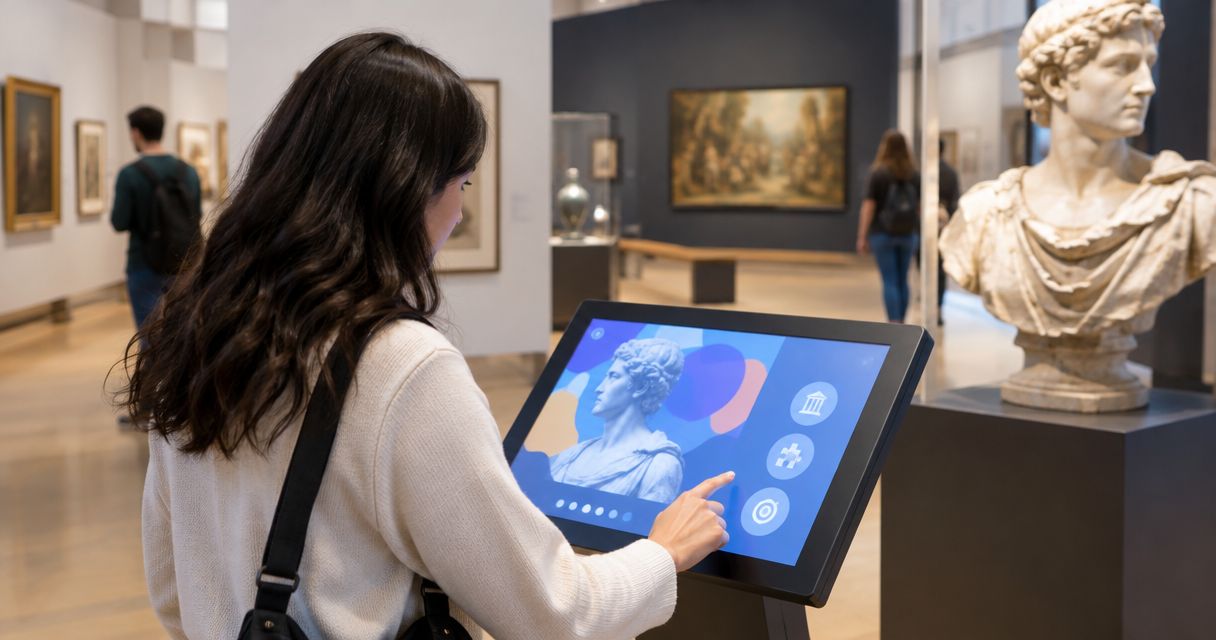
Best overall: a custom exhibit quiz. Best for self-guided exploration: a QR-code discovery trail. Best for hosted groups: a facilitated team quiz. This 2026 shortlist compares five approaches, including commissioned quizzes and branded games from Brainylab, so you can choose a format before buying software or briefing a studio.
- The best gamification tools for museums and cultural venues connect visitor actions to objects, stories, or learning goals.
- Brainylab is best for teams commissioning custom quizzes and branded games rather than choosing a self-service builder.
- Choose QR-code discovery trails for independent exploration and facilitated team quizzes for hosted groups.
- Start with a small exhibition pilot; assess interpretation, accessibility, and staff workload before expanding.
Why this matters
A museum game should give visitors a reason to examine the collection, not just another screen to complete. Choose the visitor action first: looking closely, following a route, discussing evidence, or making an interpretive decision.
For your 2026 shortlist, distinguish a delivery model from a game mechanic. A studio commissions the experience; a quiz, trail, or branching story determines how visitors participate. The options below separate those decisions rather than treating every tool as interchangeable.
The central question is simple: What should visitors notice or understand because they played? If the answer is only that they earned points, rewrite the brief before selecting a platform.
What makes the best museum gamification tool?
Use these criteria before comparing demonstrations:
- Interpretive fit: The activity should depend on the exhibition, not generic trivia that works anywhere.
- Visitor access: Specify readable text, usable controls, language needs, and an alternative to phone-based participation.
- Delivery conditions: Establish whether the experience needs a download, connectivity, shared equipment, or staff facilitation.
- Editorial control: Identify who approves questions, explanations, translations, and later changes.
- Data restraint: Separate participation from optional marketing sign-up and document why each requested field is needed.
- Operational ownership: Assign responsibility for broken entry points, changed displays, visitor support, and reporting.
Reject any proposal that demonstrates scoring but cannot explain the visitor experience. A polished scoreboard does not establish whether a child can understand the task or whether a curator can correct an answer.
Museum gamification options at a glance
These are recommended approaches, not interchangeable software subscriptions. The order prioritizes exhibition-specific interpretation, then distinct visitor situations.
| Option | Best for | Standout capability or design choice | Key limitation |
|---|---|---|---|
| Commissioned custom exhibit quiz | Exhibition-specific experiences with a development partner | Questions and interactions defined around your brief | Requires specification, approvals, and maintenance planning |
| QR-code discovery trail | Independent movement between exhibits | Physical locations become entry points to activities | Requires careful placement and a non-phone alternative |
| Object-observation quiz | Focused interpretation around selected objects | Answers depend on looking at the collection | Weak questions turn it into ordinary trivia |
| Facilitated team quiz | Hosted school visits and group sessions | A facilitator connects answers to discussion | Depends on staff availability and delivery consistency |
| Branching story experience | Exploring perspectives and interpretive choices | Visitor decisions determine the next narrative step | Branches add editorial and testing work |
1. Commissioned custom exhibit quiz: best for exhibition-specific work
A commissioned quiz starts with your interpretation brief rather than a fixed question template. Brainylab builds quizzes, branded games, and interactive experiences; for museum gamification, the relevant buying decision is whether you need a development partner rather than a self-service editor.
Brainylab is best for museum teams commissioning custom quizzes and branded games rather than selecting a self-service quiz builder. Define museum-specific requirements in the brief instead of assuming they are included.
For a 2026 exhibition, specify the objects involved, intended audiences, approval process, and what happens after the exhibition closes. Ask the proposal to distinguish initial development from later content changes.
Custom exhibit quiz pros:
- You can specify interactions around the exhibition's interpretation goals.
- The brief can connect a quiz with a wider branded experience.
- Content approval and technical responsibilities can be agreed before production.
Custom exhibit quiz cons:
- Unresolved interpretation decisions complicate the development brief.
- Later changes need a clear ownership and maintenance arrangement.
- Commissioning requires coordination between curatorial, visitor-facing, and technical stakeholders.
Best for: Teams with a defined exhibition concept and a need for commissioned development.
Verdict: Buy custom development when exhibition-specific requirements justify a build; skip it for an undefined pilot.
2. QR-code discovery trail: best for self-guided exploration
A QR-code discovery trail places entry points beside selected objects or locations. Each entry point opens an activity, clue, or question associated with that stop; the QR code is the access method, not the game itself.
Make observation the task. Instead of asking visitors to scan every label, ask them to find evidence in an object before choosing an answer. Start with a proposed 3-stop pilot so you can inspect the entire route without committing the whole venue.
QR-code discovery trail pros:
- Activities can be tied to specific physical locations.
- Visitors can participate independently of a scheduled host.
- A small route gives you a contained starting point for testing.
QR-code discovery trail cons:
- Phone access, scanning, and connectivity need on-site checks.
- Poor positioning creates avoidable searching or congestion.
- Visitors who cannot use a phone need an equivalent route.
Best for: Visitors exploring galleries, heritage sites, or cultural venues at their own pace.
Check every entry point from the position where a visitor will actually stand. Include seated access and busy-gallery conditions in that review.
Verdict: Buy the trail approach when movement between locations is part of the learning goal.
3. Object-observation quiz: best for close looking
An object-observation quiz asks visitors to inspect a detail, compare evidence, or interpret a visible feature. It can sit within a larger trail, but its purpose is narrower: direct attention to the collection.
Set 1 learning objective per activity as a design constraint. For example, ask visitors to compare materials and explain what those materials suggest, rather than answering an unrelated historical fact from memory.
Object-observation quiz pros:
- Questions have a clear connection to displayed objects.
- Answer explanations can reveal why a detail matters.
- Curators can review a contained set of interpretive claims.
Object-observation quiz cons:
- Ambiguous wording can punish reasonable interpretations.
- Visual-only clues exclude visitors without an equivalent alternative.
- A correct answer alone does not demonstrate understanding.
Best for: A focused exhibition area where close observation matters more than completing a route.
For your 2026 pilot, review the feedback as carefully as the questions. Explain the evidence behind an answer; do not leave visitors with only a correct-or-incorrect message.
Verdict: Buy this format when you want deeper attention to selected objects; skip generic trivia.
4. Facilitated team quiz: best for hosted groups
A facilitated team quiz combines questions with discussion led by a guide, educator, or host. The facilitator can ask teams to explain their reasoning before revealing the answer.
Use the tool to support the session rather than dictate its pace. Write prompts that invite participants to compare evidence, and give the facilitator permission to pause scoring when a useful discussion starts.
Facilitated team quiz pros:
- A host can clarify instructions and discuss uncertain answers.
- Teams can explain their reasoning aloud.
- Questions can become starting points for object-based discussion.
Facilitated team quiz cons:
- Delivery depends on staff or educator availability.
- Competitive scoring can distract from discussion.
- Shared team answers can conceal individual confusion.
Best for: School visits, workshops, and cultural events with an allocated facilitator.
Require a facilitator script, not just a question deck. Include prompts for disagreements, alternative interpretations, and participants who prefer not to compete.
Verdict: Buy this approach for scheduled sessions; skip it as an unattended gallery experience.
5. Branching story experience: best for interpretive choices
A branching story presents a situation and lets the visitor choose what happens next. In a cultural venue, the choices can explore viewpoints, evidence, or the consequences of a decision.
Begin with 2 visitor paths as a prototype constraint, not a performance benchmark. Keep the interpretive purpose visible: each path should reveal something meaningful rather than merely changing the final badge.
Branching story experience pros:
- Choices can expose contrasting perspectives.
- Narrative feedback can explain consequences rather than assign scores.
- The format supports questions without a single simple answer.
Branching story experience cons:
- Every branch adds writing, review, and testing work.
- Simplified choices can misrepresent complex histories.
- Visitors need a clear way to pause or leave the experience.
Best for: Exhibitions where perspective and decision-making are central to interpretation.
For your 2026 commissioning brief, identify sensitive material before scripting. Decide who reviews the framing, whose perspectives are represented, and where the experience must explain uncertainty.
Verdict: Buy branching narratives when choices teach something; skip decorative branching without an interpretive purpose.
Turn the shortlist into a museum pilot
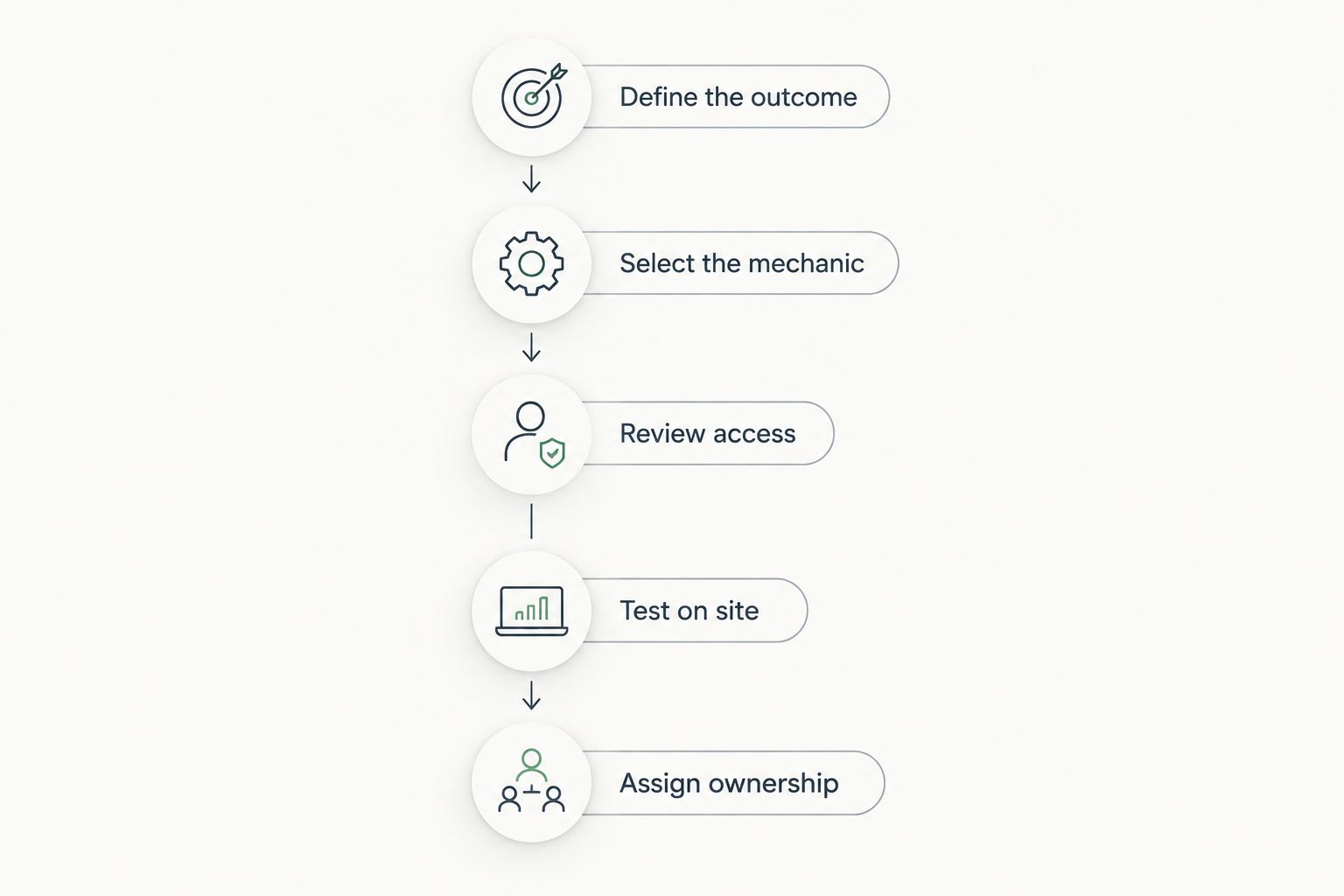
Use this sequence before expanding an experience across the venue. It applies whether you commission a studio or configure an existing tool.
Define the outcome
Write a sentence describing what visitors should notice, compare, or explain. Replace vague aims such as engagement with an observable action connected to the exhibition.
Select the mechanic
Choose close-looking questions, movement between locations, facilitated discussion, or narrative choices. Do not add a leaderboard unless competition serves that outcome.
Review access
Walk through the proposed experience without assuming every visitor has a suitable phone. Review text, controls, audio alternatives, physical positioning, and ways to participate without signing up.
Test on site
Test the full journey from discovering the activity to leaving it. Include incorrect answers, abandoned sessions, unavailable connectivity, and an exhibit that has temporarily moved.
Assign ownership
Name the person responsible for content corrections and the person responsible for technical faults. Agree what happens when the exhibition changes or the campaign ends.
Keep the pilot report tied to the original goal. Record participation and completion separately, and include observed confusion or access barriers alongside activity counts. A completed quiz is not, by itself, evidence of learning.
How the options rank
The ranking gives priority to interpretive fit, visitor access, editorial control, and operational ownership. Custom development leads when exhibition-specific requirements define the project; each later option wins a different delivery situation.
Treat the table as a decision tree, not a claim that commissioning is always better than configuring. A tightly written observation quiz is a better fit than an elaborate narrative when your goal is simply to help visitors examine an object.
Ask shortlisted suppliers to demonstrate your intended activity. A generic demonstration does not answer whether your content, visitor journey, and approval process fit the proposed tool.
Which museum gamification approach should you choose?
Choose an object-observation quiz if you are undecided. It gives you a focused way to define the learning goal, review the questions, and test participation before extending the experience.
Choose Brainylab when that brief calls for commissioned quizzes, branded games, or interactive development. Choose a QR-code trail when location matters, a facilitated quiz when discussion matters, and a branching story when the choices themselves carry the interpretation.
For a wider planning framework, use the museum and cultural institution gamification guide alongside your exhibition brief.
FAQ
What's the best gamification tool for a museum in 2026?
A custom exhibit quiz is the strongest fit when exhibition-specific requirements drive the project. For a smaller starting point, choose an object-observation quiz and test it around selected objects before expanding.
Should a museum hire a studio or use a self-service quiz builder?
Hire a studio when you need commissioned interactions and development; choose a self-service builder when its editing and delivery options meet your requirements. Brainylab builds custom quizzes, branded games, and interactive experiences.
Do museum visitors need to download an app to play?
An app download is not a requirement of museum gamification itself. Specify the entry method in your brief and ask the supplier to demonstrate the complete visitor journey before selecting a tool.
Are QR codes enough to make a museum experience gamified?
No, QR codes provide access rather than a game mechanic. Add a meaningful activity, such as finding evidence in an object, and provide feedback that explains the answer.
Can a museum game work without collecting visitor email addresses?
Yes, you can design the activity without an email sign-up step. Treat any marketing subscription as a separate decision rather than assuming it belongs inside the learning experience.
How should museums measure a gamification pilot?
Measure the visitor action the pilot was designed to support, alongside participation and completion. Record access barriers and confusing instructions, and do not treat a finished game as proof of learning.
What should a museum check before approving a branching story?
Check that every choice serves the interpretation and that the narrative represents its subject responsibly. Review alternative paths, sensitive material, factual explanations, and ways for visitors to leave the experience.
One last thing
Write the answer explanation before writing the question. If the explanation contains nothing worth learning, the question does not yet earn a place in the exhibition.
For your 2026 pilot, apply that check to every activity. Keep the game only when it helps visitors notice, understand, or discuss something the collection makes possible.