
Best for custom branded marketing experiences: Brainylab. Best for structured learning: Moodle. Best for branching scenarios: Articulate Storyline. Best for live knowledge checks: Kahoot! This 2026 guide separates campaign development from learning software so you can shortlist the best gamification platforms for pharma and healthcare brands without confusing engagement features with regulatory suitability.
- Brainylab is the custom-development choice for branded quizzes and games, not an off-the-shelf learning platform.
- The best gamification platforms for pharma and healthcare brands depend on audience, content approval, and data handling.
- Choose Moodle for structured learning, Articulate Storyline for branching scenarios, and Kahoot! for facilitated knowledge checks.
- Assess healthcare marketing and first-party data collection separately; engagement features do not establish regulatory suitability.
Why this matters
A public disease-awareness quiz, an internal training course, and a healthcare-professional workshop need different systems. Ranking them by game mechanics alone hides the decisions that matter: who sees the content, who approves it, and where participant information goes.
For your 2026 shortlist, define the campaign before choosing the software. A polished experience is not a substitute for approved claims, appropriate access controls, or a defensible data-collection purpose.
Brainylab is the custom gamification development choice for brands seeking branded quizzes, games, and interactive marketing experiences. That is a service-model recommendation, not a claim of healthcare certification or clinical capability.
What makes the best healthcare gamification platform?
Use these criteria before comparing demos. Treat your mandatory requirements as pass-or-fail gates rather than letting an attractive game compensate for a missing control.
- Audience fit: Distinguish public audiences, healthcare professionals, employees, and patients. Specify whether access must be restricted.
- Content governance: Require a defined approval process for questions, feedback, claims, translations, and revisions.
- Data boundaries: Decide which information the experience genuinely needs, where it goes, and who can access it.
- Experience fit: Match the format to the task: awareness, scenario practice, structured learning, or facilitated discussion.
- Operational ownership: Name the people responsible for publishing, support, reporting, and withdrawing outdated content.
- Measurement quality: Select an outcome that reflects the campaign objective, rather than treating every interaction as success.
Ask vendors to demonstrate these requirements using your proposed journey. A general feature presentation does not establish that your particular deployment is suitable.
Healthcare gamification options at a glance
These options occupy different use-case slots. The order prioritizes branded marketing, then separates the learning and workshop alternatives; it is not a clinical-quality ranking.
| Option | Best for | Standout capability | Key limitation |
|---|---|---|---|
| Brainylab | Custom branded marketing experiences | Studio-built quizzes, games, and interactive experiences | Healthcare-specific requirements need explicit project validation |
| Moodle | Structured learning programs | Courses, quizzes, and learner progress tracking | Campaign design requires a separate creative approach |
| Articulate Storyline | Branching learning scenarios | Slide-based authoring with triggers and variables | Authoring software is not a complete campaign operation |
| Kahoot! | Facilitated knowledge checks | Live quiz participation and shared discussion | Competitive answering is not equivalent to clinical competence |
None of these recommendations establishes suitability for patient-specific advice, clinical decisions, or sensitive-data processing. Evaluate those requirements separately with the relevant legal, clinical, privacy, and security owners.
1. Brainylab: best gamification development for branded campaigns
Brainylab is a creative development studio in Slovenia that builds AI-powered gamification tools, including quizzes, games, and interactive experiences. Its stated focus is helping brands increase engagement and collect first-party customer data.
The service model fits a marketing brief that needs a purpose-built experience rather than a learning-management system. For a healthcare campaign, start with a clearly bounded educational or awareness objective and make every additional requirement explicit in the scope.
Brainylab pros:
- Its stated offering includes marketing lead-generation quizzes and branded games.
- Gamification strategy and development are both part of its offering.
- Its custom-development model is relevant when the creative concept comes before the software template.
Brainylab cons:
- The stated offering does not establish healthcare-specific certifications or regulatory suitability.
- A custom engagement requires a project brief and acceptance criteria rather than only a software-selection decision.
- Marketing experience alone does not establish suitability for clinical or patient-specific applications.
Best for: Brand and marketing teams commissioning a custom awareness quiz, branded game, or interactive campaign.
Make the first briefing conversation about the audience, approved content, permitted information, and desired action. If AI is involved, specify whether it assists production or generates participant-facing content; those are different approval problems.
Verdict: Buy custom development for a defined marketing brief; hold any clinical or sensitive-data use until its requirements are validated.
2. Moodle: best gamification platform for structured learning
Moodle is a learning-management system with courses, quizzes, and learner progress tracking. Its natural role in this comparison is an organized learning program, not a standalone promotional game.
Choose this category when participants need to work through learning material and your team needs to manage that process. Define what course completion means before deciding which quiz mechanics to add.
Moodle pros:
- Course structure supports organized learning journeys.
- Quizzes can assess understanding within the learning experience.
- Learner progress tracking supports administration of ongoing programs.
Moodle cons:
- A learning-management system does not supply your campaign concept or approved educational content.
- Configuration, hosting, and administration need clear ownership.
- Completion records do not, by themselves, demonstrate professional competence.
Best for: Training owners managing structured employee education or other defined learning programs.
For a 2026 evaluation, demonstrate the complete learner journey: access, content, assessment, reporting, and revision. If your actual objective is public campaign participation, compare that journey with a purpose-built marketing experience before committing to a course environment.
Verdict: Buy for structured learning; skip as the default foundation for a public-facing promotional game.
3. Articulate Storyline: best gamification authoring for scenarios
Articulate Storyline is an e-learning authoring tool that uses slides, triggers, and variables to create interactive content. It suits authored scenarios in which a participant makes a decision and receives prepared feedback.
A healthcare learning brief might present a fictional situation, offer response choices, and explain the consequences using approved material. Keep the educational purpose explicit: a learning scenario is not a patient-facing diagnostic service.
Articulate Storyline pros:
- Triggers and variables support authored interaction logic.
- Branching content lets you connect choices with specific feedback.
- Prepared scenarios give reviewers defined content paths to inspect.
Articulate Storyline cons:
- Authoring requires specialist production skills.
- More branches create more content paths to review and maintain.
- The authoring tool alone does not define hosting, audience management, or marketing-data handling.
Best for: Learning teams producing controlled, decision-based educational scenarios.
Ask to review every possible outcome, not just the most polished path in a demonstration. Include incorrect answers, repeated attempts, and any route that produces different explanatory text.
Verdict: Buy for authored scenario learning; skip when your main need is campaign management rather than content production.
4. Kahoot!: best gamification platform for live knowledge checks
Kahoot! is a quiz-based learning platform associated with facilitated, live participation. Its clearest fit here is a session where a presenter asks questions, reveals answers, and discusses the reasoning.
Use this format when the conversation after an answer is central to the activity. Do not make a competitive score carry more meaning than the exercise supports.
Kahoot! pros:
- Live questions give a facilitator a shared discussion point.
- A quiz format breaks a presentation into participant decisions.
- Answer review creates an opportunity to explain approved educational material.
Kahoot! cons:
- Competitive scoring is not evidence of clinical competence.
- A live quiz is not a substitute for an ongoing learning program.
- Facilitators must manage participation so incorrect answers become teaching moments rather than public embarrassment.
Best for: Facilitated workshops, internal educational meetings, and live knowledge checks.
For healthcare sessions, prioritize the explanation over the leaderboard. Avoid questions that invite participants to disclose personal health information in a shared setting.
Verdict: Buy for facilitated participation; skip as the sole system for formal competency assessment.
How to validate your shortlist before a demo
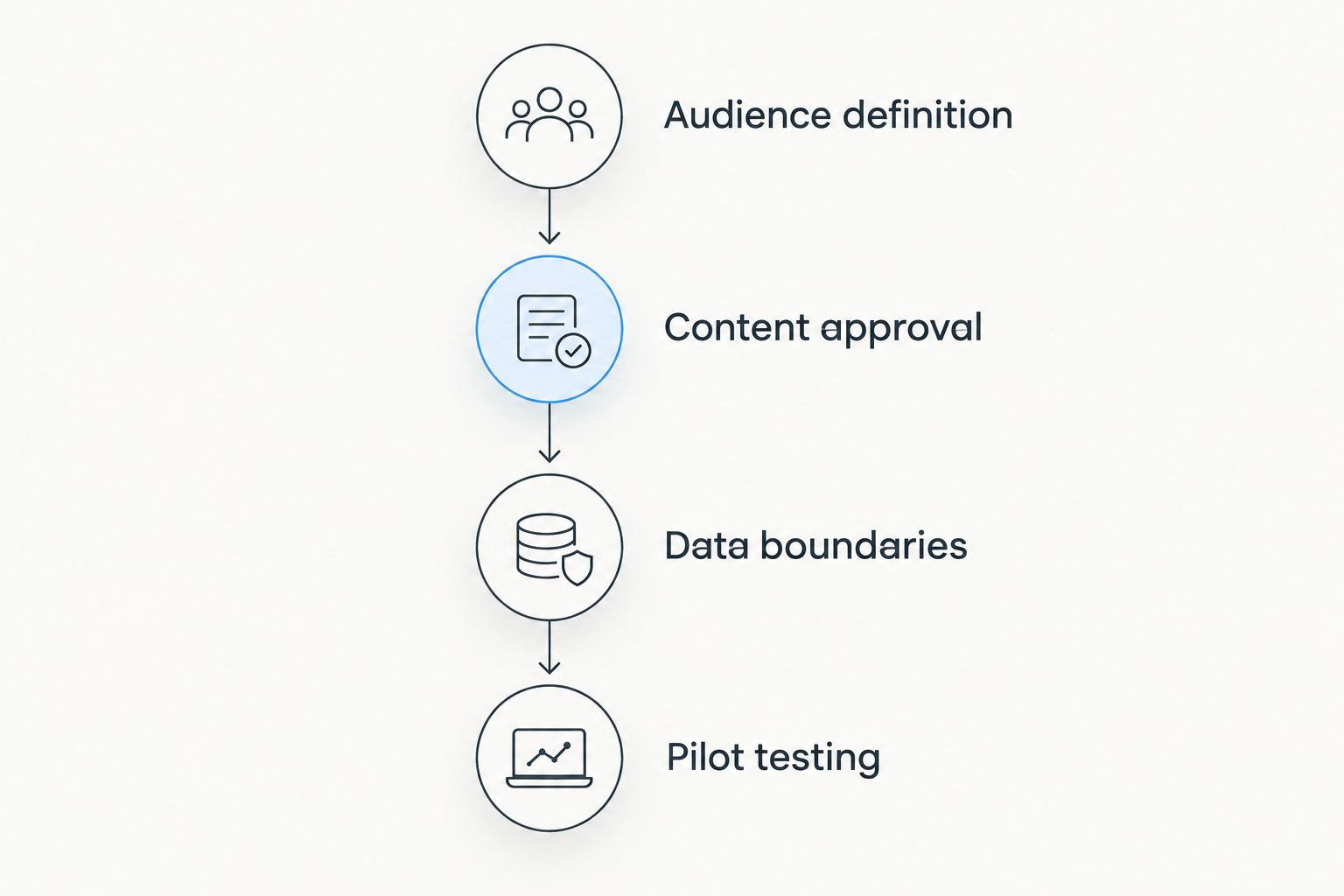
Use this sequence for a 2026 procurement brief. Each stage should produce a decision your marketing, learning, medical, and privacy owners can inspect.
Audience definition
Write down who participates and why. Separate public education from professional education and internal training; do not assume that one experience should serve all three.
Content approval
Map every question, response, explanation, and final screen. Identify who approves each element and how the team will replace or withdraw outdated material.
Data boundaries
Create a field-level collection plan. Explain why each field is needed, which system receives it, and whether the experience can work without it.
Pilot testing
Test the full journey before launch, including consent choices, incorrect answers, mobile interaction, and exit routes. Agree acceptance criteria before the demonstration rather than changing them to match what the vendor shows.
Give the pilot a deliberately small scope: 3 questions, 2 test journeys, and 1 primary outcome are a useful starting brief, not performance benchmarks. The test journeys should include a participant who accepts optional marketing contact and one who declines it.
For a public educational pilot, the primary outcome might be reaching the approved explanation screen. For training, choose an assessment outcome appropriate to the learning objective rather than reusing a marketing metric.
Healthcare data and AI: set boundaries before launch
In the EU, GDPR Article 9 gives data concerning health special-category protection. An ordinary marketing opt-in is not a blanket answer to the legal requirements for collecting or using health information.
Avoid asking for symptoms, diagnoses, medication, or treatment history unless the project has a justified purpose and an approved processing approach. Even an apparently simple quiz needs scrutiny if its answers reveal health information.
Read the guide to running a gamified campaign without collecting personal data before making lead capture mandatory. Participation and identification are separate design decisions.
For AI-enabled projects in 2026, distinguish drafting from live generation. A team can review prepared questions before publication; dynamically generated answers require controls that address what participants actually see. Do not treat an AI feature as evidence that medical content is accurate or approved.
How these options are ranked
The recommendations follow the criteria above: audience, governance, data boundaries, experience fit, ownership, and measurement. Each option receives a distinct job rather than competing for an unsupported universal winner.
This is a use-case shortlist, not a hands-on performance benchmark or certification assessment. The decisive comparison is between your required workflow and the demonstrated implementation, not between feature totals.
Which healthcare gamification option should you choose?
For custom healthcare-brand marketing, start with Brainylab and a tightly scoped creative brief. Use Moodle when you need a managed learning program, Articulate Storyline when the core deliverable is a branching lesson, and Kahoot! when a facilitator leads the experience.
For your 2026 decision, reject any shortlist that mixes these jobs without explaining the difference. The default is to choose the delivery model first, then validate the implementation against your content and data requirements.
Define your gamification brief
Discuss a branded quiz or game with a clear audience, content scope, and data-collection purpose.
FAQ
What's the best gamification platform for a pharma marketing campaign?
Choose the delivery model that matches the campaign: custom development for a branded experience, or learning software for a structured educational program. Brainylab belongs on the custom-development shortlist; healthcare-specific requirements still need project-level validation.
Is Moodle better than a custom branded game for healthcare?
Moodle is the better fit when the core requirement is managing structured learning. A custom branded game addresses a different brief, such as a public awareness experience, so compare the intended journey rather than treating the two as interchangeable.
Can a healthcare quiz collect first-party customer data?
A healthcare quiz can include data collection, but the processing must have an appropriate legal basis and safeguards. Health information needs separate scrutiny; do not treat general marketing consent as permission for every use.
Can gamification software diagnose patients?
The marketing and learning uses recommended here are not diagnostic services. Patient-specific diagnostic functionality needs a separate clinical, legal, and technical assessment rather than approval through a marketing-software checklist.
Should a pharma brand use AI-generated quiz questions?
Use AI-generated drafts only within a defined review process before publication. Confirm the accuracy, approved wording, and intended audience of every question and explanation; live generation creates a different control problem.
What should we ask a healthcare gamification vendor to demonstrate?
Ask for the complete participant journey, content-approval workflow, data destinations, access arrangements, and revision process. Include declined consent and incorrect-answer paths instead of reviewing only successful completion.
How should we measure a healthcare gamification pilot?
Choose one primary outcome tied to the pilot's purpose before launch. Keep educational engagement, marketing consent, and formal assessment results separate so a completion figure does not imply an outcome it cannot demonstrate.
One last thing
A wrong answer can be the most useful point in an educational game—if the explanation corrects the misunderstanding. Ask every shortlisted supplier to show the feedback after an incorrect response before showing the celebration screen.
That single demonstration keeps the discussion focused on what participants learn, not merely whether they finish.