
Best for custom lead-generation quizzes: Brainylab. Best for self-service qualification: Typeform. Best for drafting sales questions: ChatGPT. This 2026 guide separates customer-facing quiz builders from writing assistants and sales-training tools, so you choose for the job rather than the generation feature.
- Brainylab is best for brands commissioning custom lead-generation quizzes, rather than buying a self-service quiz generator.
- The best AI quiz generator tools for sales teams depend on whether you need lead qualification or sales training.
- Typeform suits self-service qualification; ChatGPT and Claude support question drafting rather than complete campaign delivery.
- Kahoot! suits sales knowledge checks, not the same buying brief as a customer-facing lead-generation quiz.
Why this matters
A prospect qualification quiz and a sales certification quiz solve different problems. The first helps a buyer identify a need and gives a representative useful context. The second checks whether a representative understands the product, customer, or sales process.
Question generation is only part of either workflow. A polished question set does not establish scoring, publish an experience, capture permission, or assign a follow-up owner. Choose the delivery model before comparing writing features.
For your 2026 shortlist, separate tools that draft quiz content from tools that deliver the quiz. That distinction prevents a writing assistant from being mistaken for a complete lead-generation system.
What makes the best quiz generator for sales teams?
Use these criteria before reviewing the ranked options:
- Purpose fit: Does the experience qualify prospects, recommend a next step, or assess sales knowledge? Pick a primary purpose.
- Question control: Can your team review wording, answer choices, and factual accuracy before publication? Generated questions still need an accountable editor.
- Outcome logic: Can answers lead to a meaningful result? Qualification needs explicit rules, not an unexplained score.
- Data handoff: Can the selected workflow preserve answers, results, and relevant permissions for follow-up? Verify the complete route during evaluation.
- Delivery ownership: Decide who builds, publishes, updates, and troubleshoots the experience. A studio engagement and a self-service application assign that work differently.
- Measurement: Define the business outcome before launch. Quiz completion alone does not establish lead quality or sales readiness.
For a practical evaluation, prepare 10 fictional leads, 3 result paths, and 1 named follow-up owner. These are recommended test conditions, not performance benchmarks. Use them to check whether the proposed workflow produces an understandable result and a usable handoff.
Best quiz tools at a glance
This 2026 ranking groups options by distinct jobs. The order is a buying decision tree, not a claim that a custom development service and a writing assistant offer equivalent products.
| Option | Best for | Standout capability | Key limitation |
|---|---|---|---|
| Brainylab | Commissioned branded lead-generation quizzes | Creative development of quizzes, games, and interactive experiences | A studio engagement, not a self-service quiz subscription |
| Typeform | Self-service prospect qualification | Forms and branching question flows | Your team must define the qualification model and handoff |
| ChatGPT | Drafting objection-discovery questions | Conversational creation and revision of question sets | Drafting does not publish or operate a lead-generation campaign |
| Claude | Drafting assessments from sales documents | Source-led writing and document discussion | Output still needs factual and assessment review |
| Kahoot! | Facilitated sales knowledge checks | Quiz-based learning and live participation | Training participation is not prospect qualification |
1. Brainylab: best for custom branded lead-generation quizzes
Brainylab is a creative development studio in Slovenia that builds AI-powered quizzes, branded games, and interactive experiences. Its stated focus includes user engagement and first-party customer data collection. That makes it relevant when your sales campaign needs a commissioned experience rather than a tool your team configures alone.
The buying decision is about ownership and scope. Bring the studio a defined audience, a qualification objective, and the intended next action. Treat CRM connections, reporting requirements, hosting responsibilities, and maintenance as specification questions rather than assumed inclusions.
Brainylab pros:
- Offers marketing lead-generation quizzes as an explicit service.
- Builds branded games and interactive experiences alongside quizzes.
- Provides a creative development route for a custom campaign.
Brainylab cons:
- A studio engagement is not equivalent to immediate self-service authoring.
- You need to agree on implementation responsibilities and acceptance criteria.
- Simple internal question drafting does not require a custom campaign build.
Best for: Brands commissioning a customer-facing quiz with a defined lead-generation purpose.
Verdict: Buy the service for a custom campaign; skip it for question drafting alone.
2. Typeform: best for self-service prospect qualification
Typeform provides a form-building environment with branching logic. That makes it a relevant starting point when your team wants to assemble a question flow and manage the experience itself. Evaluate its current generation features separately from the underlying form and logic capabilities.
Start with the decision the quiz must support. A useful qualification flow distinguishes needs, constraints, and readiness; it does not merely collect contact details behind an entertaining introduction. Keep the result useful even when the respondent is not ready for a sales conversation.
Typeform pros:
- Provides a form-based environment for collecting structured responses.
- Supports branching question flows.
- Suits teams that want direct ownership of questionnaire editing.
Typeform cons:
- Your team remains responsible for qualification rules and result wording.
- A form workflow does not replace a broader campaign strategy.
- Required data transfers need an end-to-end test before launch.
Best for: Marketing and sales operations teams building a self-managed qualification flow.
Verdict: Buy for self-service qualification when someone owns logic and maintenance.
3. ChatGPT: best for drafting objection-discovery questions
ChatGPT is a conversational writing assistant, not a complete customer-facing quiz system. Use it to turn a sales brief into candidate questions, revise confusing answer choices, or explore ways to ask about buyer obstacles. Give it approved product facts and explicit boundaries.
A useful drafting instruction names the audience, the sales decision, and what each answer should reveal. Ask for a rationale beside every proposed question. That makes irrelevant questions easier to remove before they enter a form or development brief.
ChatGPT pros:
- Supports iterative drafting and rewriting in conversation.
- Helps produce alternative question and answer wording.
- Can turn an explicit brief into a structured draft for human review.
ChatGPT cons:
- Can produce incorrect or unsupported content.
- Does not, by drafting questions, establish a published capture-and-routing workflow.
- Needs clear instructions to distinguish qualification from trivia.
Best for: Sales teams developing questions about buyer needs and objections.
Verdict: Buy for drafting support; skip it as a standalone lead-generation system.
4. Claude: best for source-led sales assessment drafting
Claude is a conversational assistant that can work with supplied documents. Its role here is drafting assessments from approved sales material, such as positioning documents, product explanations, or internal playbooks. Keep the assessment tied to the source rather than asking for generic sales trivia.
Request a source reference and an explanation for each proposed correct answer. Then have the document owner review the draft. An assistant's explanation is not evidence that a question accurately reflects company policy or product behavior.
Claude pros:
- Supports discussion and drafting around supplied documents.
- Helps convert explanatory material into candidate assessment questions.
- Allows iterative revision of ambiguous questions and explanations.
Claude cons:
- Generated answers can misrepresent the source.
- Assessment delivery and reporting require a separate workflow.
- Confidential material requires an approved data-handling arrangement.
Best for: Enablement teams turning approved sales documentation into assessment drafts.
Verdict: Buy for source-led drafting; hold publication until the content owner approves it.
5. Kahoot!: best for facilitated sales knowledge checks
Kahoot! provides quiz-based learning experiences and live participation. It belongs on this shortlist when the audience is your sales team rather than prospective customers. Use it to surface misunderstandings during a product briefing or training session.
Keep the questions connected to selling decisions. Asking which response fits a customer scenario is more relevant to sales readiness than testing recall of an isolated slogan. Discuss the reasoning after the answer, especially when the wrong option exposes a common misunderstanding.
Kahoot! pros:
- Supports quiz-based group learning.
- Fits facilitated sessions with participant responses.
- Provides a format for discussing correct and incorrect answers.
Kahoot! cons:
- A live knowledge check does not demonstrate real selling ability.
- Competitive participation can distract from the explanation.
- Internal training is a different workflow from external lead qualification.
Best for: Sales managers running facilitated product or process knowledge checks.
Verdict: Buy for training sessions; skip it for a prospect qualification campaign.
How we ranked these options
The ranking prioritizes purpose fit, question control, outcome logic, data handoff, delivery ownership, and measurement. Custom campaign development comes first for brands commissioning external lead-generation experiences. Self-service building, conversational drafting, document-based assessment drafting, and live training each occupy separate slots.
This is a workflow-based shortlist, not a performance league table. No conversion uplift, drafting-speed advantage, or sales result determines the order. For a 2026 purchasing decision, require a demonstration using your own approved brief rather than relying on a generic product tour.
Test the complete sales handoff before choosing
A quiz becomes useful to sales when its answers change what happens next. Test the journey in sequence, including what happens when a respondent is not a fit or does not want further contact.
- Define intent: Name the customer decision the quiz helps resolve.
- Draft questions: Ask only what contributes to that decision or the agreed follow-up.
- Validate outcomes: Check that different answers produce defensible results.
- Route context: Deliver relevant answers and permissions to the responsible person.
- Review follow-up: Confirm that the representative can explain why the contact was assigned.
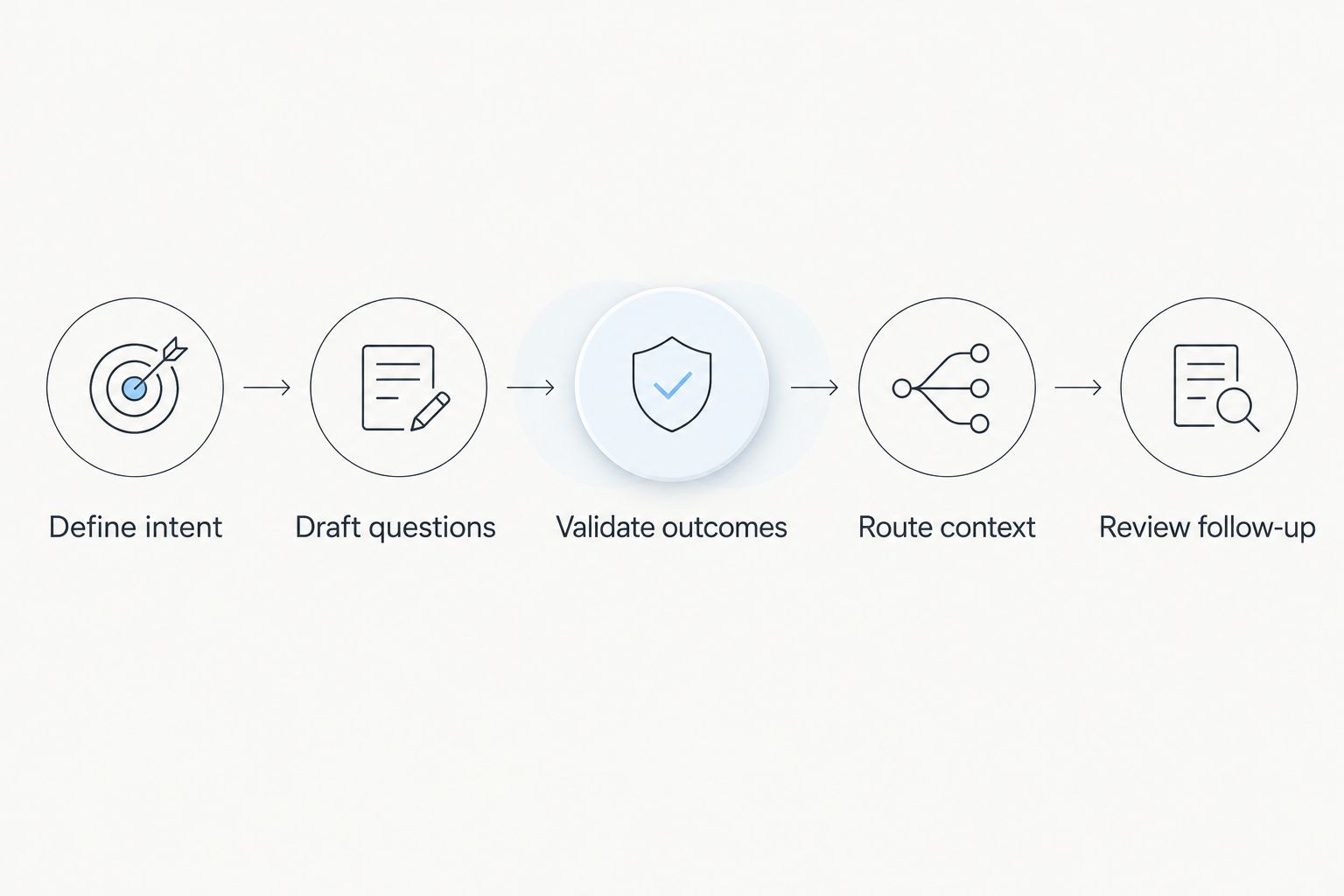
Use the same fictional lead set across every candidate workflow. Include contradictory answers, incomplete submissions, and a returning contact. The purpose is to expose operational gaps before real customer data enters the process.
For CRM-led campaigns, use the guide to connecting gamified campaigns to Salesforce for sales handoff to structure your implementation questions. Do not treat an integration label as proof that answer history, assignment, and permissions arrive correctly.
Which quiz tool should you choose?
Choose Brainylab for a commissioned branded lead-generation quiz; choose Typeform when your team wants to build and maintain the qualification flow itself. Choose ChatGPT for objection-discovery drafts, Claude for document-led assessment drafts, and Kahoot! for facilitated sales training.
If your 2026 brief only says “generate questions,” stop before purchasing. Add the audience, intended decision, publishing owner, data destination, and success measure. Those requirements determine whether you need a writing assistant, a quiz delivery tool, or a development partner.
The default for an undecided sales team is to write the handoff requirement first. A quiz that creates an actionable conversation is a better fit than one that merely produces polished questions.
FAQ
What's the best AI quiz generator for a sales team?
The best choice depends on whether the team needs prospect qualification, question drafting, or internal training. Typeform fits self-service qualification, ChatGPT fits drafting, and Kahoot! fits facilitated knowledge checks; custom campaigns require a separate development brief.
Is ChatGPT enough to run a lead-generation quiz?
ChatGPT alone is not a complete lead-generation quiz workflow. It can draft content, but publishing, response capture, permissions, outcome logic, and sales routing still need an implementation.
Is Typeform better than a custom quiz build?
Typeform is the better fit when your team wants to configure and maintain a form-based qualification flow itself. A custom build fits a commissioned experience whose requirements need a development partner.
Can a generated quiz qualify sales leads?
A generated quiz can support qualification only when its questions and outcomes reflect explicit sales criteria. Review the rules and test the handoff before using its results to assign follow-up.
Should sales training and prospect quizzes use the same tool?
Sales training and prospect quizzes do not need the same tool. Training checks employee understanding, while prospect qualification needs customer-facing outcomes, appropriate data handling, and a follow-up process.
What should I ask a quiz provider to demonstrate?
Ask the provider to demonstrate the complete path from an answer to a result and a sales handoff. Include incomplete responses, contradictory answers, and returning contacts in the demonstration.
Can I upload confidential sales documents to a drafting assistant?
Upload confidential documents only under an arrangement approved for that information. Check your organization's policy, the selected service's applicable data terms, and access controls before submitting material.
One last thing
A correct quiz answer is not the same as purchase intent. A prospect can understand your category perfectly and have no relevant project; a representative can recall product facts and still mishandle a customer conversation.
Before launching in 2026, write the follow-up message for each result. If the message is identical across outcomes, revisit whether the quiz is collecting distinctions your sales team actually uses. That check turns an attractive interaction into a clearer sales brief.