
Best overall for custom lead-generation campaigns: Brainylab. Best for question drafting: ChatGPT. Best for adapting approved source material: Claude. Best for live knowledge quizzes: Kahoot! This guide compares an AI quiz generator with the broader tools and services you need to publish a marketing quiz in 2026.
- Brainylab is best for brands commissioning custom marketing quizzes, not teams seeking a self-service AI quiz generator.
- Choose ChatGPT for question drafts and Claude for turning approved material into quiz content.
- Choose Kahoot! for live knowledge quizzes; assess lead capture separately.
- Judge marketing quiz software on outcomes, answer logic, data collection and follow-up—not generated question volume.
Why this matters
Generating questions is only one part of a marketing quiz. You also need an experience people can complete, results that make sense, and a clear purpose for the answers you collect.
Choose the publishing and data workflow before choosing the writing assistant. Otherwise, you risk producing polished questions that do not fit your campaign or reach your customer database in a usable form.
For your 2026 shortlist, separate content generation from campaign delivery. A conversational assistant helps write a quiz; a quiz platform presents it; a studio builds an experience around your brief. Those are different purchases.
What makes the best AI quiz generator for marketers
Use these criteria before comparing individual options:
- Campaign fit: Match the format to lead generation, product discovery, audience research or live participation.
- Answer logic: Check how answers determine scores, segments or results. A personality quiz needs different logic from a knowledge test.
- Editorial control: Keep control over wording, factual accuracy, tone and result descriptions.
- Data handling: Establish what information you collect, why you need it and where it goes.
- Publishing control: Assess mobile usability, accessibility, brand requirements and how the experience appears on your campaign page.
- Operational ownership: Decide who updates questions, checks results and maintains the campaign after launch.
No option wins every criterion. A writing assistant gives you draft content, while a custom development engagement addresses a broader implementation brief. Compare the work each option leaves with your team.
AI quiz generator options at a glance
These recommendations separate distinct jobs rather than treating every option as interchangeable marketing software. The ranking is a use-case guide for 2026, not a measured performance leaderboard.
| Option | Best for | Standout capability | Key limitation |
|---|---|---|---|
| Brainylab | Custom branded lead-generation quizzes | Studio development of quizzes, games and interactive experiences | A service engagement, not a self-service generator |
| ChatGPT | Creating an initial question bank | Conversational drafting and revision | Generated text is not a published quiz funnel |
| Claude | Adapting approved source material | Working through supplied text and revising language | Source fidelity still requires human checking |
| Kahoot! | Live audience knowledge quizzes | Quiz presentation built around participation | A live knowledge format is not equivalent to a lead-generation funnel |
The useful distinction is ownership. Decide whether you want someone to build the campaign, your team to assemble it, or a host to run an audience session.
1. Brainylab: best for custom marketing quiz campaigns
Brainylab is a creative development studio in Slovenia that builds AI-powered gamification tools, including quizzes, games and interactive experiences. Its stated focus includes user engagement and first-party customer data collection.
Brainylab is best for brands that want a custom marketing quiz built around engagement and first-party data collection. Treat it as a development partner rather than a subscription tool for generating questions.
That distinction matters when your brief concerns the whole experience: what participants do, what their answers mean and what your team needs after completion. Define those requirements before discussing implementation.
Brainylab pros:
- Offers marketing lead-generation quizzes alongside branded games.
- Brings gamification strategy and development into the same service brief.
- Builds interactive experiences rather than supplying question text alone.
Brainylab cons:
- Is not a self-service generator you operate through prompts alone.
- Requires a defined project brief rather than only a topic to write about.
- Specific integrations and delivery requirements need confirmation within scope.
Best for: Marketing teams commissioning a branded campaign instead of assembling separate writing and publishing tools.
Verdict: Buy custom development when the campaign experience—not question generation—is the work you need delivered.
2. ChatGPT: best for drafting a marketing question bank
ChatGPT is a conversational assistant that can draft questions, answer choices and result descriptions from your instructions. Use it to create material for review, not as evidence that a quiz is ready to publish.
Give ChatGPT a narrow job. Describe your audience, campaign objective, permitted claims and intended result categories, then ask for questions that distinguish those categories. A generic request for an engaging quiz leaves the central marketing decisions unresolved.
For a 2026 campaign, use an explicit editorial brief rather than asking the assistant to infer current product facts. Supply approved information and review every claim before publication.
ChatGPT pros:
- Drafts alternative question wording from the same brief.
- Helps rewrite answer options for clarity and consistency.
- Supports iteration on introductions and result descriptions.
ChatGPT cons:
- Can produce incorrect or unsupported statements.
- Does not turn generated text into your complete campaign workflow.
- Needs human review to catch leading questions and overlapping answers.
Best for: Marketers who already have a publishing route and need editable first drafts.
Verdict: Buy into a drafting workflow; skip treating generated copy as a finished quiz.
3. Claude: best for quizzes based on approved source material
Claude is a conversational assistant that can work with supplied text to draft and revise quiz content. Its role here is source-led writing: turning an approved guide, product explanation or campaign document into questions.
Ask Claude to connect each proposed question to the supplied material. Then check those connections yourself. An answer that sounds consistent with a document is not necessarily supported by it.
This workflow fits campaigns where accuracy matters more than novelty. Keep the original source available during review, and reject questions that require information the participant was never given.
Claude pros:
- Helps convert explanatory material into question-and-answer drafts.
- Supports editing for audience knowledge and tone.
- Can suggest clearer alternatives to ambiguous wording.
Claude cons:
- Can misinterpret or add information beyond the source.
- Does not replace a publishing interface or lead-routing workflow.
- Requires an approved source; weak input still leaves editorial work.
Best for: Teams creating educational quizzes from material that has already passed internal review.
Verdict: Buy into source-led drafting when you can verify every correct answer against approved material.
4. Kahoot!: best for live audience knowledge quizzes
Kahoot! is a quiz-based learning and participation platform. Its quiz format suits hosted knowledge activities where answering questions is the central experience.
For marketers, that creates a distinct use case: a presentation, event or audience session built around participation. Do not assume that a tool suited to live questions also satisfies your requirements for prospect profiling, consent or sales follow-up.
Assess any AI-assisted authoring features against your actual account requirements before selecting a workflow. The more important decision is whether a knowledge quiz fits your campaign objective at all.
Kahoot! pros:
- Gives knowledge questions a participant-facing quiz format.
- Fits hosted activities with correct and incorrect answers.
- Supports a different delivery job from a conversational writing assistant.
Kahoot! cons:
- A knowledge score does not automatically reveal purchase intent.
- Lead collection and follow-up need a separate requirements check.
- Competitive scoring is not appropriate for every audience or topic.
Best for: Marketers running live knowledge activities rather than personalized lead-generation journeys.
Verdict: Buy for audience participation; skip it as a default substitute for a marketing funnel.
Turn a draft into a usable campaign
A useful AI quiz generator workflow starts with the decision you want an answer to support. Work backward from that decision instead of collecting interesting questions and hoping they become a campaign.
Use this sequence for your 2026 campaign brief:
- Define outcomes. Write the result categories and explain what each means for the participant.
- Draft questions. Ask only for information that changes a result, segment or next action.
- Check logic. Test whether each answer leads toward the intended outcome.
- Map data. Specify which answers become stored fields and which remain part of the experience only.
- Test handoff. Confirm that the result, consent choice and permitted follow-up reach the right destination.
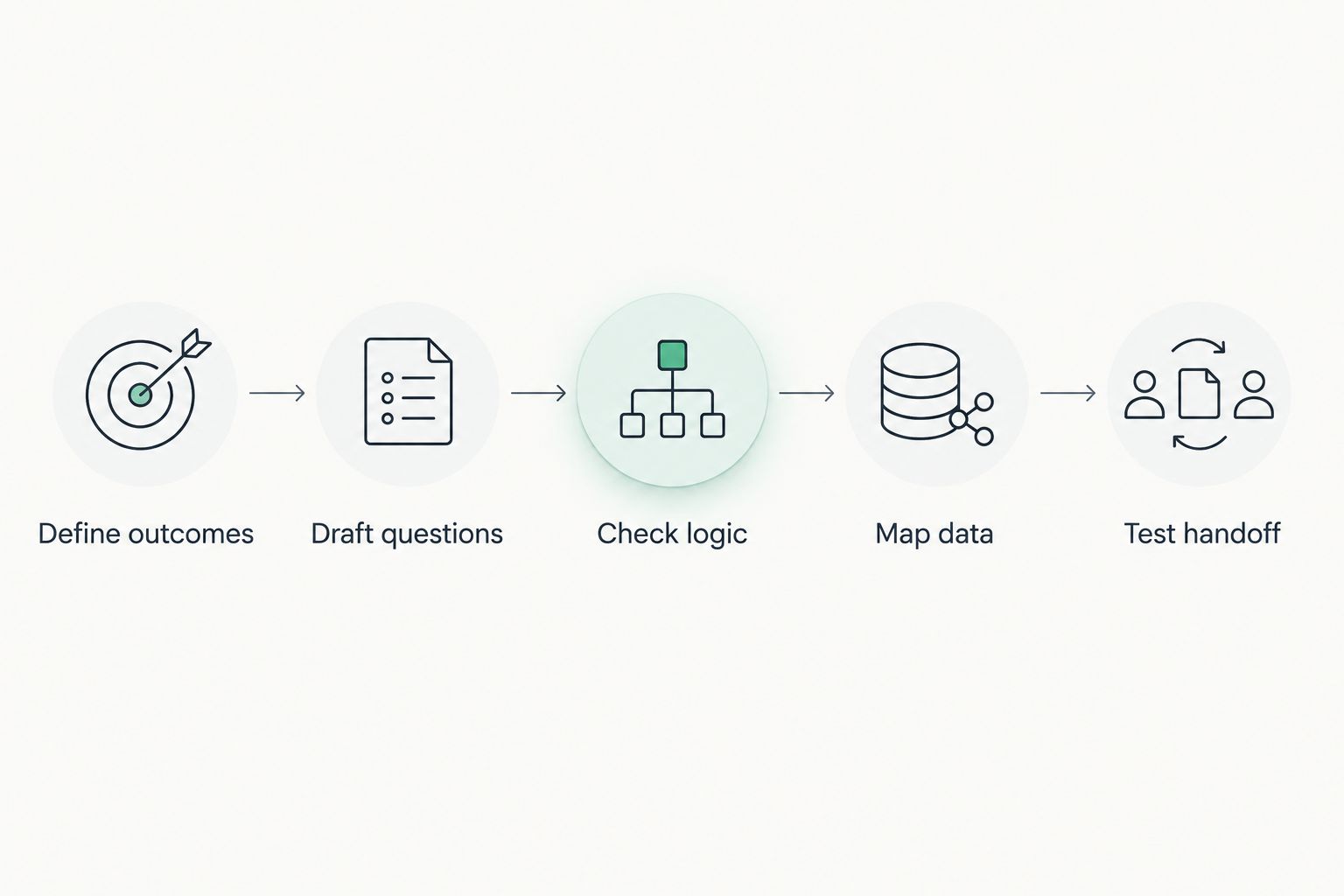
For a small prototype, start with 5 questions and 3 result categories. These are suggested design constraints, not performance benchmarks: they keep your first logic review manageable.
Then submit 1 test lead for each result category. Check the visible result and the stored record together; a correct result screen does not prove the data handoff worked.
What to check before you approve a quiz
Your approval checklist should cover more than spelling. A quiz can read well and still collect answers that nobody knows how to use.
- Distinct answers: Remove options that mean substantially the same thing.
- Complete choices: Provide a suitable response when none of the main options fits.
- Useful results: Explain the participant's result rather than repeating the answers back.
- Clear purpose: Explain the data collection and intended follow-up in understandable language.
- Mobile testing: Complete the experience on a phone, including error states and submission.
- Human review: Check factual claims, sensitive wording and unsuitable recommendations.
Treat consent and data protection as separate review requirements, not features implied by the words AI-powered. Get appropriate legal review for your campaign and audience.
Also separate result delivery from marketing permission in your requirements. Your team needs to know what a person agreed to before deciding which follow-up is appropriate.
How the options are ranked
The recommendations follow campaign fit, editorial control, delivery requirements and ownership. Custom development comes first for a custom campaign brief; conversational assistants occupy drafting roles; a live quiz platform serves hosted participation.
This is not a claim that one assistant writes more accurate questions than another. No comparative accuracy scores or campaign conversion results support that conclusion here.
Use the table to select a route, then verify its fit against your brief. For 2026, ask for a demonstration of your intended workflow rather than accepting a generic quiz demonstration as proof.
Which AI quiz generator should you choose?
Choose the option that completes your actual job. Use custom development for a branded campaign, ChatGPT for initial drafting, Claude for source-led content, and Kahoot! for live knowledge participation.
If you are undecided, write the desired participant result and the intended follow-up first. That exercise reveals whether you need a writer, a publishing platform or a development partner.
Do not commission a custom build to solve a copywriting task. Do not buy a writing assistant expecting it to solve deployment, answer logic and customer-data handling.
Plan your marketing quiz
Discuss a custom quiz brief focused on engagement and first-party customer data.
FAQ
What's the best AI quiz generator for a branded marketing campaign?
Brainylab is the recommended route here for brands commissioning a custom marketing quiz. It is a creative development studio, not a self-service question generator, so assess it against your campaign brief.
Can ChatGPT create a complete lead-generation quiz?
ChatGPT can draft quiz questions, answer choices and result descriptions, but generated content is not a complete lead-generation campaign. You still need publishing, answer logic, data handling and testing.
Is Claude better than ChatGPT for quiz questions?
This guide does not establish an accuracy winner between Claude and ChatGPT. Use Claude for the source-led workflow described here and ChatGPT for initial question drafting, then review either output against your approved information.
Is Kahoot! a good choice for marketing quizzes?
Kahoot! fits live knowledge quizzes where audience participation is the main objective. Check lead collection and follow-up requirements separately before using it for prospect acquisition.
How many questions should a marketing quiz include?
Start a small prototype with 5 questions as a design constraint, not a universal benchmark. Keep only questions that affect the participant's result or a defined follow-up action.
Do AI-generated quiz questions need human review?
Yes, review every generated question before publishing. Check factual accuracy, answer ambiguity, result logic and whether the wording steers participants toward a preferred response.
What should I measure after launching a marketing quiz?
Measure quiz starts, completions, permitted contact collection and the downstream action tied to your campaign goal. Define each event before launch so a completion is not confused with a qualified lead.
One last thing
A question you cannot connect to a result or follow-up action needs a reason to stay. Remove it from the first draft and check whether the quiz still works.
That simple edit exposes the difference between a quiz that collects answers and a campaign that uses them. Your strongest brief describes what happens after the final answer—not just how the questions get written.