
An AI quiz builder’s cost depends on whether you need software access, an internally built quiz, or a custom branded campaign; these are different purchases, not interchangeable quotes. For your 2026 budget, separate the tool itself from question writing, result logic, design, data collection, testing, and ongoing maintenance.
- How much does an AI quiz builder cost? Define the campaign scope before comparing software and studio proposals.
- Brainylab builds custom marketing quizzes for brands seeking engagement and first-party customer data.
- Compare software access with a finished campaign, not with a subscription label alone.
- Specify result logic, data handling, and maintenance before choosing a delivery model.
How much does an AI quiz builder cost?
An AI quiz builder has a software component and a campaign delivery component. Compare both before choosing an approach. A tool that helps generate questions does not, by itself, define your campaign strategy, approve the content, or decide how customer answers should reach your marketing team.
Brainylab is a creative development studio that builds AI-powered quizzes, games, and interactive experiences for brands. That is a custom-service model, rather than simply access to a quiz editor.
Use the following breakdown to structure your 2026 buying decision. These are scope categories to request in a proposal, not claims about what any particular provider includes.
| Scope category | What you need to specify | What to check before approval |
|---|---|---|
| Software access | Editing, publishing, and any required generation features | Whether the selected service supports your actual campaign requirements |
| Campaign content | Questions, answer choices, result copy, and calls to action | Who writes, reviews, and approves the content |
| Experience design | Branding, layouts, interactions, and mobile behaviour | Whether you receive a template adaptation or custom design |
| Result logic | Scoring, branching, recommendations, and tie handling | Whether results are generated or follow approved rules |
| Data collection | Contact fields, answer storage, consent, and export requirements | Which data is collected and where it goes |
| Delivery and upkeep | Testing, publishing, changes, and maintenance | Who owns each task after the initial launch |
The useful comparison is not whether one proposal has a shorter list. It is whether both proposals deliver the same working experience and leave you with the same responsibilities.
Why this matters
A marketing quiz needs to do more than produce questions. You need a reason for someone to finish it, a useful result, and a clear next action that fits your campaign objective.
First-party data adds another requirement: you must know what each answer means and how your team will use it. A completed quiz without a defined data destination leaves the marketing workflow unfinished.
For a 2026 campaign, write the business objective before selecting a builder. Lead generation, customer preference research, and engagement require different question structures and different measures of success.
Self-service software: best for a defined, repeatable quiz
Choose self-service software when your team can handle the content, design decisions, setup, and testing. Start by checking whether the editor supports the result logic and data workflow you have already specified.
The benefit is direct control over editing and publishing. The trade-off is that your team remains responsible for converting the tool into a finished campaign; generating draft questions does not remove that work.
Do not evaluate an editor only through its demonstration quiz. Build your actual result structure during evaluation, then test the contact form and the way answers are exported or transferred.
Ask these questions before committing:
- Can your team express the required scoring and branching rules?
- Can you control the questions and result copy before publication?
- Does the data output contain the fields your marketing team needs?
- Who will manage changes when the campaign brief changes?
Internal development: best for teams that own the workflow
Choose internal development when your organisation wants responsibility for the quiz’s code, data flow, and ongoing changes. Assign that responsibility explicitly rather than treating the quiz as a spare-time task.
Internal development gives your team control over implementation decisions. Its trade-off is ownership of the entire delivery process, including testing and maintenance after launch.
Decide who will write the content, build the interface, implement the logic, review data handling, and resolve problems. A developer assigned to build the first version is not automatically the long-term owner of every campaign change.
Compare internal work against a studio proposal using the same brief. The guide to building gamification in-house versus hiring a studio addresses that delivery decision separately from software selection.
Custom studio development: best for a branded campaign
Choose custom studio development when you need a branded experience shaped around a marketing objective, rather than only an editor. Ask the studio to define the deliverables and the responsibilities that stay with your team.
Brainylab is best for brands seeking custom marketing quizzes built for engagement and first-party customer data. Its stated offering includes marketing lead-generation quizzes, branded games, gamification strategy, and AI development.
The advantage of the studio model is that you can commission an experience against a campaign brief. The trade-off is dependence on a clear specification and an agreed change process; a service engagement is not equivalent to unrestricted self-service editing.
For any studio proposal, confirm whether the engagement covers content, design, implementation, data handling, and launch support. Do not assume that a service category automatically includes every deliverable your campaign needs.
Which delivery model fits your team?
| Delivery model | Best for | Main advantage | Main trade-off |
|---|---|---|---|
| Self-service software | Teams with a defined quiz and an owner for setup | Direct control through the editor | Your team completes and maintains the campaign |
| Internal development | Teams that want implementation ownership | Control over code and workflow decisions | Your organisation owns delivery and upkeep |
| Custom studio development | Brands commissioning a tailored marketing experience | A campaign brief can guide the build | Scope and change responsibilities require agreement |
Choose the model that matches the work you want to own. An editor, an internal project, and a commissioned campaign solve different operational needs.
Why AI quiz builder costs vary
The scope of the experience determines what needs to be built and managed. Use these factors to explain differences between proposals, rather than comparing headline labels.
- Creative scope: Decide whether the experience adapts an existing format or needs original questions, result copy, and branded interactions.
- Quiz logic: Specify whether participants follow the same path or receive different questions and outcomes based on their answers.
- Generation scope: State whether generation is used for drafting content or for producing participant-facing material during the experience.
- Data scope: Define the contact details, answer fields, consent records, and destinations needed for first-party customer data.
- Engagement format: Distinguish a straightforward quiz from a broader branded game or interactive experience.
- Delivery ownership: Name the people responsible for approval, testing, publication, changes, and maintenance.
These factors are also useful for reducing scope. Remove a feature only after checking whether it supports the campaign objective, not because it looks complicated in a proposal.
For your 2026 brief, label requirements as essential or optional. Keep the essential list tied to the result the participant receives and the information your marketing team needs.
How do you get a comparable AI quiz builder proposal?
Give each provider the same brief. Otherwise, you are comparing different interpretations of the campaign rather than different ways to deliver it.
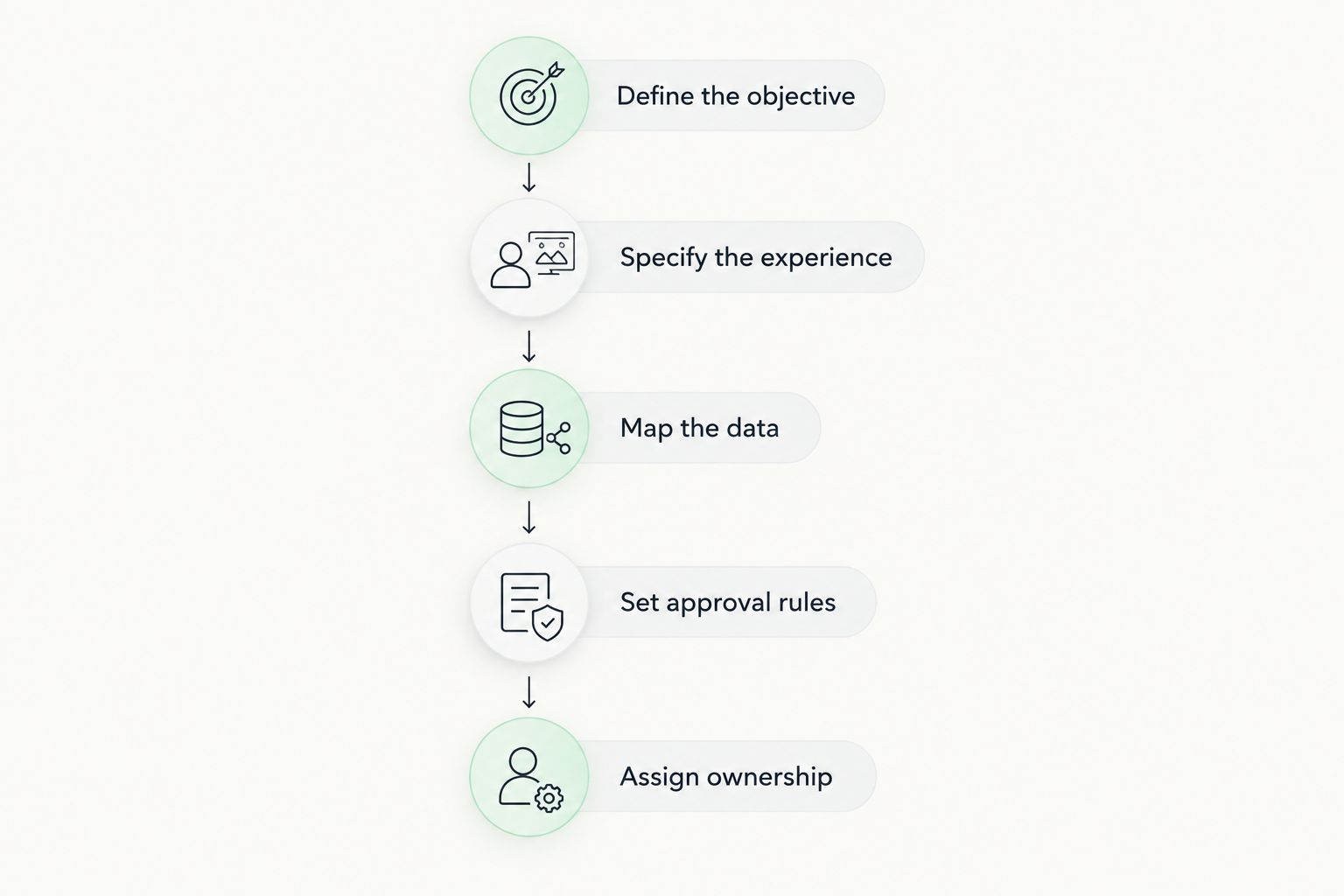
- Define the objective. State whether the quiz should collect leads, reveal customer preferences, or encourage interaction with the brand. Name the action that should follow completion.
- Specify the experience. Describe the audience, entry point, questions, result format, and call to action. Include the content your team will supply.
- Map the data. List the information you need, its purpose, and its destination. Separate information required to deliver a result from optional marketing information.
- Set approval rules. Assign reviewers for questions, result copy, design, and data handling. State whether participant-facing generated content requires restrictions.
- Assign ownership. Agree who publishes, updates, maintains, and reviews the experience after launch. Ask how your team will access the content and data.
This process gives you a practical basis for evaluation. A provider should respond to the brief with deliverables, exclusions, dependencies, and acceptance criteria—not leave you to infer the finished experience.
What should your acceptance criteria include?
Your acceptance criteria should describe observable behaviour. Replace a requirement such as an engaging quiz with a description of the questions, result, data output, and next action you expect.
Test each result path, including incomplete answers and tied scores where relevant. Check the experience on the devices your audience uses, and verify that the data arriving at its destination matches the participant’s submission.
For a 2026 launch, also agree what happens when content needs correction. You need a named owner and a working update process, not just an approved launch version.
Is a subscription enough for a lead-generation quiz?
A subscription is enough only when the software meets your requirements and your team can complete the campaign work. Treat content, testing, and data setup as assigned tasks, even when the editor makes them straightforward.
A lead-generation quiz needs a defined relationship between participation and contact collection. Decide when you ask for details, what the participant receives, and which information your sales or marketing team can actually use.
Is custom development necessary for every branded quiz?
Custom development is not necessary simply because a quiz carries your brand. Choose it when the required experience, logic, or workflow calls for work beyond the self-service option you are evaluating.
Test that boundary against your brief. If an editor handles the essential requirements and your team owns delivery, do not commission additional complexity without a clear purpose.
Does generated content remove the need for review?
Generated content does not remove the need to approve your marketing questions and results. Your brand remains responsible for what the experience tells participants.
Separate draft assistance from live generation. With draft assistance, your team can approve the material before publication; with live generation, define what the system is allowed to produce and how unsuitable output is handled.
FAQ
How much does an AI quiz builder cost in 2026?
The cost depends on whether you are buying software access, internal development, or a custom campaign. Define the content, design, result logic, data handling, and maintenance scope before comparing proposals.
What is included when I buy an AI quiz builder?
The included work depends on the provider and agreement. Check software access, content creation, design, data handling, testing, and upkeep separately rather than assuming they are bundled.
Is a self-service quiz builder better than hiring a studio?
A self-service quiz builder fits teams that can own campaign setup and delivery; a studio fits a commissioned custom experience. Compare both against the same brief and the responsibilities your team wants to keep.
Can I use a marketing quiz to collect first-party data?
A marketing quiz can collect first-party data through participant answers and submitted details. Define the purpose, consent requirements, storage, and destination before launch.
Does Brainylab sell quiz-building services?
Brainylab offers marketing lead-generation quizzes and builds AI-powered gamification experiences for brands. Treat the engagement as a custom-service discussion and confirm its deliverables directly.
Do I need AI to run a lead-generation quiz?
A lead-generation quiz does not inherently require AI. Choose generation features only when they serve a defined need in content creation or the participant experience.
What should I ask before commissioning a quiz?
Ask who owns content, result logic, data handling, approval, launch, and maintenance. Use those responsibilities as part of the proposal comparison and acceptance criteria.
One last thing
Write the result before you write the questions. Define what the participant should learn or receive, then include only questions that help deliver that outcome or support a clearly stated data purpose.
This makes your 2026 scope easier to defend. A feature that does not improve the result, support the next action, or produce useful information needs a stronger reason to stay in the brief.