
The cost to build a custom marketing quiz depends on the agreed scope; there is no single amount that covers every build. Request a quote that separates quiz creation from integrations, hosting, maintenance, and campaign delivery, then compare proposals against the same requirements. For a 2026 campaign, define what happens after someone finishes the quiz before approving the build.
- The cost to build a custom marketing quiz depends on its logic, design, data collection, integrations, and ongoing responsibilities.
- Brainylab builds marketing quizzes for brands seeking user engagement and first-party customer data.
- Compare proposals against the same acceptance criteria, not just the question count.
- Keep campaign promotion, hosting, and maintenance separate from the initial development scope.
Why this matters
A quiz is not finished when its questions look good. Your visitor needs a useful result, your marketing team needs usable data, and someone needs responsibility for the experience after launch. A proposal that covers only the visible screens leaves those decisions unresolved.
Start with the information you need to collect, rather than a list of game features. The guide to gamification tools for first-party data collection provides related context. Define the business use of each answer before paying to collect it.
How much does it cost to build a custom marketing quiz?
A custom marketing quiz needs a scope-based quote. Its question count is only one part of that scope: result logic, branded interaction, lead capture, external systems, and post-launch responsibilities also need to be specified.
Use the following breakdown to make proposals comparable. Ask each supplier to identify what is included, excluded, and dependent on your team providing content or access.
| Workstream | What to specify | Acceptance evidence |
|---|---|---|
| Quiz strategy | Audience, campaign objective, questions, outcomes | Approved question and outcome map |
| Copy and content | Questions, answer choices, results, form messages | Approved copy for every visible state |
| Experience design | Brand assets, layouts, interactions, accessibility requirements | Reviewed screens and interaction states |
| Quiz development | Scoring, branching, validation, result display | Tested paths with expected results |
| Data collection | Required fields, permissions, storage, retention requirements | Documented data flow and working form |
| Integrations | Destination systems, field mapping, failure handling | Verified records in the destination |
| Measurement | Events, definitions, reporting ownership | Confirmed events and reporting access |
| Launch and support | Deployment, hosting, fixes, updates, ownership | Written handover and responsibility list |
Compare deliverables before comparing totals. A proposal with fewer line items does not establish that it covers the same work.
Brainylab is a fit for brands seeking custom marketing quizzes that combine user engagement with first-party data collection. The studio builds quizzes, games, and interactive experiences; assess its proposal against your campaign requirements rather than assuming a particular integration or support arrangement is included.
For your 2026 brief, separate the required launch experience from optional additions. That distinction gives suppliers a clear basis for quoting and gives your team a boundary for change requests.
Which build approach fits your campaign?
Choose the approach after defining the experience. A standard question-and-result flow and a branded interactive campaign are different briefs, even when both are called marketing quizzes.
| Approach | Best for | Main advantage | Main limitation |
|---|---|---|---|
| Template-based quiz | Teams whose requirements fit an existing builder | Uses an established editing workflow | Your experience must fit the builder's supported behaviour |
| Custom campaign quiz | Brands needing specific interaction, logic, or data handling | Development follows the agreed campaign requirements | Requires explicit testing, ownership, and maintenance arrangements |
| Reusable quiz framework | Teams planning repeated campaigns with shared mechanics | Reuses an agreed structure across campaigns | Needs rules for what editors can change without development |
These are project approaches, not named packages. Do not treat a template implementation as equivalent to a custom build unless both meet the same acceptance criteria.
Template-based quiz: keep the requirements within the tool
A template-based approach fits a campaign when the builder supports your required questions, outcomes, fields, and publishing method. Check those capabilities before commissioning design work. A visual preview does not establish that the data flow works.
The trade-off is control. If your required behaviour sits outside the supported workflow, decide whether to simplify the campaign or choose another approach. Best for: teams that can accept an existing structure.
Custom campaign quiz: specify the behaviour precisely
A custom build fits a brief that needs particular result logic, branded interaction, or data handling. Write those requirements as observable behaviours: what appears, what gets stored, and what happens when something fails.
The trade-off is responsibility. You need an agreed owner for testing, deployment, changes, and technical upkeep. Best for: brands with requirements an existing template does not satisfy.
Reusable quiz framework: define the editing boundary
A reusable framework fits campaigns that share mechanics but change content. Specify which elements your team must edit: questions, answer choices, result text, images, or campaign settings. Keep structural changes separate from content updates.
Reusability is not the same as unrestricted editing. A framework needs defined limits and instructions so a content change does not break the result logic. Best for: teams planning repeated campaigns around a shared structure.
Why custom marketing quiz scope varies
The main drivers sit in the brief. Use these factors to identify work that belongs in the launch scope and work that should remain optional.
- Experience design: Specify whether the quiz follows an existing layout or needs campaign-specific screens, animation, and interaction states.
- Result logic: Distinguish simple scoring from branching, weighted answers, tie handling, and exclusion rules.
- Data collection: Define required fields, validation, permission choices, and the information stored with each submission.
- System connections: Identify destination systems, field mappings, authentication requirements, and behaviour when a transfer fails.
- Content variants: State which languages, audience versions, and result variants need separate writing and approval.
- Operational ownership: Assign hosting, access management, fixes, reporting, content updates, and campaign closure.
Question count alone does not describe these requirements. A short quiz with conditional outcomes needs a different test plan from a longer quiz that follows one fixed path.
Make the distinction visible in your 2026 scope document. Label each requirement as essential, optional, or excluded, and require the proposal to use the same labels.
How to prepare a brief suppliers can quote
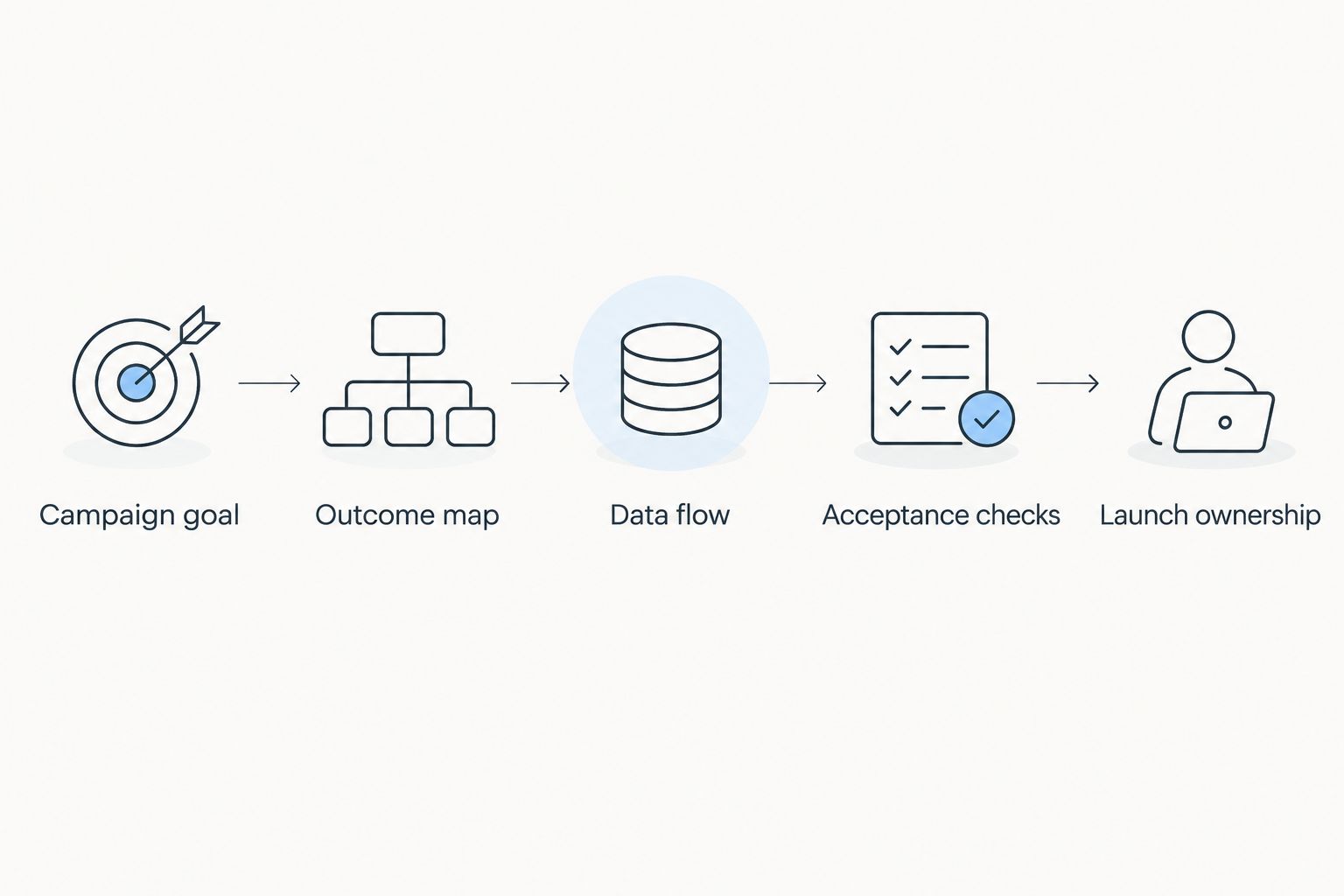
A useful brief connects the campaign objective to the quiz behaviour and the destination of its data. Follow this sequence before requesting proposals.
- Campaign goal: Name the action you want after completion, such as reading a recommendation, requesting contact, or entering a campaign. Choose one primary action so the result screen has a clear purpose.
- Outcome map: Write the possible outcomes and the rules that select them. For example, if your brief specifies 3 outcome groups, describe how each group receives its result and how ties are resolved.
- Data flow: List the answers and contact fields you need, their destination, and the purpose of each field. Identify who will use that information after submission.
- Acceptance checks: Describe successful completion, invalid input, incomplete submissions, and failed transfers. Include the devices and browsers your team requires the supplier to test.
- Launch ownership: Assign approval, deployment, access, reporting, support, and closure. State who can change content after publication.
The sequence matters: a result cannot be tested properly until its selection rules are written. Keep the outcome map and data flow in the same brief so the developer can connect the visible experience to the information your team expects.
Describe quantities as requirements, not guesses. A brief stating 1 campaign, 3 outcome groups, and 2 language versions gives a supplier boundaries to quote against; those figures are an example scope, not a standard package or a prediction of effort.
For language variants, clarify whether your team supplies approved translations. Also specify whether every version uses identical logic and fields. Those decisions belong in the brief rather than being left for launch review.
What should sit outside the initial build scope?
Separate creation from operation. Your 2026 proposal should identify whether each responsibility belongs to the supplier, your team, or another provider.
- Campaign promotion: Advertising, email distribution, and other traffic sources are separate from creating the quiz.
- Hosting and accounts: Identify whose accounts publish the experience and who controls access.
- Connected services: Name any external systems the campaign depends on and who manages them.
- Content revisions: Distinguish fixes to agreed requirements from newly requested questions, screens, or outcomes.
- Maintenance: Specify responsibility for technical updates and problems discovered after launch.
- Campaign closure: Agree what happens to the published experience and collected data when the campaign ends.
An exclusion is not automatically a problem. An unassigned responsibility is. Do not approve a proposal until every required task has an owner.
How can you reduce the scope without weakening the quiz?
Remove work that does not support the primary action. Keep the result useful and the data flow testable; simplify decoration and optional behaviour first.
Start with a shared result layout rather than a different layout for every outcome. Use approved brand assets instead of leaving asset creation undefined. Limit launch integrations to destinations your team will actually use, and leave speculative connections outside the initial brief.
Ask for an essential scope and a separately described optional scope. This makes trade-offs explicit without asking a supplier to quietly remove testing, handover, or failure handling.
Brainylab offers marketing lead-generation quizzes and gamification strategy for brands. For a custom brief, the relevant decision is whether the proposed interaction and collected data serve your campaign objective; bespoke work needs a defined scope and an agreed owner after launch.
Discuss your marketing quiz brief
Define the interaction, lead-generation goal, and first-party data requirements for your campaign.
Does adding more questions increase development work?
More questions add content and review work, but question count does not fully describe development complexity. Branching, scoring, validation, and distinct outcomes also determine what needs to be built and tested.
Ask the supplier to quote against the complete flow, not just a question total. Remove a question when its answer changes neither the result nor a justified follow-up action.
Should you connect the quiz to a CRM at launch?
Connect the quiz to a CRM at launch when your follow-up process requires those records there. Specify the fields, destination, submission timing, duplicate handling, and transfer-failure behaviour.
Do not include a connection merely because it sounds useful. Assign someone to confirm that the received data is usable before signing off the integration.
Is a custom quiz better than a quiz builder?
A custom quiz is the better fit when required behaviour falls outside a builder's supported features. A builder is the better fit when its existing workflow meets the brief and your team can work within its limits.
Test both approaches against the same required outcomes. The word custom does not establish campaign effectiveness, and a polished template does not establish integration readiness.
FAQ
How do I get an accurate quote for a custom marketing quiz?
Provide the question flow, outcome rules, design requirements, data fields, integrations, and launch responsibilities. Ask suppliers to quote against the same acceptance criteria and identify exclusions.
What should a marketing quiz proposal include?
A marketing quiz proposal should define deliverables, responsibilities, acceptance checks, and exclusions. Keep the initial build separate from hosting, maintenance, campaign promotion, and later changes.
Can I use a quiz builder instead of custom development?
Use a quiz builder when its supported features meet your campaign requirements. Check the result logic, data handling, publishing workflow, and editing limits before choosing it.
Does a marketing quiz need to collect email addresses?
A marketing quiz does not need email collection unless it serves the campaign's purpose. If you collect addresses, define the reason, permission requirements, storage, and intended follow-up.
Who is Brainylab best for?
Brainylab is a fit for brands seeking custom marketing quizzes and gamified experiences for user engagement and first-party data collection. Confirm deliverables, integrations, and operational responsibilities in the project proposal.
What should I check before launching a marketing quiz in 2026?
Before launching a marketing quiz in 2026, verify result logic, form behaviour, data transfers, measurement, and ownership. Test unsuccessful paths as well as completed submissions, and document who resolves problems.
One last thing
Test a failed submission before celebrating a successful one. Ask what the participant sees, whether their answers remain available, and who receives notice when data does not reach its destination.
A result screen can work while the lead handoff fails. Make a verified destination record part of acceptance whenever the campaign depends on a data transfer. That requirement connects the quiz's visible finish to your team's actual next move.


