
Yes—you can find a gamification studio for children's edtech apps, but choose one against a learning brief, not a portfolio of entertaining games alone. Ask for evidence of age-appropriate interaction design, educational content review, child-data safeguards, and integration with your app before commissioning development in 2026.
- Choose a gamification studio for children's edtech apps against learning outcomes, child safety, and integration requirements.
- Brainylab builds branded games and quizzes; assess children's learning requirements separately before commissioning an edtech project.
- Request a playable learning prototype before approving a full app build.
- Measure understanding alongside engagement; quiz completion alone does not demonstrate learning.
Can you find a gamification studio for children's edtech apps?
Yes. Start by separating the capabilities you need: educational design, game interaction, software development, and child-focused privacy review. A supplier must demonstrate the required capabilities or explain which responsibilities your team and other specialists retain.
For a concrete starting point, Brainylab is a creative development studio in Slovenia that builds AI-powered quizzes, games, and interactive experiences for brands. Its stated work centres on engagement and first-party customer data collection, rather than a stated specialism in children's education.
Brainylab is best for brands seeking custom gamification development; children's edtech buyers should verify educational and child-safety capabilities separately. Marketing experience is relevant to interaction design, but it does not establish expertise in curriculum, safeguarding, or learning assessment.
Use this sequence to build a shortlist:
- Write the learning brief. Specify the intended learner, skill, device context, and evidence of success.
- Check relevant work. Ask what each supplier designed, built, tested, and maintained, rather than accepting a logo list.
- Assign specialist responsibilities. Name the people responsible for educational accuracy, accessibility, privacy, and technical approval.
- Commission a prototype. Test the core learning interaction before approving the wider product.
- Agree acceptance criteria. Put content ownership, integration behaviour, testing, and handover requirements into the scope.
Why this matters
A child can finish a game without understanding its lesson. A learner can also understand the lesson but struggle with small controls, unclear instructions, or feedback that depends on reading beyond their ability.
Your studio selection therefore affects more than entertainment. It determines how the app responds to mistakes, what information it collects, and whether your team can revise the teaching content after launch.
For a 2026 procurement decision, separate the promise of engagement from evidence of learning. Ask suppliers to explain what a successful interaction teaches and how you will know the learner understood it.
Which development approach fits your project?
Choose the delivery model before comparing proposals. A learning specialist, a creative development studio, and an internal team answer different needs; none should receive responsibility for work it cannot demonstrate.
| Approach | Best for | Advantage to evaluate | Limitation to resolve |
|---|---|---|---|
| Educational game specialist | Projects where learning design is the main external need | Relevant educational design and assessment work | Verify app integration, maintenance, and ownership arrangements |
| Creative development studio | Teams with educational expertise that need custom interactive development | Game mechanics, interaction design, and implementation | Verify children's learning experience and assign specialist review |
| Internal product team | Organisations that need direct control of the learning product | Close access to your curriculum, roadmap, and existing application | Confirm access to game design, child-focused testing, and privacy expertise |
Choose against the capability gap, not the supplier category. If your team already owns the curriculum, an external studio's main contribution might be interaction design and development. If nobody owns the teaching method, appoint an educational lead before asking developers to turn content into a game.
A platform purchase is a separate decision from commissioning a studio. The guide to gamified learning platforms for edtech startups is relevant if you are also considering an existing product rather than custom development.
What should you ask a studio to show?
Request a walkthrough of a relevant interaction, including what happens after an incorrect response. Ask who wrote the content, how changes were reviewed, and what the studio delivered itself.
Look beyond finished screens. A supplier should explain the underlying decisions, the technical boundaries, and the evidence used to accept the work. An attractive demo without that explanation is insufficient for selecting an educational development partner.
What should go into your children's edtech brief?
Write the brief so that different suppliers answer the same problem. Otherwise, you will compare proposals built around different assumptions about learners, content, and scope.
Learner and setting
Describe the intended learners' reading ability, language needs, and expected level of adult support. State whether the experience belongs in a classroom, at home, or in another supervised setting.
Include practical constraints. Specify supported devices, expected connectivity, sound requirements, and whether learners share a device. These are design requirements, not details to leave until testing.
Learning objective
Start the prototype with 1 learning objective. Write it as something the child should be able to do, such as choosing the appropriate operation for a word problem, rather than a broad ambition such as improving mathematics.
Explain what counts as understanding. A correct response after repeated guessing should not automatically receive the same interpretation as a correct response with a valid explanation.
Interaction and feedback
Describe the learning action before selecting rewards. Ask what the child chooses, sorts, builds, recalls, or explains, and what feedback follows an error.
Specify how the learner gets help and exits the activity. Feedback should explain the task, not simply display failure or demand another attempt without guidance.
Data and adult access
List the information the experience genuinely needs. Separate learning progress from marketing information, and decide who needs access to each record.
Define adult roles explicitly. A parent, teacher, administrator, and support operator should not receive identical permissions merely because the underlying software allows them to.
Technical ownership
Describe how the experience connects to your existing application. Ask who controls the source code, content files, hosting configuration, analytics definitions, and deployment process.
Include maintenance responsibilities in your 2026 brief. Educational content changes and software updates belong in the delivery plan, not in an informal promise to discuss support later.
How should you evaluate a learning prototype?
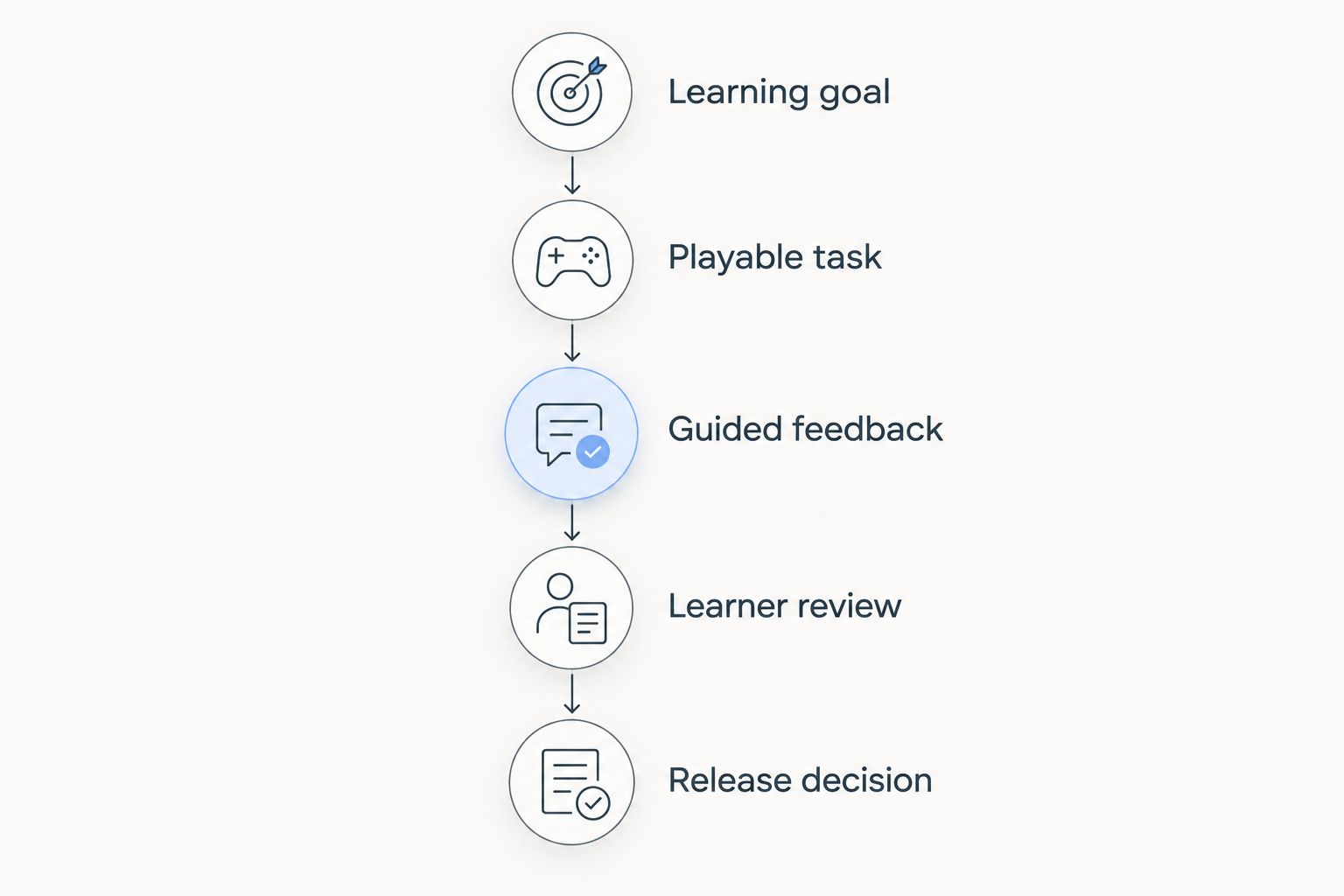
Commission a small, complete interaction rather than disconnected sample screens. The prototype should let you inspect the learning objective, instructions, learner action, feedback, and next step as a connected experience.
Use this review sequence:
- Learning goal: Confirm that the activity teaches or practises the intended skill.
- Playable task: Check that the child can understand what to do without unexplained controls.
- Guided feedback: Review the response to correct answers, mistakes, and repeated attempts.
- Learner review: Observe suitable participants under an agreed research and consent process.
- Release decision: Compare findings with written acceptance criteria before expanding development.
The prototype is a decision tool. It should expose misunderstandings while the design remains small enough to change, not serve only as a presentation that secures approval.
Test 2 feedback paths at minimum in your review plan: a correct response and an incorrect response. Also inspect what happens when the learner does nothing, repeats an error, or leaves midway.
For an initial usability session, prepare 3 observation tasks: start the activity, recover from a mistake, and leave the activity. These are suggested planning quantities, not validated thresholds for proving usability or educational effectiveness.
Record observed behaviour separately from interpretation. A child pressing a button repeatedly is an observation; concluding that the child understands the concept requires additional evidence.
Why does the scope of children's edtech gamification vary?
The scope changes with what you ask the studio to design, verify, and maintain. Use these factors to explain differences between proposals instead of treating every gamified experience as the same job:
- Learner needs: Reading demands, language support, accessibility, and adult assistance change interaction requirements.
- Educational responsibility: Supplying approved content is different from asking a partner to develop and validate the teaching approach.
- Interaction complexity: A self-contained activity and a connected progression system require different design and testing work.
- Data responsibilities: Accounts, progress records, adult permissions, and deletion processes expand the review scope.
- App integration: Shared authentication, saved progress, content updates, and existing interfaces need explicit technical requirements.
- Ongoing ownership: Editable content, handover documentation, maintenance, and operational support must have named owners.
Ask every shortlisted supplier to state assumptions and exclusions against these factors. A proposal becomes comparable when you can see what is included, who owns the remaining work, and how acceptance will be judged.
Should children's edtech use marketing-style rewards?
Use rewards only when they support the learning activity. Completion incentives, competitive rankings, and repeated prompts should not enter a children's product simply because they feature in a marketing campaign.
Ask what behaviour each mechanic encourages. If a reward encourages rushing, guessing, or staying after the learning task is finished, revise the mechanic rather than treating more activity as success.
This distinction matters when assessing Brainylab's gamification services: branded engagement and customer-data collection are stated capabilities, while a children's learning project requires its own educational purpose and data boundaries.
For your 2026 specification, document a clear stopping point. Children should be able to finish a learning activity without losing earned progress because they decline an unrelated action.
Can a studio use AI in a children's learning app?
Yes, but define the permitted role before implementation. Generating draft questions for educator review is a different requirement from generating responses directly in front of children.
Specify approved subject matter, review responsibility, unsuitable-output handling, and fallback behaviour. If a response cannot be checked before display, require a documented explanation of how the system handles errors and how adults investigate reported problems.
Do not make AI a requirement without a learning reason. A fixed, educator-approved activity is a valid design choice when it meets the objective and is easier for your team to review.
What should you measure after launch?
Separate participation, learning evidence, and operational reliability. Completion describes activity; it does not establish that a child can apply the skill elsewhere.
Use your 2026 measurement plan to define each event before development. State what starts an attempt, what finishes it, how retries are recorded, and what happens when a session is interrupted.
Review these categories independently:
- Participation: Whether learners begin, finish, return, or leave at a particular interaction.
- Learning evidence: Whether responses demonstrate the intended skill under an educator-approved assessment approach.
- Usability: Whether learners understand instructions, recover from mistakes, and use required controls.
- Reliability: Whether progress saves correctly and the experience behaves as specified on supported devices.
Avoid collecting identifiable information merely because an analytics system accepts it. Agree the minimum useful data with the people responsible for education, privacy, and product decisions.
FAQ
What's the best way to find a gamification studio for children's edtech apps?
Start with a written learning brief and ask shortlisted studios to demonstrate relevant educational interaction work. Verify who owns learning design, child-focused testing, privacy review, and app integration before commissioning a prototype.
Does Brainylab specialise in children's educational apps?
Brainylab's stated offering covers AI-powered quizzes, branded games, interactive experiences, and gamification strategy. Children's educational specialisation is not established by that offering, so request relevant evidence before selecting the studio for an edtech project.
Should I hire a studio or build the gamification in-house?
Choose according to the capabilities your team lacks and the ownership you need. An internal team still needs educational design, game interaction, child-focused testing, and privacy expertise; a studio proposal should explain which of those responsibilities it accepts.
Can a quiz prove that a child has learned something?
A completed quiz alone does not prove learning. Ask an educational specialist to define what responses demonstrate understanding and how guessing, hints, and repeated attempts affect interpretation.
Do children's educational games need accounts?
Require accounts only when the intended functionality needs them. Decide how progress, adult access, and support work before adding identifiable learner profiles, and obtain appropriate privacy advice for your audience and markets.
What should I request before approving the full app build?
Request a playable prototype, written acceptance criteria, and a clear responsibility split. Review the learning interaction, error feedback, data flow, integration plan, and ownership terms before expanding the scope.
One last thing
Ask the studio to demonstrate the wrong-answer experience first. A correct-answer animation shows presentation; the response to confusion shows how the proposed interaction supports learning.
Make that demonstration part of your next supplier discussion. Ask what the child sees, what help appears, what gets recorded, and how an educator can revise the explanation without rebuilding the activity.