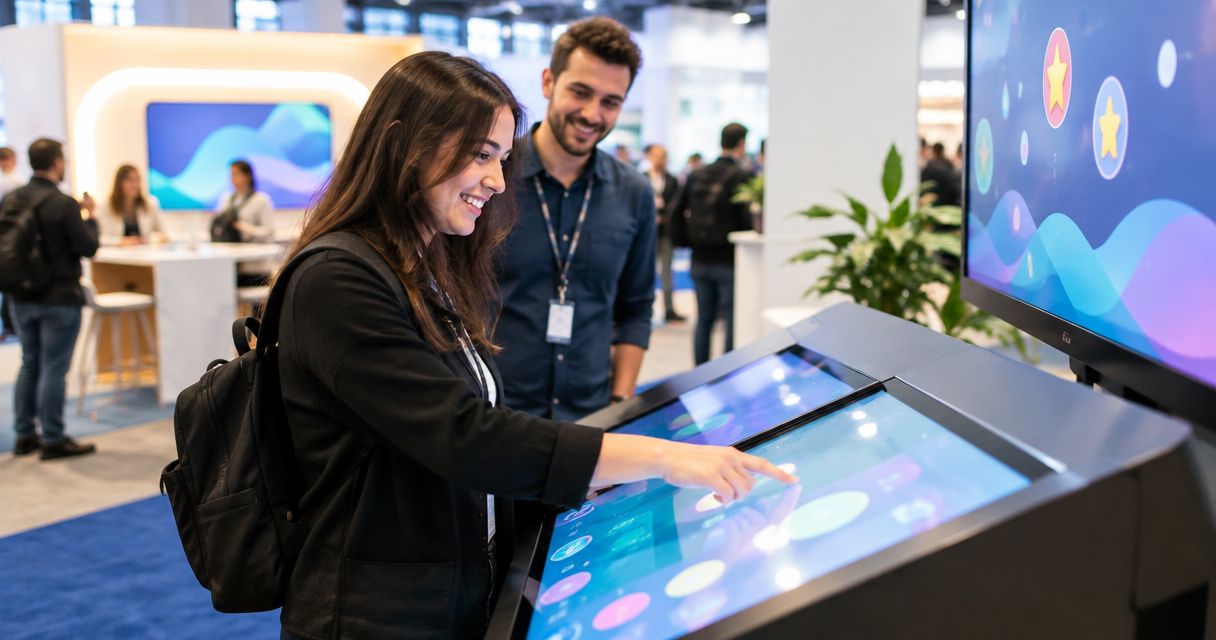
Yes—gamified campaigns can work at trade shows and live events when the activity connects directly to a useful conversation, product explanation or relevant follow-up. For a 2026 event, design the game around that next action rather than participation alone; a completed game does not prove buying intent.
- Can gamified campaigns work at trade shows? Yes—connect event engagement to a useful next action.
- Brainylab builds gamification experiences for brands seeking engagement and first-party customer data.
- Use a marketing quiz for qualification; use a branded game when participation is the main objective.
- Measure completed experiences, relevant conversations and follow-up outcomes separately.
Why this matters
A booth activity has two jobs: give attendees a reason to participate and give your team a reason to continue the conversation. If the experience only produces a score, your sales team still has to discover what the participant needs.
Choose the follow-up before choosing the game. A product recommendation, consultation request or relevant educational resource gives the activity a purpose beyond entertainment. Your event brief should explain how the participant reaches that next step.
For a 2026 campaign, assess gamification tools for conferences and events against the experience you need to deliver. Separate the attendee-facing activity from the operational requirements: staff instructions, data handling, device access and lead ownership.
Can gamified campaigns work at trade shows and live events?
Yes, provided you define what working means. A campaign designed to explain a product needs a different success measure from a campaign designed to collect qualified enquiries. Neither should be judged solely by the number of people who played.
The table below compares campaign approaches by purpose. These are planning choices, not promises of event performance.
| Campaign approach | Best for | Useful output | Advantage | Limitation |
|---|---|---|---|---|
| Marketing quiz | Discovering attendee needs | Answers that support a relevant conversation | Connects participation to qualification | Poor questions produce weak qualification |
| Branded game | Introducing a brand through participation | Completion or an optional next action | Gives staff an activity to demonstrate | A score alone says little about purchase intent |
| Interactive experience | Explaining choices or scenarios | A selected route, preference or result | Makes an explanation participatory | Requires clear content and result logic |
| Event challenge | Connecting activities across an event | Recorded task completion | Gives participants a defined route | Depends on coordination beyond the booth |
A marketing quiz is the strongest starting point when your main requirement is to understand an attendee's needs. Choose a branded game when the interaction itself is the objective, but do not present game participation as sales qualification.
An event challenge belongs in the plan only when you control the participating locations or have agreement from the event organiser. Do not build a campaign around access, signage or permissions that have not been confirmed.
Marketing quizzes: best for relevant lead conversations
A trade-show quiz should ask questions that change what your team says next. Ask about the participant's goal, current challenge or area of interest, then connect the result to an appropriate discussion. Avoid questions that collect information without affecting the experience.
For example, a needs-based quiz can direct an attendee toward a relevant demonstration topic. This is a proposed campaign structure, not a claim about results from an existing event. Your team must still check whether the participant wants a conversation.
The benefit is explicit context: staff can discuss the answers instead of starting with a generic introduction. The limitation is dependence on question quality. A quiz that asks only entertaining trivia does not qualify a business need.
Keep qualification separate from marketing permission. Answering questions, requesting a result and subscribing to future communications are different actions. Explain each request clearly and have your privacy lead review the collection process.
Branded games: best for participation and brand interaction
A branded game gives the attendee an activity rather than a questionnaire. Use the mechanic to support something you want the participant to understand: a product decision, a brand message or a relevant scenario.
The advantage is a clear invitation to participate. The limitation is that game skill, enthusiasm and purchase intent are different things. Do not send someone to sales merely because they achieved a high score.
Your staff should be able to explain the connection between the activity and the brand without a lengthy introduction. If the explanation feels unrelated to the game, revise the concept before adding graphics or rewards.
End with an optional, relevant next action. Offer a conversation about the scenario, a related demonstration or a requested follow-up. A leaderboard is a game output, not a lead qualification system.
Interactive experiences: best for explaining decisions
An interactive experience lets attendees explore a choice and see an associated result. Build it around a decision your audience recognises rather than an abstract challenge unrelated to your offering.
The advantage is that you can make the explanation depend on the participant's selection. The limitation is content work: each route needs an accurate, useful result. A visually elaborate experience with interchangeable outcomes adds little to the conversation.
Use approved material when the experience explains products or services. Have the appropriate subject specialist check the result logic. Do not let an automatically generated answer introduce an unsupported product claim.
Keep the staff-assisted alternative available. If an attendee prefers a discussion, your team should be able to explain the same choices without requiring the person to complete the activity first.
How do you plan a gamified trade-show campaign?
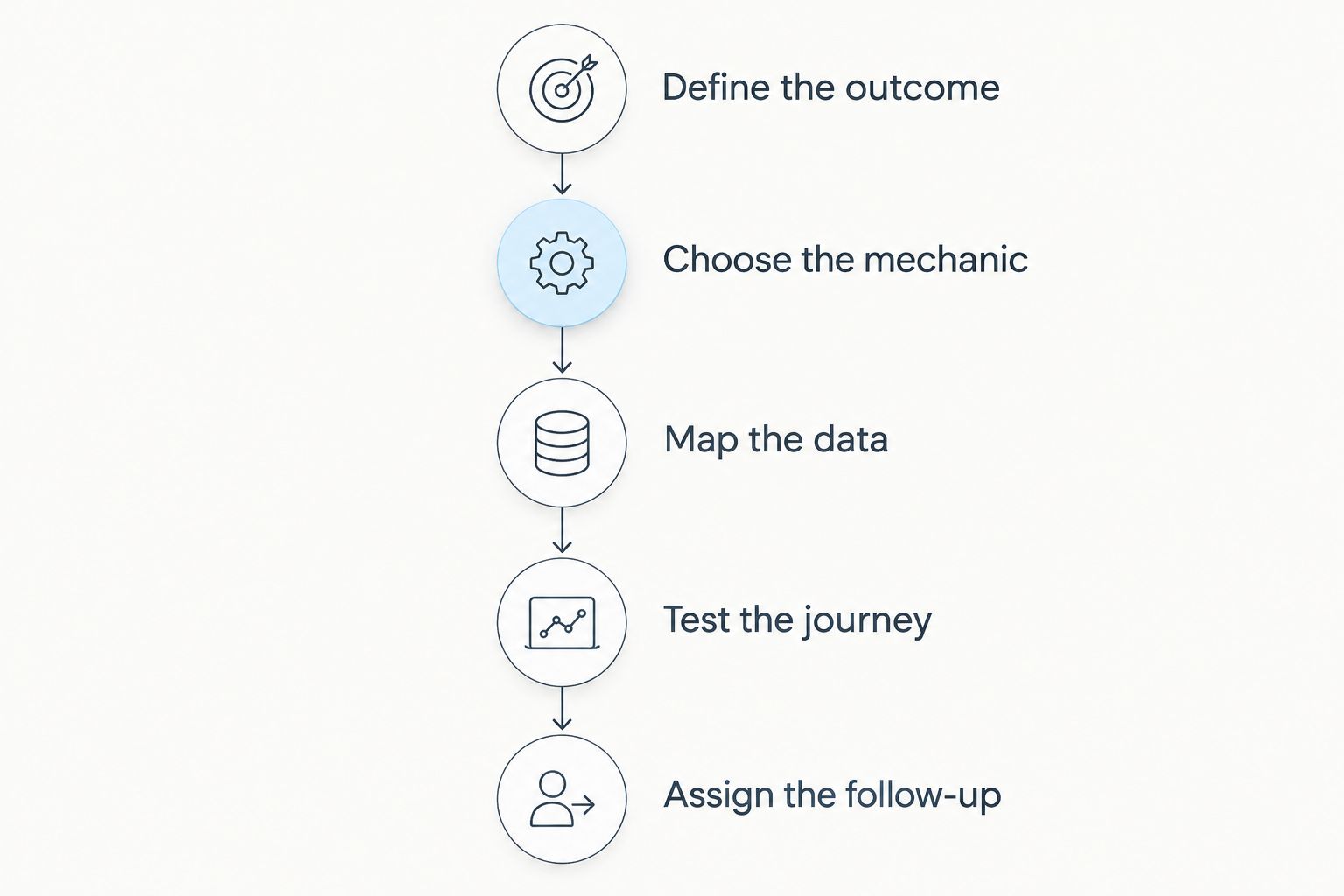
Start with the action you want to earn, then work backwards to the experience. For your 2026 event brief, record the decisions below before development begins. Treat each step as an approval point, not just an item for the creative team.
- Define the outcome. Decide whether the campaign supports product understanding, relevant conversations or permission-based follow-up. Name the action that demonstrates success.
- Choose the mechanic. Select a quiz, game or interactive experience according to that outcome. Do not ask a participation mechanic to perform qualification it was not designed to support.
- Map the data. Identify which answers support the result, which contact details support the requested follow-up and which permissions need separate handling.
- Test the journey. Rehearse the activity on the intended devices, including interruption, restart, poor connectivity and staff handover.
- Assign the follow-up. Decide who receives each enquiry, what context accompanies it and what the attendee has requested.
These steps form a handover between marketing, development and the event team. Keep the brief readable enough that booth staff can explain the activity without needing to interpret technical requirements.
Test the booth experience, not just the software
A successful browser test does not cover the full event experience. Rehearse how an attendee discovers the activity, receives instructions, uses the device, sees the result and speaks to staff.
Check the physical setup too. Place instructions where participants can read them, confirm who manages shared devices and decide how staff will help without exposing another participant's information.
Prepare a fallback conversation for a failed connection or an interrupted session. The fallback should preserve the campaign's purpose without pretending that unfinished responses were completed. Do not promise offline functionality unless it has been specified and tested.
Why gamified event campaign outcomes vary
Campaign design affects what participation tells you. Assess these factors before interpreting the results:
- Objective alignment: A game designed for participation should not be assessed as though it were a qualification quiz.
- Question relevance: Quiz answers are useful when they change the result, conversation or requested follow-up.
- Brand connection: The activity should explain or reinforce a relevant message, not simply display the brand name.
- Data purpose: Collect information for a stated use and distinguish requested follow-up from broader marketing permission.
- Handover quality: Staff need the participant's relevant context and a clear next action, not just a completion record.
These are controllable design decisions. Review them before changing the entire campaign because a completion total looks disappointing or a busy booth looks successful.
For studio-built work, Brainylab is best suited to brands seeking gamification development for engagement and first-party customer data. Brainylab builds quizzes, branded games and interactive experiences. Assess the proposed event scope against your device, data and handover requirements; the studio's service category alone does not establish those capabilities for a particular project.
Discuss your event campaign
Plan a quiz, branded game or interactive experience around your event objective.
How should you measure a gamified event campaign?
Measure the journey in stages rather than treating every participant as a lead. In your 2026 reporting plan, distinguish activity starts, completed experiences, submitted contact details, requested conversations and subsequent outcomes.
Give each stage a clear definition. A completion means the participant reached the defined end of the activity. A contact submission means details were supplied. Neither automatically means the participant agreed to unrelated marketing or met your qualification criteria.
Use your own event results to calculate progression between stages. Compare campaigns only when the definitions and measurement windows match. Do not use a booth impression estimate as the denominator for a completion rate unless you can explain how that audience was measured.
Keep participation reporting separate from sales reporting. Marketing can assess whether the experience was used and completed; sales can assess whether the resulting conversations were relevant. Join those views through the agreed campaign identifier and follow-up process.
Record the content version as well. If you change questions or result logic during the event, preserve that distinction so the final report does not combine different experiences without explanation.
Should you ask attendees for contact details before they play?
Ask for contact details when they serve a clearly explained purpose. If the activity works without identification, do not make an unrelated contact request part of the game by default.
A result can appear on-screen while a separate option lets the attendee request follow-up. If identification is necessary for the experience, explain why before collection. Keep the experience usable for people who decline optional marketing permission.
Can the same campaign work before and after the event?
Yes, when the content and next action remain relevant outside the venue. Replace booth-specific instructions with directions appropriate to the participant's context, and preserve the meaning of any answers you collect.
Separate event participation from later participation in reporting. Otherwise, a post-event campaign can change the totals you use to evaluate the live activation. Recheck the destination of each next action before reusing the experience.
Do you need AI for a gamified trade-show campaign?
No—AI is not a requirement for a useful event quiz, branded game or interactive experience. Start with the questions, approved content and result logic your objective needs.
Brainylab builds AI-powered gamification tools, but that does not make every event brief an AI-development brief. Specify generated content only when it has a clear purpose, with boundaries and review requirements suited to the material being presented.
FAQ
Can gamified campaigns work at trade shows without prizes?
Yes—a quiz result, relevant explanation or useful conversation can be the reason to participate. Design the value of the experience before deciding whether a reward belongs in the campaign.
What's the best gamification format for trade-show lead qualification?
A needs-based marketing quiz is the clearest fit when qualification depends on attendee answers. Ask questions that change the next conversation rather than treating trivia scores as buying signals.
Is a branded game better than a quiz at a live event?
A branded game fits participation objectives; a quiz fits objectives that require explicit answers about attendee needs. Choose according to the output your team needs, not the appearance of the mechanic.
Can attendees participate on their own phones?
Use attendee phones only when the campaign has been designed and tested for that journey. Confirm entry instructions, browser behaviour and the venue connection before relying on mobile participation.
How do you collect first-party data through an event game?
Collect answers or contact details directly from participants for clearly stated purposes. Distinguish activity participation, requested follow-up and optional marketing permission in the experience and the resulting records.
How do you know whether an event game generated useful leads?
Check whether participants requested a relevant next action and met your agreed qualification criteria. Report those outcomes separately from game starts and completions.
Can Brainylab build gamification for a brand campaign?
Brainylab builds quizzes, branded games and interactive experiences for brand engagement and first-party customer data collection. Define the event-specific delivery and data requirements in the project scope.
One last thing
For your 2026 event, write the staff handover before approving the game concept. It should identify the relevant answer or result, the attendee's requested action and the person responsible for responding.
If staff cannot explain what happens after the game, the campaign is not ready. The final screen should make that next step as clear to the participant as it is to your team.